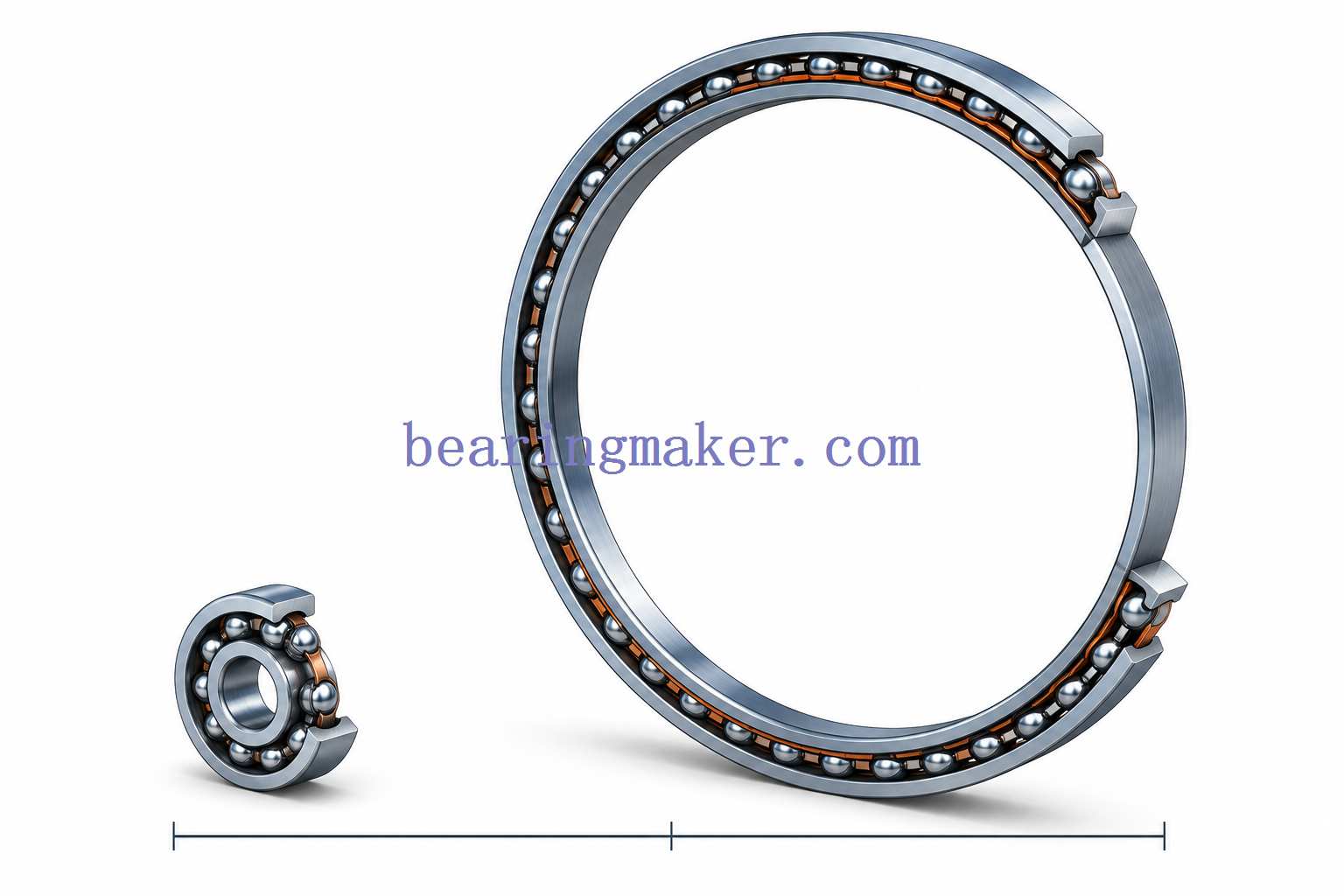
Thin section bearings and standard ball bearings are both rolling-element bearings, and at first glance they may appear to work in essentially the same way.
Both typically use:
- an inner ring
- an outer ring
- balls
- a cage or separator
- precision-ground raceways
Both can provide smooth, low-friction rotary motion.
But they are optimized for very different design priorities.
A standard ball bearing is generally designed to provide a practical balance of:
- load capacity
- stiffness
- speed
- durability
- cost
A thin section bearing is designed primarily to provide a large bore and compact cross-section while minimizing weight and radial space.
That difference in geometry affects almost every aspect of performance, including:
- load capacity
- ring stiffness
- housing sensitivity
- preload behavior
- rotational accuracy
- mounting requirements
- weight
- system packaging
The correct question is therefore not:
Which bearing is better?
The more useful question is:
Which bearing architecture better matches the mechanical priorities of the application?
This guide compares thin section bearings and standard ball bearings from a system-design perspective and explains when each type is the better choice.
What Is a Thin Section Bearing?
A thin section bearing is a ball bearing with a relatively small cross-section compared with its bore diameter.
Its defining characteristic is the ability to provide a large central opening without requiring a proportionally large outside diameter.
This makes thin section bearings useful where designers need:
- large hollow shafts
- cable routing
- optical paths
- reduced weight
- compact rotary joints
- low rotational inertia
Thin section bearings may use several internal contact geometries, including:
- radial contact
- angular contact
- four-point contact
The reduced cross-section is the defining system-level feature.
What Is a Standard Ball Bearing?
A standard ball bearing generally belongs to a conventional dimensional series in which:
- bore diameter
- outside diameter
- bearing width
increase together as bearing size increases.
This gives the rings more material and therefore generally more:
- stiffness
- load-carrying capacity
- resistance to mounting distortion
Common standard ball-bearing configurations include:
- deep groove ball bearings
- angular contact ball bearings
- self-aligning ball bearings
- thrust ball bearings
For general industrial machinery, standard bearings are often the default solution unless the application has strong packaging or weight constraints.

The Core Difference: Bore-to-Cross-Section Ratio
The most important geometric difference is the relationship between the bore and the bearing section.
A conventional bearing usually increases in:
- ring thickness
- ball size
- overall width
as bore size increases.
A thin section bearing attempts to maintain a relatively small section even as bore diameter becomes large.
This creates a very different bore-to-cross-section ratio.
For example, two bearings may have a similar bore diameter, but:
- the standard bearing may have a much larger outer diameter
- the thin section bearing may leave far more room around the outside of the joint
This difference is often more important than the actual bearing diameter itself.
Why the Cross-Section Matters So Much
A smaller cross-section changes several things simultaneously.
It reduces:
- bearing mass
- radial envelope
- material volume
- rotational inertia
But it also reduces:
- ring stiffness
- structural resistance to deformation
- available rolling-element size in many designs
This creates the fundamental trade-off between the two bearing families.
Thin section bearings optimize packaging.
Standard bearings generally optimize structural robustness.
Thin Section vs. Standard Ball Bearing: Quick Comparison
| Feature | Thin Section Bearing | Standard Ball Bearing |
|---|---|---|
| Bore-to-section ratio | High | Lower |
| Radial envelope | Small | Larger |
| Weight | Lower | Higher |
| Ring stiffness | Lower | Higher |
| Load capacity for similar bore | Generally lower | Generally higher |
| Housing sensitivity | Higher | Lower |
| Shaft sensitivity | Higher | Lower |
| Mounting tolerance | More demanding | More forgiving |
| Large hollow bore | Excellent | Less packaging-efficient |
| Low inertia | Better | Higher |
| Precision potential | High | High |
| Cost | Often higher | Often lower |
| Best use | Space/weight-constrained systems | General industrial machinery |
This table describes general tendencies. Actual performance depends on the specific bearing design.
Difference 1: Radial Envelope
The most obvious advantage of a thin section bearing is reduced radial space.
For the same or similar bore diameter, a thin section bearing can occupy much less room between:
- shaft
- bearing
- housing
- surrounding components
This can make the difference between a mechanism that fits and one that does not.
Where Reduced Radial Space Matters
Typical examples include:
- robot joints
- optical gimbals
- medical scanners
- rotary actuators
- compact positioning stages
- aerospace mechanisms
In these applications, adding 20 or 30 mm of bearing cross-section may force the entire machine to become larger.
A thin section bearing can therefore influence much more than the bearing housing.
It may reduce:
- enclosure diameter
- structural mass
- joint size
- cable-routing complexity

Difference 2: Large Hollow-Bore Capability
Thin section bearings are particularly efficient when a large central opening is required.
The bore can be used for:
- power cables
- signal cables
- hoses
- optics
- sensors
- shafts
- fluid lines
This is one of the main reasons they are widely used in robotics and optical equipment.
A standard bearing can also provide a large bore, but achieving that bore often means accepting a much larger outside diameter.
The thin section bearing improves the ratio between:
usable central opening / total bearing envelope
Difference 3: Weight
Thin section bearings generally contain less ring material and often use smaller rolling elements.
As a result, they are usually lighter than conventional bearings with similar bore dimensions.
This matters when:
- the bearing itself moves
- the bearing is part of a robot arm
- weight must be minimized
- acceleration is frequent
Why Bearing Weight Can Affect the Whole Machine
Reducing bearing mass may allow:
- smaller motors
- lighter housings
- lower counterweight requirements
- less structural reinforcement
The impact can therefore extend beyond the bearing itself.
This is especially valuable in:
- robotics
- aerospace
- mobile equipment
where every gram added to a moving axis may increase the load on upstream joints.
Difference 4: Rotational Inertia
A lighter bearing can also reduce rotational inertia.
Rotational inertia affects how much torque is required to:
- accelerate
- decelerate
- reverse direction
In a continuously rotating motor, this may not matter much.
In a robot joint or indexing table that repeatedly starts and stops, it can matter significantly.
Thin section bearings are therefore often advantageous in:
- rapidly reversing axes
- scanners
- gimbals
- pick-and-place equipment
- dynamic positioning systems
Difference 5: Load Capacity
This is where standard bearings usually regain the advantage.
For a similar bore diameter, a conventional bearing often has:
- thicker rings
- larger rolling elements
- greater internal contact capacity
This usually translates into greater load capacity.
Why Thin Section Bearings Often Carry Less Load
A smaller cross-section limits the physical space available for:
- ball diameter
- raceway depth
- ring section
This does not mean thin section bearings are low-capacity in absolute terms.
It means that if maximum load capacity is the main objective and space is available, a standard bearing may provide better performance per unit cost.
Load Capacity Should Be Compared by Application, Not Bore Alone
A common mistake is to compare:
two bearings with the same bore diameter
and conclude that the one with the higher load rating is automatically better.
But the thin section bearing may have been selected precisely because it saves substantial radial space.
The more meaningful comparison is often:
Which bearing meets the required load while fitting within the available envelope?

Difference 6: Ring Stiffness
This is one of the most important technical differences.
Standard bearings generally have thicker rings.
Thicker rings resist:
- ovalization
- local deformation
- clamping distortion
more effectively.
Thin section bearing rings are more flexible.
That makes them more dependent on the quality of the shaft and housing.
Why Ring Stiffness Matters
A bearing is manufactured with precise raceway geometry.
But after installation, the rings may deform.
If the housing is slightly oval, a thick conventional outer ring may resist part of that distortion.
A thin outer ring may conform much more closely to the housing shape.
The result can be:
- non-uniform clearance
- uneven ball loading
- increased running torque
- altered preload
- reduced life
System Stiffness vs. Bearing Stiffness
Thin section bearing design should therefore consider:
bearing stiffness + housing stiffness + shaft stiffness
as one system.
A high-quality thin section bearing installed into a flexible or distorted housing may perform worse than a standard bearing in a more robust structure.

Difference 7: Housing Sensitivity
Because of lower ring stiffness, thin section bearings are usually more sensitive to housing geometry.
Important housing characteristics include:
- roundness
- cylindricity
- wall thickness
- material
- bolt pattern
- flange rigidity
Housing Material Can Matter More
Thin section bearings are often installed in lightweight aluminum housings.
This is common in:
- robotics
- aerospace
- precision equipment
The combination is attractive because it reduces mass.
But aluminum structures generally have lower stiffness than steel structures of similar geometry.
That means designers must pay more attention to:
- housing wall thickness
- bolt locations
- local reinforcement
- thermal expansion
Bolt Distortion
Even a precisely machined housing can change shape after bolts are tightened.
Uneven clamping may create:
- lobing
- ovalization
- local compression
A thin section bearing may follow this distortion.

Difference 8: Shaft Sensitivity
The same issue applies to the inner ring.
A thin inner ring can be more sensitive to:
- shaft ovality
- shaft taper
- excessive interference
- insufficient stiffness
A standard bearing ring generally offers more resistance to these geometric errors.
This means shaft manufacturing quality becomes more important in thin section applications.
Difference 9: Interference Fits
Standard bearings are commonly mounted with interference fits when required by the load condition.
Thin section bearings may also require interference, but excessive interference can create larger unintended effects.
Too much interference can:
- expand the inner ring
- compress the outer ring
- reduce internal clearance
- increase preload
- raise running torque
Why “Tighter” Is Not Always Better
A fit that prevents ring creep may still be too tight from a precision standpoint.
With thin section bearings, fit design must balance:
- ring retention
- internal clearance
- thermal effects
- deformation

Difference 10: Mounting Accuracy
Thin section bearings generally demand more accurate installation.
Important mounting surfaces include:
- shaft shoulders
- housing shoulders
- retaining faces
Errors in flatness or squareness may tilt the rings.
Because the rings are relatively thin, they may respond more strongly to those errors.
Standard Bearings Are Often More Forgiving
A standard bearing is not immune to bad mounting.
However, its thicker rings generally make it more tolerant of moderate geometric errors.
For general-purpose machinery where:
- tolerances are less controlled
- housings are rougher
- maintenance is basic
standard bearings are often the more robust choice.
Difference 11: Moment-Load Behavior
Thin section bearings are frequently used in large-diameter rotary systems where overturning moment is important.
Moment load is created when a force acts at a distance from the bearing center.
Examples include:
- robot arms
- optical gimbals
- rotary tables
Large Diameter Can Help
A large bearing diameter provides a longer lever arm for resisting moment.
This means certain thin section arrangements can manage moment loads effectively despite their small cross-section.
Common options include:
- four-point contact
- paired angular contact
But Moment Stiffness Still Matters
A bearing may have enough load capacity to survive the moment while still deflecting too much.
This is why thin section bearing design often emphasizes:
- angular stiffness
- elastic deflection
- preload
rather than only fatigue rating.
Standard Ball Bearings and Moment Load
A single standard deep groove ball bearing is generally not the best solution for substantial overturning moment.
Standard machines often use two bearings separated along the shaft to create a support span.
Thus, the comparison is often not:
one thin section bearing vs. one standard bearing
but rather:
one large-diameter thin section arrangement vs. a conventional two-bearing shaft arrangement
Difference 12: Precision
Both thin section and standard bearings can be manufactured to high precision.
However, thin section systems require more attention to preserving that precision after installation.
Bearing Precision Is Only One Part
System accuracy depends on:
- bearing runout
- shaft runout
- housing geometry
- mounting faces
- preload
- thermal distortion
A precision thin section bearing installed in an inaccurate housing may produce poor system accuracy.
Standard Bearings Can Be Easier to Integrate
The greater ring stiffness of conventional bearings often makes it easier to maintain their manufactured geometry after mounting.
Thin section bearings can achieve excellent accuracy, but the surrounding structure must support it.
Difference 13: Preload
Preload is commonly used in precision thin section bearing arrangements.
It can improve:
- rigidity
- repeatability
- axial positioning
- moment stiffness
This is especially common with:
- angular contact bearings
- four-point contact bearings
Why Thin Section Preload Requires Care
Because the rings are flexible, mounting distortion can create additional unintended preload.
That means total operating preload may come from:
designed preload + fit effect + housing distortion + thermal effects
If these factors are not controlled, the result may be:
- high friction
- heat
- reduced bearing life
Standard bearings are generally less sensitive because their rings are more rigid.
Difference 14: Running Torque
Thin section bearings can provide very low running torque, especially when:
- lightly preloaded
- open or low-contact sealed
- properly lubricated
This makes them useful in:
- optical equipment
- precision stages
- robotic joints
However, their torque can increase significantly if installation distorts the rings.
Torque as a Diagnostic Signal
A thin section bearing that suddenly requires more drive torque after assembly may indicate:
- excess preload
- excessive fit
- housing distortion
- overgreasing
Running torque can therefore be a useful installation check.
Difference 15: Speed Capability
Both thin section and standard ball bearings can support high speed.
But the way speed should be evaluated differs.
RPM Alone Can Be Misleading
A thin section bearing may have a very large diameter.
At the same shaft RPM, a larger bearing has greater internal circumferential speed.
Therefore, designers should consider:
- bearing diameter
- RPM
- lubrication
- cage design
- preload
rather than shaft speed alone.
Standard Bearings Often Have an Advantage in Familiarity
Conventional bearings have extremely well-established speed-rating data across common industrial applications.
Thin section bearings also have defined speed capabilities, but large diameter and special mounting conditions can make thermal evaluation more application-sensitive.
Difference 16: Lubrication
Both bearing families commonly use:
- grease
- oil
The principles are similar.
However, low-torque thin section applications can be more sensitive to lubricant quantity.
Overgreasing
Excess grease can produce:
- churning
- drag
- heat
In a high-torque gearbox this may be relatively unimportant.
In a precision optical stage, a small increase in torque may be unacceptable.
Difference 17: Sealing
Both thin section and standard bearings can use:
- open construction
- shields
- seals
But the trade-off between protection and friction becomes especially important in low-torque thin section systems.
Difference 18: Cost
Standard ball bearings are produced in enormous quantities across many industries.
As a result, they are generally:
- more widely available
- less expensive
- easier to replace
Thin section bearings are more specialized.
They may have higher costs due to:
- lower production volume
- specialized geometry
- tighter application requirements
Cost Should Be Evaluated at System Level
Although the bearing itself may cost more, a thin section bearing can reduce:
- housing size
- machine weight
- component count
- joint diameter
Therefore, a higher bearing price does not necessarily mean a higher machine cost.
When Thin Section Bearings Are the Better Choice
Thin section bearings are usually worth considering when several of the following are true:
- a large central opening is required
- radial space is limited
- machine weight matters
- rotating inertia must be reduced
- the design requires a compact joint
- cables or optics must pass through the bearing
- precision rotation is required
- large bearing diameter is beneficial
Typical Applications
Robotics
Thin section bearings can allow:
- hollow joints
- internal cable routing
- lower arm mass
- reduced inertia
Optical Equipment
A large bore can preserve:
- light path
- lens aperture
- sensor clearance
while maintaining rotary support.
Medical Equipment
Thin section bearings can support:
- large scanning assemblies
- compact mechanisms
- low-noise positioning systems
Aerospace
Reduced weight and compact geometry may justify the increased design complexity.
Semiconductor Machinery
Applications may value:
- low torque
- large central access
- precision
- repeatability
When Standard Ball Bearings Are the Better Choice
A conventional ball bearing may be the better solution when:
- installation space is generous
- high load capacity is more important than size
- cost is critical
- mounting tolerances are less controlled
- housing rigidity is limited
- common replacement parts are preferred
- the central bore does not need to remain unusually large
General Industrial Machinery
Standard bearings are often the better choice for:
- electric motors
- pumps
- fans
- conventional gearboxes
- general conveyors
- machinery with ordinary shaft supports
In these cases, there may be little benefit in paying for the packaging advantage of a thin section bearing.
Thin Section vs. Standard Bearing by Application Requirement
| Requirement | Better Starting Point |
|---|---|
| Large hollow bore | Thin section |
| Minimal radial space | Thin section |
| Low moving mass | Thin section |
| Low inertia | Thin section |
| High load within generous space | Standard |
| Maximum robustness | Standard |
| Lower cost | Standard |
| Very simple installation | Standard |
| Compact robot joint | Thin section |
| General motor support | Standard |
| Optical path through bearing | Thin section |
| Large manufacturing tolerance | Standard |
Thin Section Bearing vs. Standard Bearing in Robotics
A robot joint is a useful example because it shows why a bearing cannot be evaluated alone.
Standard Bearing Approach
A conventional bearing may provide:
- high load capacity
- good stiffness
- lower component cost
But it may require:
- larger joint diameter
- smaller hollow bore
- heavier housing
Thin Section Approach
A thin section bearing may provide:
- larger central opening
- smaller joint envelope
- lower joint mass
- better cable routing
The trade-off is greater attention to:
- housing stiffness
- preload
- moment load
- mounting accuracy

Thin Section Bearing vs. Standard Bearing in Optical Systems
Optical systems often prioritize:
- large open aperture
- low runout
- low torque
- compact structure
A standard bearing may obstruct too much of the central opening or force the mechanism to become larger.
Thin section bearings can therefore be especially effective around:
- lenses
- cameras
- laser paths
- sensors
Thin Section Bearing vs. Standard Bearing in Industrial Machinery
In ordinary industrial equipment, the calculation may reverse.
If the machine:
- has enough space
- carries heavy loads
- does not require a large hollow bore
a standard bearing is often:
- simpler
- cheaper
- more robust
This is why thin section bearings should be treated as a specialized engineering solution rather than a universal upgrade.
Common Selection Mistakes
Mistake 1: Assuming Thin Section Means Better
Thin section bearings solve space and weight problems.
They do not automatically provide:
- higher load
- higher rigidity
- longer life
Mistake 2: Comparing Only Bore Diameter
Two bearings with the same bore may have very different intended functions.
Compare:
- load
- envelope
- stiffness
- weight
rather than bore alone.
Mistake 3: Ignoring Housing Design
A thin section bearing may be selected correctly but perform poorly because the housing is too flexible.
Mistake 4: Ignoring Moment Load
Many thin section applications involve large-diameter rotary structures.
Moment load should be evaluated explicitly.
Mistake 5: Using Excessive Interference
Too much fit can create unwanted preload and torque.
Mistake 6: Assuming High Precision Bearing Means High Precision Machine
System accuracy depends on:
- shaft
- housing
- assembly
- preload
as well as bearing accuracy.
Mistake 7: Choosing Thin Section Only to Save a Small Amount of Space
If the packaging benefit is insignificant, the added design sensitivity may not be justified.
Practical Selection Process
Step 1: Define the Bore Requirement
Is a large central opening essential?
If yes, thin section becomes more attractive.
Step 2: Define the Radial Envelope
Is outside diameter severely limited?
If yes, thin section may offer a major advantage.
Step 3: Define the Loads
Calculate:
- radial load
- axial load
- moment load
Step 4: Define Required Rigidity
Determine allowable:
- radial deflection
- axial deflection
- angular deflection
Step 5: Evaluate Weight and Inertia
If moving mass is important, include bearing and housing mass in the system calculation.
Step 6: Evaluate Housing Quality
Can the structure maintain:
- roundness
- stiffness
- alignment
under operating load?
If not, a thin section bearing may become difficult to use successfully.
Step 7: Evaluate Installation Capability
Can fits, shoulders, and preload be controlled accurately?
Step 8: Compare Total System Cost
Compare:
- bearing cost
- housing cost
- machine size
- weight
- installation complexity
not bearing price alone.

Decision Matrix
| Design Priority | Thin Section | Standard Ball Bearing |
|---|---|---|
| Large bore | ★★★ | ★★ |
| Small radial section | ★★★ | ★ |
| Low weight | ★★★ | ★★ |
| Low inertia | ★★★ | ★★ |
| High absolute load | ★★ | ★★★ |
| Ring stiffness | ★ | ★★★ |
| Mounting tolerance | ★★ | ★★★ |
| Housing tolerance | ★★ | ★★★ |
| Availability | ★★ | ★★★ |
| Cost | ★★ | ★★★ |
| Robotics | ★★★ | ★★ |
| General machinery | ★★ | ★★★ |
The ratings are qualitative and are intended only as a first-pass comparison.
Frequently Asked Questions
What Is the Main Difference Between a Thin Section Bearing and a Standard Ball Bearing?
A thin section bearing has a much smaller cross-section relative to its bore diameter.
This allows:
- larger hollow bores
- smaller radial envelopes
- lower weight
but generally results in lower ring stiffness.
Are Thin Section Bearings Less Strong?
They often have lower load capacity than a much larger conventional bearing with the same bore.
However, they are designed to optimize:
- space
- weight
- bore size
rather than maximum load capacity.
Are Thin Section Bearings More Precise?
They can be manufactured to very high precision, but final system accuracy depends heavily on:
- shaft
- housing
- mounting
- preload
A thin section bearing is not automatically more precise than a conventional bearing.
Why Are Thin Section Bearings More Sensitive to Housing Accuracy?
Their rings are thinner and more flexible.
The outer ring can conform more readily to a distorted housing, which can alter:
- clearance
- preload
- load distribution
Can a Thin Section Bearing Replace a Standard Bearing Directly?
Not necessarily.
Even if bore and outside diameter are compatible, the bearings may differ in:
- load capacity
- stiffness
- internal geometry
- mounting requirements
A complete application review is required.
Why Are Thin Section Bearings Used in Robotics?
They allow designers to combine:
- large hollow bore
- compact joint diameter
- low weight
- low inertia
This is especially useful for routing cables through the joint.
Which Bearing Is Better for Heavy Loads?
If space is available and maximum load capacity is the main priority, a standard bearing is often the better choice.
Thin section bearings become more attractive when packaging and weight constraints are strong.
Which Bearing Is Better for High Speed?
Both can operate at high speed depending on design.
Thin section bearings can offer low friction, but their large diameter means internal rolling-element speed may become high even at moderate RPM.
Which Bearing Is Better for Low Torque?
Thin section bearings can provide very low torque when correctly installed.
However, they are more sensitive to:
- preload
- fit
- distortion
Standard bearings may be more forgiving.
Are Thin Section Bearings More Expensive?
They are often more expensive than common standard bearings because they are more specialized.
However, total machine cost may still be lower if they reduce:
- housing size
- weight
- part count
When Should I Avoid a Thin Section Bearing?
A standard bearing may be preferable when:
- there is plenty of space
- maximum load is the priority
- housing accuracy is limited
- cost is critical
- the large hollow bore provides no real benefit
Selection Checklist
Before choosing between thin section and standard ball bearings, define:
| Parameter | Question |
|---|---|
| Bore requirement | Is a large hollow opening necessary? |
| Radial envelope | Is outside diameter restricted? |
| Weight | Is moving mass important? |
| Inertia | Does the axis accelerate frequently? |
| Radial load | Continuous and peak? |
| Axial load | Magnitude and direction? |
| Moment load | Significant overturning moment? |
| Rigidity | Maximum allowable deflection? |
| Speed | RPM and bearing diameter? |
| Housing stiffness | Can the housing remain round? |
| Shaft accuracy | Is roundness adequate? |
| Fit | Can interference be controlled? |
| Preload | Is precision preload required? |
| Accuracy | What runout is acceptable? |
| Cost | Bearing cost or total system cost? |
| Maintenance | Standard replacement availability important? |
Conclusion
Thin section bearings and standard ball bearings share the same basic rolling-element principle, but they solve very different mechanical design problems.
Thin section bearings are optimized for:
- large bore
- compact radial envelope
- low weight
- low inertia
- space-efficient rotary support
Standard ball bearings are generally optimized for:
- higher structural stiffness
- greater load capacity
- easier mounting
- lower cost
- broad industrial use
The key trade-off is simple:
Thin section bearings save space and weight by using less ring material.
That same reduction in material makes them more sensitive to:
- housing deformation
- shaft geometry
- interference fits
- preload
- mounting accuracy
A thin section bearing is therefore most valuable when its packaging advantages create a meaningful system-level benefit.
If the machine needs a large hollow bore, compact joint, low weight, or low inertia, thin section bearings can provide an elegant solution.
If space is available and the main priorities are load capacity, robustness, simplicity, and cost, a standard ball bearing may be the better engineering choice.
The most useful selection sequence is:
Bore Requirement → Radial Envelope → Load → Moment → Rigidity → Weight → Housing Accuracy → Installation Capability → Total System Cost
The goal is not to choose the thinner bearing.
The goal is to choose the bearing architecture that produces the best complete machine.