How to Choose the Right Type of Bearing
Choosing the correct bearing type is one of the first steps in bearing selection. Different bearing designs handle loads, speed, misalignment, rigidity, and installation space in different ways.
Ball bearings generally offer low friction and high-speed capability, while roller bearings typically provide greater load capacity and rigidity. Some bearings are designed primarily for radial loads, others for axial loads, and some can support both simultaneously.
This guide compares the most common bearing types and explains where each design is typically used.
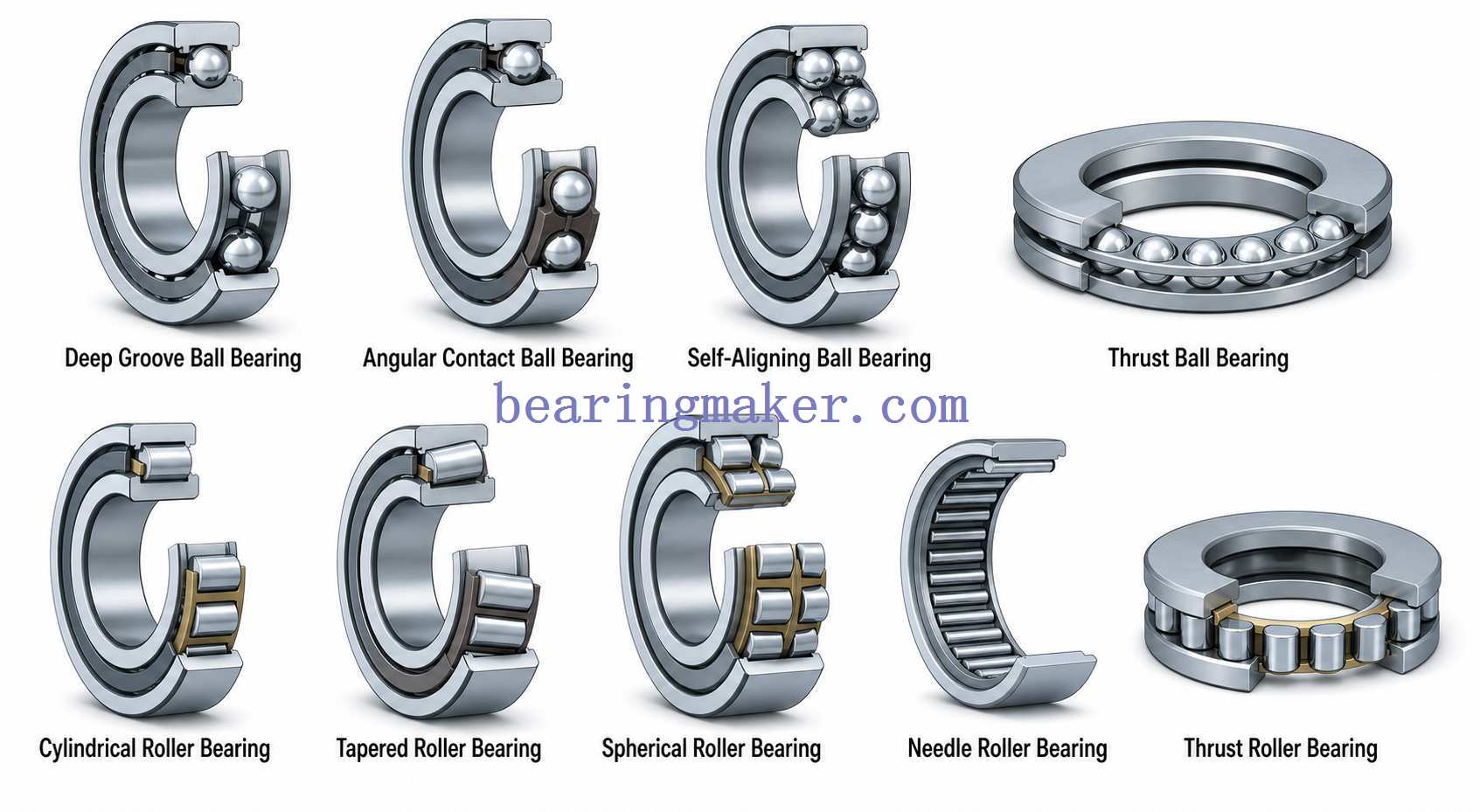
[Image / Diagram — Main Types of Bearings]
1. Ball Bearings vs Roller Bearings
The first major distinction is between ball bearings and roller bearings.
Ball bearings use spherical rolling elements. Because the contact area between the balls and raceways is relatively small, they generally produce low friction and are well suited to high rotational speeds.
Roller bearings use cylindrical, tapered, spherical, or needle-shaped rolling elements. Their larger contact area generally provides greater load capacity and rigidity, particularly under radial loads.
| Characteristic | Ball Bearings | Roller Bearings |
|---|---|---|
| Rolling Element | Ball | Cylindrical, tapered, spherical, or needle roller |
| Contact | Primarily point/elliptical contact | Primarily line contact |
| Load Capacity | Moderate to high | Generally higher for a comparable envelope |
| Speed Capability | Generally higher | Generally lower |
| Friction | Generally lower | Generally higher |
| Rigidity | Moderate | Generally higher |
| Radial Load | Good | Excellent |
| Axial Load | Depends on design | Depends strongly on design |
| Typical Use | Motors, pumps, fans, precision equipment | Gearboxes, heavy machinery, industrial equipment |
These are general characteristics rather than absolute rules. Actual performance depends on bearing size, internal geometry, cage, material, lubrication, precision, clearance, and operating conditions.
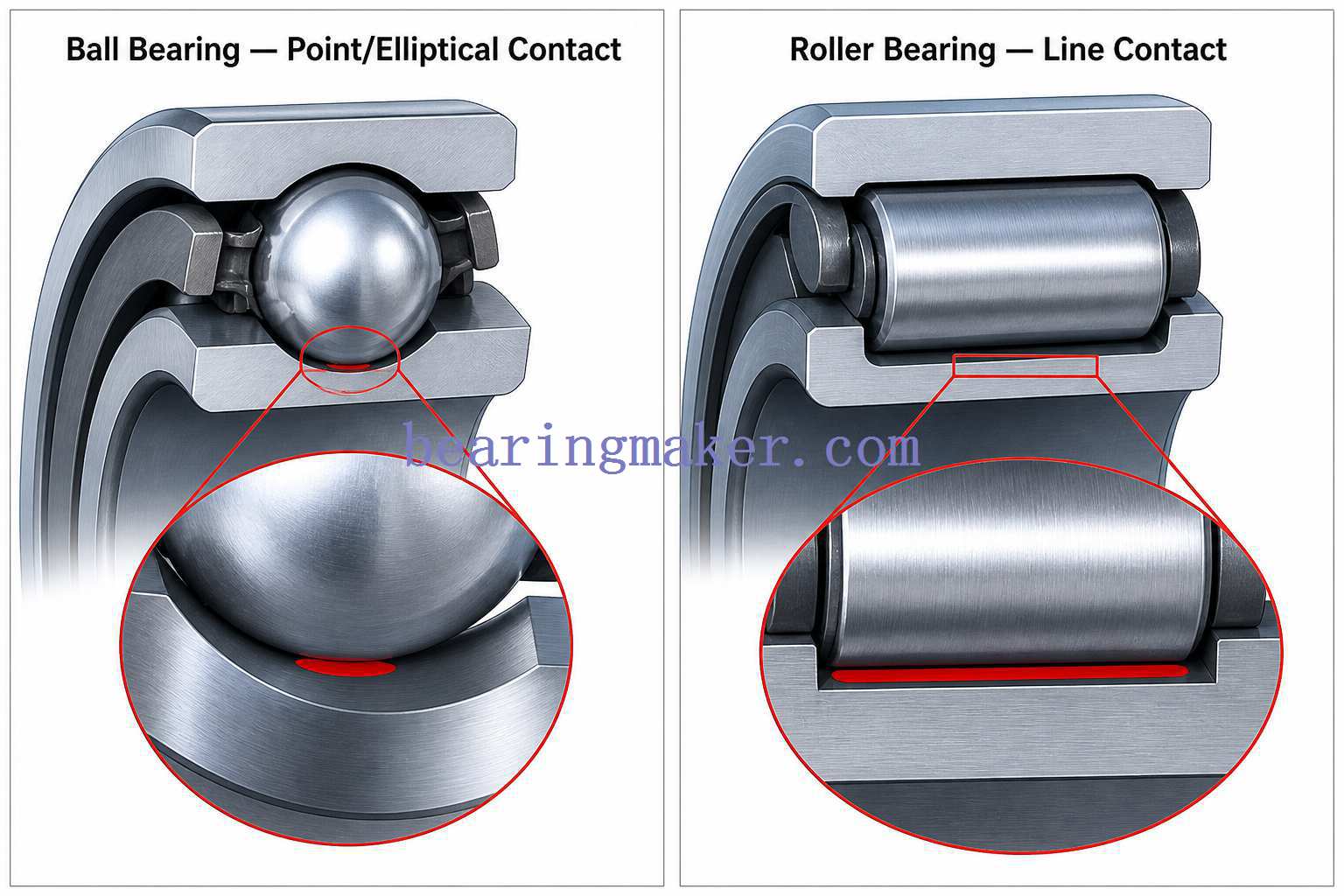
[Image / Diagram — Ball vs Roller Contact]
2. Deep Groove Ball Bearings
Deep groove ball bearings are among the most widely used rolling bearings.
Their inner and outer ring raceways have deep grooves that closely conform to the balls. This design allows them to support primarily radial loads while also carrying moderate axial loads in both directions.
Key Characteristics
- Low friction
- High-speed capability
- Radial load capacity
- Moderate axial load capacity
- Compact construction
- Low maintenance requirements
- Wide range of sizes and configurations
They are available in open, shielded, and sealed versions and can be supplied with different internal clearances, materials, lubricants, and precision levels.
Typical Applications
Deep groove ball bearings are commonly found in:
- Electric motors
- Fans and blowers
- Pumps
- Gearboxes
- Power tools
- Appliances
- Conveyors
- General industrial machinery
When Should You Choose a Deep Groove Ball Bearing?
Consider a deep groove ball bearing when the application requires high speed, relatively low friction, primarily radial loading, and moderate axial load capability.
For many general-purpose rotating systems, it is one of the first bearing types worth considering.
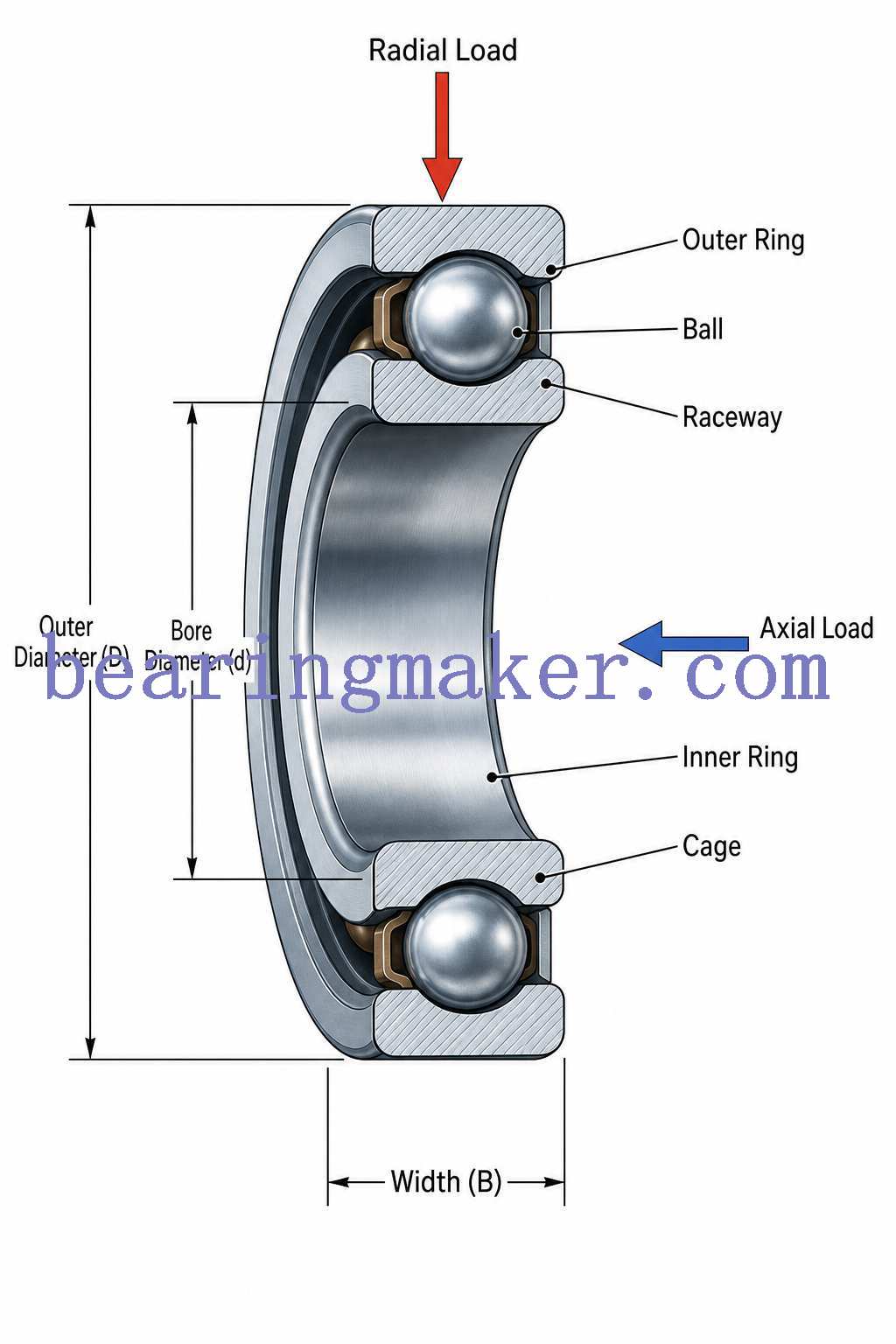
[Image / Diagram — Deep Groove Ball Bearing]
Related: Deep Groove Ball Bearings →
3. Angular Contact Ball Bearings
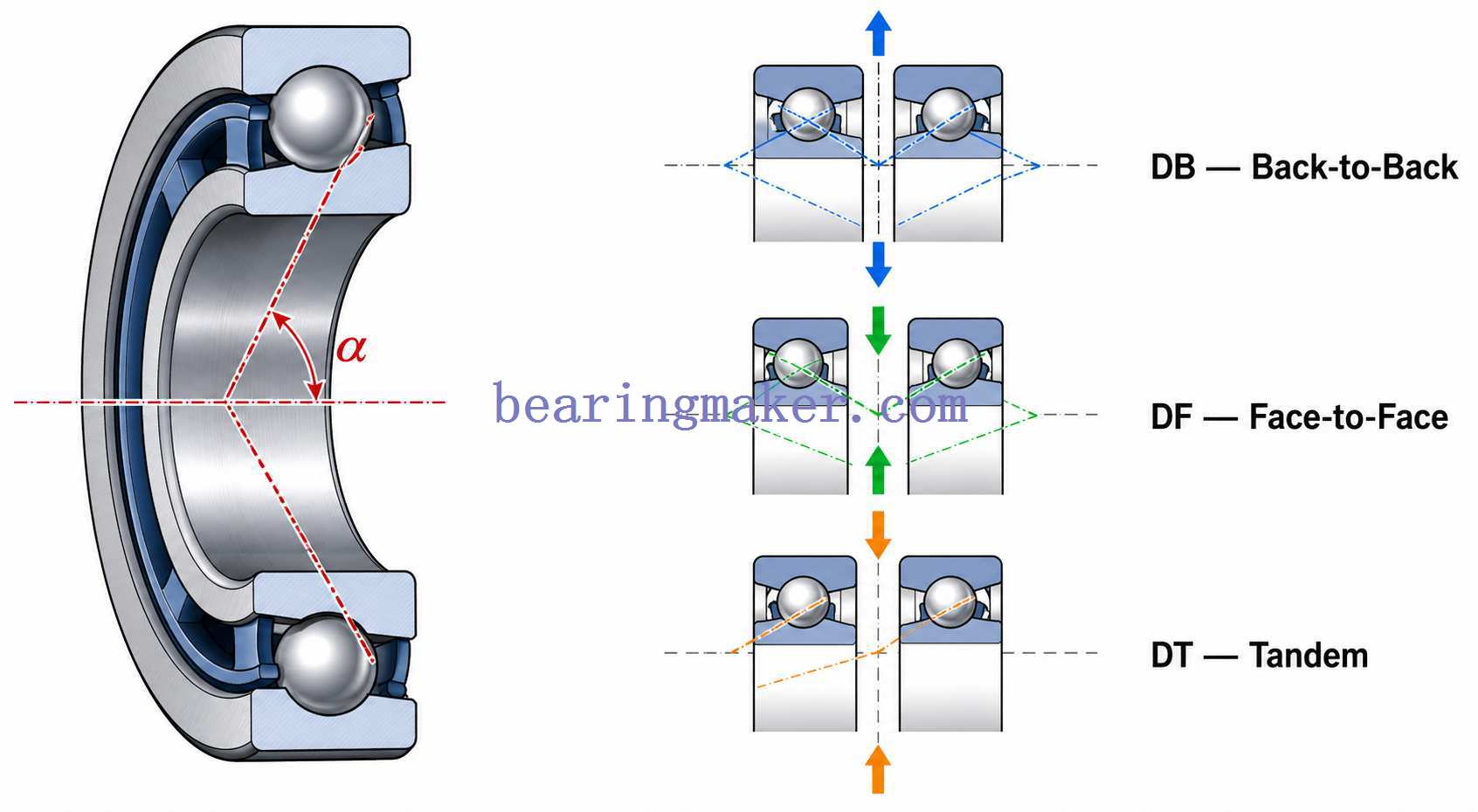
Angular contact ball bearings are designed so that the contact lines between the balls and raceways form an angle relative to the radial plane.
This contact angle enables the bearing to support combined radial and axial loads more effectively than a conventional deep groove ball bearing.
Generally, a larger contact angle provides greater axial load capacity, while designs with smaller contact angles may be better suited to higher rotational speeds.
Key Characteristics
- Suitable for combined radial and axial loads
- High-speed capability
- Good axial rigidity
- Available in precision grades
- Can be arranged in matched sets
- Widely used in precision rotating systems
Single-Row Angular Contact Bearings
A single-row angular contact bearing normally carries axial load primarily in one direction.
Applications requiring axial load support in both directions commonly use two bearings or another suitable arrangement.
Bearing Arrangements
Angular contact bearings may be arranged in configurations such as:
- Back-to-back — DB
- Face-to-face — DF
- Tandem — DT
The appropriate arrangement depends on axial load direction, rigidity, moment loading, shaft alignment, and preload requirements.
Typical Applications
- Machine tool spindles
- High-speed motors
- Pumps
- Compressors
- Precision gearboxes
- Robotics
- Industrial spindles
When Should You Choose an Angular Contact Bearing?
Consider angular contact ball bearings when the application combines high speed with significant axial loading, high rigidity, or precise shaft positioning.
[Image / Diagram — Angular Contact Bearing]
Related: Angular Contact Ball Bearings →
4. Self-Aligning Ball Bearings
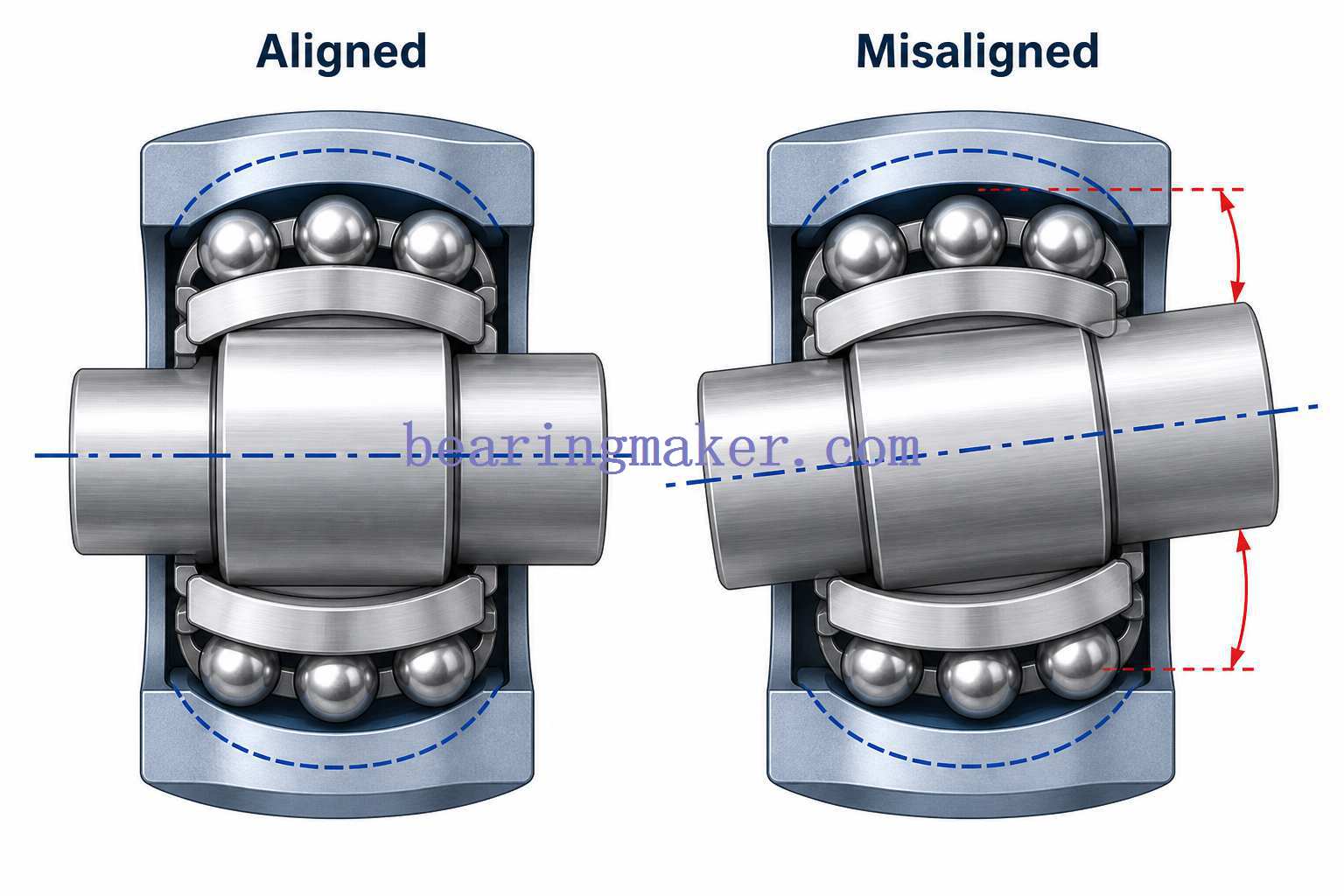
Self-aligning ball bearings typically contain two rows of balls and a common spherical raceway in the outer ring.
This geometry allows the inner ring, balls, and cage assembly to tilt relative to the outer ring, helping accommodate angular misalignment.
Key Characteristics
- Self-aligning capability
- Low friction
- Moderate radial load capacity
- Limited axial load capacity
- Suitable for shaft deflection and mounting errors
Typical Applications
- Conveyors
- Agricultural equipment
- Fans
- Textile machinery
- Long shaft systems
- Equipment where precise alignment is difficult
When Should You Choose a Self-Aligning Ball Bearing?
Consider this design when misalignment is more important than very high load capacity or axial rigidity.
For significantly heavier loads combined with misalignment, a spherical roller bearing may be more appropriate.
[Image / Diagram — Self-Alignment Principle]
5. Thrust Ball Bearings
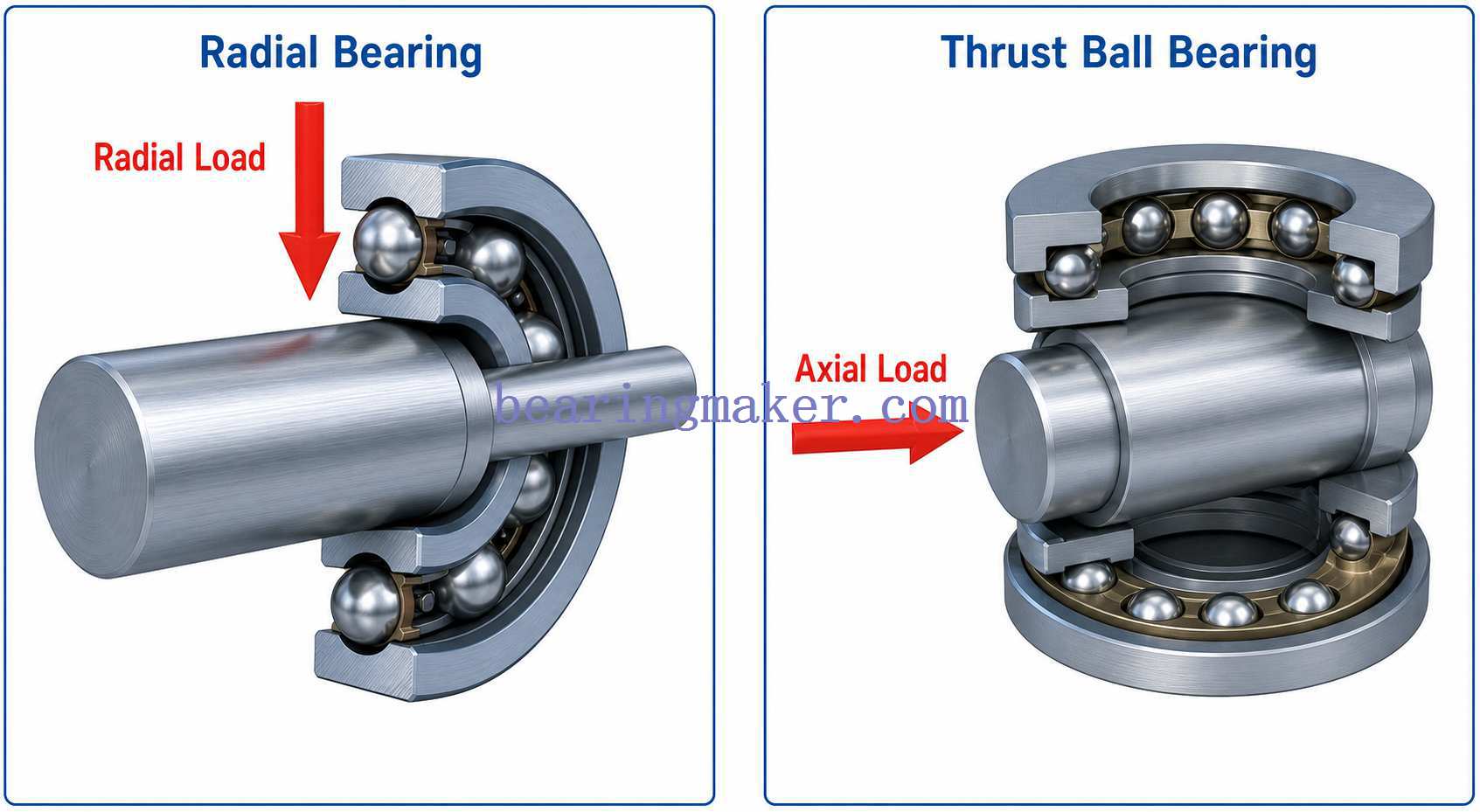
Thrust ball bearings are designed primarily to carry axial loads.
Their structure typically consists of shaft washers, housing washers, and a ball-and-cage assembly.
Unlike conventional radial ball bearings, thrust ball bearings are not normally intended to support significant radial loads.
Key Characteristics
- Designed for axial loading
- Relatively low friction
- Available for one-direction or two-direction axial loads
- Generally unsuitable for substantial radial loading
Typical Applications
- Machine tool mechanisms
- Vertical shafts
- Rotary tables
- Screw mechanisms
- Low- to moderate-speed thrust applications
When Should You Choose a Thrust Ball Bearing?
Choose a thrust ball bearing when the dominant force acts along the shaft axis and radial load is minimal or handled by another bearing.
[Image / Diagram — Radial vs Thrust Bearing]
6. Cylindrical Roller Bearings
Cylindrical roller bearings use cylindrical rolling elements that provide a relatively large contact area with the raceways.
This allows them to carry high radial loads while maintaining good rigidity.
Depending on the internal design, some cylindrical roller bearings can also accommodate limited axial displacement or axial load.
Key Characteristics
- High radial load capacity
- High rigidity
- Suitable for relatively high speeds
- Low friction compared with many other heavy-load roller designs
- Certain designs allow axial displacement between shaft and housing
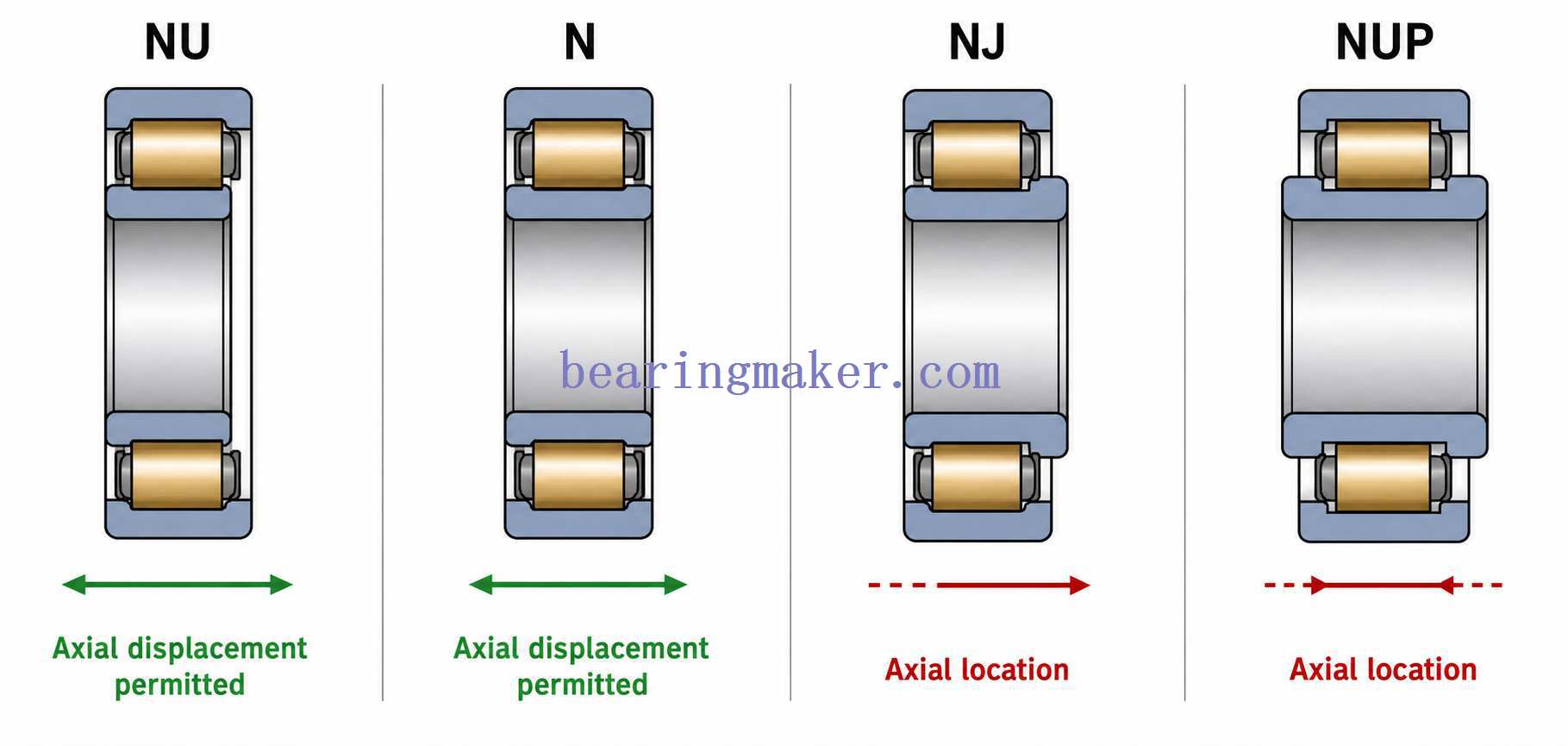
Common Designs
Common configurations include:
- NU
- N
- NJ
- NUP
- NF
Their flange arrangements determine whether the bearing permits axial displacement or provides axial location.
Typical Applications
- Electric motors
- Industrial gearboxes
- Machine tools
- Compressors
- Pumps
- Heavy industrial machinery
When Should You Choose a Cylindrical Roller Bearing?
Consider a cylindrical roller bearing when the application requires greater radial load capacity and rigidity than a typical ball bearing while maintaining relatively good speed capability.
[Image / Diagram — Cylindrical Roller Bearing Designs]
7. Tapered Roller Bearings
Tapered roller bearings use tapered rollers running between tapered inner and outer raceways.
The geometry is designed so that the projected raceway and roller contact lines converge toward a common point on the bearing axis.
This makes tapered roller bearings particularly effective for carrying combined radial and axial loads.
Key Characteristics
- High radial load capacity
- High axial load capacity
- High rigidity
- Suitable for combined loads
- Bearing clearance or preload can be adjusted in many arrangements
- Often installed in opposing pairs
Typical Applications
- Automotive wheel hubs
- Gearboxes
- Axles
- Agricultural machinery
- Construction equipment
- Industrial transmissions
When Should You Choose a Tapered Roller Bearing?
Consider tapered roller bearings when the application involves heavy combined radial and axial loads, particularly where rigidity and controlled shaft positioning are important.
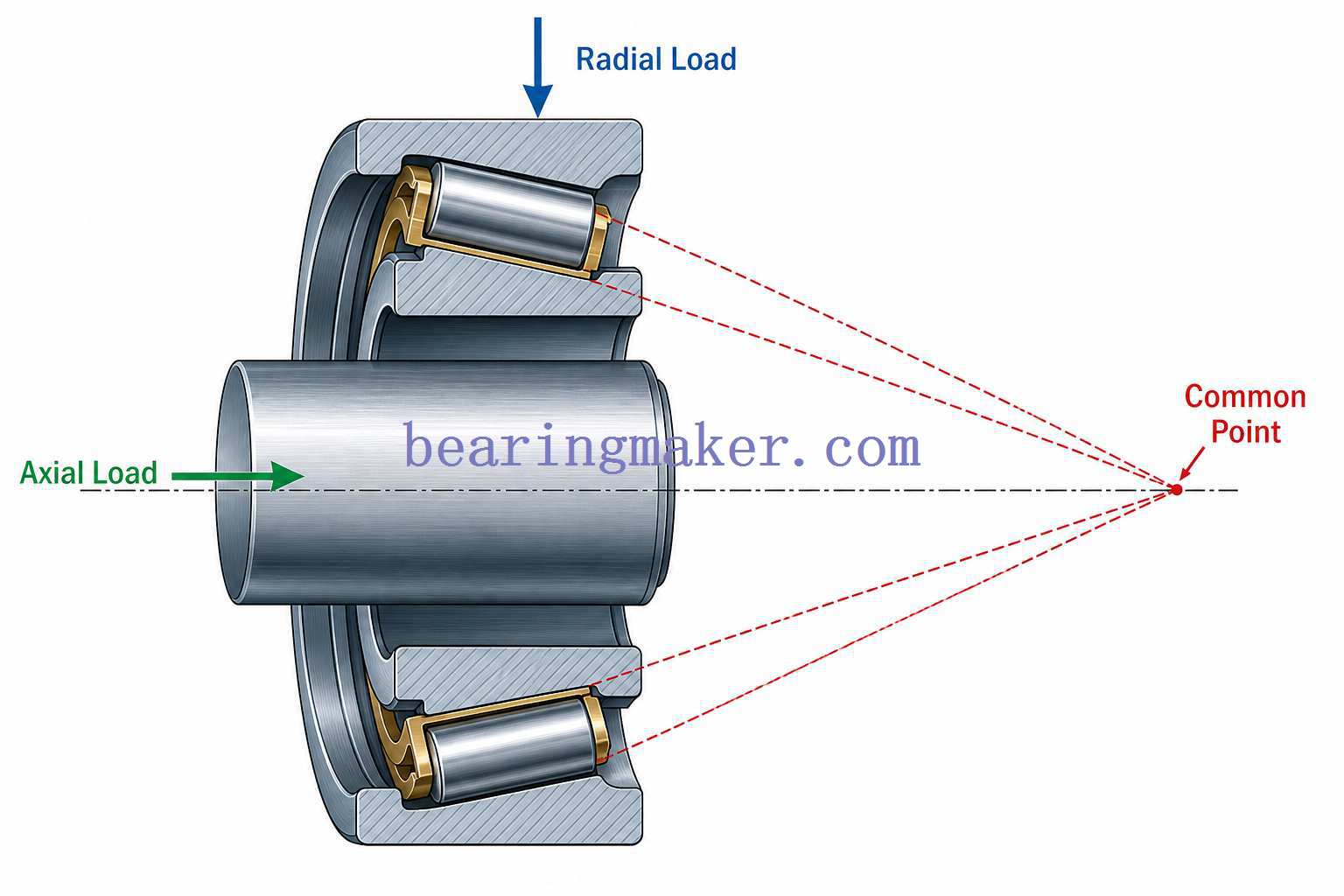
[Image / Diagram — Tapered Roller Load Geometry]
8. Spherical Roller Bearings
Spherical roller bearings typically contain two rows of barrel-shaped rollers running on a spherical outer-ring raceway.
This design combines very high load capacity with self-aligning capability.
They can tolerate shaft deflection and housing misalignment while carrying substantial radial loads and, depending on design, axial loads.
Key Characteristics
- Very high radial load capacity
- Good axial load capability
- Excellent self-aligning capability
- Suitable for shock and vibration
- High rigidity
- Well suited to heavy-duty applications
Typical Applications
- Mining equipment
- Crushers
- Conveyors
- Paper machinery
- Steel mills
- Heavy industrial gearboxes
- Construction machinery
When Should You Choose a Spherical Roller Bearing?
Consider spherical roller bearings when the application combines heavy loads, shock, vibration, shaft deflection, or significant misalignment.
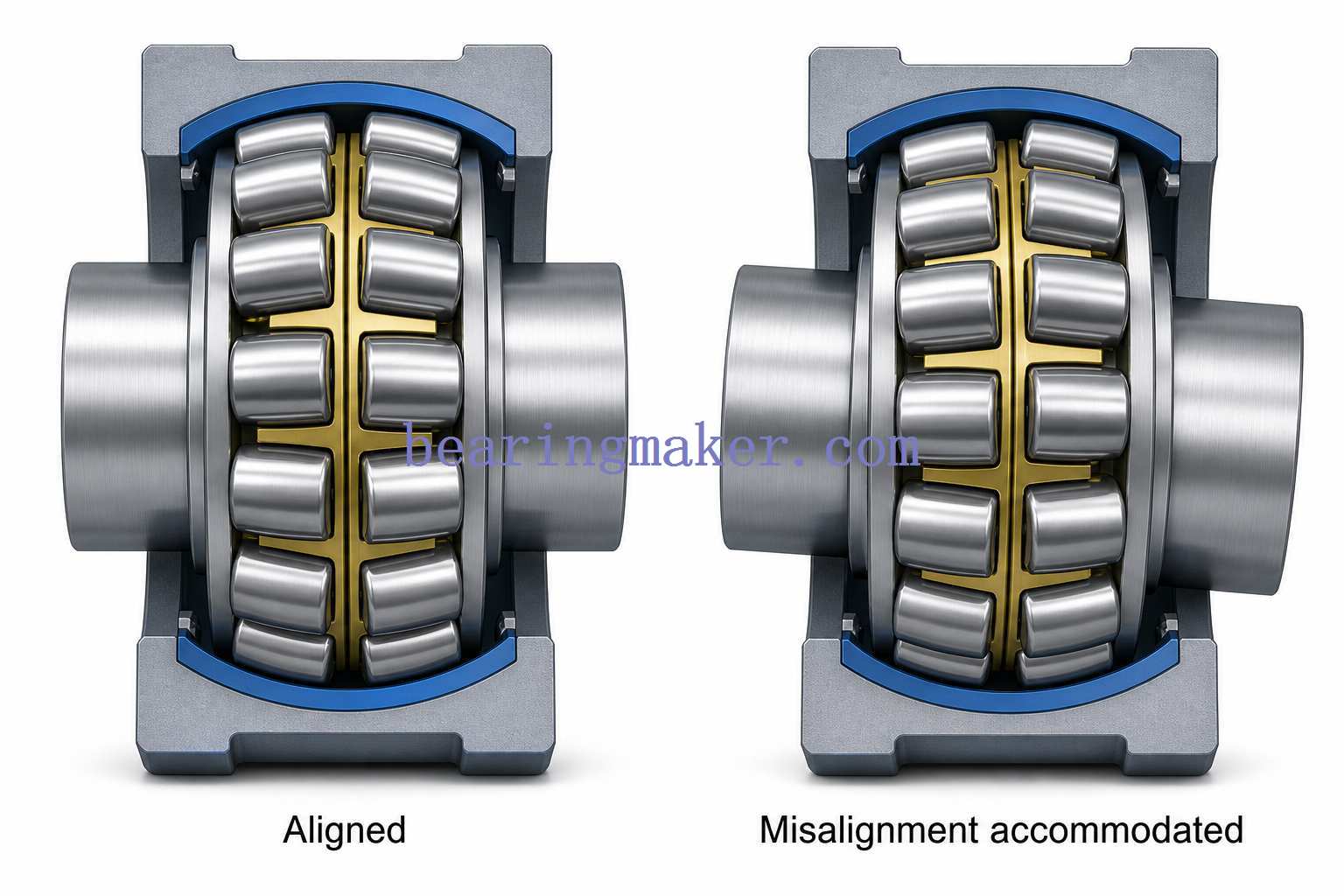
[Image / Diagram — Spherical Roller Bearing]
9. Needle Roller Bearings
Needle roller bearings use long, thin cylindrical rollers with a relatively small diameter compared with their length.
Their primary advantage is the ability to provide substantial radial load capacity within a very small radial cross-section.
Key Characteristics
- Very compact radial dimensions
- High radial load capacity relative to cross-section
- Suitable for compact mechanisms
- Available with or without inner rings
- Multiple structural configurations
Common Types
Needle bearing designs include:
- Drawn cup needle roller bearings
- Machined-ring needle roller bearings
- Needle roller and cage assemblies
- Inner rings
- Needle thrust bearings
Typical Applications
- Automotive transmissions
- Compact gearboxes
- Power tools
- Compressors
- Industrial machinery
- Small mechanisms
When Should You Choose a Needle Roller Bearing?
Consider needle roller bearings when radial installation space is severely limited but relatively high radial load capacity is required.
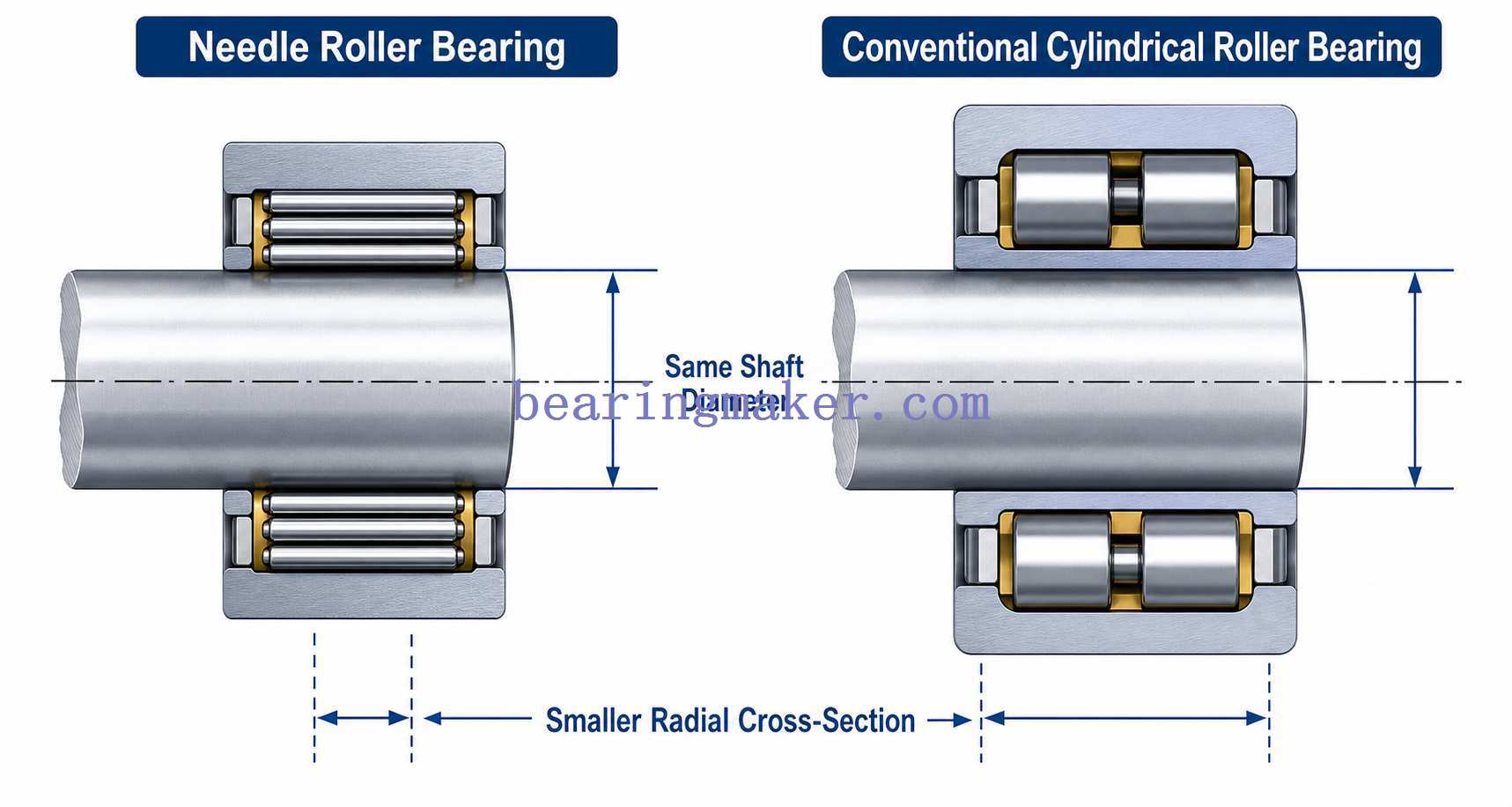
[Image / Diagram — Needle vs Standard Roller Bearing]
10. Thrust Roller Bearings
Thrust roller bearings are designed to carry axial loads using roller elements instead of balls.
Different designs provide different combinations of load capacity, speed, and alignment capability.
Common types include:
- Cylindrical roller thrust bearings
- Needle roller thrust bearings
- Spherical roller thrust bearings
Cylindrical Roller Thrust Bearings
Provide high axial load capacity and rigidity.
Needle Roller Thrust Bearings
Provide axial load capacity within a very small axial installation space.
Spherical Roller Thrust Bearings
Can carry very high axial loads together with some radial load and can accommodate a degree of misalignment.
Typical Applications
- Heavy machinery
- Industrial transmissions
- Extruders
- Vertical shafts
- Gear systems
- Heavy thrust mechanisms
When Should You Choose a Thrust Roller Bearing?
Consider a thrust roller bearing when axial load is too high for a conventional thrust ball bearing or when greater rigidity is required.
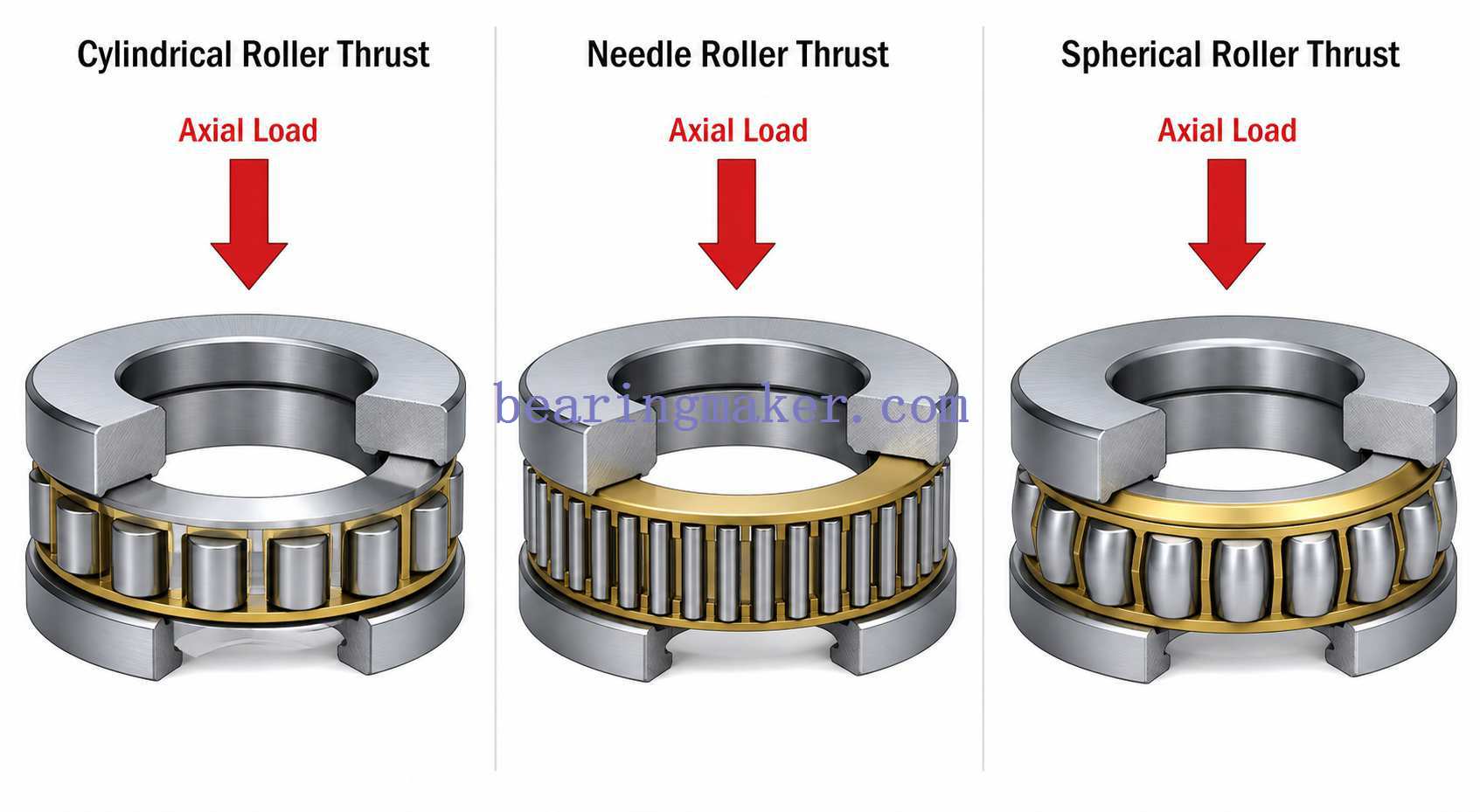
[Image / Diagram — Three Thrust Roller Types]
11. Spherical Plain Bearings
Spherical plain bearings differ fundamentally from the rolling bearings described above.
Instead of balls or rollers rolling between raceways, they use spherical sliding contact surfaces between the inner and outer rings.
This design allows oscillating movement, tilting, and substantial angular misalignment while supporting high loads.
Key Characteristics
- Sliding rather than rolling contact
- High load capacity
- Large misalignment capability
- Suitable for oscillating and slow movements
- Compact construction
- Available in lubricated and maintenance-free designs
Typical Applications
- Hydraulic cylinders
- Aircraft control systems
- Construction equipment
- Linkages
- Suspension systems
- Articulating joints
- Heavy machinery
When Should You Choose a Spherical Plain Bearing?
Consider spherical plain bearings when the application requires high load capacity combined with oscillation, articulation, or significant angular misalignment rather than continuous high-speed rotation.
They should not be treated as direct substitutes for spherical roller bearings simply because both designs can accommodate misalignment.
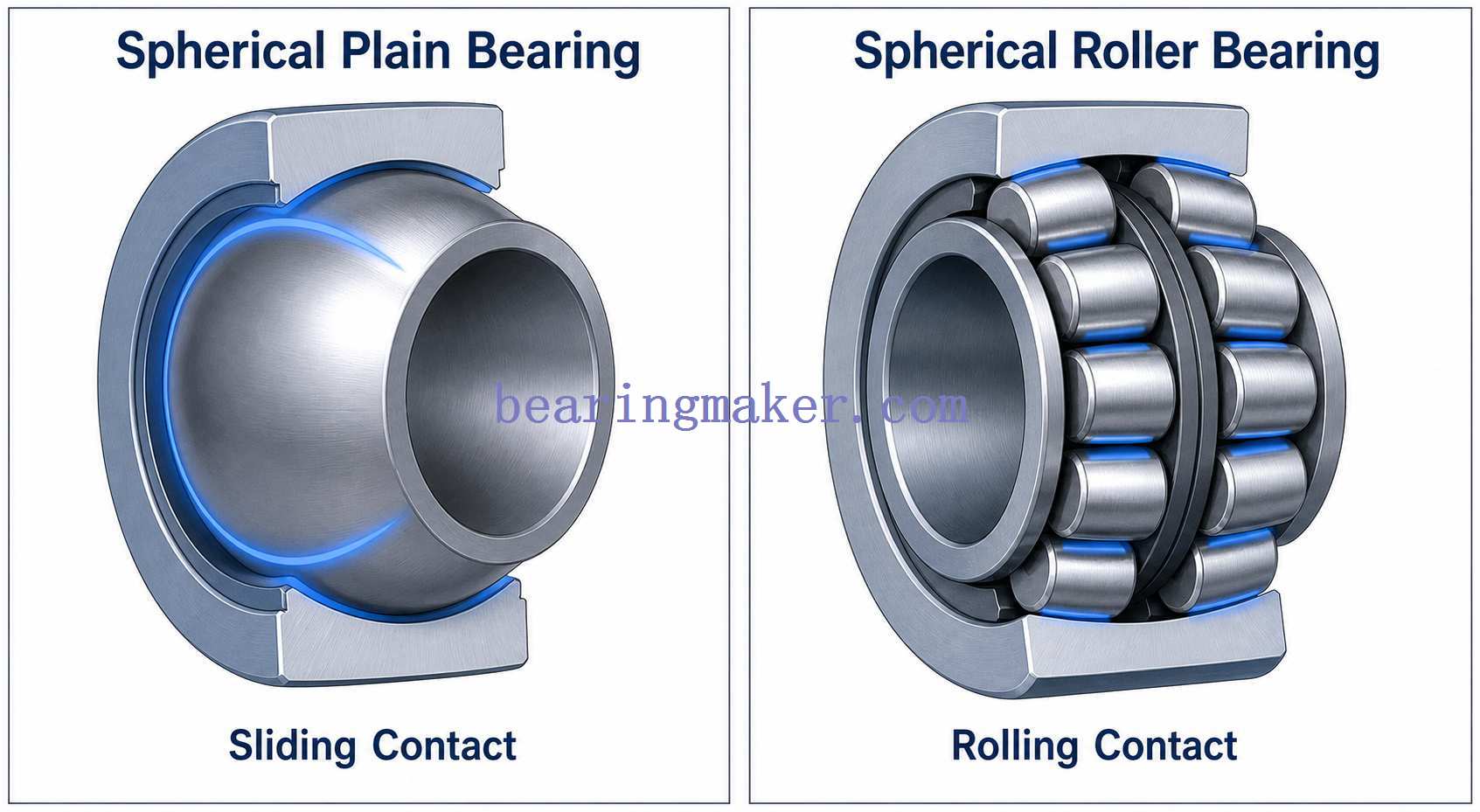
[Image / Diagram — Spherical Plain vs Spherical Roller Bearing]
Related: Spherical Plain Bearings →
12. Bearing Type Comparison
The following table provides a general starting point for comparing common bearing types.
| Bearing Type | Radial Load | Axial Load | Speed | Rigidity | Misalignment | Space Efficiency |
|---|---|---|---|---|---|---|
| Deep Groove Ball | High | Moderate | Very High | Moderate | Low | High |
| Angular Contact Ball | High | High | Very High | High | Low | High |
| Self-Aligning Ball | Moderate | Low | High | Moderate | Very High | Moderate |
| Thrust Ball | None/Minimal | High | Moderate | Moderate | Low | Axially Moderate |
| Cylindrical Roller | Very High | Design Dependent | High | Very High | Low | High |
| Tapered Roller | Very High | Very High | Moderate | Very High | Low | Moderate |
| Spherical Roller | Very High | High | Moderate | Very High | Very High | Low |
| Needle Roller | Very High* | Limited | High | High | Low | Very High |
| Thrust Roller | Minimal/Design Dependent | Very High | Low–Moderate | Very High | Design Dependent | Moderate |
| Spherical Plain | Very High | Design Dependent | Low | High | Very High | High |
*Relative to the bearing’s radial cross-section.
This table should be used for preliminary comparison only. Actual load ratings, speed limits, allowable misalignment, and other characteristics must be verified for the specific bearing design and size.
13. How to Choose a Bearing Type
A practical bearing-type selection process can begin with five questions.
Question 1: What Direction Is the Load?
Mainly Radial Load
Start by considering:
- Deep groove ball bearings
- Cylindrical roller bearings
- Needle roller bearings
- Spherical roller bearings
Significant Combined Radial and Axial Load
Consider:
- Angular contact ball bearings
- Tapered roller bearings
- Certain spherical roller bearings
Mainly Axial Load
Consider:
- Thrust ball bearings
- Thrust roller bearings
Question 2: How Heavy Is the Load?
For relatively light to moderate loads and high speeds, ball bearings are often suitable.
As load and rigidity requirements increase, roller bearings become increasingly attractive.
For very heavy radial loads, consider designs such as:
- Cylindrical roller bearings
- Spherical roller bearings
- Tapered roller bearings
Question 3: How Fast Will the Shaft Rotate?
For high-speed applications, common starting points include:
- Deep groove ball bearings
- Angular contact ball bearings
- Certain cylindrical roller bearings
For extremely high-speed precision applications, bearing size, precision, preload, lubrication, cage design, and rolling-element material must also be evaluated.
Question 4: Is Misalignment Expected?
For significant shaft deflection or housing misalignment, consider:
- Self-aligning ball bearings
- Spherical roller bearings
- Spherical plain bearings for suitable oscillating or articulating applications
Question 5: Is Installation Space Limited?
If radial space is limited:
- Needle roller bearings
- Thin section bearings
- Certain compact ball bearing series
may be suitable depending on load and speed.
If axial space is limited and the application carries thrust load, needle roller thrust bearings may be considered.
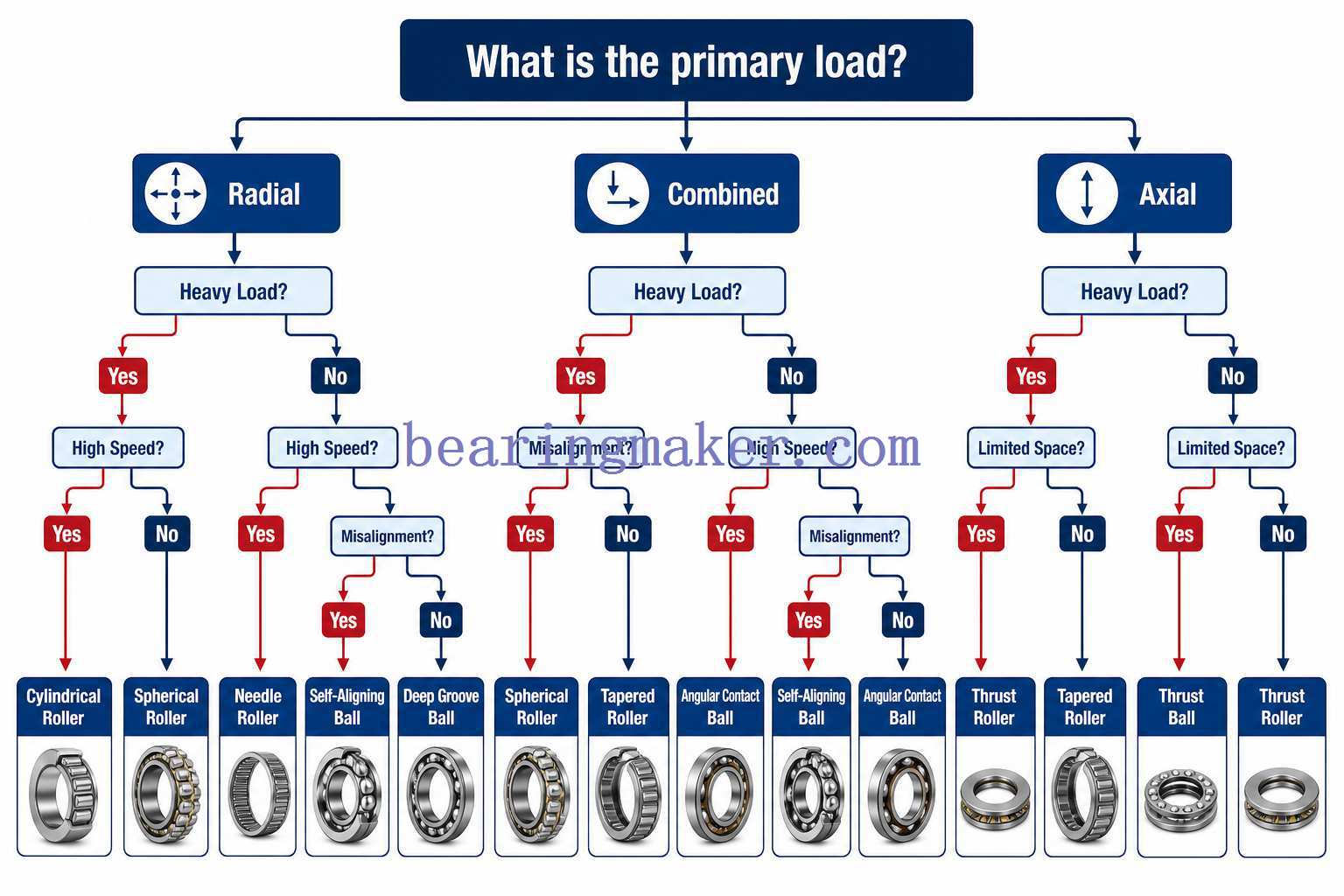
[Image / Diagram — Bearing Type Decision Tree]
14. Quick Selection by Application
The equipment itself can also provide an initial indication of suitable bearing types.
| Application | Common Bearing Types to Consider | Important Selection Factors |
|---|---|---|
| Electric Motors | Deep Groove Ball, Cylindrical Roller, Hybrid Ceramic | Speed, noise, clearance, electrical current |
| Pumps | Deep Groove Ball, Angular Contact, Cylindrical Roller | Axial thrust, speed, lubrication |
| Gearboxes | Deep Groove, Cylindrical Roller, Tapered Roller, Spherical Roller | Gear forces, rigidity, shock |
| Machine Tool Spindles | Angular Contact, Precision Cylindrical Roller | Precision, speed, preload, rigidity |
| Automotive Hubs | Tapered Roller, Angular Contact | Combined load, rigidity, sealing |
| Conveyors | Deep Groove, Self-Aligning Ball, Spherical Roller | Contamination, misalignment, load |
| Heavy Machinery | Cylindrical, Tapered, Spherical Roller | Heavy load, shock, rigidity |
| Robotics | Thin Section, Angular Contact, Deep Groove | Compact size, accuracy, torque |
| Compact Transmissions | Needle Roller | Space, radial load |
| Articulating Joints | Spherical Plain | Oscillation, load, misalignment |
These are typical starting points rather than universal recommendations. Final selection should always be based on the actual operating conditions.
15. Bearing Type Selection Examples
Example 1 — High-Speed Electric Motor
Application requirements:
- Primarily radial load
- Moderate load
- High rotational speed
- Low noise
- Compact design
A deep groove ball bearing would normally be one of the first bearing types to evaluate.
The next steps would be to determine:
Bearing Size → Load Rating → Speed Capability → Internal Clearance → Precision → Seal → Lubrication
Example 2 — Heavy Industrial Gearbox
Application requirements:
- Heavy radial load
- Significant gear forces
- High rigidity required
- Moderate speed
Depending on the direction of the gear forces, suitable candidates may include:
- Cylindrical roller bearings
- Tapered roller bearings
- Spherical roller bearings
The actual choice depends particularly on axial load, alignment, bearing arrangement, and shaft rigidity.
Example 3 — Compact Transmission
Application requirements:
- Very limited radial installation space
- Significant radial load
- Moderate to high speed
A needle roller bearing may provide an effective solution because of its high radial load capacity relative to its cross-section.
Example 4 — Heavy Load With Shaft Misalignment
Application requirements:
- Very high radial load
- Shaft deflection
- Shock and vibration
- Misalignment expected
A spherical roller bearing would normally be one of the primary designs to evaluate.
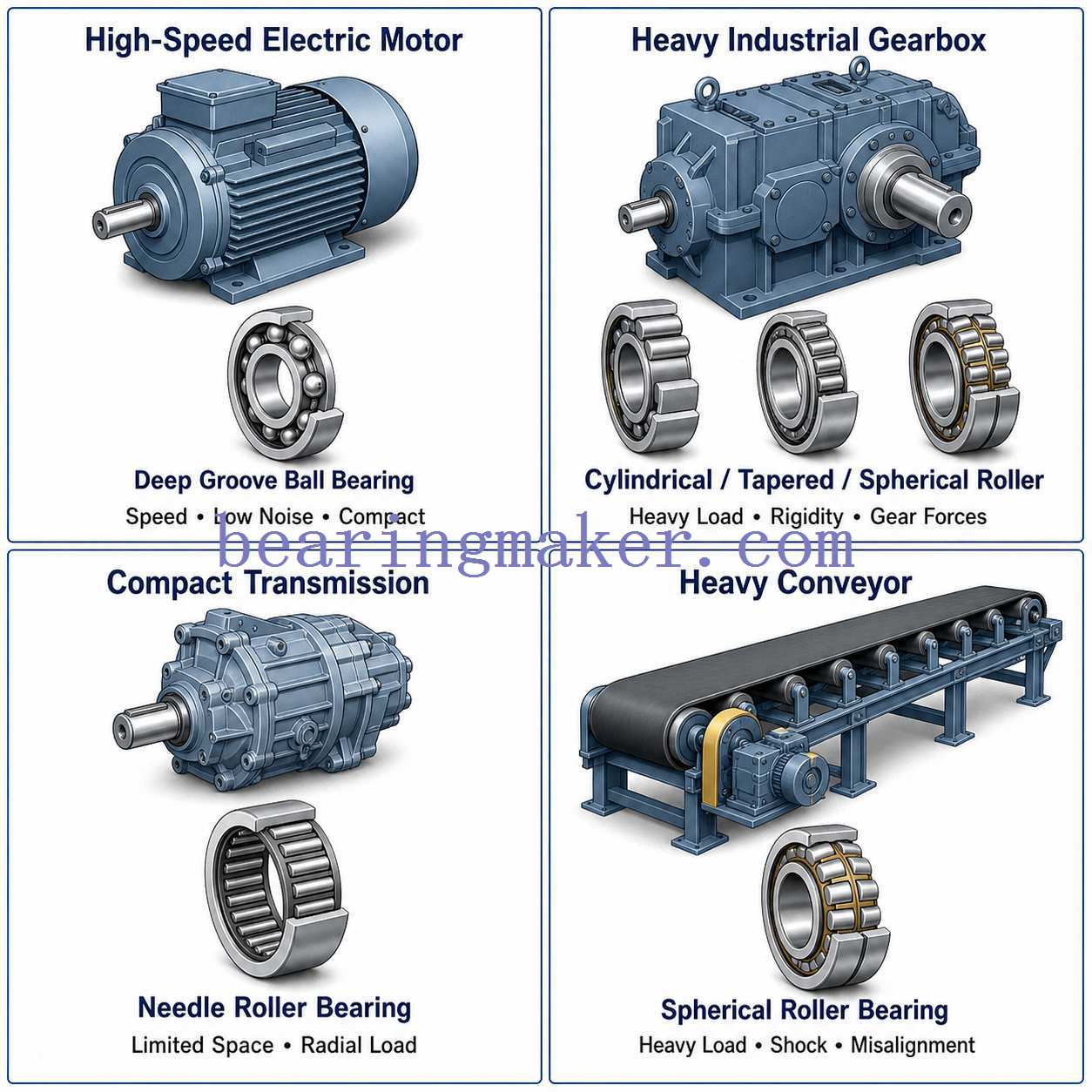
[Image / Diagram — Four Selection Examples]
16. Bearing Type Is Only the First Step
Choosing the correct bearing family does not complete the selection process.
Once the bearing type has been identified, the following factors should still be evaluated:
- Bearing dimensions and available installation space
- Dynamic and static load capacity
- Required bearing life
- Operating speed
- Precision requirements
- Internal clearance
- Shaft and housing fits
- Bearing material
- Seals or shields
- Lubrication
- Operating temperature
- Contamination and corrosion
- Mounting and maintenance requirements
A deep groove ball bearing, for example, may be the correct type, while the wrong size, clearance, seal, material, or lubricant can still result in poor performance.
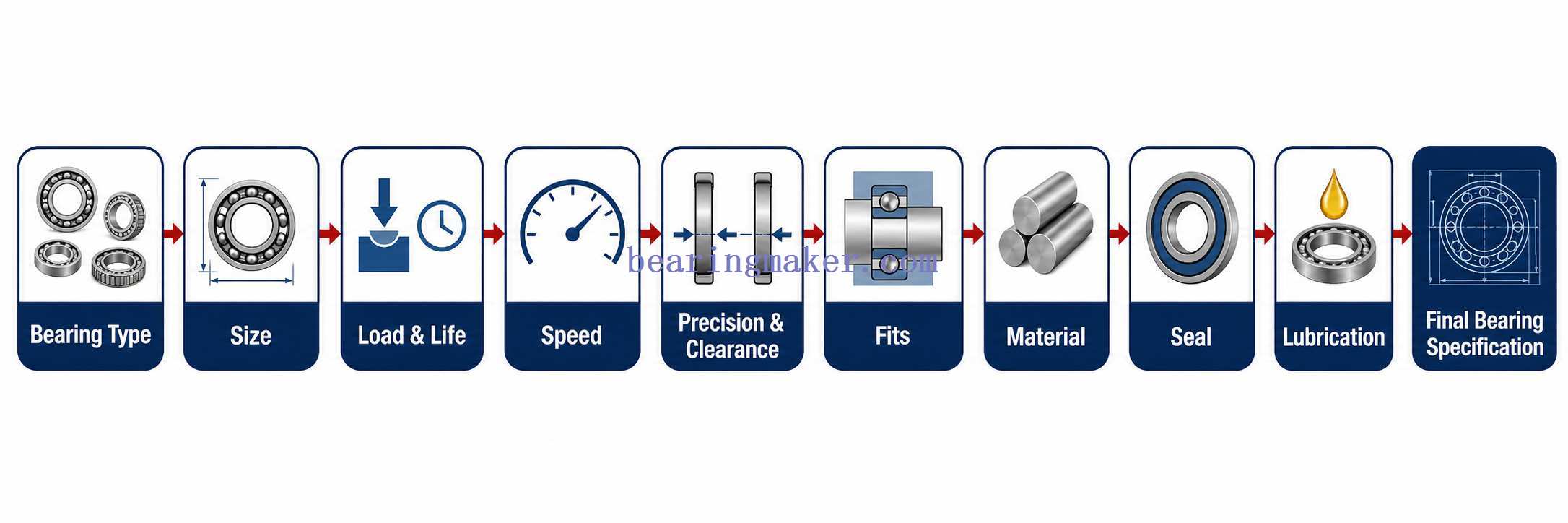
[Image / Diagram — From Bearing Type to Final Bearing]
a horizontal engineering workflow: Bearing Type → Size → Load & Life → Speed → Precision & Clearance → Fits → Material → Seal → Lubrication → Final Bearing Specification.
Need Help Choosing a Bearing Type?
If you are comparing several bearing types or are unsure which design best fits your application, provide as much operating information as possible.
Useful information includes:
- Shaft diameter
- Available outer diameter and width
- Radial load
- Axial load
- Normal and maximum RPM
- Operating temperature
- Expected misalignment
- Environmental conditions
- Required service life
- Existing bearing number, if available
- Technical drawing, if available
- Required quantity
Our team can review your application requirements and help identify suitable bearing types and manufacturing options.
Request a Bearing Recommendation →
Continue Your Bearing Selection
Once you have identified the appropriate bearing type, continue with the next engineering considerations:
Bearing Dimensions & Series Guide →
Determine the appropriate bearing size and dimensional series.
Bearing Load Calculation Guide →
Evaluate radial, axial, combined, dynamic, and static loads.
Bearing Life Calculation Guide →
Estimate the required bearing fatigue life.
Bearing Speed Guide →
Check whether the bearing is suitable for your operating RPM.
Bearing Internal Clearance Guide →
Choose the appropriate CN, C2, C3, C4, or C5 clearance.
Bearing Fits & Tolerances Guide →
Determine appropriate shaft and housing fits.
Technical Note
The information in this guide is intended for preliminary bearing-type selection. Bearing capabilities vary significantly by series, size, internal design, material, cage, clearance, lubrication, manufacturer, and operating conditions.
Final bearing selection should be verified using the applicable bearing specifications and the actual load, speed, temperature, mounting, lubrication, environmental, and service-life requirements of the application.
