Brushless DC (BLDC) motors have become one of the most important motor technologies in modern engineering. Thanks to their high efficiency, long service life, compact size, and precise electronic control, they are widely used in applications ranging from consumer electronics and industrial automation to robotics, medical devices, and electric vehicles.
Compared with conventional brushed DC motors, BLDC motors eliminate mechanical brushes and commutators, replacing them with electronic commutation. This design significantly improves reliability, reduces maintenance requirements, and enables more accurate speed and torque control.
This chapter introduces the basic concepts of BLDC motors, explains why they were developed, and compares them with traditional brushed DC motors.
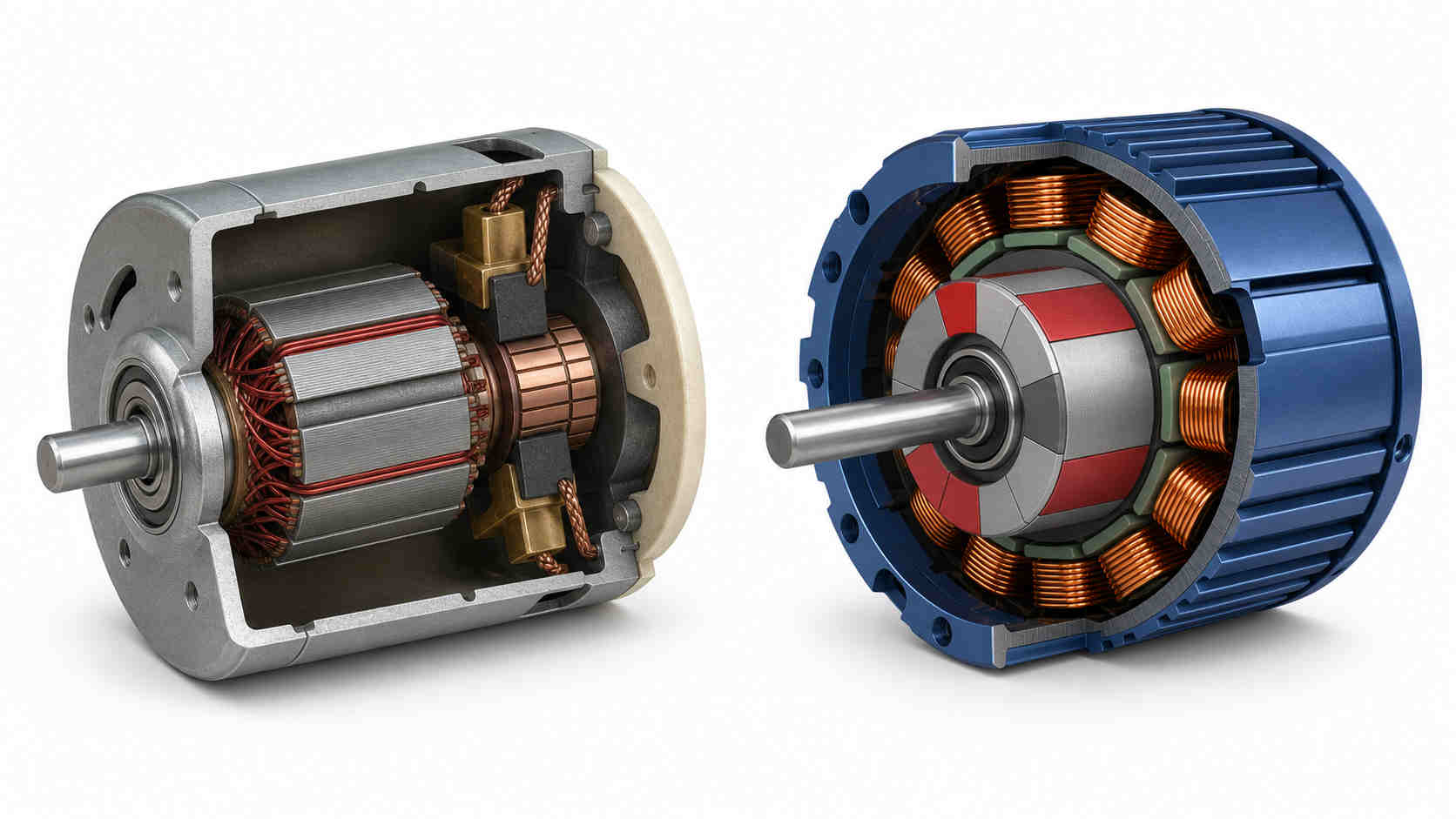
(Illustration: A modern brushless DC motor placed beside a traditional brushed DC motor, highlighting the absence of brushes and commutator in the BLDC motor.)
What Is a Brushless DC Motor?
A Brushless DC (BLDC) motor is an electric motor that converts electrical energy into mechanical motion using permanent magnets, electromagnetic fields, and electronic commutation.
Unlike a brushed DC motor, a BLDC motor does not use carbon brushes or a mechanical commutator to switch current between windings. Instead, an electronic controller continuously energizes the stator windings according to the rotor position, producing a rotating magnetic field that drives the rotor.
Because mechanical contact between brushes and the commutator is eliminated, BLDC motors generally offer:
- Higher operating efficiency
- Longer service life
- Lower maintenance requirements
- Lower operating noise
- Better speed and torque control
Today, BLDC motors are widely regarded as the preferred solution for many high-performance motion-control applications.
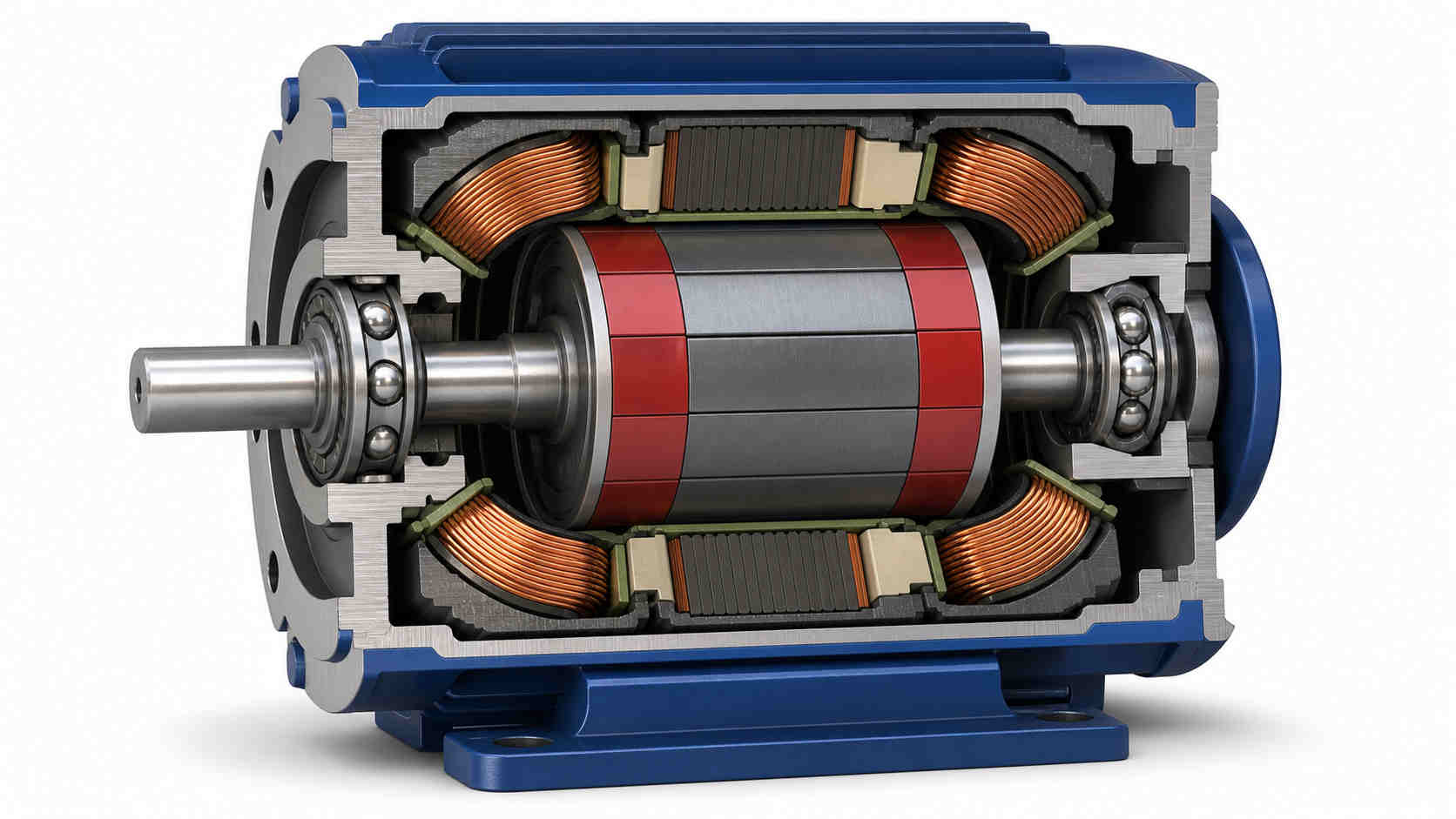
(Illustration: Cross-sectional view of a typical BLDC motor showing the stator, permanent-magnet rotor, shaft, bearings, and three-phase windings.)
Why Were Brushless DC Motors Developed?
Traditional brushed DC motors have been used successfully for more than a century because they are simple, inexpensive, and easy to control.
However, their mechanical commutation system introduces several limitations.
As the motor operates, the brushes remain in continuous contact with the rotating commutator. Over time, this contact causes:
- Mechanical wear
- Electrical arcing
- Increased friction
- Heat generation
- Electromagnetic interference (EMI)
These issues limit motor life, increase maintenance requirements, and reduce overall efficiency.
The development of reliable semiconductor devices and digital motor controllers made it possible to replace mechanical commutation with electronic commutation.
As a result, the brushless DC motor was developed to overcome many of the limitations associated with brushed motors while maintaining the advantages of DC motor control.
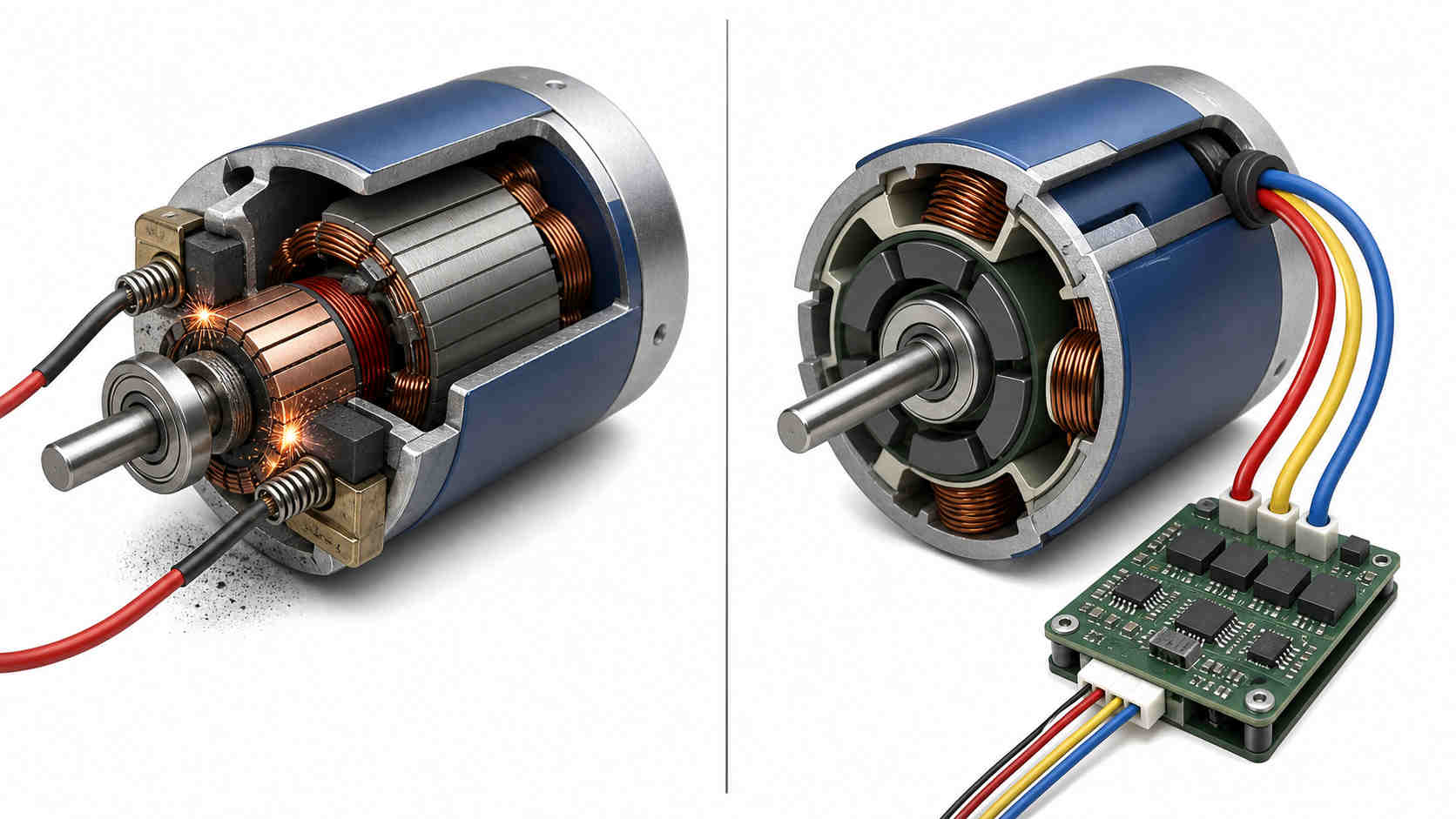
(Illustration: Comparison showing mechanical commutation in a brushed DC motor versus electronic commutation in a BLDC motor.)
Brushed DC Motor vs. Brushless DC Motor
Both brushed and brushless DC motors convert electrical energy into rotational motion. However, they differ significantly in their construction and operating methods.
| Feature | Brushed DC Motor | Brushless DC Motor |
|---|---|---|
| Commutation | Mechanical (brushes and commutator) | Electronic controller |
| Rotor | Wound armature | Permanent magnets |
| Stator | Permanent magnets or field windings | Three-phase windings |
| Maintenance | Regular brush replacement | Minimal routine maintenance |
| Efficiency | Moderate | High |
| Noise | Higher due to brush contact | Lower |
| Service Life | Limited by brush wear | Typically longer |
| Speed Control | Simple | Highly precise with electronic control |
While brushed motors remain suitable for many low-cost and intermittent-duty applications, BLDC motors have become the preferred choice where efficiency, reliability, and precise control are important.
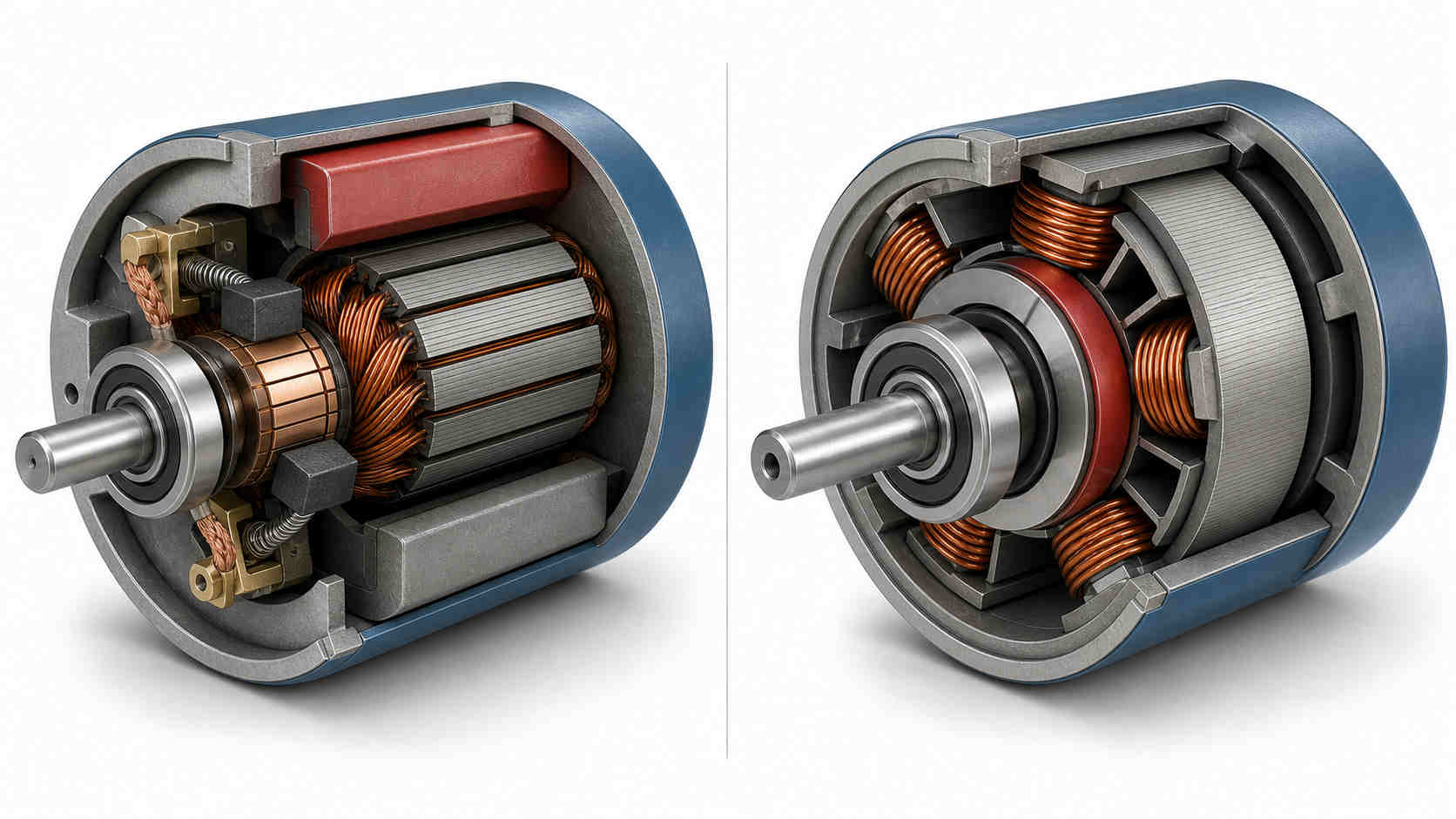
(Illustration: Side-by-side comparison of the internal structures of a brushed DC motor and a brushless DC motor.)
Common Applications
Because of their performance advantages, BLDC motors are now found in an increasingly wide range of products.
Typical applications include:
- Industrial automation equipment
- Robots and collaborative robots
- Electric bicycles and scooters
- Drones and UAVs
- Medical devices
- Cooling fans and pumps
- Household appliances
- Power tools
- Precision instruments
As electronic control technology continues to improve, BLDC motors are replacing brushed motors in many applications where long-term reliability and energy efficiency are essential.
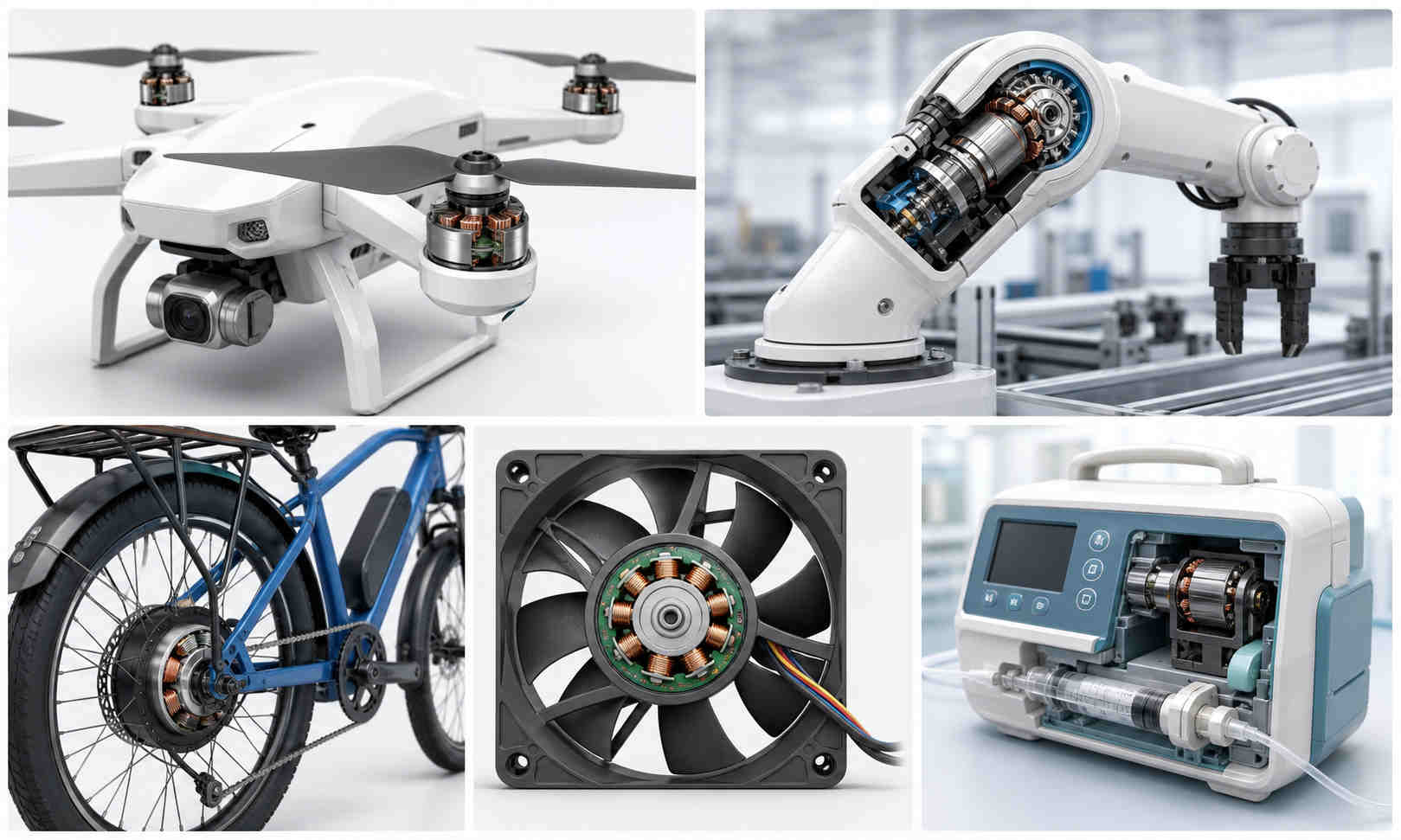
(Illustration: A collage showing BLDC motors used in drones, industrial robots, electric bicycles, cooling fans, and medical equipment.)
Common Misconceptions
Although BLDC motors are widely used, several misconceptions are common among beginners.
“Brushless” Does Not Mean “Controller-Free”
A BLDC motor cannot operate simply by connecting it directly to a DC power supply.
Unlike a brushed motor, it requires an electronic controller to perform commutation by switching current between the stator windings.
Higher Speed Does Not Always Mean Better Performance
A motor with a higher speed rating is not necessarily more powerful or more suitable.
Motor selection should always consider:
- Required torque
- Operating speed
- Supply voltage
- Load characteristics
- Duty cycle
- Control requirements
These topics will be discussed in later chapters.
Brushless Does Not Mean Maintenance-Free
Although BLDC motors eliminate brush wear, they still contain mechanical components such as bearings that require proper design and, in some applications, periodic maintenance.
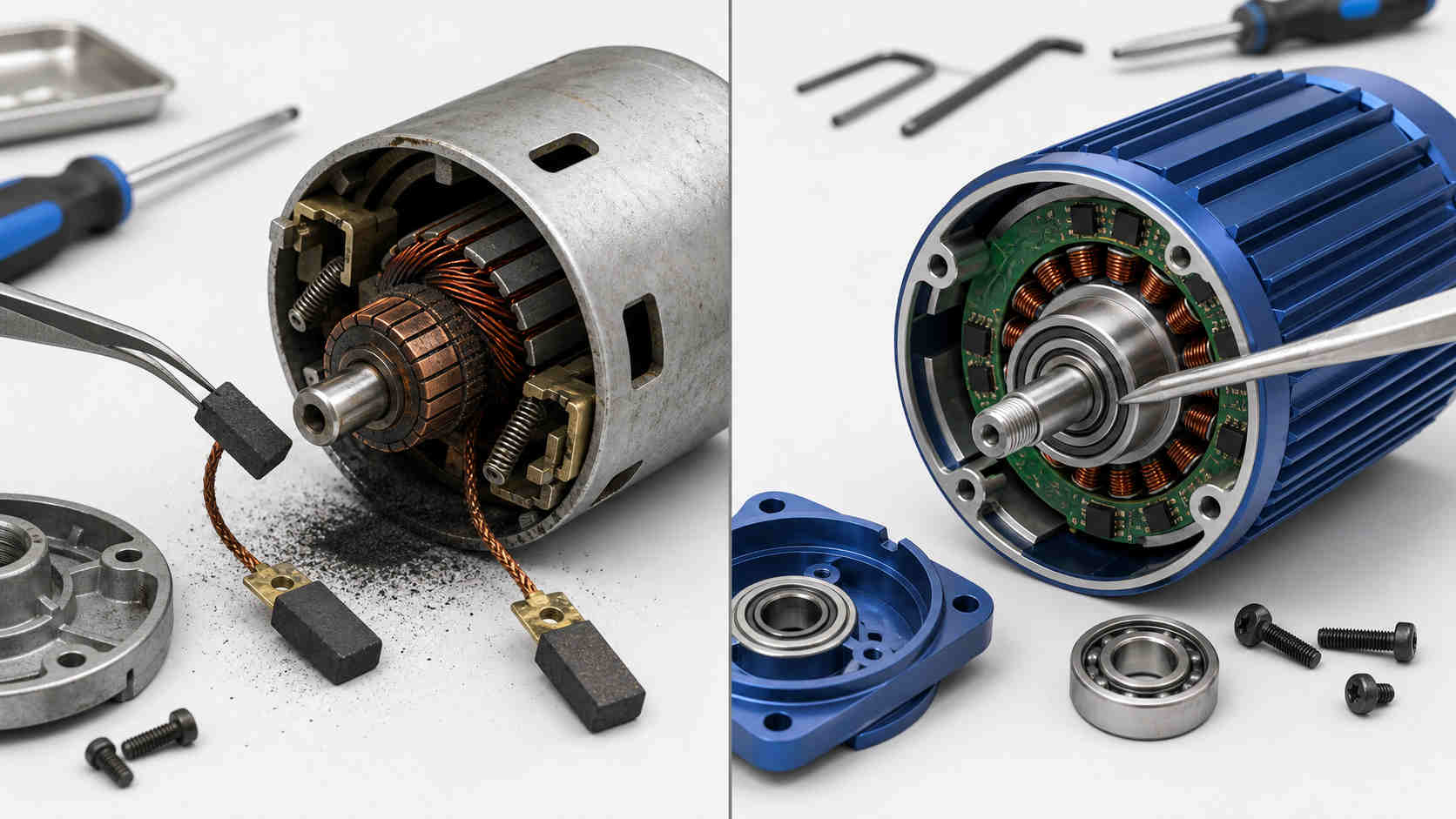
(Illustration: Maintenance comparison highlighting brush replacement in brushed motors and bearing maintenance in BLDC motors.)
Engineering Note
Many introductory articles describe BLDC motors simply as “motors without brushes.”
While technically correct, this definition is incomplete.
A more accurate definition is:
A Brushless DC motor is a permanent-magnet synchronous motor driven by electronic commutation from a DC power source.
This explanation better reflects how modern BLDC motors actually operate while remaining accessible to readers who are new to motor technology.
Key Takeaways
- A Brushless DC (BLDC) motor replaces mechanical commutation with electronic commutation.
- Eliminating brushes improves efficiency, reliability, and service life while reducing maintenance requirements.
- BLDC motors are widely used in industrial, commercial, and consumer applications.
- Although they operate from a DC power source, BLDC motors require an electronic controller to function.
- Understanding the differences between brushed and brushless motors provides the foundation for learning how BLDC motors are constructed, controlled, and selected.
