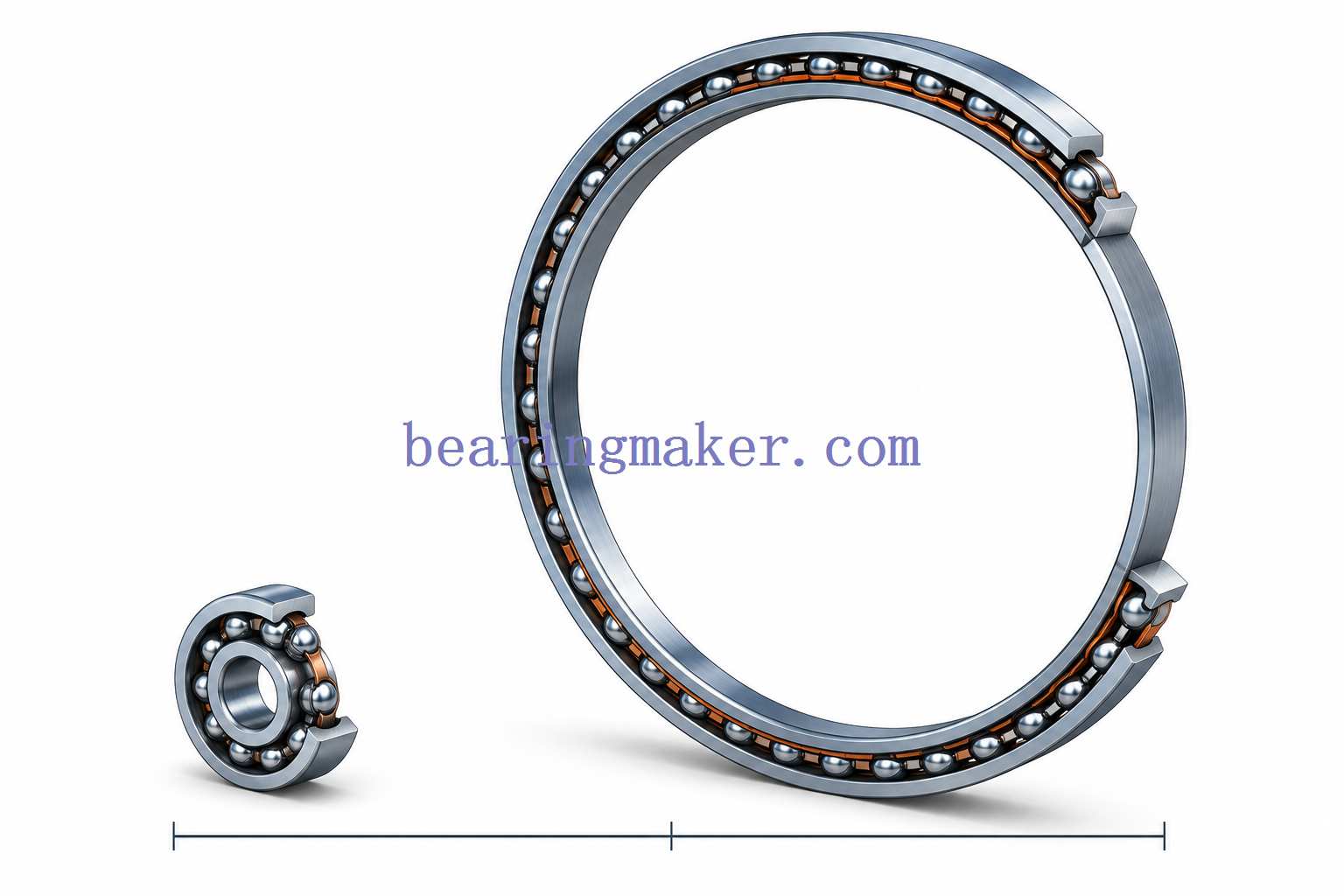
Thin section bearings are often selected because they offer a large bore, compact cross-section, low weight, and precise rotary support.
But once the bearing type and load capacity have been chosen, another set of questions becomes equally important:
- How fast will the bearing rotate?
- What lubricant should be used?
- Should the bearing be open, shielded, or sealed?
- Which bearing material is appropriate for the environment?
- How will temperature affect torque, preload, and service life?
These factors are closely connected.
Higher speed increases:
- rolling-element velocity
- centrifugal forces
- lubricant shear
- cage loading
- heat generation
Adding seals improves contamination protection but usually increases friction.
Using more grease may appear safer, but excessive lubricant can raise torque and temperature.
Changing from bearing steel to stainless steel or hybrid ceramic may improve certain environmental or speed characteristics while introducing different cost, stiffness, corrosion, or impact considerations.
For thin section bearings, these interactions matter even more because the bearings are often:
- relatively large in diameter
- used in low-torque precision systems
- installed in compact housings
- sensitive to temperature-induced changes in clearance and preload
This guide explains how to evaluate thin section bearing speed, lubrication, seals, materials, temperature, and environmental requirements as one integrated operating system.
Why Operating Conditions Matter
A bearing can have sufficient load capacity and still fail to perform properly if the operating environment is wrong.
Typical problems include:
- excessive heat
- rising running torque
- lubricant breakdown
- seal wear
- corrosion
- cage damage
- ball skidding
- contamination damage
- shortened fatigue life
The catalog load rating therefore answers only part of the selection problem.
A reliable thin section bearing must also operate within acceptable limits for:
- speed
- temperature
- lubrication
- contamination
- material compatibility
What Limits Thin Section Bearing Speed?
Bearing speed is not limited by one single factor.
The practical speed limit is influenced by:
- bearing diameter
- ball size
- cage design
- internal clearance
- preload
- contact angle
- lubrication
- seals
- operating temperature
- load
The same bearing may have very different usable speeds depending on how it is installed and lubricated.
Why RPM Alone Can Be Misleading
A common mistake is to compare bearings only by shaft RPM.
Consider two bearings:
- one with a small mean diameter
- one with a very large mean diameter
If both rotate at 1,000 rpm, the larger bearing has much greater circumferential speed at the rolling-element path.
This means the internal rolling elements, cage, and lubricant experience very different conditions.
For thin section bearings, this is especially important because a bearing can have:
- a very large bore
- a relatively large pitch diameter
while still appearing mechanically “thin.”

Mean Bearing Diameter
Bearing speed is often evaluated using a mean diameter rather than bore size alone.
A simplified mean diameter can be expressed as:
dm=d+D2d_m = \frac{d + D}{2}
where:
- dmd_m = mean bearing diameter
- dd = bore diameter
- DD = outside diameter
This provides a useful representation of the approximate rolling-element path diameter.
DN and nDm Concepts
Bearing speed discussions often use a speed factor based on:
- rotational speed
- bearing diameter
A common form is:
n×dmn \times d_m
where:
- nn = rotational speed in rpm
- dmd_m = mean bearing diameter
This is useful because it distinguishes between:
- a small bearing at high rpm
- a large bearing at the same rpm
However, no single nDm limit applies to all thin section bearings.
Allowable values depend on:
- internal design
- cage
- lubricant
- preload
- seals
- temperature
It should therefore be used as a comparison and selection tool rather than a universal speed limit.
Large Diameter Changes the Speed Problem
Thin section bearings often operate at relatively modest shaft speeds.
But a large bearing diameter can still produce:
- high ball orbital speed
- significant cage velocity
- lubricant churning
- centrifugal force
This means a large rotary table running at several hundred rpm may require more careful lubrication analysis than a small bearing running at a numerically higher rpm.
Centrifugal Force
As rotational speed increases, centrifugal forces acting on the rolling elements increase.
This can affect:
- ball-to-raceway contact
- internal load distribution
- cage forces
The effect becomes more important with:
- large bearing diameters
- high shaft speed
- heavy rolling elements
Why Low Rolling-Element Mass Can Help
Reducing rolling-element mass reduces centrifugal force.
This is one reason hybrid ceramic bearings may be considered in selected high-speed applications.
Ceramic balls can be lower in density than steel balls, reducing centrifugal loading.
However, material selection should never be based on this one advantage alone.
Cage Loading at High Speed
The cage keeps the rolling elements:
- separated
- guided
- correctly spaced
At higher speeds, cage behavior becomes increasingly important.
The cage may experience:
- inertial forces
- sliding contact
- lubricant drag
- acceleration and deceleration forces
Repeated rapid reversals may be especially demanding.
High-Speed Reversing Motion
Some thin section bearing applications do not simply rotate continuously.
Robot joints and positioning systems may:
- accelerate rapidly
- stop
- reverse
- repeat
In these systems, peak cage and rolling-element dynamics may matter as much as steady-state RPM.
The operating profile should therefore include:
- maximum speed
- acceleration
- deceleration
- reversing frequency
Speed and Contact Type
Different thin section bearing contact geometries have different speed characteristics.
Radial Contact Bearings
Radial contact designs generally favor:
- lower friction
- relatively high speed
when radial load dominates.
Angular Contact Bearings
Angular contact bearings can also support high speed, especially when properly lubricated and preloaded.
However, higher preload increases:
- torque
- heat
which can reduce practical speed capability.
Four-Point Contact Bearings
Four-point contact bearings are often selected for:
- combined loads
- moment loads
- compact arrangements
rather than maximum speed.
Their internal contact geometry may produce more friction than a pure radial-contact design.
Speed and Preload
Preload improves stiffness but increases rolling-element contact forces.
As speed rises, preload can contribute to:
- greater friction
- higher temperature
- lubricant stress
A preload that works well at low speed may generate excessive heat at high speed.
Thermal Preload at Speed
Operating speed creates heat.
As temperature rises:
- shaft expands
- bearing rings expand
- housing expands
If these components expand differently, internal clearance may decrease.
A bearing that begins with moderate preload may become more heavily preloaded during operation.
This can create a feedback loop:
higher speed → more heat → more preload → more friction → more heat
Preventing this thermal escalation is an important part of precision bearing design.

Bearing Heat Generation
Heat is produced by several mechanisms, including:
- rolling contact
- sliding contact
- lubricant shear
- seal friction
- cage contact
At low speed, these effects may be minor.
At higher speed, they can become the dominant limitation.
Why Temperature Monitoring Matters
A bearing does not need to reach an extreme temperature before performance becomes unacceptable.
Even moderate temperature increase may change:
- lubricant viscosity
- preload
- runout
- system accuracy
In precision applications, thermal drift may matter before material damage occurs.
Lubrication: Why It Is Essential
Rolling bearings are often described as low-friction components, but their contacts still require lubrication.
Lubrication helps:
- separate rolling surfaces
- reduce wear
- reduce friction
- control temperature
- protect against corrosion
- reduce noise
Without adequate lubrication, rolling-element contacts can experience:
- metal-to-metal interaction
- surface distress
- smearing
- premature fatigue
Main Lubrication Methods
Thin section bearings commonly use:
- grease
- oil
- specialized low-torque lubricants
The correct method depends on:
- speed
- load
- temperature
- maintenance
- contamination
- torque requirement
Grease Lubrication
Grease is widely used because it combines lubricant with a thickener that helps keep it in place.
Advantages include:
- simple application
- low leakage
- good contamination barrier
- low maintenance
- compact system design
This makes grease common in:
- robotics
- medical equipment
- optical systems
- general automation
Grease Limitations
Grease can become problematic when:
- speed is very high
- operating temperature is high
- heat removal is important
- extremely low running torque is required
Oil Lubrication
Oil may be preferred when:
- rotational speed is high
- heat must be removed
- the machine already uses circulating oil
- relubrication must be continuous
Oil can be supplied through systems such as:
- oil bath
- circulation
- jet
- oil-air
depending on machine design.
Oil as a Cooling Medium
One major advantage of circulating oil is that it can transport heat away from the bearing.
This can make oil attractive in high-speed or high-temperature systems.
Oil Limitations
Oil systems can require:
- pumps
- seals
- reservoirs
- filtration
- additional maintenance
For compact equipment, this complexity may not be justified.
Grease vs. Oil
| Factor | Grease | Oil |
|---|---|---|
| System simplicity | High | Lower |
| Leakage control | Good | More demanding |
| Maintenance | Low | Higher |
| High-speed capability | Good–Moderate | Generally better |
| Heat removal | Limited | Good |
| Contamination protection | Good | Depends on system |
| Compact equipment | Excellent | More complex |
| Precision low-maintenance system | Often good | Application-dependent |
Lubricant Viscosity
Viscosity affects the thickness of the lubricating film.
If viscosity is too low:
- lubricant film may be insufficient
- surface contact increases
If viscosity is too high:
- drag increases
- heat generation increases
The correct viscosity depends on:
- bearing size
- speed
- operating temperature
- load
Why Operating Temperature Matters for Viscosity
Lubricant viscosity generally decreases as temperature rises.
A lubricant that is suitable at room temperature may become much thinner during operation.
Lubrication should therefore be evaluated at the expected bearing operating temperature, not just ambient temperature.
Overlubrication
A common mistake is to assume:
More grease provides more protection.
In many bearing applications, excessive grease creates problems.
It can cause:
- churning
- drag
- high running torque
- heat generation
This is especially noticeable in thin section bearings used in low-torque precision systems.
Why Thin Section Bearings Can Be Sensitive to Grease Quantity
Many thin section systems have:
- low motor torque
- precision positioning requirements
- large bearing circumference
Small increases in grease drag can therefore become noticeable in system performance.
Underlubrication
Too little lubricant can cause:
- surface wear
- higher friction
- increased noise
- shorter life
The objective is not minimum lubricant.
It is the correct lubricant quantity for the operating condition.
Lubricant Distribution
Lubricant must reach the actual contact zones.
In slow or oscillating applications, lubricant may not redistribute as easily as in continuously rotating bearings.
This is important in:
- gimbals
- robotic pivots
- scanning systems
Oscillating Motion
Small repeated oscillations can create challenging lubrication conditions because rolling elements repeatedly travel over the same limited raceway region.
Potential issues include:
- localized wear
- fretting
- false brinelling
Lubrication strategy should therefore reflect the actual motion pattern.
Relubrication
Some thin section bearings are lubricated for long-term service.
Others require periodic relubrication.
Relubrication intervals depend on:
- speed
- temperature
- contamination
- bearing size
- lubricant type
- operating hours
There is no universal interval appropriate for every application.
Why Over-Relubrication Can Be Harmful
Adding grease too frequently may gradually fill the available free space.
This can increase:
- churning
- temperature
- seal pressure
A relubrication plan should therefore specify both:
- interval
- quantity
Low-Torque Lubricants
Some precision applications require extremely low rotational resistance.
Examples include:
- optical gimbals
- sensitive instruments
- tracking systems
In these systems, lubricant selection may prioritize:
- low starting torque
- low viscous drag
- stable behavior across temperature
Lubrication and Noise
Lubrication can influence bearing noise.
Poor lubricant condition may increase:
- vibration
- rolling noise
But excessive or inconsistent grease distribution can also create torque variation.
Open, Shielded, and Sealed Bearings
Bearing closures determine how much protection exists between the internal rolling contacts and the environment.
The three broad configurations are:
- open
- shielded
- sealed
Open Thin Section Bearings
Open bearings have no integral shield or contact seal.
Advantages include:
- minimal closure friction
- high speed potential
- easier lubricant circulation
They are well suited to controlled environments where external contamination protection already exists.
Open Bearing Limitations
Open bearings provide little protection from:
- dust
- moisture
- debris
They may require external sealing or a clean enclosure.
Shielded Thin Section Bearings
Shielded bearings use non-contact or very low-contact closures, often metallic.
Their main purpose is to reduce entry of larger contaminants while keeping friction relatively low.
Advantages include:
- low drag
- better contamination protection than open bearings
- good speed capability
Shield Limitations
Shields do not provide the same level of protection as contact seals.
Fine particles or moisture may still enter depending on the design.
Sealed Thin Section Bearings
Sealed bearings use contact or low-contact sealing elements.
They provide stronger protection from:
- dust
- debris
- moisture
This can be valuable in:
- robotics
- industrial automation
- outdoor equipment
- medical machinery
Seal Trade-Off
Better sealing usually increases:
- friction
- starting torque
- heat
The selection therefore becomes:
protection vs. drag
Seal Drag in Precision Systems
In very low-torque systems, seal friction can become a significant portion of total bearing torque.
A sealed bearing may provide excellent contamination protection but still be unsuitable if:
- servo torque is extremely low
- motion must begin smoothly from rest
Open vs. Shielded vs. Sealed
| Configuration | Friction | Contamination Protection | Speed Potential | Typical Use |
|---|---|---|---|---|
| Open | Lowest | Low | Highest | Clean enclosed systems |
| Shielded | Low | Moderate | High | Light contamination |
| Low-contact sealed | Moderate | High | Moderate–High | Precision systems needing protection |
| Contact sealed | Higher | Very high | Lower | Contaminated environments |
These are qualitative comparisons.
External Sealing
Sometimes the best solution is not an integral bearing seal.
The machine may use external:
- labyrinths
- covers
- rotary seals
This allows the bearing itself to remain low-friction.
External sealing can be valuable in large thin section bearing systems where seal drag across a large diameter would otherwise become significant.

Contamination and Bearing Life
Contamination can reduce bearing life dramatically.
Hard particles can indent:
- balls
- raceways
These indentations create local stress concentrations.
Possible consequences include:
- increased vibration
- spalling
- reduced fatigue life
Moisture
Water can cause:
- corrosion
- lubricant degradation
Even small corrosion pits can later become fatigue initiation points.
Material Selection
Material selection should be based on the complete operating environment.
Common bearing material options include:
- bearing steel
- stainless steel
- hybrid ceramic constructions
- specialized materials for unusual environments
Bearing Steel
Hardened bearing steel is the standard choice for many thin section bearings.
Its main advantages include:
- high hardness
- excellent rolling-contact fatigue resistance
- good wear resistance
- good dimensional stability
It is usually a strong choice when:
- corrosion is controlled
- load capacity matters
- conventional operating temperatures are expected
Limitations of Bearing Steel
Standard bearing steels generally require protection from:
- moisture
- corrosive chemicals
If corrosion risk is significant, another material may be preferable.
Stainless Steel
Stainless steel may be selected when corrosion resistance is important.
Possible applications include:
- medical equipment
- food-processing machinery
- humid environments
- washdown systems
- outdoor mechanisms
Not All Stainless Steels Are the Same
Different stainless bearing materials provide different balances of:
- corrosion resistance
- hardness
- load capacity
- fatigue resistance
A more corrosion-resistant material may not always provide the same mechanical performance as a harder bearing steel.
Corrosion Resistance vs. Load Capacity
Material selection often involves a trade-off.
The environment may favor corrosion resistance, while the mechanical load favors higher hardness.
The correct choice should evaluate both.
Hybrid Ceramic Thin Section Bearings
Hybrid bearings typically use:
- ceramic balls
- metallic bearing rings
This construction may provide benefits in selected applications.
Lower Rolling-Element Mass
Ceramic rolling elements can have lower density than steel balls.
This reduces centrifugal forces at high speed.
Potential benefits include:
- lower ball inertial load
- reduced cage loading
Electrical Insulation
Ceramic balls are electrically insulating.
Hybrid bearings may therefore help interrupt current paths through the bearing.
This can be useful in electrically sensitive equipment.
High Hardness
Ceramic rolling elements can provide very high hardness and wear resistance.
However, hardness alone does not mean they are ideal for all machines.
Hybrid Ceramic Limitations
Potential considerations include:
- higher cost
- different impact behavior
- different contact characteristics
Hybrid ceramic should be selected because the application benefits from its properties, not simply because it appears more advanced.
Full Ceramic Bearings
Some specialized applications may use ceramic materials for both rings and rolling elements.
Potential benefits can include:
- corrosion resistance
- electrical insulation
- non-magnetic behavior
However, full ceramic designs have different:
- toughness
- stiffness
- impact behavior
and are generally reserved for specialized conditions.
Material Comparison
| Material | Load Capability | Corrosion Resistance | Weight | Electrical Insulation | Typical Use |
|---|---|---|---|---|---|
| Bearing steel | High | Low | High | No | General precision machinery |
| Stainless steel | Moderate–High | High | High | No | Corrosive environments |
| Hybrid ceramic | High | Depends on rings | Lower rolling-element mass | Yes through balls | High-speed/electrical applications |
| Full ceramic | Application-dependent | Very high | Lower | Yes | Specialized environments |
Material and Temperature
Bearing material must remain dimensionally and mechanically stable across the expected temperature range.
High temperature can affect:
- hardness
- dimensional stability
- lubricant
- cage
- seals
The usable bearing temperature is therefore limited by the complete assembly, not just the ring material.
Cage Material
The cage may use:
- metal
- polymer
- other engineered materials
Cage choice can affect:
- speed
- friction
- weight
- temperature capability
Polymer Cages
Potential advantages include:
- low mass
- low friction
- quiet operation
Potential limitations can include:
- temperature
- chemical compatibility
Metal Cages
Metal cages can provide:
- temperature resistance
- structural robustness
but may have greater mass.
Seal Material
Seal material must also match:
- temperature
- chemicals
- lubricant
A bearing ring material may survive the environment while the seal fails.
Temperature: A System-Level Requirement
Temperature affects nearly every part of bearing performance.
It changes:
- lubricant viscosity
- fits
- preload
- seals
- cage properties
- housing geometry
High Temperature
At higher temperature:
- lubricant becomes thinner
- grease may degrade faster
- seals may soften
- thermal expansion changes clearance
Low Temperature
At low temperature:
- lubricant viscosity increases
- starting torque may rise
- seals may stiffen
Low-temperature behavior is especially important in:
- aerospace
- outdoor equipment
- cold-start precision systems
Thermal Cycling
Some machines repeatedly cycle between hot and cold conditions.
This can create repeated changes in:
- fit
- preload
- torque
Thin section bearings may be especially sensitive because the rings respond strongly to mating-component dimensions.
Vacuum Applications
Vacuum environments create special lubrication challenges.
Conventional lubricants may:
- outgas
- evaporate
- contaminate nearby sensitive surfaces
Applications such as:
- semiconductor equipment
- optical systems
may require specialized low-outgassing lubrication and suitable materials.
Cleanroom Applications
Clean environments may prioritize:
- low particle generation
- lubricant retention
- low wear
Seal, cage, and lubricant selection all contribute.
Corrosive Environments
In corrosive environments, bearing material should be selected together with:
- seals
- lubricant
- housing material
A corrosion-resistant bearing ring alone does not protect the complete system.
Electrical Environments
Electrical current passing through rolling bearings can damage raceways.
Possible damage includes:
- pitting
- fluting
Hybrid ceramic rolling elements may be considered where electrical insulation is needed.
Other system-level electrical isolation methods may also be used.
Material and Magnetic Requirements
Some specialized systems may require:
- low magnetic response
- non-magnetic materials
Material selection should then consider the entire bearing assembly, including:
- rings
- balls
- cage
- seals
Speed, Lubrication, Seal, and Material Interactions
These parameters should not be selected independently.
For example:
High Speed + Heavy Contact Seal
may create excessive:
- friction
- heat
High Speed + Excess Grease
may create:
- lubricant churning
- thermal rise
Stainless Steel + Corrosive Environment
may improve corrosion resistance, but the lubricant and seals must also tolerate the environment.
Hybrid Ceramic + High Speed
may reduce rolling-element centrifugal force, but preload and lubrication still need to be correct.
Practical Selection by Operating Condition
| Operating Priority | Common Direction |
|---|---|
| Highest speed | Low-friction ball design + suitable lubrication |
| Low running torque | Open/low-contact closure + controlled lubricant |
| Dirty environment | Sealed or externally protected design |
| High humidity | Corrosion-resistant material + appropriate sealing |
| High heat | Temperature-compatible material, cage, seal, lubricant |
| Vacuum | Low-outgassing lubricant/material system |
| Electrical isolation | Hybrid ceramic may be considered |
| Low-temperature startup | Low-temperature lubricant + compatible seals |
| Cleanroom | Low-particle materials and controlled lubrication |
Selecting Thin Section Bearings for High Speed
A useful high-speed design process includes:
- determine maximum and continuous RPM
- calculate or consider mean diameter
- evaluate nDm
- check bearing contact type
- evaluate preload
- select cage
- select lubricant
- evaluate seal drag
- estimate heat generation
- validate steady-state temperature
Selecting Lubrication
A practical lubrication process should consider:
- speed
- load
- temperature
- motion type
- maintenance interval
- torque requirement
- contamination
- environment
Then choose:
- grease
- oil
- specialized lubricant
Selecting Sealing
Ask:
- Is the environment clean?
- Is dust present?
- Is moisture present?
- Is very low torque required?
- Can the machine provide external sealing?
The strongest seal is not automatically the best seal.
Selecting Material
Material selection should consider:
- load
- corrosion
- speed
- electrical environment
- temperature
- weight
- cost
Speed and Operating Condition Selection Workflow
Step 1: Define Motion Profile
Specify:
- continuous speed
- peak speed
- acceleration
- reversing frequency
Step 2: Calculate Mean Diameter
Use bearing geometry to estimate internal speed condition.
Step 3: Evaluate Contact Type
Determine whether the bearing architecture supports the required speed.
Step 4: Define Preload
Minimize unnecessary preload where speed and low torque are important.
Step 5: Select Lubrication Method
Choose grease or oil based on:
- speed
- heat
- maintenance
Step 6: Select Lubricant Properties
Consider:
- viscosity
- temperature range
- torque
- environmental compatibility
Step 7: Select Closure Type
Choose:
- open
- shielded
- low-contact seal
- contact seal
- external sealing
Step 8: Select Bearing Material
Choose based on:
- load
- corrosion
- electrical requirements
- speed
Step 9: Check Cage and Seal Materials
Make sure non-metal components tolerate:
- temperature
- lubricant
- chemicals
Step 10: Evaluate Thermal Expansion
Check how temperature affects:
- fit
- clearance
- preload
Step 11: Validate Running Torque
Confirm that:
- lubricant
- seal
- preload
remain within the drive-system torque budget.
Step 12: Validate Operating Temperature
Test or model the complete system under realistic duty conditions.

Common Design Mistakes
Mistake 1: Using RPM Alone to Judge Speed
Large-diameter thin section bearings can have high internal rolling-element velocity at moderate RPM.
Mistake 2: Assuming More Grease Is Better
Excess grease can increase:
- drag
- heat
- torque
Mistake 3: Selecting the Strongest Seal Automatically
A heavy contact seal may create unnecessary friction.
Mistake 4: Ignoring Seal Torque
In low-power systems, seal drag can be significant.
Mistake 5: Choosing Stainless Steel Only Because It “Doesn’t Rust”
Different stainless materials provide different mechanical properties.
Mistake 6: Choosing Ceramic Because It Is “Higher Performance”
Hybrid ceramic is useful only when its specific properties benefit the application.
Mistake 7: Ignoring Temperature-Dependent Viscosity
Lubricant behavior at operating temperature matters more than room-temperature behavior.
Mistake 8: Ignoring Thermal Preload
Speed-generated heat can change fits and increase preload.
Mistake 9: Ignoring Cage Material
Cage performance can limit:
- speed
- temperature
Mistake 10: Treating the Bearing as the Only Contamination Barrier
External machine sealing may provide a better low-friction solution.
Troubleshooting High Operating Temperature
Possible causes include:
- excessive preload
- lubricant viscosity too high
- excessive grease
- seal friction
- excessive speed
- inadequate cooling
Troubleshooting High Starting Torque
Possible causes include:
- cold lubricant
- contact seals
- excessive preload
- overgreasing
Troubleshooting Rising Torque at Speed
Possible causes include:
- thermal preload
- lubricant churning
- seal heating
- insufficient thermal dissipation
Troubleshooting Premature Lubricant Failure
Possible causes include:
- high temperature
- contamination
- incompatible lubricant
- excessive relubrication interval
Troubleshooting Corrosion
Check:
- bearing material
- seal effectiveness
- moisture ingress
- lubricant corrosion protection
- housing drainage
Frequently Asked Questions
How Fast Can a Thin Section Bearing Run?
There is no single universal RPM limit.
Speed capability depends on:
- bearing diameter
- contact type
- preload
- cage
- lubricant
- seals
- temperature
Why Is RPM Not Enough to Determine Bearing Speed?
Because a larger bearing has greater circumferential rolling-element speed at the same RPM.
Mean diameter should also be considered.
What Is nDm?
nDm is a speed factor combining:
- shaft RPM
- mean bearing diameter
It helps compare internal speed conditions among different bearing sizes.
Are Thin Section Bearings Suitable for High Speed?
Yes, many thin section ball bearings can operate at high speed.
However, large diameter, preload, lubrication, and seals must be considered.
Is Grease or Oil Better?
Neither is universally better.
Grease is simpler and lower-maintenance.
Oil is often more suitable where:
- speed is high
- heat removal is important
Can Too Much Grease Damage a Bearing?
Excess grease can increase:
- churning
- heat
- torque
which may shorten lubricant and bearing life.
Are Sealed Thin Section Bearings Slower?
Seals generally add some friction.
Contact seals usually create more drag than open or shielded designs.
What Is the Difference Between a Shield and a Seal?
A shield provides low-friction contamination protection without strong contact.
A seal generally provides stronger contamination protection but with more friction.
Which Bearing Material Is Best?
There is no universal best material.
Bearing steel is common for general performance.
Stainless steel is useful where corrosion resistance matters.
Hybrid ceramic may be useful in selected high-speed or electrical applications.
Are Ceramic Bearings Always Better?
No.
Ceramic rolling elements offer specific advantages but also increase cost and may behave differently under impact.
Can Stainless Steel Bearings Handle the Same Load as Bearing Steel?
It depends on the specific stainless material and heat treatment.
Corrosion resistance and mechanical performance should both be evaluated.
Why Does My Bearing Run Hot at High Speed?
Possible causes include:
- preload
- lubricant churning
- seal drag
- thermal expansion
- excessive speed
Can Temperature Change Bearing Preload?
Yes.
Differential expansion of:
- shaft
- bearing rings
- housing
can change internal clearance and preload.
What Bearing Type Is Best for Low Torque?
Radial or angular-contact thin section ball bearings with:
- low preload
- low-friction lubricant
- open or low-contact closure
are common starting points.
What Should Be Used in a Dirty Environment?
A sealed bearing or an externally protected bearing system may be appropriate.
The best choice depends on:
- contamination level
- torque requirement
- speed
What Should Be Used in a Vacuum?
Vacuum applications may require:
- low-outgassing lubricant
- compatible materials
- controlled contamination
Operating Condition Selection Checklist
Before finalizing a thin section bearing, define:
| Parameter | What to Determine |
|---|---|
| Continuous speed | rpm |
| Peak speed | rpm |
| Mean diameter | mm or in |
| nDm | Operating speed factor |
| Acceleration | Normal and peak |
| Reversing motion | Frequency |
| Preload | Required amount |
| Running torque | Maximum acceptable |
| Starting torque | Maximum acceptable |
| Lubrication | Grease/oil/special |
| Lubricant viscosity | At operating temperature |
| Lubricant quantity | Controlled fill |
| Relubrication | Interval and quantity |
| Seal type | Open/shielded/sealed |
| External sealing | Required or not |
| Bearing material | Steel/stainless/hybrid/etc. |
| Cage material | Temperature/speed compatible |
| Seal material | Chemical/temperature compatible |
| Operating temperature | Minimum/normal/maximum |
| Thermal expansion | Effect on fit/preload |
| Contamination | Dust/particles |
| Moisture | Expected exposure |
| Corrosion | Required resistance |
| Electrical current | Isolation needed? |
| Vacuum/cleanroom | Special requirements |
| Cooling | Natural/forced/oil circulation |
Conclusion
Speed, lubrication, sealing, and material selection should not be treated as separate afterthoughts in thin section bearing design.
They interact directly.
Higher speed increases:
- rolling-element velocity
- friction
- heat
Lubrication controls friction and wear but can also add drag.
Seals protect the bearing but may increase:
- starting torque
- running torque
- temperature
Materials can improve corrosion resistance, reduce rolling-element mass, or provide electrical insulation, but every material introduces its own trade-offs.
Thin section bearings require particular attention because their large diameter and compact geometry can create demanding internal speed conditions even at moderate RPM.
Their relatively flexible rings also make them sensitive to thermal changes in:
- fit
- clearance
- preload
The most reliable operating-condition selection process is therefore:
Speed Profile → Mean Diameter → Contact Type → Preload → Lubrication → Sealing → Material → Cage and Seal Compatibility → Temperature → Thermal Expansion → Torque → Final Validation
The goal is not simply to choose the highest-speed bearing, the strongest seal, or the most advanced material.
The goal is to create a bearing system that maintains:
- acceptable torque
- stable temperature
- adequate lubrication
- contamination protection
- material compatibility
- reliable service life
throughout the actual operating environment of the machine.