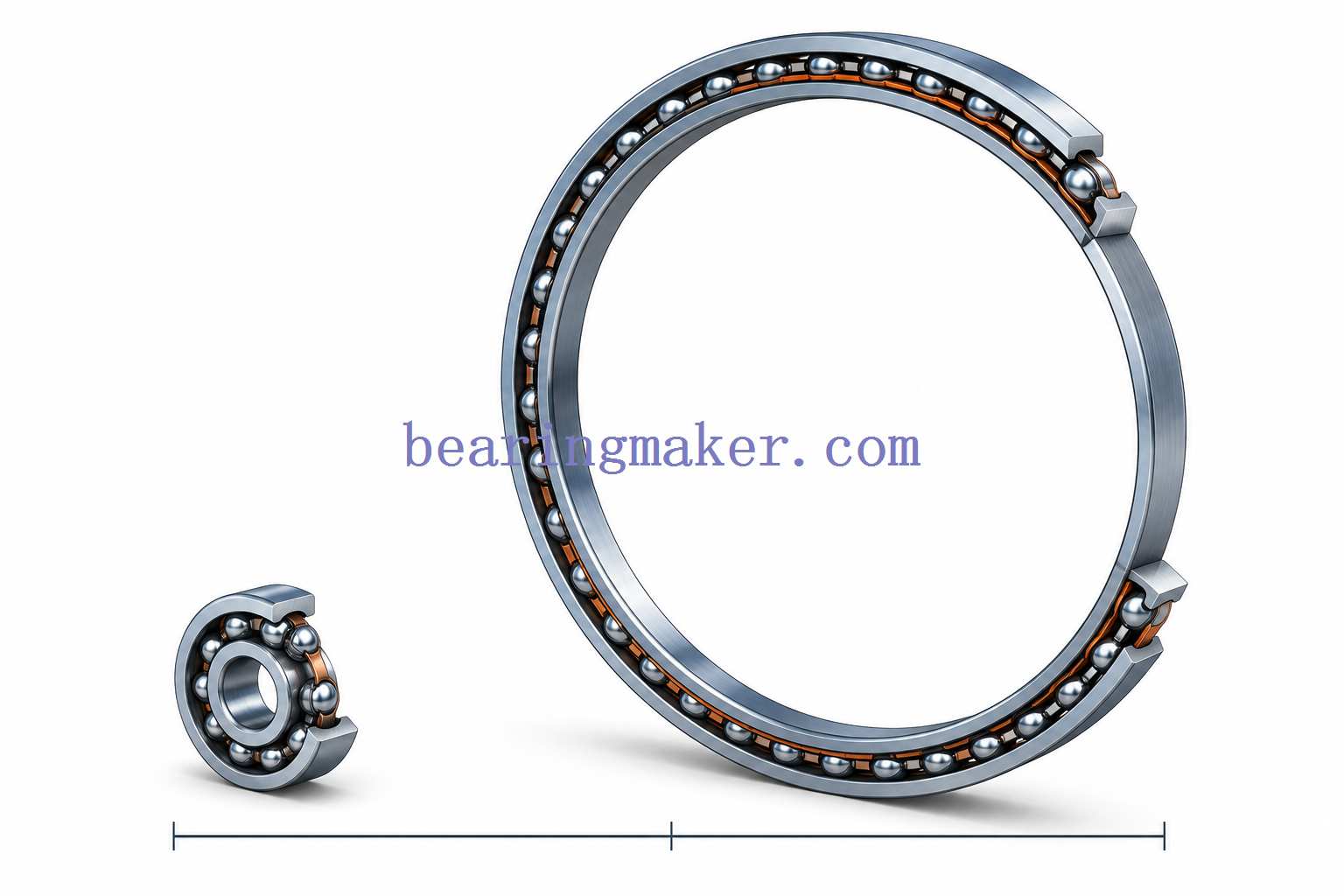
Thin section bearings are used in applications where conventional bearing arrangements create too much size, weight, or structural complexity.
Their main advantage is not simply that they are thin.
It is that they allow engineers to combine:
- a large bore
- small radial cross-section
- low weight
- low rotational inertia
- precise rotary support
within a compact mechanical package.
That combination makes thin section bearings particularly valuable in:
- robotics
- medical equipment
- aerospace mechanisms
- optical systems
- semiconductor equipment
- precision automation
- rotary stages
- gimbals
- antenna systems
- inspection equipment
However, the reason for using a thin section bearing is different in each application.
A robot designer may prioritize:
- hollow cable routing
- low inertia
- moment stiffness
A medical equipment designer may prioritize:
- quiet operation
- smooth motion
- corrosion resistance
- cleanliness
An aerospace engineer may care more about:
- mass
- temperature
- vibration
- reliability
An optical system may be dominated by:
- low runout
- low torque
- large clear aperture
For this reason, thin section bearing selection should begin with the application-level design problem, not just the bearing dimensions.
This guide examines the major applications of thin section bearings and explains why they are used, what design priorities dominate in each industry, and what bearing configurations are most commonly considered.
Why Thin Section Bearings Are Used in Precision Machinery
Many precision machines need large rotating structures but have limited space around the rotation axis.
A conventional bearing with the required bore may force the machine to become:
- larger
- heavier
- more complex
Thin section bearings reduce the radial envelope while preserving a large central opening.
This can create room for:
- cables
- optics
- shafts
- hoses
- sensors
- internal drive components
The result is often a more compact system architecture.
Application-Level Benefits
Thin section bearings are particularly attractive when several of the following requirements appear together:
- large hollow bore
- compact outer diameter
- low moving mass
- low inertia
- precision rotation
- limited radial space
- combined loads
- moment loads
- integrated cable routing
The stronger these constraints become, the more valuable thin section bearing architecture becomes.

Robotics
Robotics is one of the most important application areas for thin section bearings.
Modern robot joints must combine:
- compact dimensions
- high payload
- precise movement
- internal cable routing
- low joint mass
These requirements often conflict with each other.
Thin section bearings help reduce that conflict.
Why Robot Joints Need Large Hollow Bores
A robotic joint often contains more than just a shaft.
The central passage may need to carry:
- motor cables
- encoder wiring
- communication cables
- pneumatic tubes
- cooling lines
- sensor connections
If all these components must route outside the joint, the robot becomes:
- bulkier
- harder to protect
- harder to service
A thin section bearing allows the joint to preserve a relatively large central opening.
Compact Joint Diameter
Using a conventional bearing with the same bore may require a much larger outer diameter.
That can increase:
- joint size
- arm interference
- weight
- housing mass
A thin section bearing can help keep the joint compact.
Low Joint Mass
Bearing weight matters strongly in robots because mass added near the end of an arm affects upstream joints.
Reducing joint mass can lower:
- actuator torque
- energy consumption
- structural load
It can also improve payload efficiency.
Low Rotational Inertia
Robotic joints often:
- accelerate
- decelerate
- reverse direction
Lower rotating inertia reduces the torque required for these movements.
This can improve:
- responsiveness
- servo performance
- cycle time
Moment Load in Robot Joints
Robot joints frequently experience substantial overturning moments.
For example, a payload at the end of a long arm creates a moment at the joint.
The basic relationship is:
M=F×LM = F \times L
where:
- MM = overturning moment
- FF = force
- LL = lever arm
A relatively moderate payload can therefore create a large moment.
Why Joint Stiffness Matters
A bearing may safely carry the load but still deflect too much.
In robotics, small angular deflection at one joint can produce much larger positional error at the end effector.
This means robot joint selection often depends on:
- moment stiffness
- preload
- housing stiffness
as much as fatigue life.

Common Thin Section Bearing Types in Robotics
Typical choices include:
- four-point contact bearings
- angular contact pairs
Four-point contact bearings may be attractive where:
- axial space is limited
- one bearing must support radial, axial, and moment load
Angular contact pairs may be preferred where:
- higher stiffness
- more controlled preload
- precise positioning
are required.
When Crossed Roller Bearings May Be Better
If very high:
- moment stiffness
- radial stiffness
- axial stiffness
dominate the joint design, a crossed roller bearing may be worth considering.
Thin section ball bearings remain attractive where:
- low mass
- low friction
- higher speed
- low inertia
matter more.
Robotics Design Priorities
| Requirement | Importance |
|---|---|
| Hollow bore | Very high |
| Low weight | Very high |
| Moment stiffness | Very high |
| Low inertia | High |
| Speed | High |
| Preload control | High |
| Housing stiffness | Very high |
| Cable routing | Very high |
Medical Equipment
Medical equipment frequently combines:
- compact structure
- precise motion
- low noise
- cleanliness
Thin section bearings can support large rotating structures without requiring excessively large housings.
Medical Imaging Systems
Imaging equipment may require:
- large central openings
- smooth rotation
- precise positioning
Thin section bearings can provide rotary support while leaving space for:
- imaging components
- detectors
- cables
- patient-access geometry
Low Noise
Medical equipment often operates close to patients and staff.
Bearing noise may therefore matter more than in conventional industrial machinery.
Smooth ball-bearing operation can help reduce:
- audible noise
- vibration
Low Torque
Low running torque can help produce:
- smooth motion
- smaller drive requirements
- precise servo control
This is particularly valuable in diagnostic or positioning equipment.
Corrosion Resistance
Some medical equipment may be exposed to:
- cleaning agents
- humidity
- repeated sanitation
Material and sealing may therefore require additional attention.
Possible solutions include:
- corrosion-resistant bearing materials
- appropriate seals
- compatible lubricants
Cleanliness
Medical and laboratory environments may require:
- low lubricant leakage
- controlled contamination
- low particle generation
This can influence:
- seal type
- grease selection
- cage material
Medical Robotics
Medical robots may combine the requirements of:
- robotics
- medical equipment
They may need:
- compact joints
- low mass
- high precision
- low noise
- cleanliness
Thin section bearings can be useful where several of these requirements occur simultaneously.

Medical Application Priorities
| Requirement | Importance |
|---|---|
| Smooth motion | Very high |
| Low noise | Very high |
| Precision | Very high |
| Cleanliness | High |
| Corrosion resistance | Application-dependent |
| Low torque | High |
| Compact geometry | Very high |
| Hollow bore | High |
Aerospace Applications
Aerospace mechanisms often operate under demanding conditions where:
- mass
- reliability
- temperature
- vibration
are critical.
Thin section bearings can offer major system-level benefits because they reduce both:
- bearing weight
- structural volume
Why Weight Matters So Much
In aerospace systems, reducing mass can affect:
- fuel consumption
- payload capacity
- launch cost
- actuator size
A lighter bearing can therefore create value far beyond the component itself.
Gimbals
Aerospace gimbals may support:
- sensors
- cameras
- antennas
- optical equipment
They often require:
- low inertia
- low friction
- precise angular positioning
Thin section bearings are well suited to these requirements.
Antenna Systems
Rotating antenna structures may require:
- large diameter
- central cable routing
- low structural mass
Thin section bearings can provide a compact support around the central passage.
Actuators
Some aerospace actuators need compact rotary support where:
- space is restricted
- weight is tightly controlled
Thin section bearings may allow smaller housings and lighter rotating assemblies.
Vibration and Shock
Aerospace bearings may be exposed to:
- launch vibration
- turbulence
- landing shock
- transport loads
Bearing selection should therefore include:
- dynamic loads
- static safety
- mounting security
not just normal operating load.
Temperature Variation
Aerospace equipment may experience wide temperature ranges.
This can change:
- fits
- preload
- lubricant viscosity
- seal behavior
Thin section bearings can be especially sensitive because the rings respond strongly to shaft and housing dimensional changes.
Lubrication in Aerospace
Lubricant selection may be influenced by:
- low temperature
- high temperature
- vacuum
- long maintenance intervals
The bearing material and lubricant should be selected as a system.
Aerospace Precision
For aerospace optical or navigation systems, the bearing may need to maintain accuracy under:
- thermal cycling
- vibration
- changing orientation
This requires careful control of:
- preload
- housing stiffness
- material expansion

Aerospace Design Priorities
| Requirement | Importance |
|---|---|
| Low weight | Extremely high |
| Low inertia | Very high |
| Reliability | Extremely high |
| Temperature stability | Very high |
| Vibration resistance | Very high |
| Low friction | High |
| Precision | High–Very high |
| Hollow bore | Often high |
Optical Systems
Optical equipment is one of the clearest examples of why a large hollow bore can be more important than maximum load capacity.
A rotating optical system may need a central opening for:
- lenses
- cameras
- laser beams
- detectors
- mirrors
A conventional bearing may block too much of this path.
Large Clear Aperture
Thin section bearings allow the bearing structure to sit around the optical path rather than obstruct it.
This is useful in:
- telescopes
- scanners
- camera gimbals
- optical inspection systems
- tracking equipment
Low Runout
Optical systems are sensitive to geometric errors.
Radial or axial runout can cause:
- image displacement
- focus variation
- optical-axis movement
High bearing precision is therefore important.
But bearing accuracy alone is not enough.
The complete system must control:
- shaft runout
- housing runout
- mounting-face flatness
Low Torque
Optical systems may use small precision motors.
High bearing torque can:
- reduce servo accuracy
- cause stick-slip
- increase motor size
Thin section ball bearings are often attractive because they can provide low rolling friction.
Smooth Torque
Absolute torque is not the only requirement.
Torque variation during one revolution can create:
- servo disturbances
- pointing error
- vibration
Housing distortion, lubricant distribution, and preload should therefore be controlled carefully.
Optical Gimbals
Optical gimbals often combine:
- low inertia
- low friction
- large aperture
- precision
This is a strong application for thin section bearings.
High Moment Loads in Optical Platforms
Not all optical systems are lightly loaded.
Large cameras, lenses, or sensor arrays may create:
- substantial off-axis weight
- overturning moments
If maintaining optical alignment under load is critical, stiffness may become more important than low torque.
In such cases, designers may compare:
- preloaded angular contact thin section bearings
- four-point contact bearings
- crossed roller bearings

Optical Application Priorities
| Requirement | Importance |
|---|---|
| Clear central aperture | Extremely high |
| Low runout | Extremely high |
| Low torque | Very high |
| Smooth torque | Very high |
| Low vibration | Very high |
| Low inertia | High |
| Moment stiffness | Application-dependent |
| Thermal stability | High |
Precision Automation
Precision automation includes a wide range of equipment such as:
- indexing systems
- assembly machines
- inspection equipment
- rotary stages
- metrology systems
These machines often require:
- precise motion
- compact packaging
- repeatability
Rotary Stages
A rotary stage may need:
- large center opening
- low profile
- high positioning accuracy
Thin section bearings can provide compact support around the center.
Indexing Systems
Indexing machinery often:
- accelerates
- stops
- repeats
Low inertia and low torque can improve:
- cycle time
- motor response
Inspection Equipment
Inspection systems may use:
- cameras
- sensors
- optical heads
that need accurate rotary positioning.
Thin section bearings can support large rotating fixtures without creating a bulky assembly.
Repeatability
Automation equipment may perform the same motion thousands or millions of times.
The bearing system must maintain:
- stiffness
- preload
- smooth torque
over repeated cycles.
Precision Automation Design Priorities
| Requirement | Importance |
|---|---|
| Repeatability | Very high |
| Compact geometry | Very high |
| Low torque | High |
| Low inertia | High |
| Runout | Very high |
| Stiffness | High |
| Long service life | Very high |
| Maintenance | High |
Semiconductor Equipment
Semiconductor machinery deserves separate attention because it combines:
- precision
- cleanliness
- thermal stability
at unusually demanding levels.
Wafer Handling
Rotating wafer-handling mechanisms may require:
- smooth motion
- low particle generation
- low vibration
Thin section bearings can reduce mechanism size while maintaining a large internal opening.
Inspection Systems
Semiconductor inspection equipment may use:
- optics
- cameras
- sensors
that require very precise rotary positioning.
Cleanroom Requirements
Bearing systems may need:
- low outgassing
- controlled lubrication
- low particle generation
Seal and lubricant selection become especially important.
Thermal Stability
Even small temperature changes may influence:
- bearing preload
- runout
- stage accuracy
Precision systems may therefore require controlled thermal design.
Vacuum Applications
Some semiconductor processes operate in vacuum.
This may require:
- specialized lubricants
- compatible materials
- low-outgassing components
Conventional grease may not be suitable.
Semiconductor Design Priorities
| Requirement | Importance |
|---|---|
| Precision | Extremely high |
| Repeatability | Extremely high |
| Cleanliness | Extremely high |
| Thermal stability | Extremely high |
| Low particle generation | Extremely high |
| Low runout | Very high |
| Low torque | High |
| Stiffness | Very high |
Rotary Tables
Rotary tables are another important thin section bearing application.
They may be used in:
- manufacturing
- inspection
- automation
- measurement
Why Large Diameter Helps
A large-diameter bearing can provide:
- central workpiece access
- good moment resistance
- stable rotary support
Thin section geometry keeps the overall package compact.
Axial Load
Rotary tables often carry substantial axial load from:
- workpieces
- fixtures
The bearing must support this load while maintaining:
- axial runout
- stiffness
Moment Load
An off-center workpiece creates an overturning moment.
This can become a dominant design factor.
Thin Section vs. Crossed Roller for Rotary Tables
Thin section bearings may be attractive when:
- speed
- low friction
- lower weight
matter.
Crossed roller bearings may be more appropriate when:
- very high stiffness
- very low deflection
dominate.
Gimbals and Stabilized Platforms
Gimbals are widely used in:
- cameras
- aerospace sensors
- radar
- surveillance systems
They need smooth angular movement around one or more axes.
Key Requirements
Typical priorities include:
- low friction
- low inertia
- precision
- central cable passage
Thin section bearings align well with these requirements.
Balance and Torque
A balanced gimbal may operate with very small motor torque.
Bearing drag can therefore become a major part of the total load.
Low-friction lubrication and sealing are especially important.
Antenna and Radar Systems
Large rotating antenna systems may benefit from thin section bearings because they need:
- large diameter
- cable routing
- low structural mass
Slow Speed Does Not Mean Easy Bearing Conditions
Antenna systems often rotate slowly.
But they may experience:
- wind load
- moment load
- outdoor contamination
This shifts design priorities away from speed and toward:
- stiffness
- sealing
- corrosion resistance
Aerospace Antenna Platforms
Aerospace antenna mechanisms may additionally require:
- very low weight
- temperature tolerance
- vibration resistance
Metrology Equipment
Measurement equipment may place extremely strict requirements on:
- runout
- repeatability
- stiffness
The bearing itself may carry only light loads, but even tiny movement can invalidate measurements.
Why Load Capacity May Be Secondary
In metrology, the limiting requirement may be:
- angular displacement
- runout
- torque consistency
rather than fatigue life.
Preload in Metrology
Preload may be used to improve stiffness.
But too much preload can create:
- thermal drift
- high torque
The correct preload must balance:
- rigidity
- stability
Industrial Automation
Not every thin section bearing application is ultra-high precision.
Industrial automation may use them simply to create:
- compact rotary fixtures
- hollow-axis manipulators
- inspection stations
The main advantage may be packaging rather than extreme accuracy.
When Thin Section Bearings Are Especially Valuable
They are particularly useful when the machine needs:
large internal opening + compact external dimensions
This combination is common in:
- rotary tooling
- inspection heads
- cable-fed mechanisms
When Thin Section Bearings May Not Be Necessary
A standard bearing may be better if:
- space is available
- heavy load dominates
- low cost is critical
- large hollow bore provides no benefit
Thin section bearings should not be selected simply because they appear more advanced.
Application Comparison
| Application | Main Reason for Thin Section Bearing | Critical Design Concern |
|---|---|---|
| Robotics | Hollow bore + low weight | Moment stiffness |
| Medical equipment | Compact, smooth, quiet motion | Cleanliness + torque |
| Aerospace | Low mass + compact size | Temperature + vibration |
| Optics | Large aperture + low runout | Torque + precision |
| Semiconductor | Precision + compact geometry | Cleanliness + thermal stability |
| Rotary stages | Large bore + low profile | Runout + stiffness |
| Gimbals | Low inertia + low torque | Smoothness + precision |
| Antennas | Large diameter + cable routing | Moment + environment |
| Metrology | Precision rotary support | Runout + stiffness |
| Automation | Compact packaging | Repeatability |
Choosing Bearing Type by Application
Application alone does not determine the exact bearing type, but it provides a useful starting point.
Radial Contact Bearings
Best suited where:
- radial load dominates
- speed is relatively high
- low friction matters
Possible applications include:
- light optical systems
- instruments
- low-load automation
Angular Contact Bearings
Best suited where:
- axial positioning matters
- combined loads are present
- high stiffness is required
Possible applications include:
- robotics
- precision stages
- rotary tables
- semiconductor equipment
Four-Point Contact Bearings
Best suited where:
- one compact bearing must carry multiple load directions
- axial space is limited
- moment load is significant
Possible applications include:
- robot joints
- gimbals
- antenna systems
- compact rotary mechanisms
Application → Bearing Type Matrix
| Application Condition | Common Starting Point |
|---|---|
| Predominantly radial, high speed | Radial contact |
| High axial positioning accuracy | Angular contact |
| High moment stiffness | Paired angular contact |
| Compact bidirectional combined load | Four-point contact |
| Low friction + low weight | Ball-type thin section |
| Very high rigidity | Consider crossed roller |
| Very low torque | Radial/angular contact with controlled preload |
Design Factor 1: Hollow Bore Requirement
The first application-level question should often be:
What must pass through the center?
Possible requirements include:
- cables
- optics
- fluid lines
- drive shafts
If nothing needs to pass through the center, the packaging advantage of thin section bearings may be less important.
Design Factor 2: Weight
Weight matters especially in:
- robotics
- aerospace
- gimbals
The bearing should be evaluated together with the housing.
A lighter bearing that requires a much heavier housing may not produce the expected system benefit.
Design Factor 3: Inertia
Dynamic systems should evaluate:
- rotating mass
- radius of that mass
Mass farther from the axis contributes more strongly to inertia.
This makes large-diameter bearing design particularly important.
Design Factor 4: Moment Load
Large rotary structures frequently experience off-axis forces.
The design should calculate:
M=F×LM=F\times L
rather than focusing only on radial and axial load.
Design Factor 5: Stiffness
Precision applications should define allowable:
- radial deflection
- axial deflection
- angular deflection
before bearing selection.
Design Factor 6: Torque
Low torque matters strongly in:
- optical systems
- medical equipment
- gimbals
Torque comes from more than rolling contact.
It also includes:
- seals
- lubrication
- preload
- distortion
Design Factor 7: Runout
Runout may dominate in:
- metrology
- semiconductor
- optical systems
System runout includes:
- bearing
- shaft
- housing
- mounting
Design Factor 8: Environment
Different industries introduce different environments.
Robotics
- dust
- repeated motion
- industrial contamination
Medical
- cleaning
- humidity
- low noise
Aerospace
- temperature
- vibration
- low pressure
Semiconductor
- cleanroom
- vacuum
- low particle generation
Bearing material, lubricant, and seals must reflect the environment.
Design Factor 9: Maintenance
Some machines allow easy bearing replacement.
Others may be extremely difficult to service.
Examples include:
- aerospace systems
- sealed medical equipment
- semiconductor machinery
These applications may require greater emphasis on:
- lubricant life
- sealing
- contamination control
Application-Based Selection Workflow
Step 1: Define the System Function
Determine whether the bearing supports:
- joint
- stage
- gimbal
- table
- scanner
Step 2: Define the Hollow-Bore Requirement
Specify the minimum opening required for:
- cables
- optics
- hoses
Step 3: Define Packaging Limits
Determine:
- maximum outside diameter
- maximum bearing width
- total system envelope
Step 4: Calculate Loads
Include:
- radial load
- axial load
- moment load
- shock
Step 5: Define Precision
Specify:
- radial runout
- axial runout
- repeatability
Step 6: Define Stiffness
Determine allowable:
- radial deflection
- axial deflection
- angular tilt
Step 7: Define Motion Profile
Specify:
- speed
- acceleration
- reversing frequency
Step 8: Define Torque Budget
Determine allowable:
- starting torque
- running torque
Step 9: Choose Contact Type
Compare:
- radial contact
- angular contact
- four-point contact
Step 10: Select Preload
Balance:
- stiffness
- torque
- life
Step 11: Evaluate Housing Design
Check:
- roundness
- stiffness
- material
- bolt distortion
Step 12: Select Lubrication and Sealing
Match the environment and motion.
Step 13: Select Material
Consider:
- corrosion
- temperature
- electrical requirements
Step 14: Validate Under Real Operating Conditions
Test or analyze:
- load
- temperature
- speed
- torque
- accuracy
together.

Common Application Selection Mistakes
Mistake 1: Choosing Thin Section Bearings Only to Save Space
If space is not genuinely constrained, a conventional bearing may be simpler.
Mistake 2: Ignoring Moment Load in Robotics
Robot joints often fail stiffness requirements before load-capacity requirements.
Mistake 3: Ignoring Torque in Optical Systems
A bearing can be accurate but still produce too much drag.
Mistake 4: Ignoring Thermal Stability in Semiconductor Equipment
Small temperature changes can alter:
- preload
- runout
Mistake 5: Ignoring Vibration in Aerospace
Normal operating load is not the only condition.
Mistake 6: Selecting Four-Point Contact for Every Compact Application
Four-point contact is versatile but not always the lowest-friction or highest-stiffness solution.
Mistake 7: Selecting by Load Rating Only
Application success may depend more on:
- stiffness
- runout
- torque
Mistake 8: Ignoring Housing Design
Thin rings depend strongly on the supporting structure.
Mistake 9: Treating Precision as Bearing Accuracy Alone
System precision includes:
- shaft
- housing
- assembly
- thermal effects
Mistake 10: Ignoring Maintenance Environment
A bearing that works in a laboratory may not survive a dirty industrial system without suitable protection.
Frequently Asked Questions
Where Are Thin Section Bearings Commonly Used?
They are commonly used in:
- robotics
- medical equipment
- aerospace
- optics
- semiconductor equipment
- precision automation
- rotary tables
- gimbals
Why Are Thin Section Bearings Used in Robotics?
They provide:
- large hollow bore
- low weight
- compact joint size
- low inertia
while supporting precise rotation.
Why Are Thin Section Bearings Used in Medical Equipment?
They can provide:
- compact geometry
- smooth motion
- low noise
- large central openings
Why Are Thin Section Bearings Used in Aerospace?
Their low weight and compact cross-section can help reduce:
- structural mass
- actuator load
while maintaining rotary support.
Why Are Thin Section Bearings Used in Optical Equipment?
Their large central opening can preserve the optical path while providing low-friction rotary support.
Are Thin Section Bearings Suitable for Semiconductor Equipment?
Yes.
They can provide:
- precision
- compact geometry
- large bore
but lubrication, cleanliness, thermal stability, and material selection must be controlled carefully.
Which Thin Section Bearing Is Best for Robotics?
Common options include:
- four-point contact
- paired angular contact
The best choice depends on:
- moment load
- stiffness
- speed
- space
Which Thin Section Bearing Is Best for Optical Gimbals?
Radial or angular contact bearings may be attractive when:
- low torque
- high speed
- smooth motion
are priorities.
Four-point or crossed roller designs may be preferred if moment stiffness dominates.
Can Thin Section Bearings Be Used in Rotary Tables?
Yes.
They are useful when:
- low profile
- large bore
- smooth rotation
are required.
Are Thin Section Bearings Better Than Crossed Roller Bearings for Robotics?
Not universally.
Thin section ball bearings generally favor:
- low weight
- low friction
- higher speed
Crossed roller bearings generally favor:
- high rigidity
- high moment stiffness
Are Thin Section Bearings Suitable for Vacuum?
They can be, but vacuum applications usually require:
- specialized lubricant
- compatible materials
- low outgassing
Are Thin Section Bearings Suitable for High Temperature?
Potentially, but the bearing, cage, seals, lubricant, and mounting fits must all be suitable for the temperature.
Why Is Housing Stiffness Important in Robotics?
A flexible housing can distort the bearing and reduce:
- stiffness
- accuracy
- life
Why Is Low Torque Important in Optical Equipment?
High torque can reduce:
- positioning smoothness
- servo accuracy
and require larger drive motors.
What Is the Biggest Advantage of Thin Section Bearings Across All Applications?
Their strongest common advantage is the ability to combine:
large bore + compact radial section + low weight
in one rotary support.
Application Selection Checklist
Before selecting a thin section bearing for an application, define:
| Parameter | What to Determine |
|---|---|
| Application | Robot, medical, aerospace, optics, etc. |
| Hollow bore | Required opening |
| Radial envelope | Maximum OD |
| Axial space | Maximum width |
| Radial load | Continuous and peak |
| Axial load | Magnitude and direction |
| Moment load | Maximum overturning moment |
| Stiffness | Radial/axial/angular |
| Speed | Continuous and peak |
| Acceleration | Dynamic requirement |
| Inertia | Maximum allowable |
| Starting torque | Drive limit |
| Running torque | Drive limit |
| Radial runout | System requirement |
| Axial runout | System requirement |
| Repeatability | Required level |
| Preload | Required level |
| Housing stiffness | Adequate? |
| Shaft stiffness | Adequate? |
| Temperature | Operating range |
| Lubrication | Grease/oil/special |
| Sealing | Open/shielded/sealed |
| Material | Steel/stainless/hybrid/etc. |
| Contamination | Expected level |
| Corrosion | Expected exposure |
| Vibration | Expected level |
| Shock | Expected level |
| Maintenance | Service accessibility |
Conclusion
Thin section bearings are used across robotics, medical equipment, aerospace, optics, semiconductor machinery, and precision automation because they solve a recurring system-level problem:
how to support a relatively large rotating structure without allowing the bearing to dominate the size and weight of the machine.
Their main advantages include:
- large hollow bore
- compact radial cross-section
- low weight
- low inertia
- precise rotary support
But each industry uses these advantages differently.
In robotics, the priorities may be:
- hollow cable routing
- joint stiffness
- low inertia
In medical equipment:
- smooth motion
- quiet operation
- cleanliness
In aerospace:
- weight
- reliability
- temperature stability
In optical systems:
- large aperture
- low torque
- low runout
In semiconductor and precision automation:
- repeatability
- stiffness
- cleanliness
- thermal stability
The correct bearing therefore depends on the application-level performance target.
A useful selection sequence is:
Application Function → Hollow Bore → Packaging → Loads → Moment → Stiffness → Precision → Speed → Torque → Contact Type → Preload → Housing → Lubrication and Sealing → Material → Environment
The goal is not simply to fit a thin bearing into a compact space.
The goal is to use thin section bearing architecture where its combination of:
- packaging efficiency
- low mass
- low inertia
- precision
creates a meaningful advantage for the complete machine.