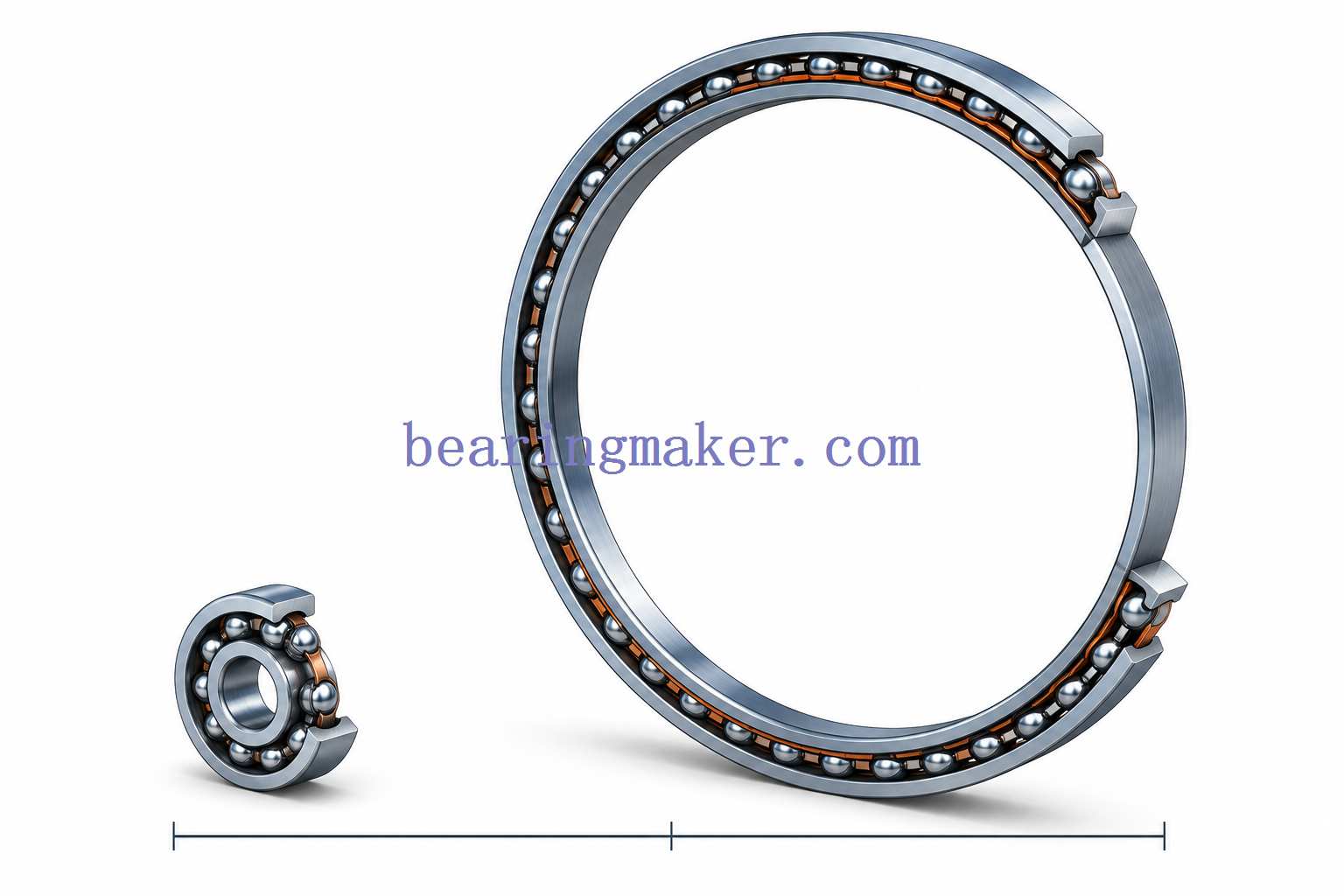
Thin section bearings and crossed roller bearings are both widely used in compact rotary systems where designers need a large bore, small cross-section, and precise motion.
Because they often appear in similar applications—robot joints, rotary tables, optical systems, medical equipment, semiconductor machinery, and precision positioning stages—they are frequently compared directly.
But despite their similar packaging advantages, their internal mechanics are very different.
Thin section ball bearings generally prioritize:
- low friction
- low weight
- higher speed
- low rotational inertia
- smooth motion
Crossed roller bearings generally prioritize:
- high rigidity
- high moment-load capacity
- low elastic deflection
- strong combined-load support
- precise positioning under load
The right choice therefore depends less on bearing diameter and more on the system’s dominant design requirement.
If the application needs fast, lightweight, low-torque rotation, a thin section ball bearing may be the better choice.
If the application needs maximum rigidity and resistance to overturning moment, a crossed roller bearing may be more appropriate.
This guide compares the two bearing architectures in detail and explains how to choose between them based on load, stiffness, speed, friction, precision, weight, installation, and application requirements.
What Is a Thin Section Bearing?
A thin section bearing is a rolling bearing with a relatively small cross-section compared with its bore diameter.
Most thin section bearings use balls as rolling elements.
Common internal configurations include:
- radial contact
- angular contact
- four-point contact
Their primary system-level advantage is the ability to provide:
- a large hollow bore
- compact radial dimensions
- low weight
while still supporting precise rotary motion.
Thin section bearings are commonly selected where the rotating assembly must remain lightweight and compact.
What Is a Crossed Roller Bearing?
A crossed roller bearing uses cylindrical rollers arranged alternately at approximately 90 degrees.
Instead of all rollers carrying load in the same orientation, adjacent rollers face different directions.
This allows one bearing to support:
- radial load
- axial load
- overturning moment
within a compact structure.
Because cylindrical rollers create a larger contact area with the raceways than balls, crossed roller bearings generally offer high rigidity and strong load-carrying capability.
The Fundamental Difference: Ball Contact vs. Roller Contact
The most important mechanical difference between these two bearing types is the rolling-element contact geometry.
Thin section ball bearings use:
balls
Crossed roller bearings use:
cylindrical rollers
This difference changes:
- contact area
- stiffness
- load distribution
- friction
- allowable speed
- deformation under load

Ball Contact
A ball contacts the raceway over a relatively small elliptical area.
This generally results in:
- lower rolling friction
- lower rotational resistance
- better high-speed capability
But the smaller contact area also means:
- lower stiffness
- greater local contact stress under the same load
compared with an appropriately sized roller system.
Roller Contact
A cylindrical roller contacts the raceway over a longer contact zone.
This generally provides:
- higher stiffness
- greater load capacity
- lower elastic deformation
The trade-off is usually:
- higher friction
- lower maximum speed
- greater sensitivity to some mounting conditions
Quick Comparison
| Feature | Thin Section Ball Bearing | Crossed Roller Bearing |
|---|---|---|
| Rolling element | Ball | Cylindrical roller |
| Friction | Lower | Higher |
| Speed capability | Higher | Lower |
| Weight | Lower | Higher |
| Rigidity | Moderate–High depending on arrangement | Very high |
| Moment-load capability | Moderate–High | Very high |
| Elastic deflection | Higher | Lower |
| Combined-load support | Good | Excellent |
| Low torque | Excellent | Moderate |
| Compact cross-section | Excellent | Excellent |
| High-speed robotics | Strong choice | Application-dependent |
| Precision rotary tables | Good | Strong choice |
These are general trends rather than universal limits.
Difference 1: Radial Load Capacity
Both bearing types can carry radial load, but they do so differently.
A thin section ball bearing transfers radial force through ball-to-raceway contact.
A crossed roller bearing distributes radial load through cylindrical rollers.
The larger contact zone of the rollers generally gives crossed roller bearings an advantage in:
- radial stiffness
- load capacity
for a similar package size.
When Thin Section Bearings Are Still Appropriate
If radial load is moderate and the design prioritizes:
- low friction
- speed
- weight
a thin section bearing may still be the more efficient choice.
Maximum load rating is not always the dominant design requirement.
Difference 2: Axial Load Capacity
Both bearing families can support axial load when the internal geometry is appropriate.
Thin section bearings may use:
- angular contact
- four-point contact
to support thrust.
Crossed roller bearings inherently support axial load because alternating rollers are oriented to react loads in different directions.
Bidirectional Axial Load
Four-point contact thin section bearings can support thrust in both axial directions.
Crossed roller bearings can also support bidirectional axial load.
The difference is often not simply:
Can it carry axial load?
but rather:
How much does it deflect while carrying the axial load?
Crossed roller bearings often provide greater axial rigidity.
Difference 3: Moment-Load Capacity
Moment load is one of the most important differences between the two bearing types.
An overturning moment tries to tilt one bearing ring relative to the other.
This is common in:
- robotic arms
- rotary tables
- gimbals
- large camera mounts
- antenna systems
Crossed roller bearings are especially strong in this area.
Why Crossed Rollers Handle Moment Loads Well
The alternating roller orientation allows opposing rollers to create strong resistance against tilting.
The roller contact also provides high stiffness.
As a result, crossed roller bearings are often selected where the machine must maintain position under a substantial overturning moment.
Thin Section Bearings and Moment Load
Thin section bearings can also handle moment loads.
Common options include:
- four-point contact bearings
- back-to-back angular contact pairs
A large bearing diameter creates a useful lever arm for resisting moment.
However, the system may still deflect more than a crossed roller design under the same moment load.

Load Capacity vs. Stiffness
This distinction is critical.
A bearing can safely carry a load without being stiff enough for the machine.
Load capacity answers:
Will the bearing survive the load?
Stiffness answers:
How far will the bearing move under the load?
For precision machinery, the second question may be more important.
Example
Suppose two bearings can both safely support the applied moment.
If one bearing allows more angular movement, the machine may experience:
- positioning error
- optical misalignment
- tool displacement
- robot end-effector error
even though the bearing is not overloaded.
This is why crossed roller bearings are often preferred in high-rigidity systems.
Difference 4: Rigidity
Rigidity is one of the strongest advantages of crossed roller bearings.
The roller geometry typically provides:
- high radial stiffness
- high axial stiffness
- high moment stiffness
Thin section ball bearings can also provide substantial rigidity when:
- properly preloaded
- used in angular-contact pairs
- supported by a rigid housing
but generally do not match the stiffness of a comparable crossed roller bearing optimized for rigidity.
When Rigidity Matters Most
Rigidity is especially important in:
- machine tools
- precision rotary tables
- semiconductor stages
- high-accuracy robots
- metrology equipment
In these applications, elastic displacement can directly reduce machine performance.
Difference 5: Elastic Deflection
Elastic deflection is the temporary deformation that occurs while a load is applied.
Ball bearings tend to deform more at their rolling contacts than roller bearings under comparable conditions.
Crossed roller bearings generally provide lower elastic displacement.
This is valuable when the system requires:
- repeatable position
- accurate angular control
- stable optical alignment
Difference 6: Rotational Friction
Thin section ball bearings usually have the advantage in friction.
Ball contact provides relatively low rolling resistance.
This makes thin section bearings attractive where:
- drive torque is limited
- low friction is important
- smooth motion matters
- energy efficiency matters
Crossed Roller Friction
Crossed roller bearings generally produce higher running resistance because:
- roller contact area is larger
- roller guidance can create additional friction
- preload may be substantial
This does not mean crossed roller bearings are inefficient.
It means low torque is usually not their strongest advantage.
Difference 7: Starting Torque
Starting torque matters in systems that repeatedly begin moving from rest.
Examples include:
- optical gimbals
- scanners
- precision positioning stages
- robotic joints
Thin section ball bearings often provide lower starting torque.
Crossed roller bearings may require more drive torque, particularly when preloaded for maximum rigidity.
Difference 8: Speed Capability
Ball bearings generally perform better at high speed.
Their rolling elements have:
- lower mass
- smaller contact area
- lower rolling resistance
Crossed roller bearings are usually more focused on:
- rigidity
- load
- precision
than on maximum RPM.
Why Bearing Diameter Still Matters
A large thin section bearing at moderate shaft RPM may still experience high internal rolling-element velocity.
Therefore, speed selection should consider:
- RPM
- mean diameter
- lubrication
- preload
- cage design
not RPM alone.
Difference 9: Rotating Mass
Thin section ball bearings are usually lighter.
This can matter significantly when the bearing is part of the moving assembly.
Lower rotating mass can reduce:
- drive torque
- inertia
- acceleration requirements
Crossed Roller Weight
Crossed roller bearings generally contain:
- more rolling-element material
- heavier ring geometry
depending on design.
This may increase system weight.
In stationary industrial machinery, this may be unimportant.
In robot arms or aerospace mechanisms, it can matter greatly.
Difference 10: Rotational Inertia
Weight and inertia are related but not identical.
Mass located farther from the rotation axis contributes more strongly to rotational inertia.
Because many precision bearings are large in diameter, bearing mass near the outside diameter can significantly affect dynamic response.
Thin section bearings can therefore provide an advantage in systems that:
- accelerate rapidly
- reverse frequently
- require responsive servo control
Difference 11: Precision
Both bearing families can provide high rotational accuracy.
But they approach precision differently.
Thin section bearings rely heavily on:
- precise raceways
- controlled preload
- housing accuracy
Crossed roller bearings combine precision with high structural stiffness.
This can help preserve positioning accuracy under load.
No-Load Accuracy vs. Loaded Accuracy
A rotary system may show excellent runout with no external load.
Once a moment or axial load is applied, the bearing deflects.
Crossed roller bearings often maintain better positional stability under load because of their greater stiffness.
This distinction is very important in:
- metrology
- optics
- robotics
Difference 12: Preload
Both bearing types may use preload.
Preload reduces internal play and improves stiffness.
Thin Section Bearing Preload
Preload is common in:
- angular contact pairs
- four-point contact bearings
It can improve:
- axial stiffness
- moment stiffness
- repeatability
But excessive preload increases:
- friction
- heat
- contact stress
Crossed Roller Bearing Preload
Crossed roller bearings are often designed or adjusted with low internal clearance or preload to maximize rigidity.
This helps achieve:
- minimal play
- high positional stability
The trade-off is increased torque and sensitivity to mounting distortion.
Difference 13: Housing Requirements
Both bearing types require accurate mounting.
Thin section bearings are particularly sensitive because their rings are flexible.
A distorted housing can:
- ovalize the outer ring
- change internal clearance
- alter preload
Crossed Roller Bearings Also Require Rigid Support
Crossed roller bearings may have greater internal stiffness, but they still depend on:
- flat mounting surfaces
- adequate housing rigidity
- correct bolt preload
A high-stiffness bearing mounted on a flexible structure cannot deliver its full performance.
Bearing Stiffness Cannot Fix a Weak Housing
This applies to both bearing families.
The total system stiffness is determined by:
bearing + shaft + housing + fasteners + surrounding structure
Selecting a stiffer bearing while ignoring the housing may produce much less improvement than expected.

Difference 14: Installation Sensitivity
Thin section bearings require careful control of:
- interference fits
- housing roundness
- shaft roundness
- preload
Crossed roller bearings require careful control of:
- mounting-face flatness
- bolt tightening
- preload or clearance
- ring support
Neither should be treated as a rough-installation component.
Difference 15: Lubrication
Both bearing types require suitable lubrication.
Thin section ball bearings often perform well with:
- grease
- oil
depending on speed and environment.
Crossed roller bearings also commonly use grease or oil.
Low-Torque Applications
Thin section bearings may be more sensitive to excessive grease because a low-torque mechanism can be noticeably affected by lubricant churning.
Crossed roller bearings may tolerate somewhat higher friction, but lubrication still directly affects:
- heat
- wear
- torque
Difference 16: Sealing and Contamination
Both bearing types can be affected severely by:
- dust
- metal particles
- moisture
Rolling-element contacts are precision surfaces.
Contamination can lead to:
- dents
- wear
- higher torque
- reduced life
The choice between:
- open
- shielded
- sealed
depends on the application.
Difference 17: Noise and Smoothness
Thin section ball bearings often provide very smooth and quiet operation.
This is valuable in:
- medical equipment
- optical systems
- laboratory machinery
Crossed roller bearings can also provide smooth motion, but their larger contact area and preload may produce a different torque characteristic.
Difference 18: Cost
Cost depends heavily on:
- size
- precision
- quantity
- construction
Neither bearing family is universally cheaper.
Thin section bearings may reduce total machine cost by:
- shrinking the housing
- reducing weight
- simplifying cable routing
Crossed roller bearings may reduce system complexity by replacing multiple bearings with one highly rigid bearing.
The correct comparison should therefore be based on total system cost, not unit price alone.
Thin Section Bearing vs. Crossed Roller Bearing: Detailed Comparison
| Design Factor | Thin Section Ball Bearing | Crossed Roller Bearing |
|---|---|---|
| Low friction | Strong advantage | Moderate |
| High speed | Strong advantage | Moderate |
| Low starting torque | Strong advantage | Moderate |
| Low weight | Strong advantage | Moderate |
| Low inertia | Strong advantage | Moderate |
| Radial stiffness | Good | Excellent |
| Axial stiffness | Good–Very good depending on arrangement | Excellent |
| Moment stiffness | Good–Very good | Excellent |
| Elastic deflection | Higher | Lower |
| Combined loads | Good | Excellent |
| Precision under load | Good–Excellent | Excellent |
| Large hollow bore | Excellent | Excellent |
| Compact cross-section | Excellent | Excellent |
| Installation sensitivity | High | High |
| High dynamic motion | Excellent | Good |
| Static precision structure | Good | Excellent |
Which Is Better for Robotics?
Robotics is one of the most important comparison areas.
Robot joints require a combination of:
- compact size
- low weight
- moment-load support
- stiffness
- cable routing
Thin Section Bearings in Robotics
They are especially attractive when:
- low joint mass matters
- low inertia matters
- high speed matters
- a large hollow bore is required
They can also support combined loads when using:
- four-point contact
- angular-contact pairs
Crossed Roller Bearings in Robotics
They are especially attractive when:
- joint stiffness dominates
- payload is high
- positioning error must be minimized
- moment load is substantial
The Robotics Trade-Off
A high-speed collaborative robot joint may prioritize:
- low mass
- low friction
A precision industrial robot carrying a long arm may prioritize:
- rigidity
- moment stiffness
The bearing choice should therefore be made axis by axis rather than assuming one bearing type is best for the entire robot.

Which Is Better for Rotary Tables?
Rotary tables often prioritize:
- axial stiffness
- moment stiffness
- low runout
- positioning accuracy
Crossed roller bearings are therefore a strong candidate.
They can provide:
- high rigidity
- excellent combined-load support
- compact arrangement
When Thin Section Bearings Make Sense
A thin section bearing may be better if the rotary table needs:
- higher speed
- lower friction
- lower weight
and the load is moderate.
A paired angular-contact thin section arrangement may also provide substantial precision and stiffness.
Which Is Better for Optical Equipment?
Optical equipment frequently prioritizes:
- low running torque
- low vibration
- low weight
- large clear aperture
These requirements often favor thin section ball bearings.
A large central bore can allow:
- lenses
- cameras
- laser beams
to pass directly through the bearing.
When Crossed Rollers Are Better in Optics
If the optical system must hold alignment under:
- heavy off-axis load
- substantial moment
a crossed roller bearing may provide better positional stability.
Which Is Better for Semiconductor Equipment?
Semiconductor machinery often requires:
- precision
- stiffness
- repeatability
- cleanliness
Crossed roller bearings are frequently attractive for precision stages because of their rigidity.
Thin section bearings may still be preferred where:
- speed
- low friction
- low mass
- large bore
are more important.
Which Is Better for Medical Equipment?
Medical equipment can favor either design.
Thin section bearings may be chosen for:
- low noise
- low torque
- large central opening
- smooth rotation
Crossed roller bearings may be chosen for:
- high positional rigidity
- stable imaging geometry
- heavy rotating assemblies
The application must be evaluated around the required motion quality.
Which Is Better for Aerospace?
Aerospace systems strongly value:
- low mass
- low inertia
- compact envelope
This often favors thin section bearings.
However, if the mechanism requires extreme:
- stiffness
- positional stability
a crossed roller design may still be justified.
Which Is Better for High-Speed Applications?
Thin section ball bearings generally have the advantage.
Ball contact usually supports:
- lower friction
- lower heat generation
- higher limiting speed
Crossed roller bearings are usually chosen when stiffness matters more than maximum speed.
Which Is Better for High Moment Loads?
Crossed roller bearings generally have the advantage.
Their roller geometry provides:
- high contact stiffness
- strong resistance to tilting
However, large-diameter four-point or paired angular-contact thin section bearings can still be effective when:
- moment load is moderate
- low weight or friction is more important
Which Is Better for Low Torque?
Thin section ball bearings generally provide lower running torque.
This is especially important in:
- optical tracking systems
- sensitive instrumentation
- low-power servo axes
Which Is Better for Maximum Precision?
The answer depends on whether precision means:
- no-load runout
- positioning under load
Both bearing types can have excellent manufacturing accuracy.
Crossed roller bearings often have an advantage when high stiffness is needed to preserve accuracy under load.
Bearing Accuracy vs. System Accuracy
The bearing itself is only one part of the precision chain.
System accuracy depends on:
- shaft
- housing
- mounting flange
- fasteners
- preload
- thermal deformation
A crossed roller bearing cannot compensate for a flexible housing.
A precision thin section bearing cannot compensate for an oval mounting bore.
Common Selection Mistakes
Mistake 1: Choosing Crossed Roller Bearings Only Because They Are Stiffer
High stiffness is useful only if the application needs it.
If rigidity requirements are modest, the additional:
- friction
- mass
- cost
may provide little benefit.
Mistake 2: Choosing Thin Section Bearings Only Because They Are Lighter
A low-weight bearing that deflects too much under moment load is still the wrong bearing.
Mistake 3: Comparing Only Load Ratings
Two bearings with similar load ratings can have very different stiffness.
Load capacity and deflection should both be checked.
Mistake 4: Ignoring Starting Torque
A positioning mechanism may have enough motor torque during continuous motion but struggle with repeated low-speed starts.
Mistake 5: Ignoring Housing Stiffness
The real system may be much less rigid than the bearing catalog suggests.
Mistake 6: Assuming One Bearing Type Is Always Better for Robotics
Different robot axes have different:
- loads
- speeds
- moment arms
- stiffness requirements
Bearing choice should follow the actual joint requirements.
Mistake 7: Looking Only at Bearing Unit Price
The bearing may affect:
- motor size
- housing mass
- joint dimensions
- number of components
Compare total machine architecture.
Practical Selection Process
Step 1: Define the Load
Calculate:
- radial load
- axial load
- overturning moment
Step 2: Define Required Rigidity
Determine maximum allowable:
- radial deflection
- axial displacement
- angular tilt
If allowable displacement is extremely small, crossed roller becomes more attractive.
Step 3: Define Speed
If high RPM or rapid repeated movement is important, thin section ball bearings may have an advantage.
Step 4: Define Torque Budget
If the available drive torque is low, consider:
- rolling friction
- preload
- seals
- lubricant
Thin section ball bearings are generally more favorable.
Step 5: Evaluate Weight and Inertia
If the bearing is part of a moving axis, calculate its effect on:
- actuator torque
- acceleration
- dynamic response
Step 6: Evaluate Moment Load
High moment load combined with strict deflection limits strongly favors higher-rigidity systems.
Step 7: Evaluate Precision Under Load
Do not compare only catalog runout.
Consider how much the bearing deflects under real operating force.
Step 8: Check Installation Structure
Verify:
- housing stiffness
- mounting flatness
- shaft accuracy
- fastener arrangement
Step 9: Compare Total System Cost
Include:
- bearing
- housing
- drive motor
- structural reinforcement
- assembly complexity
Selection Decision Tree
Is extremely high rigidity the main requirement?
Yes → Crossed roller bearing deserves priority evaluation.
Is large moment load combined with very small allowable deflection?
Yes → Crossed roller bearing is usually the stronger starting point.
Is low weight or low inertia critical?
Yes → Thin section ball bearing becomes more attractive.
Is high speed important?
Yes → Thin section ball bearing generally has the advantage.
Is very low running torque required?
Yes → Thin section ball bearing is usually preferred.
Does the application need one compact bearing to support strong radial, axial, and moment loads?
Yes → Crossed roller bearing should be considered closely.
Are loads moderate but packaging is extremely constrained?
Yes → A four-point or angular-contact thin section bearing may be more efficient.

Selection Matrix
| Requirement | Thin Section Bearing | Crossed Roller Bearing |
|---|---|---|
| High speed | ★★★ | ★★ |
| Low friction | ★★★ | ★★ |
| Low starting torque | ★★★ | ★★ |
| Low weight | ★★★ | ★★ |
| Low inertia | ★★★ | ★★ |
| High radial stiffness | ★★ | ★★★ |
| High axial stiffness | ★★–★★★ | ★★★ |
| High moment stiffness | ★★–★★★ | ★★★ |
| Low elastic deflection | ★★ | ★★★ |
| Heavy combined loads | ★★ | ★★★ |
| Precision under load | ★★–★★★ | ★★★ |
| Large hollow bore | ★★★ | ★★★ |
| Compact geometry | ★★★ | ★★★ |
| Rapid dynamic motion | ★★★ | ★★ |
| Heavy static precision structure | ★★ | ★★★ |
The ratings are qualitative and should not replace engineering calculations.
Frequently Asked Questions
What Is the Main Difference Between a Thin Section Bearing and a Crossed Roller Bearing?
Thin section bearings generally use balls and prioritize:
- low friction
- low weight
- higher speed
Crossed roller bearings use cylindrical rollers and prioritize:
- high rigidity
- moment capacity
- low elastic deflection
Which Bearing Is More Rigid?
Crossed roller bearings generally provide greater radial, axial, and moment stiffness.
Which Bearing Has Lower Friction?
Thin section ball bearings generally have lower rolling friction.
Which Bearing Is Better for High Speed?
Thin section ball bearings are usually better suited to higher-speed rotation.
Which Bearing Is Better for Heavy Loads?
Crossed roller bearings generally provide higher load capacity and stiffness for a similar compact package.
Actual ratings depend on size and design.
Which Bearing Is Better for Moment Loads?
Crossed roller bearings generally have the advantage in high-moment applications.
Four-point and paired angular-contact thin section bearings can still handle meaningful moment loads.
Which Bearing Is Better for Robotics?
It depends on joint priorities.
Thin section bearings often suit:
- lightweight
- high-speed
- low-inertia joints
Crossed roller bearings often suit:
- high-payload
- high-rigidity
- precision joints
Which Bearing Is Better for Rotary Tables?
Crossed roller bearings are often attractive because rotary tables usually require:
- high axial stiffness
- high moment stiffness
- precise positioning
Thin section bearings may be better when speed and low friction matter more.
Which Bearing Is Better for Optical Systems?
Thin section ball bearings are often attractive because of:
- low torque
- low weight
- large clear bore
Crossed roller bearings may be better where optical alignment must remain extremely stable under load.
Can a Thin Section Bearing Replace a Crossed Roller Bearing?
Sometimes, but not automatically.
The replacement must be checked for:
- radial load
- axial load
- moment load
- stiffness
- allowable deflection
- speed
- torque
A bearing that meets load ratings may still fail the stiffness requirement.
Can a Crossed Roller Bearing Replace a Thin Section Bearing?
Possibly, but the system may experience:
- more mass
- greater friction
- lower speed capability
The change should be evaluated at the system level.
Which Bearing Is More Accurate?
Both can be manufactured to high accuracy.
Crossed roller bearings generally offer an advantage when loaded positional stiffness is more important than no-load runout alone.
Which Bearing Is Lighter?
Thin section ball bearings are generally lighter.
Which Bearing Has Lower Starting Torque?
Thin section ball bearings generally have lower starting torque, assuming similar sealing and preload conditions.
Which Bearing Is More Expensive?
There is no universal rule.
Cost depends on:
- size
- precision
- quantity
- construction
Total machine cost is often more important than bearing unit price.
Selection Checklist
Before deciding between a thin section bearing and a crossed roller bearing, define:
| Parameter | What to Determine |
|---|---|
| Bore | Required central opening |
| Radial load | Continuous and peak |
| Axial load | Magnitude and direction |
| Moment load | Maximum overturning moment |
| Radial stiffness | Maximum allowable displacement |
| Axial stiffness | Maximum allowable displacement |
| Angular stiffness | Maximum allowable tilt |
| Speed | rpm |
| Starting torque | Allowable drive torque |
| Running torque | Continuous torque budget |
| Weight | Moving mass limit |
| Inertia | Dynamic response requirement |
| Accuracy | No-load and loaded |
| Preload | Required stiffness level |
| Housing | Stiffness and flatness |
| Lubrication | Grease or oil |
| Environment | Dust, moisture, temperature |
| Maintenance | Access and expected service interval |
| Cost | Bearing and total system cost |
Conclusion
Thin section bearings and crossed roller bearings solve many of the same packaging problems but optimize very different mechanical characteristics.
Thin section ball bearings are strongest when the application prioritizes:
- low friction
- high speed
- low weight
- low inertia
- smooth motion
- large hollow bore
Crossed roller bearings are strongest when the application prioritizes:
- high radial stiffness
- high axial stiffness
- high moment stiffness
- low elastic deflection
- strong combined-load capability
- positional stability under load
The most important distinction is therefore not simply:
ball vs. roller
but:
dynamic efficiency vs. structural rigidity
A fast-moving robotic joint may benefit more from a lightweight thin section bearing.
A precision rotary table carrying a heavy off-axis load may benefit more from a crossed roller bearing.
A large optical platform may require low friction, while a semiconductor stage may require minimal deflection.
The practical selection sequence is:
Loads → Moment → Required Stiffness → Allowable Deflection → Speed → Torque → Weight/Inertia → Precision → Housing → Total System Cost
If stiffness and moment resistance dominate, crossed roller bearings deserve serious consideration.
If low friction, high speed, low weight, and dynamic response dominate, thin section ball bearings are often the stronger solution.
The right choice is the bearing architecture that best supports the performance of the complete machine—not simply the one with the higher catalog load rating.