
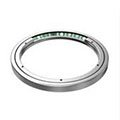
RE16025 is a crossed roller bearing. Its configuration identifies bearing type Crossed, construction Single Row, load direction Combined, and enclosure Open. The contact arrangement, ring interfaces and internal condition must be considered together when selecting the bearing. Nominal size is only one part of that decision. Relate the required reaction to the available installation space, the working component materials and the lubricant arrangement before treating another model as an alternative.
Roller Geometry and the Working Reaction
RE16025 uses a crossed roller arrangement. In this family, alternating roller directions provide different reaction paths within a compact ring package, allowing radial, axial and moment duties to be considered together. These general capabilities do not establish numerical ratings for the model. The actual ring construction, clearance or preload and mounting interfaces remain necessary parts of the selection assessment.
Reaction is shared through contacts whose position can change when a ring is distorted by its support. Housing stiffness, mounting-face accuracy and uniform retention therefore matter to the installed condition. Confirm any explicit mounting holes or locating interfaces rather than assuming that a series name guarantees them. An accuracy requirement for the mechanism must also account for seat runout and assembly alignment, not just bearing identity. The distinct configuration entries are Holes: Without Holes. Preserve each entry in its stated role.
Mating Dimensions and Package Relationships
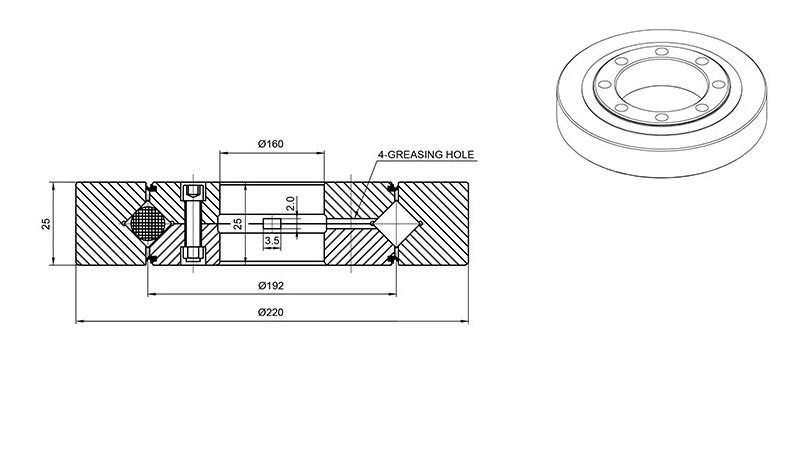
The main dimensional interfaces identify bore 160 mm, outside diameter 220 mm, and width 25 mm. The measurement system is Metric. Coordinate shaft location, housing seating and available axial space using those separate roles. A raceway diameter is not automatically a mounting bore, and a washer or cup width is not necessarily the total package width. Nominal size agreement alone does not prove that an alternative will fit and function correctly.
Obtain the applicable dimensional limits before specifying the mating parts. These are interface limits, not a ready-made machining instruction for a shaft or housing. Consider which member rotates relative to the load, the stiffness of its seat and thermal changes during operation. The installed fit must preserve ring shape and the intended contact condition as well as permit assembly.
Geometric Control and Installed Contact Condition
The internal-condition entries identify precision notation ABEC5(Available in ABEC7/9). Precision, clearance and preload describe different aspects of a rolling assembly. Preserve the notation as stated without converting between standards or treating a clearance code as an accuracy class. The installed behavior depends on the contact geometry as well as the specified component limits.
Fit interference and temperature differences can change the internal freedom available after installation. Seat roundness, shoulder runout and structural deflection also influence contact sharing. Review these relationships when judging stiffness, starting friction or heating. A precision or clearance entry cannot independently guarantee the accuracy of the machine or identify a preload that has not been stated.
Component Materials and Contact Pairing
The component material entries specify rings as Steel and rolling elements as Steel. Each entry belongs to the component named, not to an assumed homogeneous bearing. Keep roller or needle material separate from the rings, cage and any springs. Their combination determines the contact pair and the surrounding mechanical interfaces; a retainer material alone says nothing about the raceway alloy.
Material selection must be related to the actual exposure and operating duty. Surface condition, heat treatment and the mating material affect rolling contact, while lubricant compatibility matters throughout the contact system. Assess contaminants and temperature with the stated component combination. An alloy or material label does not by itself establish chemical-service qualification, corrosion immunity or a guaranteed service life for the installed mechanism.
Ratings and Their Operating Basis
Obtain the applicable operating ratings for the intended reaction and duty. Dynamic and static ratings serve different checks: fatigue assessment and contact deformation are not interchangeable. Neither figure alone is a permitted working load. Account for load combination, shock and the required reliability, preserving any speed, revolution or row-specific basis attached to a rating. Additional explicitly qualified entries are Basic Load Rating C: 81.7 kN and Basic Load Rating Co: 135 kN. Their stated bases remain distinct; no rating is converted to another basis.
The operating limits list Temperature Range: 0 -230 °F. Keep every qualifier and unit attached to its own value. A limiting speed, a reference speed and a lubricant-specific speed describe different conditions; none establishes a universal running speed. Check heat release, lubricant delivery and the surrounding support against the actual duty before setting an operating point.
Support Interfaces and Assembly Assessment
Provide stiff, accurate support to the ring interfaces and avoid uneven retention that distorts the contact geometry. Verify the actual mounting provisions before assigning fasteners or locating features. Mounting-face runout and seat geometry contribute to the installed accuracy. A crossed-roller identity does not guarantee a particular hole pattern or an assembled preload. The explicit interface provisions identify shaft mounting Press Fit. These do not imply supplied mounting accessories or compatibility beyond the stated configuration.
Review the installed running condition with the complete support structure. Radial, axial and moment reactions can interact, so evaluate the load case together with ring support and thermal change. Apply fitting force through the member being installed rather than across the rolling contacts. Confirm mounting procedure values through the actual arrangement requirements instead of guessing them from series size.
Contact Protection and Lubricant Supply
The open enclosure leaves contamination control and lubricant retention to the surrounding design. Determine how particles, fluids or debris might enter the working contact space and how lubricant reaches it during motion. Open construction is not evidence that lubrication can be omitted or that the assembly is protected against the operating environment. Lubricant-access entries identify Greasing Hole(a): 3.5 mm and Greasing Hole(b): 2 mm. These entries retain their individual roles and do not specify a replenishment interval.
Lubrication is specified as Required; select the lubricant and delivery arrangement for the application rather than assuming a factory grease fill. Film formation and heating depend on the contact materials, speed, load and temperature. Match viscosity and delivery to the complete duty, including startup and replenishment conditions. A general lubricant condition does not set a fill quantity, a service interval or a permissible operating temperature by itself.
Selection of the Complete Configuration
RE16025 may be considered in compact rotary supports with an assessed combination of radial, axial and moment reactions. This is general engineering context, not suitability approval for a named machine. Establish the load direction and duty first, then compare the contact arrangement, mating dimensions and actual internal condition. The surrounding design must support the intended reaction without an incompatible fit or an unstated operating capability.
A useful specification keeps the exact model and working component combination visible. Compare enclosure and lubricant requirements, material roles, dimensional limits and ratings on their stated bases. Relate those facts to seat support, thermal change and the completed running condition. A shared size or series designation alone does not establish interchangeability, guaranteed life or the performance of the installed mechanism.