Lubrication and contamination protection are among the most important factors in miniature bearing performance.
A miniature bearing may have the correct:
- size
- load rating
- speed capability
- precision
- fit
and still perform poorly if the lubricant or closure system is wrong.
Typical symptoms include:
- high starting torque
- high running torque
- overheating
- noise
- lubricant leakage
- contamination damage
- premature wear
- shortened service life
These problems are particularly important in miniature bearings because the internal free space is very small.
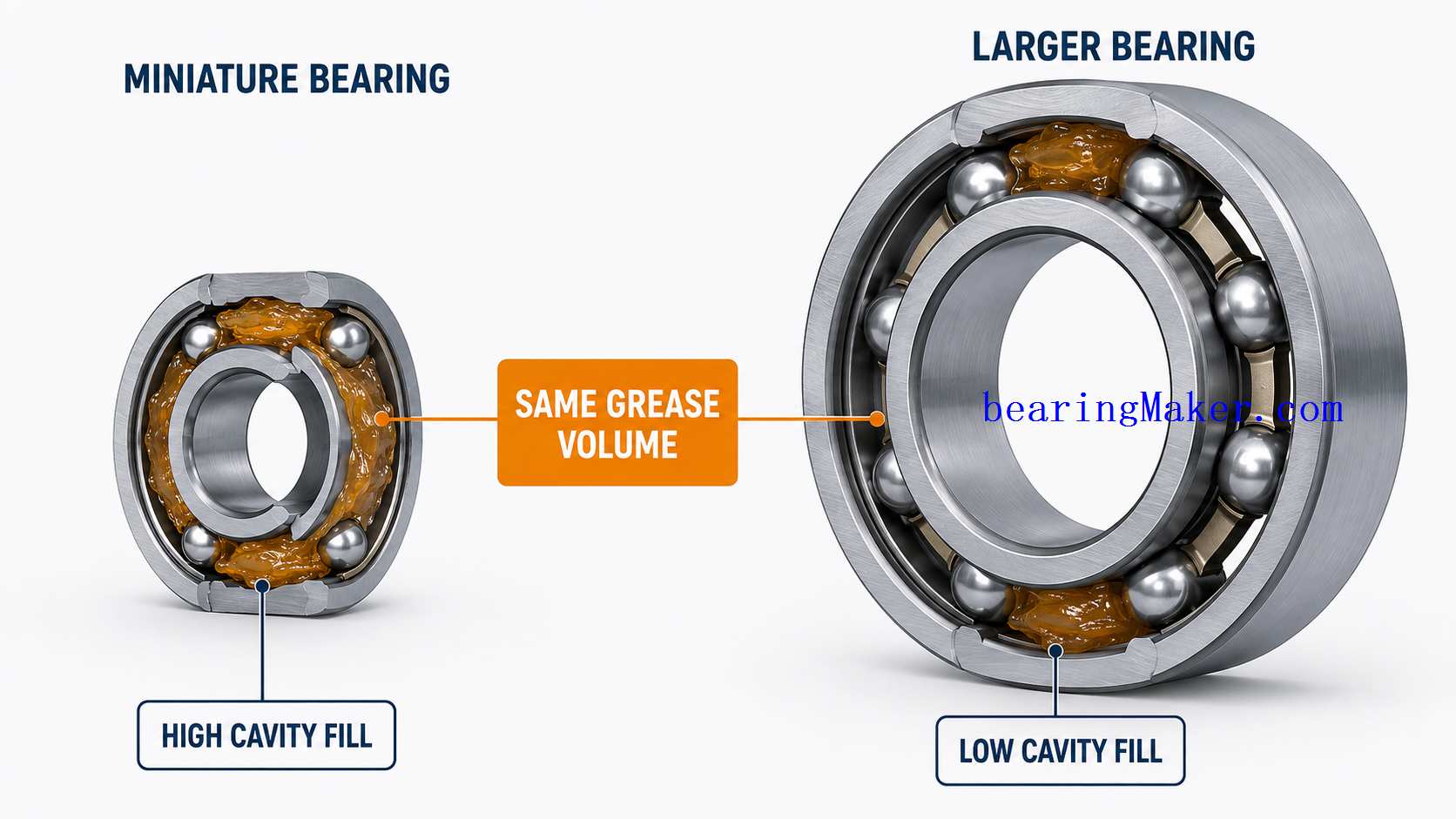
A quantity of grease that appears insignificant in absolute terms can occupy a large percentage of the available bearing cavity.
A tiny contamination particle can be large relative to:
- the ball diameter
- raceway contact
- internal clearance
A contact seal that produces only a small friction force can consume a meaningful percentage of the available torque in a miniature motor.
For this reason, miniature bearing lubrication should not be approached as:
“Add enough grease and use the strongest seal available.”
The real engineering problem is to balance:
lubrication → friction → heat → contamination protection → service life
This guide explains grease and oil lubrication, lubricant viscosity, grease quantity, low-torque and low-noise lubrication, open bearings, shields, contact and non-contact seals, environmental protection, relubrication, and common lubrication failures in miniature bearing systems.
Why Miniature Bearings Need Lubrication
Rolling bearings reduce friction by replacing sliding contact with rolling contact.
But the ball-to-raceway interface is not frictionless.
During operation, the contact involves:
- elastic deformation
- microscopic sliding
- spin
- cage interaction
Lubrication creates a film between moving surfaces and helps reduce:
- friction
- wear
- heat
- surface damage
It can also provide:
- corrosion protection
- noise reduction
- contamination control
What Does Bearing Lubricant Actually Do?
A suitable lubricant performs several functions at the same time.
It should:
- separate rolling surfaces
- reduce friction
- reduce wear
- protect against corrosion
- help control temperature
- remain in the bearing
- remain chemically stable
- avoid excessive torque
No lubricant performs all of these functions equally well in every application.
Why Miniature Bearings Are More Sensitive to Lubrication
Miniature bearings have limited internal space.
This changes the relative importance of:
- lubricant quantity
- lubricant distribution
- contamination
A very small amount of extra grease can produce a large change in:
- churning resistance
- running torque
- heat
Similarly, a small amount of dirt can significantly affect:
- noise
- vibration
- raceway life
Main Lubrication Methods
Miniature bearings commonly use:
- grease lubrication
- oil lubrication
Special applications may also use:
- low-outgassing lubricants
- dry or solid lubrication systems
depending on the operating environment.
Grease Lubrication
Grease is the most common lubrication method for miniature bearings.
It consists broadly of:
- base oil
- thickener
- additives
The thickener holds the base oil within a semi-solid structure.
Why Grease Is So Common
Grease offers several advantages:
- easy application
- good retention
- low leakage
- simple bearing design
- long maintenance intervals
- useful contamination barrier
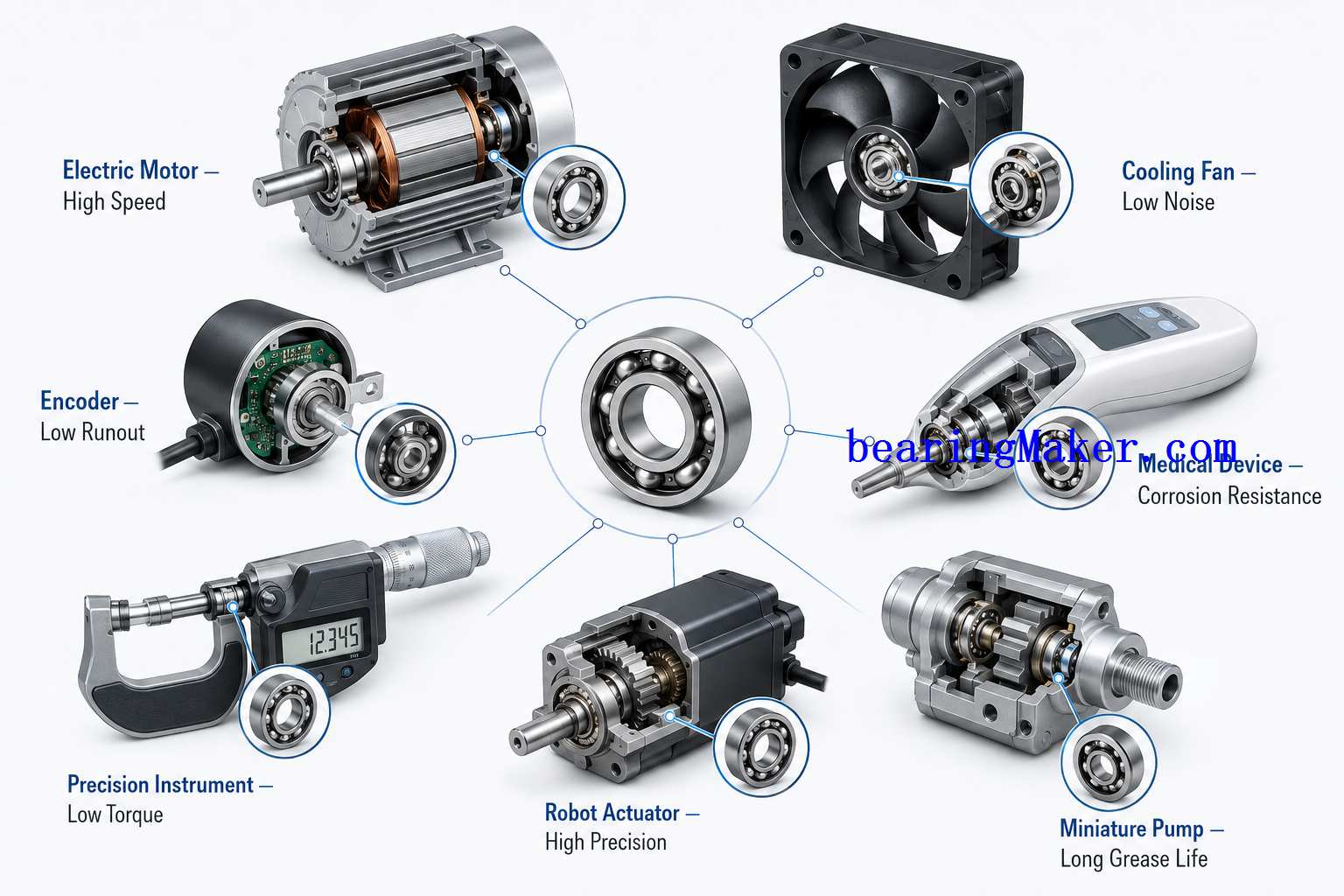
It is widely used in:
- small electric motors
- cooling fans
- encoders
- medical equipment
- instruments
- consumer electronics
Limitations of Grease
Grease can become less suitable when:
- speed is extremely high
- very low torque is required
- heat removal is critical
- lubricant circulation is required
Possible grease-related problems include:
- churning
- excessive starting torque
- heat generation
- aging
Oil Lubrication
Oil may be preferred where the application requires:
- very high speed
- low viscous drag
- continuous lubricant supply
- heat removal
Oil can reach rolling contacts more easily than a stiff grease structure.
Advantages of Oil
Depending on the system, oil can provide:
- effective lubrication at high speed
- lower churning resistance
- heat transport
- continuous renewal
Oil System Limitations
Oil systems may require:
- reservoirs
- seals
- pumps
- controlled supply
- filtration
This can be difficult to justify in a miniature mechanism.
Grease vs. Oil
| Factor | Grease | Oil |
|---|---|---|
| System simplicity | High | Lower |
| Lubricant retention | Very good | Lower |
| Leakage risk | Low | Higher |
| Maintenance | Usually low | Often higher |
| Heat removal | Limited | Better |
| Very high speed | Application-dependent | Often favorable |
| Very compact equipment | Very suitable | More difficult |
| Low contamination leakage | Good | Requires control |
Base Oil Viscosity
The base oil is the lubricating fluid contained within the grease.
Its viscosity strongly affects:
- lubricant film thickness
- starting torque
- running torque
- heat generation
Low-Viscosity Lubricants
Lower viscosity can help reduce:
- viscous drag
- startup resistance
This may be desirable in:
- precision instruments
- small motors
- low-temperature applications
However, viscosity should not be reduced so far that the lubricant film becomes inadequate for the actual:
- load
- speed
- temperature
High-Viscosity Lubricants
Higher viscosity may improve lubricant film under:
- higher load
- lower speed
but can increase:
- starting torque
- running drag
- temperature
Viscosity Changes With Temperature
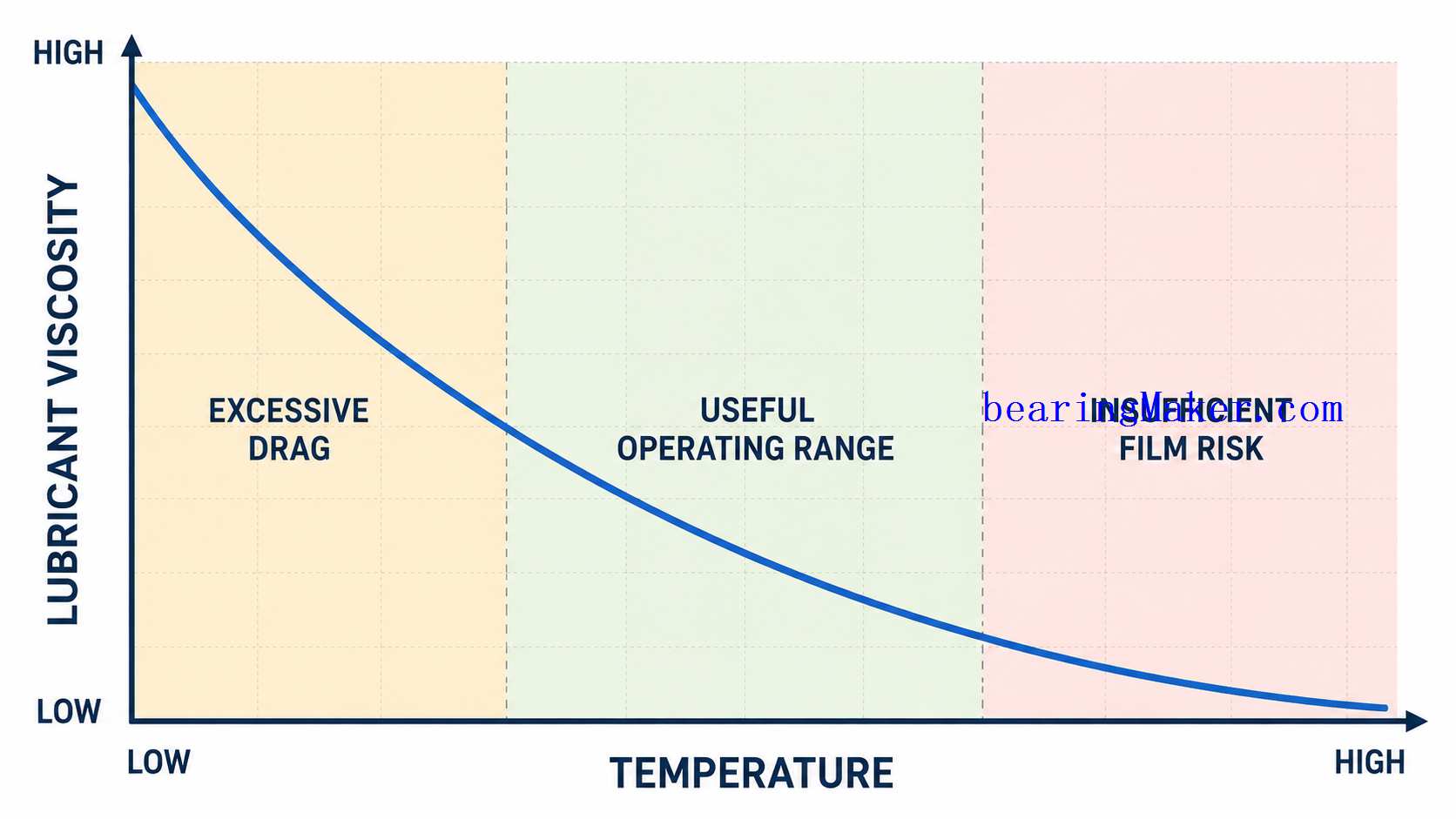
Lubricant viscosity is temperature-dependent.
At low temperature:
- viscosity rises
- starting torque often rises
At high temperature:
- viscosity falls
- lubricant film may become thinner
Lubricant selection should therefore be based on the actual operating temperature range.
Grease Consistency
Grease consistency describes how soft or stiff the grease structure is.
A softer grease may:
- redistribute more easily
- create lower churning resistance
A stiffer grease may:
- remain in place more effectively
The appropriate consistency depends on:
- speed
- orientation
- temperature
- seal configuration
Grease Quantity
Grease quantity is one of the most important miniature bearing variables.
Too little lubricant can be harmful.
Too much can also be harmful.
Why Overgreasing Is a Major Risk
A miniature bearing contains very little internal free volume.
When too much grease is added, the balls and cage must continually displace it.
This creates:
- churning
- viscous drag
- higher running torque
- temperature rise
Overgreasing Symptoms
Common symptoms include:
- high motor current
- slow startup
- excessive temperature
- high initial torque
- irregular grease leakage
Underlubrication
Too little grease may lead to:
- inadequate lubricant film
- wear
- noise
- higher contact stress
- premature failure
The objective is therefore not:
minimum grease
but:
controlled grease quantity
Why Universal Grease Fill Percentages Are Risky
There is no single grease fill percentage suitable for every miniature bearing.
The appropriate amount depends on:
- internal geometry
- speed
- grease type
- torque requirement
- temperature
- seal configuration
The actual bearing and lubricant recommendations should be followed where available.
Grease Distribution
Grease is not always evenly distributed immediately after assembly.
When the bearing begins rotating:
- some grease moves away from the rolling path
- some remains near cage and ring surfaces
This redistribution can significantly affect torque.
Grease Run-In
A freshly lubricated bearing may show:
- higher initial torque
- higher initial temperature
followed by lower steady-state values after grease redistributes.
This process is often called:
- run-in
- grease churning stabilization
Run-In Is Not an Excuse for Unlimited Temperature
Some initial temperature change may be normal.
However, continuously increasing temperature may indicate:
- excessive grease
- preload
- tight fits
- seal drag
The system should reach a stable operating condition.
Low-Torque Grease
Low-torque lubricants are useful where the available driving force is small.
Typical applications include:
- miniature motors
- encoders
- optical mechanisms
- instruments
Important properties may include:
- suitable low-temperature behavior
- low viscous resistance
- stable distribution
Low-Noise Grease
Some applications prioritize acoustic performance.
Examples include:
- cooling fans
- medical devices
- office electronics
Lubricant may influence noise by:
- damping microscopic contact excitation
- changing rolling behavior
- controlling surface interaction
Low-Torque and Low-Noise Are Not Always the Same Requirement
A lubricant optimized for minimum drag may not necessarily produce the quietest operation.
Similarly, a lubricant selected for acoustic damping may create more torque.
The priority should be defined by the machine.
High-Speed Grease
High-speed applications require lubricants that can:
- resist excessive churning
- remain stable
- tolerate temperature
- maintain film formation
Bearing speed, mean diameter, and temperature should all be considered.
Lubrication at Low Temperature
Low-temperature operation can be difficult because grease becomes more resistant to movement.
Symptoms include:
- high breakaway torque
- slow motor startup
- increased current
Applications such as:
- aerospace mechanisms
- outdoor equipment
- refrigeration devices
may need specialized low-temperature lubrication.
Lubrication at High Temperature
High temperature can accelerate:
- oxidation
- grease aging
- base-oil evaporation
- thickener degradation
As lubricant deteriorates, bearing performance may shift from:
- low torque
- stable noise
to:
- high torque
- noise
- wear
Lubricant Life
Lubricant life and bearing fatigue life are not the same thing.
A bearing may have sufficient calculated fatigue life while its grease degrades much earlier.
This is especially important in:
- continuously operating fans
- sealed motors
- maintenance-free devices
What Shortens Lubricant Life?
Common factors include:
- high temperature
- high speed
- contamination
- oxidation
- excessive shear
Temperature is often particularly important.
Relubrication
Some miniature bearings are lubricated for life.
Others may require periodic relubrication.
Relubrication depends on:
- bearing design
- speed
- temperature
- operating hours
- contamination
Why Relubrication Is Difficult in Miniature Bearings
The amount required may be very small.
Adding too much grease during maintenance can create:
- higher torque
- overheating
Relubrication therefore requires controlled:
- quantity
- cleanliness
Relubrication Interval
There is no universal interval.
A proper interval depends on:
- speed
- temperature
- lubricant
- environment
- duty cycle
Condition monitoring may be more useful than a generic calendar interval in some systems.
Oil Lubrication for High Speed
Oil can be useful in very high-speed miniature bearing systems where grease would create excessive drag.
Possible systems include:
- oil-air
- oil mist
- small controlled oil feed
Oil Quantity Also Matters
Too much oil can create:
- viscous drag
- churning
- leakage
High-speed lubrication often benefits from delivering only the amount required to maintain a suitable film.
Oil Circulation and Cooling
Circulating oil can carry heat away from the bearing.
This can be useful where:
- speed is high
- nearby motors generate heat
Lubricant Compatibility
Lubricant should be compatible with:
- seals
- cage materials
- housing materials
- existing oils or greases
Incompatible lubricants may cause:
- grease separation
- swelling
- seal damage
- loss of consistency
Mixing Greases
Mixing different greases without confirming compatibility can be risky.
Different:
- base oils
- thickeners
- additives
may interact poorly.
Possible results include:
- softening
- hardening
- separation
Lubricant Contamination
Lubricant can become contaminated by:
- dust
- metal particles
- moisture
- cleaning fluids
- adhesive
In miniature bearings, even small contamination can become significant.
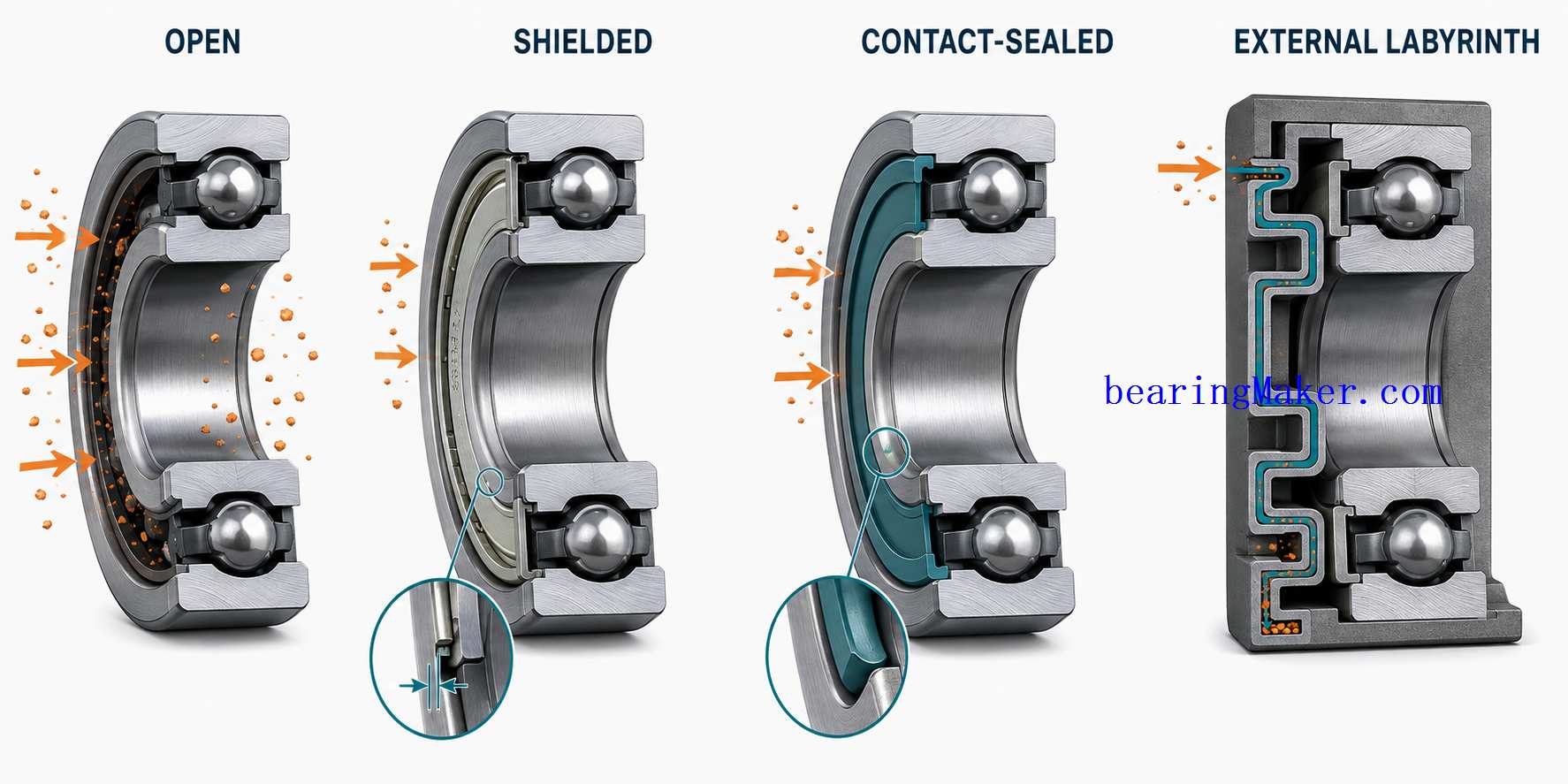
Open Miniature Bearings
Open bearings have no integral shields or seals.
They offer:
- minimum closure friction
- easy lubricant access
- excellent high-speed potential
When Open Bearings Are Useful
They are suitable when:
- the surrounding machine is clean
- external sealing already exists
- lowest possible torque is important
Limitations of Open Bearings
They provide little protection against:
- dust
- debris
- moisture
Contamination protection must come from elsewhere in the machine.
Shielded Miniature Bearings
Shielded bearings use thin closures that generally do not create strong rubbing contact with the rotating ring.
They offer a useful balance of:
- protection
- low torque
- high speed
What Shields Protect Against
Shields can help reduce entry of:
- dust
- larger particles
They also help retain grease.
Shield Limitations
Shields are not usually intended to provide complete sealing against:
- fine dust
- water
- pressure
Why Shields Are Common in Motors and Fans
Small motors and fans often need:
- low friction
- moderate contamination protection
- long grease retention
Shielded miniature bearings match these requirements well.
Contact Seals
Contact seals touch a rotating bearing surface.
They provide stronger protection against:
- dust
- moisture
- lubricant leakage
Contact Seal Trade-Off
The seal creates sliding friction.
This increases:
- starting torque
- running torque
- heat
At miniature scale, that additional torque can be significant.
Low-Contact Seals
Some seal designs minimize contact force to reduce drag.
They aim to provide a compromise between:
- protection
- low torque
Non-Contact Seals
A non-contact seal leaves a small clearance between rotating and stationary surfaces.
Advantages include:
- minimal friction
- high-speed capability
Protection is usually less complete than with a contacting seal.
Shields vs. Non-Contact Seals
Although both minimize rubbing contact, their geometry and sealing function may differ.
The specific bearing construction should be checked rather than assuming all “non-contact” closures provide the same environmental protection.
Seal Drag
Seal drag can be especially important in:
- low-power motors
- encoders
- precision instruments
A few small friction sources can add up to a large percentage of the total available motor torque.
Seal Drag and Temperature
At higher speed, sliding seal friction produces more heat.
This heat can affect:
- lubricant
- seal material
- bearing clearance
Seal Drag at Low Temperature
Seal materials may stiffen at low temperature.
This can increase:
- breakaway torque
- startup resistance
The seal and lubricant should therefore be evaluated together.
Seal Wear
Contact seals gradually wear during operation.
Wear may eventually cause:
- lower seal drag
- poorer contamination protection
- lubricant leakage
Seal Material Compatibility
Seal material must tolerate:
- lubricant
- operating temperature
- chemicals
- cleaning agents
A bearing ring can remain mechanically healthy while the seal fails chemically.
Shield Damage
Thin shields can be damaged during:
- installation
- handling
A bent shield may rub against:
- cage
- inner ring
This can create:
- noise
- torque
- heat
Do Not Press on Shields or Seals
Installation tools should contact:
- bearing rings
not the closures.
Open vs. Shielded vs. Sealed Bearings
| Bearing Configuration | Closure Friction | Dust Protection | Moisture Protection | Speed Potential | Typical Use |
|---|---|---|---|---|---|
| Open | Lowest | Low | Low | Very high | Clean enclosed systems |
| Shielded | Very low | Moderate | Low | High | Motors, fans |
| Non-contact sealed | Very low–Low | Moderate–High | Moderate | High | Precision applications |
| Low-contact sealed | Moderate | High | High | Moderate–High | Compact protected mechanisms |
| Contact sealed | Higher | Very high | Very high | Lower | Dirty/moist environments |
These comparisons are qualitative. Actual performance depends on seal geometry and bearing size.
External Sealing
The bearing does not always need to provide all environmental protection internally.
The machine can use:
- labyrinths
- covers
- dust caps
- shaft seals
Why External Sealing Can Be Better
External protection can reduce contamination while allowing the bearing itself to use:
- shields
- open construction
This may reduce bearing torque.
Labyrinth Seals
A labyrinth seal creates a tortuous path that makes it difficult for contaminants to reach the bearing.
Because there is no strong rubbing contact, friction can be very low.
Dust Contamination
Dust particles may enter through:
- open bearing spaces
- inadequate seals
- assembly contamination
Possible consequences include:
- noise
- wear
- raceway dents
- reduced life
Why Tiny Particles Matter
A contaminant only a small fraction of a millimeter in size can still be large compared with:
- lubricant film
- miniature rolling contact
This makes cleanliness critical.
Moisture
Moisture can cause:
- corrosion
- lubricant degradation
Small corrosion pits can later become:
- noise sources
- fatigue initiation sites
Water Protection
Where water exposure is possible, consider:
- seals
- external covers
- corrosion-resistant materials
- suitable lubricant
Condensation
Even sealed equipment can experience internal condensation if temperature cycles occur.
This should be considered in:
- outdoor equipment
- refrigerated systems
- automotive electronics
Corrosive Environments
In chemically aggressive environments, the complete system must be compatible.
This includes:
- bearing rings
- balls
- lubricant
- seals
Cleanroom Applications
Cleanroom systems may require:
- low particle generation
- controlled grease quantity
- low lubricant migration
- clean assembly
Applications include:
- semiconductor equipment
- precision laboratory instruments
Vacuum Applications
Vacuum creates special lubrication challenges.
Conventional oils or greases may:
- outgas
- evaporate
- contaminate nearby surfaces
Vacuum-compatible lubricants and materials may therefore be required.
Low-Outgassing Lubricants
Applications such as:
- optics
- semiconductor systems
- aerospace mechanisms
may require lubricants specifically selected to reduce volatile contamination.
Medical Applications
Miniature bearings in medical equipment may require:
- low noise
- cleanliness
- corrosion resistance
- chemical compatibility
Cleaning or sterilization requirements must be evaluated for the complete bearing system.
Food and Laboratory Equipment
Depending on the application, requirements may include:
- controlled lubricant leakage
- corrosion resistance
- cleaning compatibility
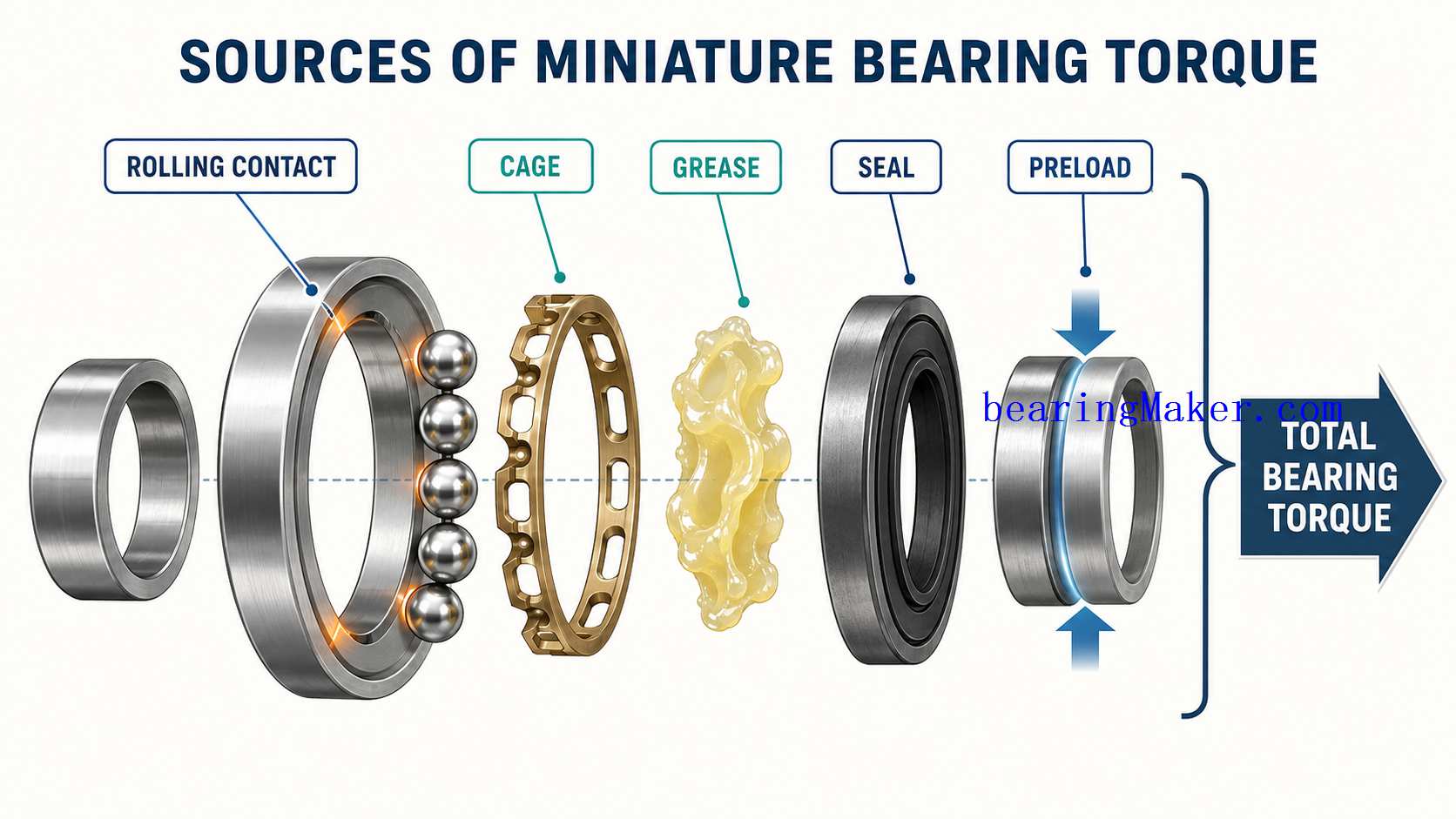
Lubrication and Starting Torque
Starting torque is strongly influenced by:
- grease viscosity
- grease quantity
- seal contact
- temperature
A bearing may have excellent steady-state performance but poor startup behavior.
Lubrication and Running Torque
Running torque is influenced by:
- viscous shear
- churning
- seal drag
- preload
As speed increases, lubricant drag may become more important.
Lubrication and Heat Generation
Friction converts mechanical power into heat.
Lubrication that creates excessive drag can therefore increase bearing temperature.
High temperature then accelerates lubricant aging.
This creates another feedback relationship:
excess drag → heat → lubricant degradation → worse lubrication → more heat
Lubrication and Noise
Lubricant affects:
- rolling smoothness
- acoustic damping
- cage behavior
A bearing selected for low-noise operation should be tested with the actual lubricant.
Lubrication and Vibration
Poor or contaminated lubrication can increase:
- roughness
- vibration
In precision systems, even small changes may be measurable.
Lubrication and Bearing Life
Basic fatigue life calculations assume suitable operating conditions.
Poor lubrication can reduce real service life even when calculated L10 life is high.
Lubrication and Internal Clearance
Lubrication itself does not define geometric clearance, but high lubricant drag can increase:
- temperature
Temperature can then change:
- fits
- internal clearance
- preload
This is why lubrication and mechanical design cannot be treated independently.
Grease Selection by Application
Small Electric Motors
Typical priorities:
- low torque
- high speed
- long life
Cooling Fans
Typical priorities:
- low noise
- long grease life
- stable performance
Encoders
Typical priorities:
- low starting torque
- low running torque
- low torque variation
Medical Equipment
Typical priorities:
- cleanliness
- low noise
- environmental compatibility
High-Speed Instruments
Typical priorities:
- low drag
- temperature stability
Outdoor Mechanisms
Typical priorities:
- moisture protection
- corrosion protection
- low-temperature behavior
Closure Selection by Application
| Application | Common Starting Direction |
|---|---|
| High-speed clean motor | Open or shielded |
| Cooling fan | Shielded or low-contact sealed |
| Precision encoder | Low-drag shield/seal |
| Dirty industrial mechanism | Contact sealed |
| Moist environment | Sealed + corrosion strategy |
| Cleanroom | Controlled low-particle closure |
| Vacuum | Special lubricant + compatible closure |
| Low-torque instrument | Open/shielded where environment allows |
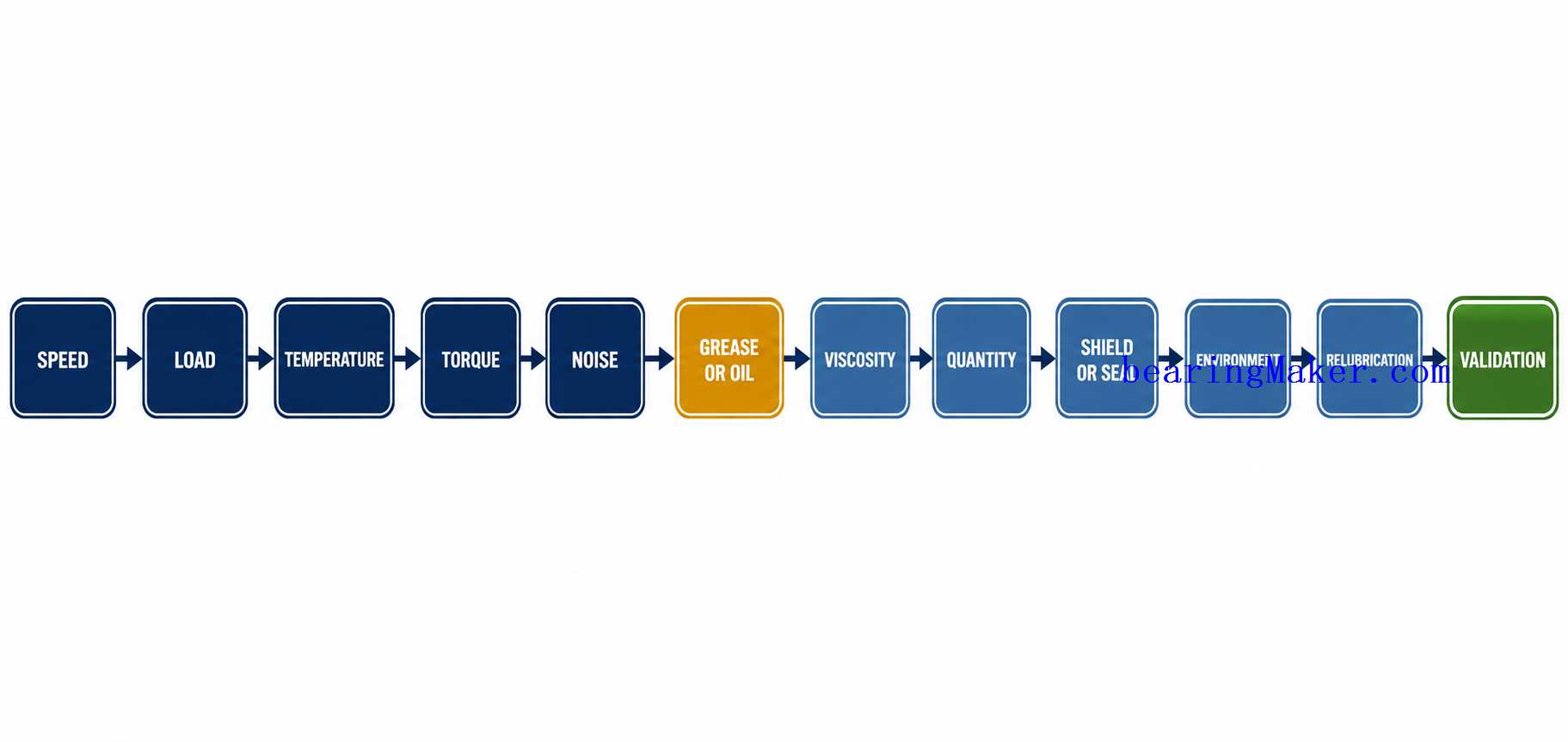
How to Select Miniature Bearing Lubrication
A practical process should consider the following.
Step 1: Define Speed
Specify:
- continuous RPM
- peak RPM
Step 2: Define Load
Determine:
- radial load
- axial load
Higher loads generally require more robust lubricant film conditions.
Step 3: Define Temperature Range
Include:
- cold start
- normal operation
- maximum steady-state temperature
Step 4: Define Torque Requirement
Specify acceptable:
- starting torque
- running torque
Step 5: Define Noise Requirement
Determine whether:
- low acoustic noise
- smooth torque
are important.
Step 6: Choose Grease or Oil
Grease is usually preferred for:
- simple
- sealed
- maintenance-free
systems.
Oil may be preferable where:
- speed
- cooling
dominate.
Step 7: Select Lubricant Viscosity
Balance:
- film formation
- viscous drag
at actual operating temperature.
Step 8: Select Grease Consistency
Choose a grease that remains in place without creating excessive drag.
Step 9: Control Lubricant Quantity
Use a controlled fill appropriate to the specific bearing and application.
Step 10: Select Closure
Choose:
- open
- shielded
- non-contact seal
- contact seal
based on:
- contamination
- moisture
- torque
Step 11: Check Seal Compatibility
Verify compatibility with:
- lubricant
- temperature
- chemicals
Step 12: Evaluate External Sealing
Determine whether the machine can provide contamination protection with lower bearing drag.
Step 13: Define Relubrication Strategy
Determine whether the bearing is:
- lubricated for life
- periodically serviced
Step 14: Validate Startup
Measure or evaluate:
- breakaway torque
- cold-start behavior
Step 15: Validate Steady-State Operation
Check:
- running torque
- temperature
- noise
- vibration
after stabilization.
Diagnosing High Starting Torque
Possible causes include:
- grease viscosity too high
- excessive grease
- contact seals
- low temperature
- preload
Diagnosing High Running Torque
Possible causes include:
- grease churning
- seal drag
- excessive preload
- tight fits
- misalignment
Diagnosing High Temperature
Check:
- grease quantity
- lubricant viscosity
- preload
- seal friction
- speed
Diagnosing Noise After Lubrication
Possible causes include:
- contaminated lubricant
- incorrect grease distribution
- underlubrication
- excessive grease
Diagnosing Grease Leakage
Possible causes include:
- excess fill
- excessive temperature
- seal damage
- high-speed centrifugal effects
Diagnosing Early Lubricant Failure
Check:
- operating temperature
- speed
- contamination
- chemical compatibility
Diagnosing Corrosion
Check:
- moisture ingress
- seal effectiveness
- lubricant corrosion protection
- bearing material
Diagnosing Shield Rubbing
Check for:
- installation damage
- deformed shield
- incorrect tooling contact
Lubrication and Closure Troubleshooting Matrix
| Symptom | Possible Cause | What to Check |
|---|---|---|
| High cold-start torque | High viscosity/seal drag | Lubricant, seal, temperature |
| High running torque | Overgreasing | Grease quantity |
| Bearing runs hot | Churning/preload/seal friction | Fill, preload, closure |
| Noise increases over time | Grease aging/contamination | Lubricant condition |
| Rough rotation | Contamination | Cleanliness, raceways |
| Grease leakage | Excess fill/heat | Quantity, temperature |
| Corrosion | Moisture ingress | Seal, material, lubricant |
| High-speed noise | Cage/lubrication | Lubricant, speed |
| Shield rubbing | Deformation | Shield geometry |
| Seal wear | Heat/misalignment | Seal condition |
| Torque falls after run-in | Grease redistribution | Initial fill behavior |
| Bearing fails despite high L10 | Lubrication/environment | Grease, contamination |
Common Lubrication Mistakes
Mistake 1: Assuming More Grease Means Longer Life
Excess grease may create:
- churning
- heat
Mistake 2: Using the Same Grease Quantity as a Larger Bearing
Miniature bearings have much less free internal volume.
Mistake 3: Selecting Grease by Viscosity Alone
Temperature, load, speed, and consistency also matter.
Mistake 4: Ignoring Cold-Start Torque
A bearing that performs well when warm may fail to start reliably when cold.
Mistake 5: Choosing the Strongest Seal Automatically
Maximum protection may create excessive torque.
Mistake 6: Treating Shields as Waterproof Seals
Shields generally provide less protection against moisture than contact seals.
Mistake 7: Ignoring Seal Material
Chemicals or temperature may damage the seal even when the bearing rings are suitable.
Mistake 8: Mixing Lubricants Without Checking Compatibility
Different grease chemistries may not mix reliably.
Mistake 9: Relubricating Without Controlling Quantity
Repeated additions can gradually overfill the bearing.
Mistake 10: Ignoring Assembly Cleanliness
Contamination may cause more damage than lubricant selection errors.
Mistake 11: Pressing on Shields or Seals
Installation tooling can deform the closure.
Mistake 12: Assuming L10 Life Equals Lubricant Life
A bearing can outlast its lubricant theoretically but fail early because the lubricant degrades.
Frequently Asked Questions
What Is the Best Lubricant for a Miniature Bearing?
There is no universal best lubricant.
Selection depends on:
- speed
- load
- temperature
- torque
- environment
Is Grease or Oil Better for Miniature Bearings?
Grease is usually simpler and more common.
Oil may be preferable where:
- speed is very high
- heat removal matters
How Much Grease Should Be Put in a Miniature Bearing?
The correct amount depends on:
- bearing geometry
- speed
- lubricant
- torque requirement
Universal fill percentages should not be applied blindly.
Can Too Much Grease Damage a Miniature Bearing?
Excess grease can cause:
- high torque
- churning
- heat
and may shorten lubricant life.
Can Too Little Grease Damage a Bearing?
Yes.
Insufficient lubricant can increase:
- wear
- noise
- surface damage
Why Does a Bearing Have High Torque After Greasing?
Possible causes include:
- excess quantity
- high viscosity
- grease not yet redistributed
Why Does Torque Decrease After Running for a While?
Grease may redistribute away from the main rolling path during run-in.
Why Is Starting Torque Higher When Cold?
Lubricant viscosity and seal stiffness generally increase at low temperature.
Are Shielded Bearings Lower Friction Than Sealed Bearings?
Usually, shielded or non-contact closure designs produce less drag than contact seals.
Do Shields Keep Water Out?
Shields generally provide limited moisture protection compared with properly designed seals.
Are Contact Seals Better?
They provide stronger contamination protection but add friction.
“Better” depends on the application.
Are Open Bearings Suitable for High Speed?
Yes, they can be very suitable in clean systems because they have no integral seal drag.
What Is a Low-Contact Seal?
It is a sealing design intended to reduce contact force and friction while still providing stronger protection than a purely open configuration.
Can External Sealing Replace a Bearing Seal?
In some machines, yes.
Labyrinths or external covers can protect the bearing while allowing a lower-drag bearing closure.
Why Are Miniature Bearings Sensitive to Dust?
Their rolling contacts and internal clearances are very small.
A tiny particle can therefore create significant local damage.
Can Lubricant Affect Bearing Noise?
Yes.
Lubricant type, condition, quantity, and distribution can all influence noise.
Can Lubrication Affect Bearing Temperature?
Yes.
Too much viscous drag or churning can significantly increase heat generation.
How Often Should Miniature Bearings Be Relubricated?
There is no universal interval.
It depends on:
- speed
- temperature
- lubricant
- environment
- duty cycle
Are Miniature Bearings Usually Lubricated for Life?
Many sealed or shielded miniature bearings are intended for long-term operation with factory-applied lubricant, but this depends on the specific bearing and application.
Can I Mix Different Bearing Greases?
Only when compatibility is known.
Unverified grease mixing can change lubricant consistency and performance.
What Lubrication Is Used in Vacuum?
Vacuum applications typically require specialized low-outgassing lubricants or other vacuum-compatible lubrication systems.
Why Does a Bearing Still Fail Even When Its Calculated L10 Life Is High?
Real service life may be limited by:
- lubricant degradation
- contamination
- corrosion
- installation damage
rather than normal rolling fatigue.
Miniature Bearing Lubrication and Sealing Checklist
Before finalizing the bearing system, define:
| Parameter | What to Determine |
|---|---|
| Continuous speed | rpm |
| Peak speed | rpm |
| Radial load | Continuous/peak |
| Axial load | Continuous/peak |
| Minimum temperature | Cold-start condition |
| Normal temperature | Operating condition |
| Maximum temperature | Steady-state/peak |
| Starting torque | Maximum acceptable |
| Running torque | Maximum acceptable |
| Noise requirement | Required level |
| Lubrication method | Grease/oil/special |
| Base oil viscosity | Suitable at operating temperature |
| Grease consistency | Suitable for speed/application |
| Grease quantity | Controlled |
| Run-in | Expected behavior |
| Lubricant life | Required service interval |
| Relubrication | Required/not required |
| Closure | Open/shield/seal |
| Seal contact | None/low/contact |
| Seal material | Temperature/chemical compatible |
| External sealing | Required or not |
| Dust | Expected level |
| Moisture | Expected level |
| Chemicals | Expected exposure |
| Corrosion | Protection required |
| Cleanroom | Particle control required |
| Vacuum | Low-outgassing requirement |
| Assembly cleanliness | Controlled |
| Lubricant compatibility | Verified |
| Shield/seal condition | Protected during assembly |
| Final torque | Verified |
| Final temperature | Verified |
| Noise/vibration | Verified |
Conclusion
Lubrication and sealing are not secondary accessories in a miniature bearing system.
They are fundamental operating parameters.
The lubricant controls:
- friction
- wear
- torque
- heat
- noise
The closure system controls:
- contamination
- moisture
- lubricant retention
but can also add:
- friction
- starting torque
- heat
Miniature bearings are especially sensitive because their internal volume and rolling contacts are very small.
A small excess of grease can create significant churning.
A small contamination particle can create significant raceway damage.
A small amount of seal drag can consume a meaningful share of the available torque in a miniature motor.
The most reliable lubrication and protection strategy therefore follows:
Speed → Load → Temperature → Torque → Noise → Lubrication Method → Viscosity → Grease Quantity → Shield or Seal → Environmental Protection → Relubrication → Operating Validation
The goal is not to maximize grease quantity or sealing strength.
The goal is to maintain the correct balance of:
- lubricant film
- low torque
- stable temperature
- contamination protection
- long lubricant life
- reliable bearing operation
throughout the actual operating environment of the machine.