Miniature bearings are often used in applications where smooth and accurate rotation matters as much as load capacity.
A small electric motor may need to run quietly.
An encoder shaft may need very low runout.
A medical instrument may require smooth motion without detectable vibration.
A precision sensor may need repeatable rotation with very low starting torque.
In these applications, engineers often focus on bearing precision classes first.
But bearing precision alone does not determine the final result.
Actual performance also depends on:
- shaft accuracy
- housing accuracy
- internal clearance
- preload
- lubricant
- contamination
- cage behavior
- seals
- rotor balance
- assembly alignment
A bearing can have excellent dimensional tolerances and still produce unacceptable:
- noise
- vibration
- runout
- torque variation
after installation.
Conversely, a bearing that does not use the highest available precision class may perform perfectly well if the surrounding system is designed correctly.
This guide explains miniature bearing precision, radial and axial runout, noise, vibration, internal clearance, preload, measurement methods, and the system-level factors that determine real rotational quality.
What Does Miniature Bearing Precision Mean?
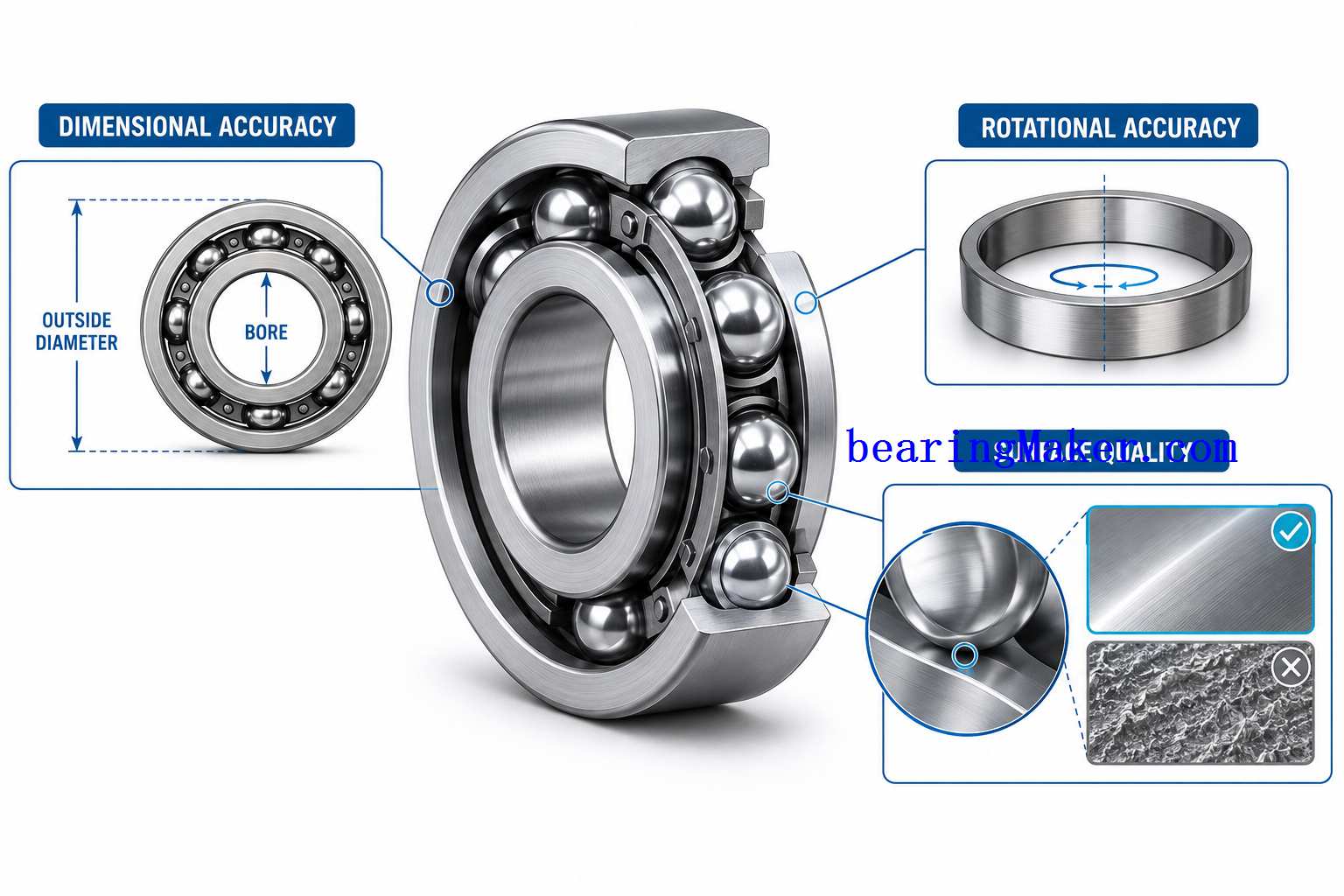
Bearing precision describes how closely the manufactured bearing geometry conforms to specified dimensional and rotational tolerances.
Typical controlled characteristics include:
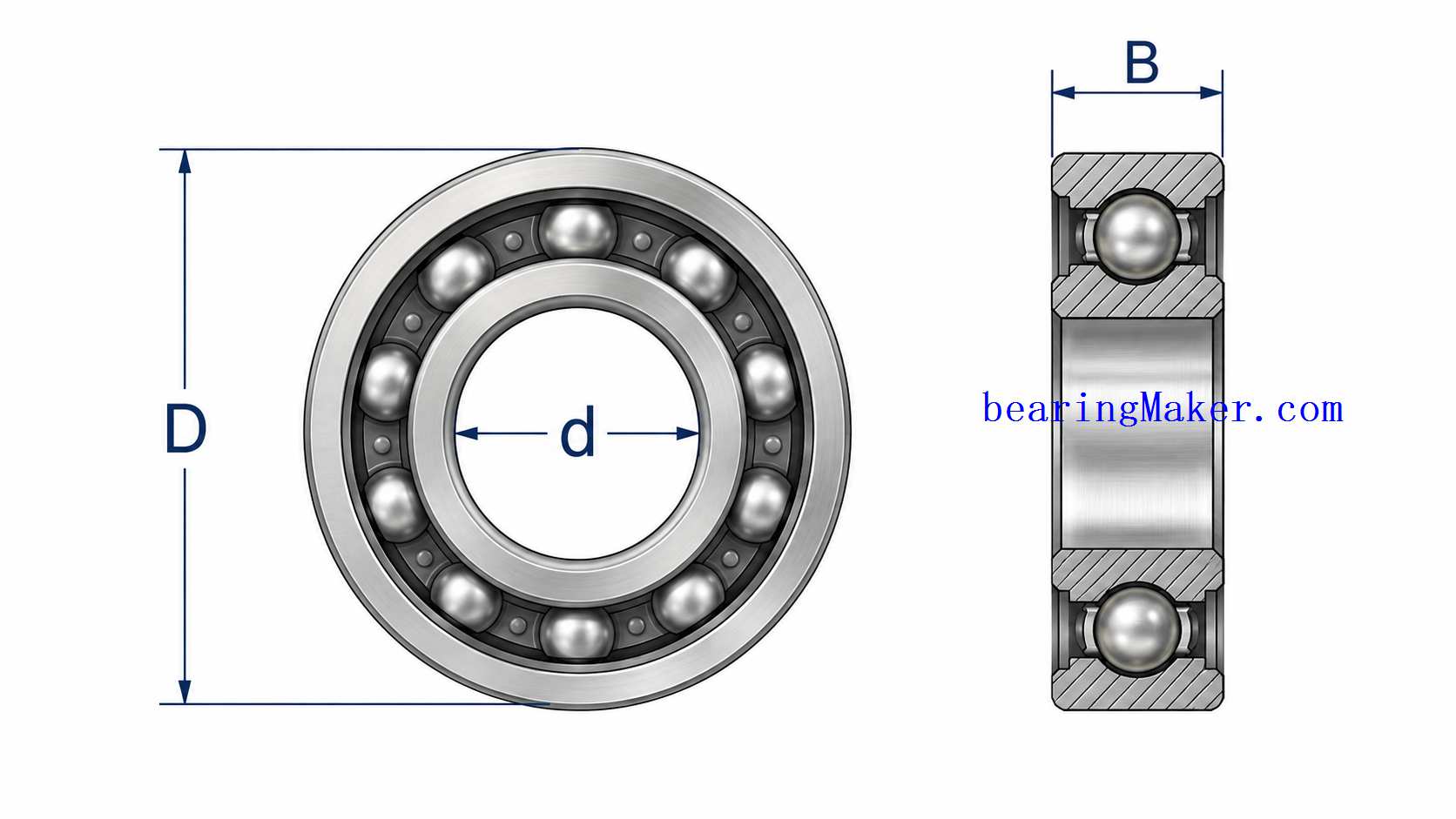
- bore diameter
- outside diameter
- ring width
- radial runout
- axial runout
- raceway geometry
Higher precision means smaller allowable deviations.
Dimensional Accuracy vs. Rotational Accuracy
These are related but not identical.
Dimensional Accuracy
Controls physical dimensions such as:
- bore
- OD
- width
Rotational Accuracy
Controls how accurately the bearing rotates relative to its reference surfaces.
This includes:
- radial runout
- axial runout
A bearing can therefore meet dimensional requirements while still having a different rotational-accuracy specification.
Bore Diameter Accuracy
The bore determines how the inner ring fits the shaft.
Bore accuracy influences:
- fit
- concentricity
- internal clearance after installation
If the bore or shaft is outside tolerance, the resulting fit may become:
- too loose
- too tight
Both conditions can reduce precision.
Outside Diameter Accuracy
The outer diameter determines how the bearing fits into the housing.
OD accuracy affects:
- housing fit
- alignment
- ring support
An excessive interference fit can reduce clearance and increase torque.
A loose fit can allow movement and reduce positioning stability.
Bearing Width Accuracy
Bearing width matters when the bearing is located axially against:
- shoulders
- spacers
- retaining components
In paired or preloaded assemblies, width variation can influence:
- axial position
- preload
Ring Geometry
The accuracy of the inner and outer rings influences:
- raceway concentricity
- rolling-element motion
- runout
At miniature scale, small geometric deviations can become important relative to the bearing dimensions.
Ball Accuracy
Ball geometry influences:
- vibration
- noise
- torque consistency
Important ball characteristics include:
- diameter variation
- roundness
- surface finish
Highly uniform balls help create smoother rolling motion.
Raceway Surface Finish
Even when overall geometry is accurate, microscopic surface irregularities can affect:
- noise
- vibration
- friction
Raceway finish is therefore an important part of precision bearing performance.
Precision Classes
Rolling bearings may be manufactured to different precision classes.
These classes generally define allowable tolerances for:
- dimensions
- runout
- rotational accuracy
Higher classes use tighter tolerances.
What Is ABEC?
ABEC is a commonly recognized bearing precision classification system.
It primarily addresses dimensional and rotational tolerances.
Higher ABEC classifications generally correspond to tighter allowable tolerances.
However, ABEC should not be interpreted as a complete measure of:
- noise
- lubricant quality
- bearing life
- torque
- overall bearing quality
Higher Precision Does Not Automatically Mean Quieter
This is one of the most important concepts in miniature bearing selection.
A higher precision bearing may provide lower geometric error, but noise can also come from:
- contamination
- lubricant
- cage
- seals
- mounting
- rotor imbalance
A high precision class therefore does not automatically guarantee low acoustic noise.
Higher Precision Does Not Automatically Mean Longer Life
Bearing life depends strongly on:
- load
- lubrication
- contamination
- alignment
Precision class alone does not determine fatigue life.
When Higher Precision Is Useful
Tighter bearing precision can be valuable where the application requires:
- very low runout
- accurate shaft positioning
- high-speed stability
- precise encoder performance
- optical alignment
When Higher Precision May Add Little Value
A tighter bearing tolerance may provide little improvement if the system is dominated by:
- poor shaft runout
- housing eccentricity
- flexible structure
- imbalance
The bearing should not be more precise than the rest of the machine can use.
Bearing Precision vs. System Precision
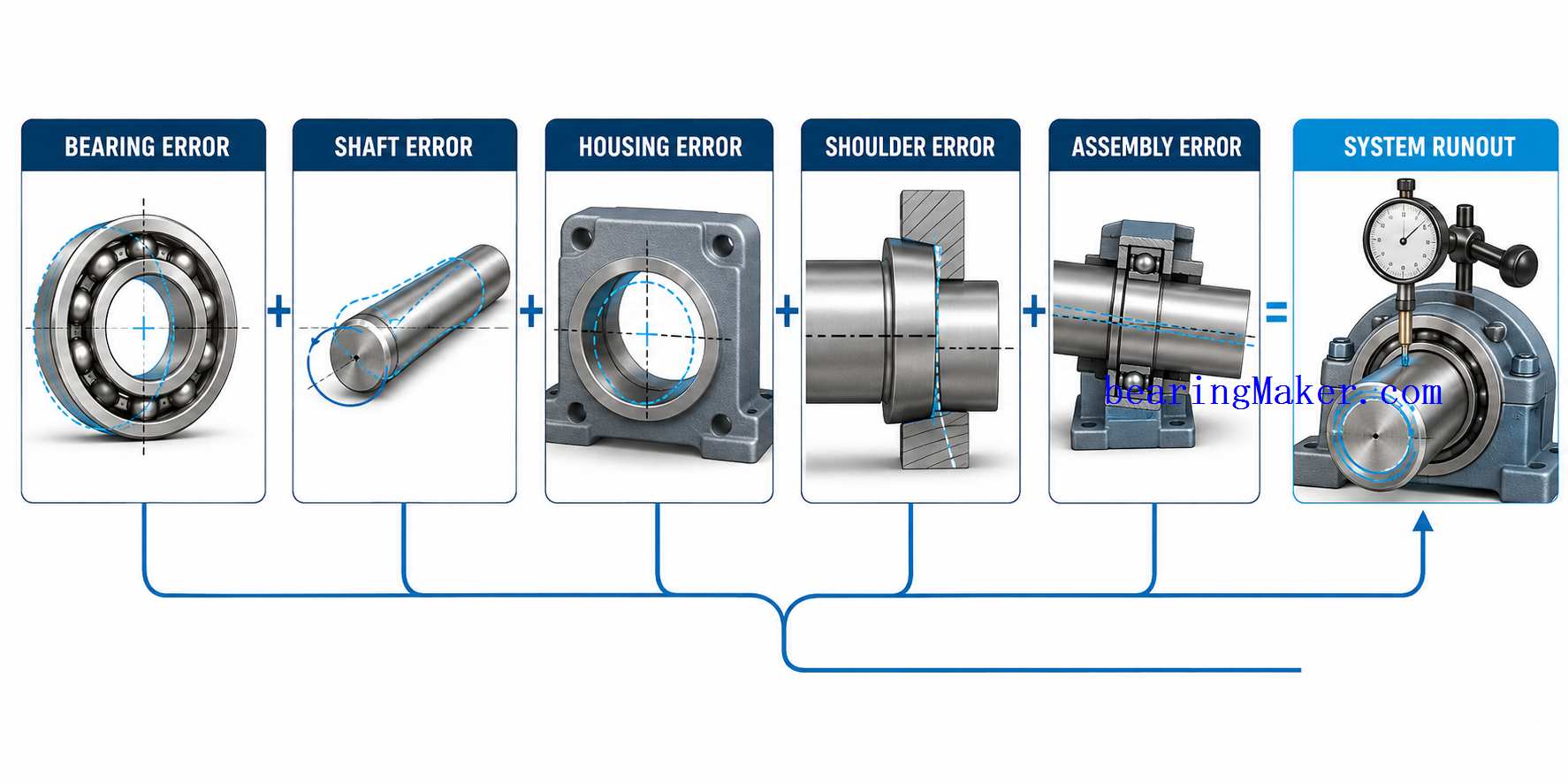
A miniature bearing is only one contributor to the final rotational accuracy.
System precision can be viewed conceptually as the combined influence of:
Bearing + Shaft + Housing + Mounting + Preload + Thermal Effects
Why the Shaft Matters
The inner ring follows the shaft.
If the shaft is:
- bent
- eccentric
- out of round
the bearing cannot fully correct that error.
Why the Housing Matters
The outer ring is positioned by the housing.
Housing errors can include:
- eccentric bore
- poor roundness
- misalignment
These can shift or distort the bearing.
Why Mounting Surfaces Matter
Shoulders and retaining surfaces locate the bearing axially.
If a shoulder is not square, the bearing may tilt.
This can increase:
- axial runout
- vibration
- uneven load
Precision Stack-Up
A useful engineering concept is the precision stack-up.
The final rotational error includes contributions from:
- bearing runout
- shaft runout
- housing runout
- shoulder error
- assembly error
- deformation
What Is Radial Runout?
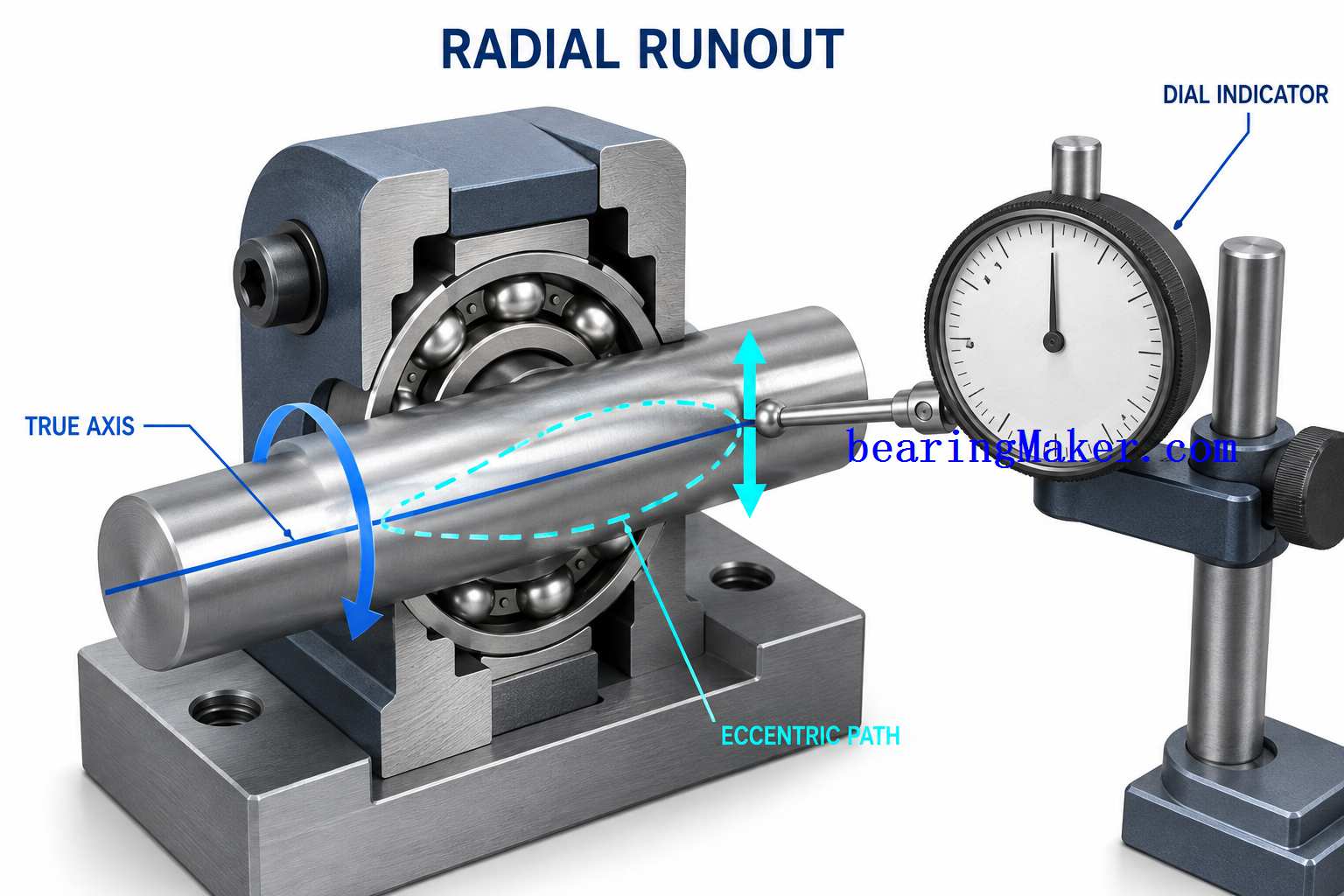
Radial runout is variation in the rotating position perpendicular to the shaft axis.
In simple terms, the rotating shaft or ring moves slightly closer to and farther from a fixed radial measurement point during one revolution.
Sources of Radial Runout
Radial runout can come from:
- bearing raceway eccentricity
- shaft eccentricity
- housing eccentricity
- fit distortion
- debris between mounting surfaces
Why Radial Runout Matters
Radial runout can affect:
- motor vibration
- encoder accuracy
- gear mesh
- rotor clearance
- instrument precision
In very small mechanisms, even small absolute displacement can represent a meaningful percentage of the required motion accuracy.
What Is Axial Runout?
Axial runout is variation in position parallel to the shaft axis.
It often appears as face wobble.
Sources of Axial Runout
Common causes include:
- ring face runout
- shaft shoulder not square
- housing shoulder not square
- bearing tilt
- debris at mounting faces
Why Axial Runout Matters
Axial runout is important in:
- encoders
- optical devices
- miniature rotary stages
- disk mechanisms
A small angular tilt can produce measurable axial movement at a larger radius.
Angular Error and Edge Displacement
For small angular errors:
δ≈Rθ\delta \approx R\theta
where:
- δ\delta = linear displacement
- RR = distance from the rotational axis
- θ\theta = angular error in radians
This means a small bearing tilt can produce a much larger displacement at the edge of a rotating disk or encoder.
Radial Runout vs. Axial Runout
| Characteristic | Radial Runout | Axial Runout |
|---|---|---|
| Direction | Perpendicular to axis | Parallel to axis |
| Typical appearance | Eccentric shaft motion | Face wobble |
| Common causes | Shaft/bearing eccentricity | Shoulder tilt/bearing tilt |
| Important in | Motors, gears, rotors | Encoders, disks, optics |
Runout Is Not the Same as Clearance
This distinction is critical.
Internal clearance describes:
- relative movement available between bearing rings
Runout describes:
- geometric variation during rotation
A bearing can have very small clearance but still have significant runout if:
- shaft is eccentric
- housing is misaligned
Runout Is Not the Same as Vibration
Runout is a geometric error.
Vibration is dynamic motion.
Runout can create vibration, but vibration can also come from:
- imbalance
- resonance
- motor electromagnetic forces
- damaged raceways
Internal Clearance and Precision
Internal clearance affects:
- shaft movement
- stiffness
- noise
- vibration
Too much clearance can allow greater relative movement.
Too little clearance can create:
- high torque
- heat
Radial Clearance
Radial clearance is the relative radial movement possible between inner and outer rings.
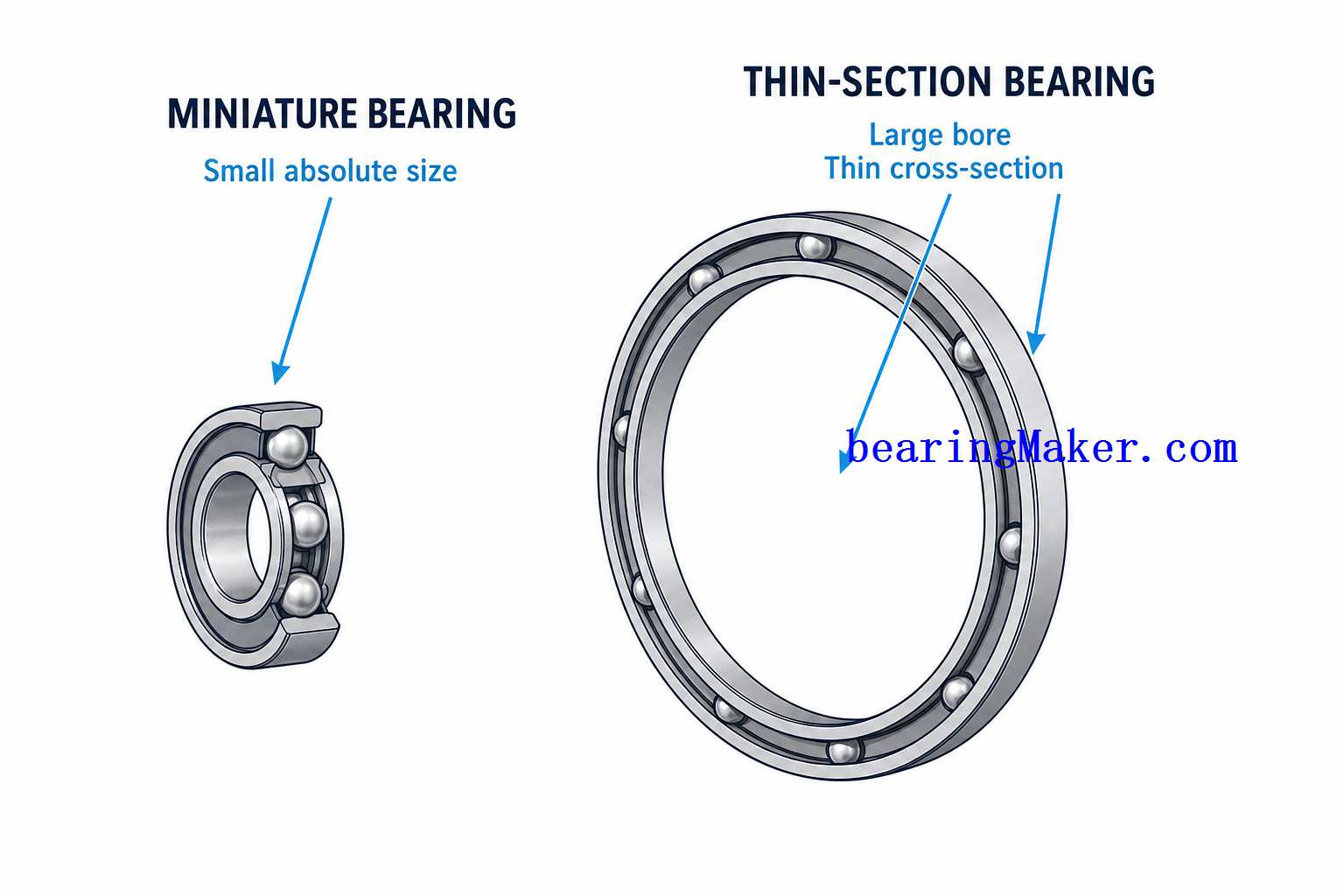
In miniature bearings, even small changes in clearance can be important because absolute dimensions are small.
Axial Clearance
Axial clearance affects movement along the shaft axis.
It can influence:
- encoder position
- shaft end play
- precision
Fit-Induced Clearance Change
A tight shaft fit expands the inner ring.
A tight housing fit can compress the outer ring.
Both effects can reduce internal clearance.
Why Fit Matters for Precision
A bearing with correct free-state clearance can become:
- excessively tight
- unintentionally preloaded
after installation.
The result may be:
- lower play
- but higher torque
- higher temperature
Precision should therefore be evaluated in the installed condition.
Preload and Precision
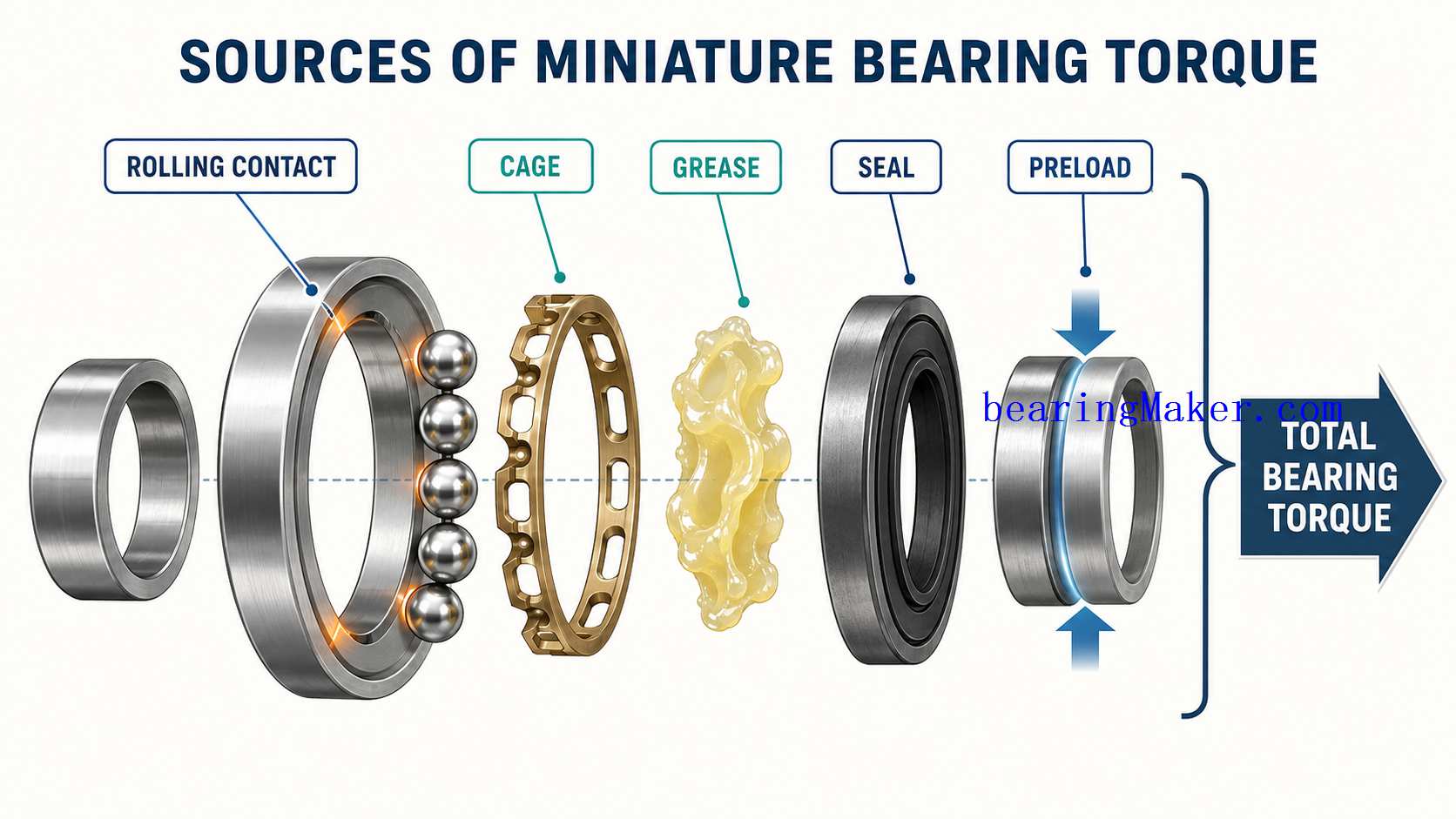
Preload applies an intentional internal force to remove clearance.
Potential benefits include:
- reduced play
- increased stiffness
- more stable shaft position
Preload in Miniature Bearings
Miniature bearing preload is often used in:
- motors
- encoders
- instruments
- precision mechanisms
It may be applied using:
- springs
- axial clamping
- bearing-pair geometry
Spring Preload
Spring preload can help maintain a relatively consistent force despite:
- thermal expansion
- dimensional variation
This is useful where the system needs:
- low play
- moderate stiffness
without excessive rigid preload.
Rigid Preload
Rigid preload can provide higher stiffness.
However, it is more sensitive to:
- dimensional tolerances
- temperature
Too Much Preload
Excessive preload can cause:
- high starting torque
- high running torque
- heat
- reduced bearing life
Higher preload does not automatically produce better precision.
Precision vs. Stiffness
Precision and stiffness are different concepts.
Precision describes:
- geometric accuracy
Stiffness describes:
- resistance to deflection under load
A bearing can have excellent runout when unloaded but allow too much shaft movement under force.
Loaded Precision
In some applications, the important question is not:
How accurate is the bearing with no load?
but:
How accurately does the shaft remain positioned under real operating load?
This depends on:
- bearing stiffness
- preload
- shaft stiffness
- housing stiffness
What Is Bearing Noise?
Bearing noise is the audible sound generated or transmitted during bearing operation.
Noise may originate from:
- rolling contacts
- cage movement
- lubricant
- seals
- contamination
- damage
Bearing Noise vs. Machine Noise
Not every noise near a bearing is caused by the bearing.
Other sources include:
- motor electromagnetic noise
- fan blades
- gear mesh
- rotor imbalance
- structural resonance
Proper diagnosis should separate bearing noise from total machine noise.
Why Noise Matters in Miniature Bearings
Miniature bearings are often used in products where users are close to the mechanism.
Examples include:
- laptop fans
- medical devices
- office equipment
- precision instruments
Even low absolute sound levels may therefore matter.
Raceway Noise
Microscopic raceway irregularities can create repeating forces as the balls pass over them.
These forces may excite:
- bearing rings
- shaft
- housing
and become audible.
Ball Quality and Noise
Variations in ball:
- diameter
- roundness
- surface finish
can affect rolling smoothness.
Lubricant Noise
Lubrication strongly influences acoustic behavior.
Possible issues include:
- inadequate lubricant
- inconsistent grease distribution
- lubricant contamination
Some lubricants are selected specifically for low-noise applications.
Grease Distribution
Freshly assembled bearings may have uneven grease distribution.
During initial operation, grease may redistribute.
This can temporarily change:
- torque
- acoustic behavior
Overgreasing and Noise
Excess grease can create:
- churning
- torque variation
It may also produce irregular operating sound.
Underlubrication and Noise
Too little lubricant can allow greater surface interaction.
Possible results include:
- increased high-frequency noise
- wear
Cage Noise
The cage interacts dynamically with the rolling elements.
Cage-related noise may depend on:
- cage clearance
- speed
- acceleration
- lubrication
Seal Noise
Contact seals may generate sliding sound.
Seal noise may increase with:
- speed
- misalignment
- insufficient lubrication at the sealing lip
Contamination Noise
Contamination is one of the most important sources of miniature bearing noise.
A tiny particle can be large relative to the contact area.
It may produce:
- clicking
- rough sound
- vibration
Why Cleanliness Is Critical
Miniature bearings have:
- small balls
- small raceways
- small internal clearances
Contaminants that would seem insignificant elsewhere can strongly affect them.
Assembly cleanliness therefore directly affects:
- noise
- vibration
- life
Bearing Damage and Noise
Damage such as:
- brinelling
- spalling
- corrosion
can produce periodic noise.
The frequency and repetition pattern may help identify the defect location.
What Is Bearing Vibration?
Bearing vibration is dynamic movement caused by varying forces during rotation.
It may be measured as:
- displacement
- velocity
- acceleration
depending on the application and frequency range.
Sources of Miniature Bearing Vibration
Common sources include:
- runout
- ball/raceway geometry
- contamination
- brinelling
- imbalance
- misalignment
- preload variation
- cage dynamics
Runout-Induced Vibration
If the shaft rotates eccentrically, the rotating mass produces varying radial force.
This can create vibration at rotational frequency.
Imbalance
Rotor imbalance may produce strong vibration even if the bearing is perfect.
This is especially common in:
- fans
- small motors
- high-speed rotors
The bearing should not be blamed automatically.
Misalignment
Misalignment creates uneven contact forces and may increase:
- vibration
- noise
- heat
Brinelling and Periodic Vibration
Raceway indentations can produce repeating vibration each time balls pass the damaged locations.
This may create a regular pattern rather than random noise.
Spalling and Rough Vibration
Spalling can generate:
- broadband vibration
- rough sound
- increasing noise
as damage progresses.
Vibration Frequency Content
Vibration analysis can provide more information than overall vibration amplitude alone.
Different components may generate different frequency patterns.
Possible contributors include:
- shaft rotation
- rolling-element passage
- cage motion
- structural resonance
Why Overall Vibration Is Not Enough
Two machines may have the same overall vibration level but different causes.
Frequency analysis can help distinguish:
- imbalance
- bearing defects
- resonance
Noise vs. Vibration
Noise and vibration are related but not identical.
Vibration is mechanical motion.
Noise is acoustic energy that reaches the listener.
A bearing may have measurable vibration without producing objectionable sound if the structure does not amplify it.
Conversely, a small vibration can become loud if it excites a resonant housing.
Structural Resonance
The machine structure can amplify bearing excitation.
A thin plastic housing, for example, may act as an acoustic radiator.
This means low bearing vibration alone does not guarantee a quiet product.
Miniature Bearings in Electric Motors
Small motors are one of the most important precision and NVH applications.
Typical requirements include:
- low radial runout
- low vibration
- low noise
- low torque
Rotor Runout
Bearing and shaft runout influence the rotor’s rotational path.
Excessive runout may create:
- air-gap variation
- imbalance-like forces
- vibration
Motor Electromagnetic Noise
Electric motors can generate noise unrelated to the bearing.
Possible sources include:
- magnetic forces
- switching
- winding excitation
Diagnosis should compare mechanical and electrical contributions.
Motor Bearing Preload
Preload may help stabilize the shaft.
But too much preload increases:
- torque
- heat
A motor may become quieter initially but suffer higher temperature and shorter bearing life.
Miniature Bearings in Cooling Fans
Cooling fans place high emphasis on:
- noise
- vibration
- long-term stability
The bearing may operate continuously for thousands of hours.
Fan Imbalance
Dust buildup or blade imbalance can create vibration even when the bearing is healthy.
Lubricant Aging
As grease ages, its properties may change.
This can increase:
- noise
- torque
over time.
Miniature Bearings in Encoders
Encoders require:
- low runout
- repeatable shaft position
Radial or axial movement may affect the relationship between:
- code disk
- sensor
Encoder Bearing Torque
Low torque is also important because excessive drag can affect:
- servo response
- small actuator performance
Precision Instruments
Precision instruments often prioritize:
- low runout
- low torque variation
- low vibration
The actual load may be very small.
In these systems, bearing load capacity may be secondary to rotational quality.
Medical Devices
Medical equipment may require:
- smooth operation
- low noise
- low vibration
especially where equipment operates near patients.
Cleanliness and lubrication consistency may also be critical.
High-Speed Spindles
At high speed, tiny geometric errors can create significant dynamic forces.
Important factors include:
- balance
- runout
- preload
- lubrication
- cage stability
How Shaft Accuracy Affects the Bearing
The shaft should be evaluated for:
- diameter
- roundness
- straightness
- runout
Shaft Roundness
An out-of-round shaft can distort the inner ring.
This may change:
- internal clearance
- rolling torque
Shaft Straightness
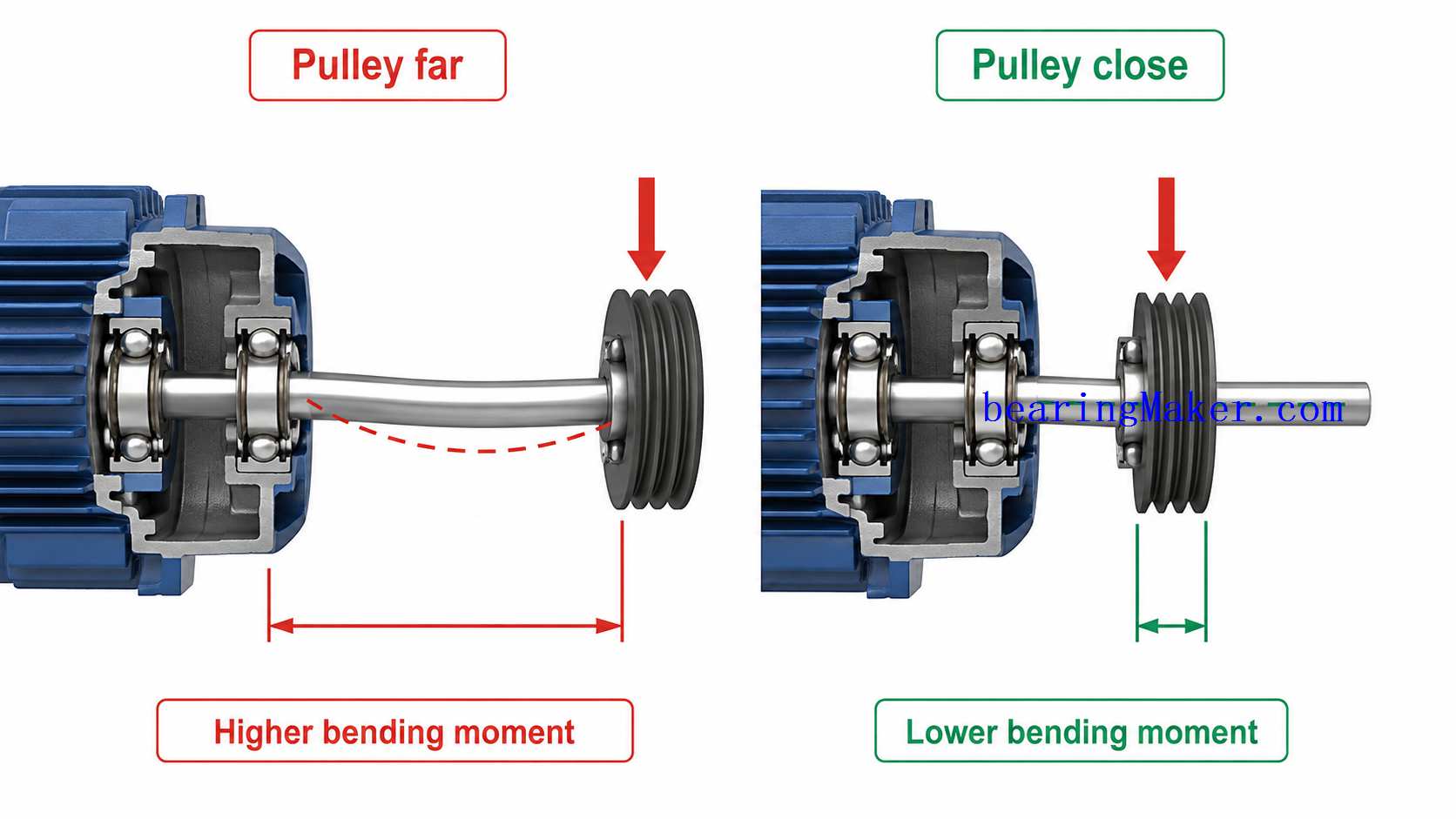
A bent shaft can force the bearings into misalignment.
Shaft Surface Finish
Poor surface finish can affect:
- fit consistency
- seating
Housing Accuracy
The housing should provide:
- correct bore diameter
- roundness
- concentricity
Housing Eccentricity
An eccentric housing can position the outer ring away from the intended rotational axis.
Housing Distortion
Thin plastic or lightweight housings may deform due to:
- assembly force
- temperature
- screw tightening
This can alter bearing alignment.
Shoulder Squareness
A shoulder should be sufficiently square to the shaft axis.
An angled shoulder can tilt the bearing.
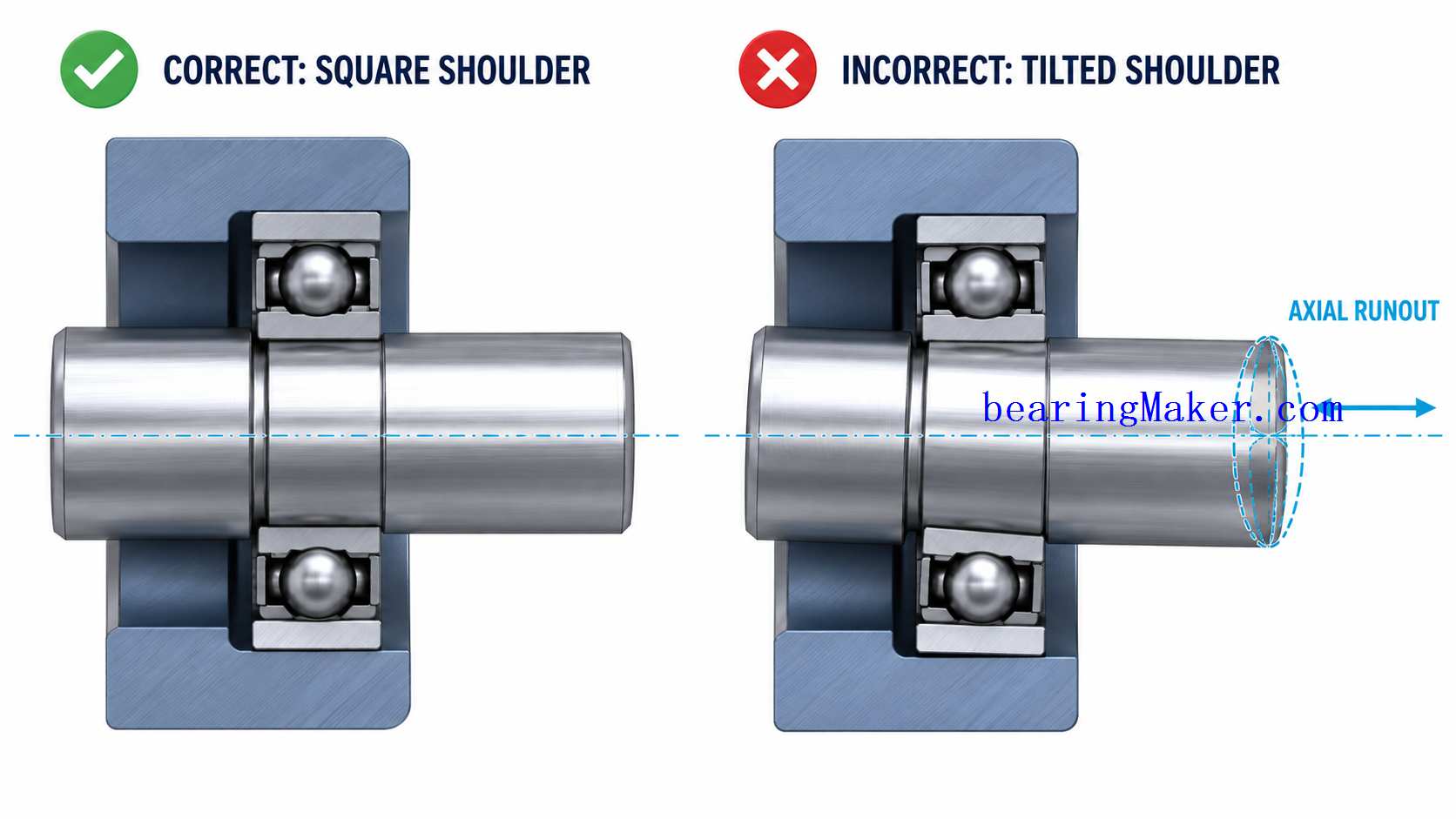
Dirt Between Bearing and Shoulder
Even a small particle trapped between:
- bearing ring
- shoulder
can tilt the bearing.
This illustrates why clean assembly is important not only for raceway contamination but also for mounting accuracy.
Precision in Plastic Housings
Miniature bearings are commonly installed in molded plastic components.
Possible issues include:
- shrinkage
- warpage
- thermal expansion
- creep
The housing may meet dimensions initially but change during operation.
Temperature and Precision
Temperature changes:
- shaft dimensions
- housing dimensions
- internal clearance
- lubricant viscosity
This can influence:
- runout
- torque
- vibration
Thermal Growth and Clearance
If the shaft and inner ring become hotter than the housing:
- internal clearance may decrease
This can increase:
- preload
- torque
Thermal Drift
Precision instruments may show different performance:
- immediately after startup
- after reaching thermal equilibrium
Measurements should therefore distinguish cold and steady-state conditions.
Measuring Radial Runout
Radial runout can be measured using:
- dial indicator
- displacement sensor
- precision metrology equipment
The probe is placed against a rotating cylindrical surface.
The total variation is recorded during one revolution.
What the Measurement Actually Includes
If runout is measured on the assembled shaft, the result may include:
- bearing error
- shaft error
- mounting error
It is therefore a system measurement, not purely a bearing measurement.
Measuring Axial Runout
A probe can be placed against a rotating face.
Variation during rotation represents axial face runout.
Measurement accuracy depends strongly on:
- measurement radius
- datum quality
- fixture rigidity
Measuring Noise
Bearing noise may be measured using:
- microphones
- acoustic test systems
- specialized bearing noise equipment
Test conditions must be controlled because sound level depends on:
- speed
- mounting
- surrounding structure
Measuring Vibration
Possible tools include:
- accelerometers
- velocity sensors
- displacement probes
The appropriate method depends on:
- frequency range
- machine size
- measurement goal
Measuring Bearing Vibration Before Installation
Specialized bearing testing can help characterize the bearing itself.
However, final machine vibration may differ greatly because of:
- rotor
- housing
- assembly
Measuring System Vibration After Installation
Final validation should be performed in the actual machine whenever practical.
This captures:
- bearing
- shaft
- housing
- rotor
- mounting
as one system.
Measurement Repeatability
For useful comparisons, keep consistent:
- speed
- temperature
- mounting
- sensor location
- preload
Without controlled conditions, results may not be directly comparable.
Establishing a Baseline
One of the best diagnostic practices is to record the behavior of a known-good system.
Baseline parameters may include:
- radial runout
- axial runout
- vibration
- noise
- torque
- temperature
Future changes can then be compared against this baseline.
Noise Trends Over Time
Increasing noise may indicate:
- lubricant degradation
- contamination
- wear
- raceway damage
Vibration Trends Over Time
Increasing vibration may indicate:
- imbalance
- looseness
- bearing damage
- shaft deterioration
Trend monitoring can reveal problems before catastrophic failure.
Diagnosing Excessive Noise
If a miniature bearing system becomes noisy, check systematically.
Check Contamination
Inspect for:
- dust
- debris
- dirty grease
Check Lubrication
Confirm:
- correct lubricant
- correct quantity
Check Raceway Condition
Look for:
- damage
- corrosion
- indentations
Check Cage
Inspect for abnormal wear.
Check Seals
Listen for:
- rubbing
- irregular contact
Check Shaft and Rotor
Verify:
- balance
- runout
Diagnosing Excessive Vibration
Possible causes include:
- rotor imbalance
- bearing runout
- shaft bending
- misalignment
- brinelling
- structural resonance
Diagnosing Periodic Vibration
Regular vibration repeating once per shaft revolution may suggest:
- imbalance
- eccentricity
- runout
Other repeating frequencies may be related to:
- rolling elements
- cage
- raceway defects
Diagnosing Random Roughness
Irregular rough vibration may point to:
- contamination
- surface damage
- poor lubrication
Diagnosing High Runout
Check:
- bearing
- shaft
- housing
- shoulder
- contamination at mounting interfaces
Do not replace the bearing until these contributors are separated.
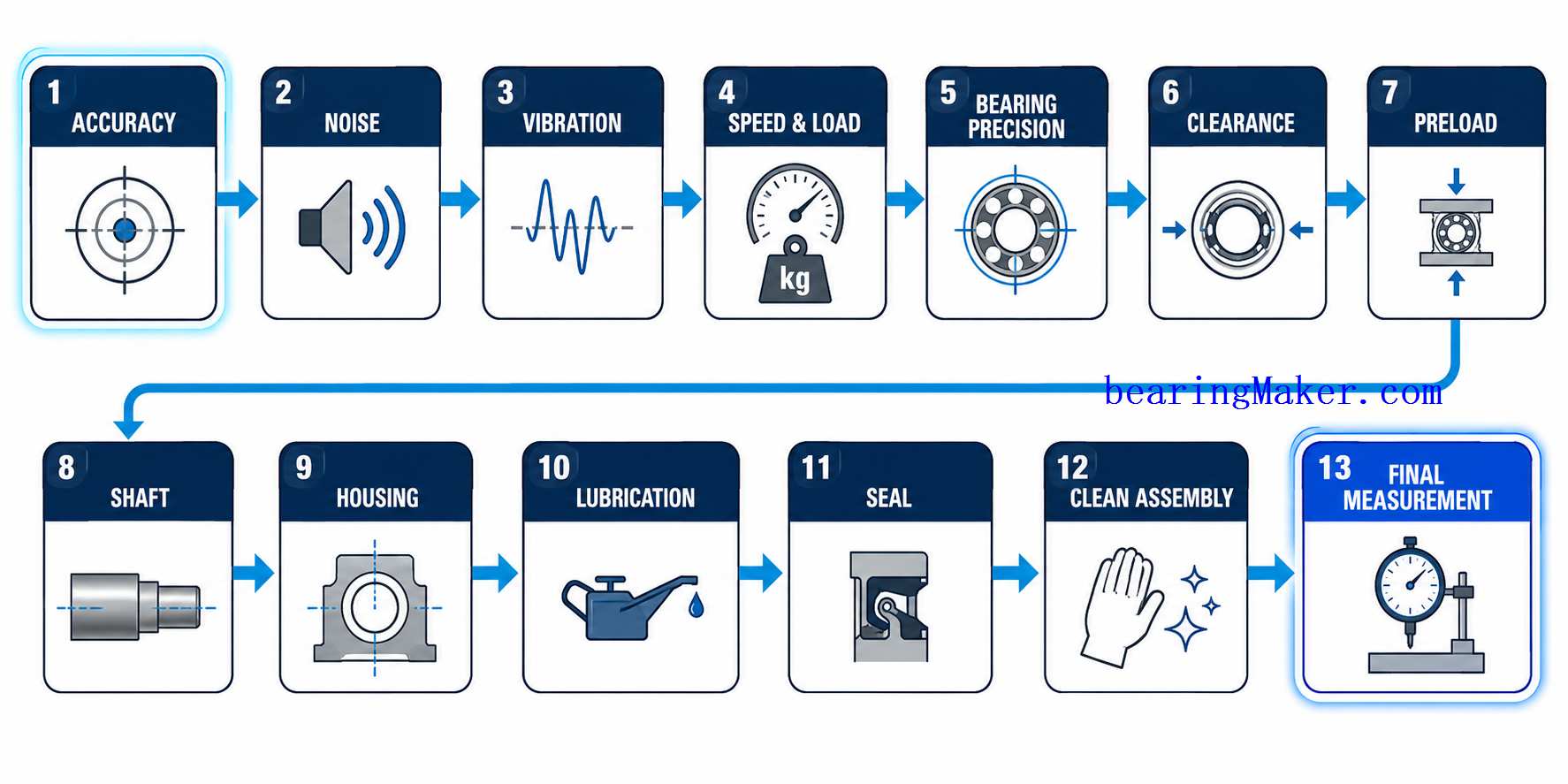
Precision Selection Workflow
Step 1: Define System Accuracy
Specify required:
- radial runout
- axial runout
- repeatability
Step 2: Define Noise Requirement
Determine whether the application has:
- acoustic limits
- subjective sound-quality requirements
Step 3: Define Vibration Requirement
Specify allowable:
- displacement
- velocity
- acceleration
as appropriate.
Step 4: Define Speed
Precision behavior should be evaluated at the real operating RPM.
Step 5: Define Load
Check whether external load changes:
- deflection
- alignment
Step 6: Select Bearing Precision
Choose a precision level appropriate to the total system error budget.
Step 7: Select Internal Clearance
Balance:
- low play
- friction
- temperature
Step 8: Define Preload
Use only the preload needed for:
- stiffness
- stability
Step 9: Specify Shaft Accuracy
Control:
- roundness
- straightness
- runout
Step 10: Specify Housing Accuracy
Control:
- bore diameter
- concentricity
- roundness
Step 11: Specify Mounting Faces
Control:
- shoulder squareness
- face flatness
Step 12: Select Lubrication
Consider:
- low noise
- low torque
- temperature
Step 13: Select Seals or Shields
Balance:
- contamination protection
- drag
- noise
Step 14: Control Assembly Cleanliness
Prevent:
- raceway contamination
- trapped particles at mounting surfaces
Step 15: Validate Final Assembly
Measure:
- runout
- vibration
- noise
- torque
Step 16: Validate at Operating Temperature
Repeat critical measurements after thermal stabilization.
Precision and NVH Comparison Matrix
| Requirement | Primary Factors |
|---|---|
| Low radial runout | Bearing + shaft concentricity |
| Low axial runout | Bearing + shoulder squareness |
| Low noise | Raceway + lubricant + contamination |
| Low vibration | Runout + balance + bearing condition |
| Low torque variation | Geometry + lubricant + preload |
| High repeatability | Clearance + stiffness + mounting |
| High-speed smoothness | Precision + balance + cage |
| Quiet fan | Bearing + lubricant + rotor + housing |
| Accurate encoder | Runout + axial play + shaft geometry |
Common Precision Design Mistakes
Mistake 1: Assuming Higher ABEC Automatically Means Lower Noise
Precision classification does not fully describe acoustic performance.
Mistake 2: Blaming All Machine Noise on the Bearing
The source may be:
- motor
- fan
- housing resonance
Mistake 3: Ignoring Shaft Runout
A precision bearing cannot correct a poor shaft.
Mistake 4: Ignoring Housing Concentricity
Outer-ring position affects system accuracy.
Mistake 5: Using Excessive Preload to Eliminate Play
This may increase:
- heat
- torque
without improving total system performance.
Mistake 6: Measuring Runout Before Final Assembly Only
Final mounting can change alignment.
Mistake 7: Ignoring Lubricant Noise
Lubricant selection can strongly influence miniature bearing acoustic behavior.
Mistake 8: Ignoring Contamination
A tiny particle can create a major noise or vibration problem.
Mistake 9: Treating Runout and Vibration as the Same Parameter
Runout is geometric; vibration is dynamic.
Mistake 10: Measuring Precision Only When Cold
Thermal growth may change actual operating performance.
Troubleshooting High Noise
Possible causes include:
- contamination
- poor lubrication
- cage noise
- seal rubbing
- raceway damage
- motor noise
- structural resonance
Troubleshooting High Radial Runout
Check:
- shaft eccentricity
- bearing raceway accuracy
- housing eccentricity
- mounting contamination
Troubleshooting High Axial Runout
Check:
- shoulder squareness
- face flatness
- bearing tilt
- axial clamping
Troubleshooting Excessive Vibration
Check:
- rotor balance
- shaft straightness
- bearing condition
- housing stiffness
- alignment
Troubleshooting Increasing Noise Over Time
Possible causes include:
- lubricant aging
- contamination
- raceway wear
- corrosion
Troubleshooting Torque Variation With Noise
This combination may indicate:
- contamination
- raceway damage
- misalignment
Troubleshooting Precision Drift After Warm-Up
Possible causes include:
- thermal expansion
- clearance reduction
- preload change
- housing distortion
Frequently Asked Questions
What Does Miniature Bearing Precision Mean?
It refers to dimensional and rotational tolerances such as:
- bore accuracy
- OD accuracy
- radial runout
- axial runout
What Is ABEC?
ABEC is a bearing precision classification system that defines dimensional and rotational tolerance levels.
It does not fully describe:
- noise
- lubrication
- life
Does a Higher ABEC Rating Mean a Quieter Bearing?
Not necessarily.
Noise also depends on:
- raceway finish
- balls
- lubricant
- contamination
- cage
- seals
What Is Radial Runout?
Radial runout is variation perpendicular to the rotational axis during one revolution.
What Is Axial Runout?
Axial runout is variation along the shaft axis, often seen as face wobble.
Is Runout the Same as Internal Clearance?
No.
Runout is rotational geometric error.
Clearance is relative movement between bearing rings.
Is Runout the Same as Vibration?
No.
Runout is geometric deviation.
Vibration is dynamic motion.
What Causes Miniature Bearing Noise?
Common causes include:
- raceway surface irregularities
- contamination
- lubricant
- cage
- seals
- bearing damage
Why Are Miniature Bearings Sensitive to Contamination?
Their rolling contacts and internal clearances are very small.
A tiny particle can therefore be large relative to the contact geometry.
Can Lubrication Affect Noise?
Yes.
Lubricant type, quantity, condition, and distribution can all influence acoustic behavior.
Why Does a Bearing Become Noisy After Installation?
Possible causes include:
- fit-induced clearance change
- misalignment
- contamination
- excessive preload
Can Preload Reduce Vibration?
Proper preload can reduce play and improve shaft stability.
Too much preload can increase:
- torque
- heat
Does Higher Preload Improve Precision?
Only up to the point where additional stiffness is useful.
Excessive preload can create thermal and friction problems.
Why Does Bearing Runout Increase After Assembly?
Possible causes include:
- shaft runout
- housing error
- tilted shoulder
- trapped debris
Can a Perfect Bearing Still Produce Machine Vibration?
Yes.
Other sources include:
- rotor imbalance
- gears
- motor electromagnetic forces
- structural resonance
Why Does My Fan Become Noisy Over Time?
Possible causes include:
- bearing wear
- grease aging
- contamination
- fan imbalance
Can Plastic Housings Affect Bearing Precision?
Yes.
Plastic may change shape due to:
- molding distortion
- temperature
- creep
Should Precision Be Checked at Operating Temperature?
For demanding applications, yes.
Thermal expansion may change:
- clearance
- runout
- preload
Miniature Bearing Precision and NVH Checklist
Before finalizing the bearing system, define:
| Parameter | What to Determine |
|---|---|
| Bore accuracy | Required tolerance |
| OD accuracy | Required tolerance |
| Width accuracy | Required tolerance |
| Bearing precision | Required class |
| Radial runout | Maximum allowable |
| Axial runout | Maximum allowable |
| Shaft runout | Maximum allowable |
| Shaft roundness | Required accuracy |
| Shaft straightness | Required accuracy |
| Housing concentricity | Required accuracy |
| Housing roundness | Required accuracy |
| Shoulder squareness | Required accuracy |
| Mounting-face flatness | Required accuracy |
| Radial clearance | Installed requirement |
| Axial clearance | Installed requirement |
| Preload | Required amount |
| Speed | Operating rpm |
| Load | Continuous and peak |
| Noise | Maximum acceptable |
| Vibration | Maximum acceptable |
| Lubricant | Low-noise/low-torque requirement |
| Lubricant quantity | Controlled |
| Closure | Open/shielded/sealed |
| Rotor balance | Required quality |
| Assembly cleanliness | Controlled |
| Operating temperature | Cold/steady state |
| Measurement datum | Defined |
| Baseline test | Established |
Conclusion
Miniature bearing precision is not defined by one tolerance, one ABEC class, or one runout measurement.
Real rotational quality is created by the interaction of:
- bearing geometry
- ball quality
- raceway finish
- internal clearance
- preload
- shaft accuracy
- housing accuracy
- lubrication
- contamination
- balance
- temperature
Radial and axial runout describe geometric rotational error.
Noise describes the acoustic result of mechanical excitation.
Vibration describes dynamic mechanical motion.
These characteristics are connected, but they are not interchangeable.
A high-precision bearing can still be noisy because of contamination or lubricant.
A low-runout bearing can still produce vibration if the rotor is unbalanced.
A quiet bearing can still provide poor system accuracy if the shaft or housing is misaligned.
The most reliable design process is therefore:
System Accuracy → Runout Budget → Noise and Vibration Requirement → Bearing Precision → Clearance → Preload → Shaft Accuracy → Housing Accuracy → Lubrication → Clean Assembly → Thermal Validation
The goal is not simply to specify the highest possible bearing precision class.
The goal is to create a miniature rotating system that remains:
- accurate
- quiet
- smooth
- low-vibration
- low-torque
- repeatable
under the actual speed, load, mounting, and temperature conditions of the machine.