Miniature bearings are widely used in small electric motors, cooling fans, precision instruments, medical devices, encoders, miniature pumps, and high-speed mechanisms.
In many of these applications, bearing load is not the main design limitation.
Instead, performance may be determined by:
- rotational speed
- starting torque
- running torque
- lubricant drag
- seal friction
- preload
- cage behavior
- heat generation
This is one of the most important differences between miniature bearing selection and ordinary industrial bearing selection.
A bearing may have more than enough load capacity but still be unsuitable because it:
- requires too much torque to start
- runs too hot
- creates excessive drag
- produces unstable torque
- cannot maintain lubrication at the required speed
These problems become especially important because the drive system itself may also be very small.
A small increase in bearing friction that would be insignificant in a large motor may consume a meaningful percentage of the available torque in a miniature motor.
High RPM also creates a large number of rolling-contact cycles in a short period of time.
For this reason, a good miniature bearing design must treat:
speed, friction, torque, lubrication, preload, seals, and temperature
as an interconnected operating system.
This guide explains what limits miniature bearing speed, where bearing friction comes from, how starting and running torque differ, why heat is generated, and how to design a miniature bearing system for stable high-speed operation.
Why Miniature Bearings Are Used at High Speed
Miniature ball bearings are naturally suited to high-speed applications because they combine:
- small rolling elements
- low mass
- relatively small rolling-path diameter
- low rolling friction
This makes them common in:
- electric motors
- cooling fans
- dental equipment
- miniature spindles
- high-speed instruments
However, “small bearing” does not automatically mean “unlimited speed.”
The practical speed limit is determined by the complete bearing system.
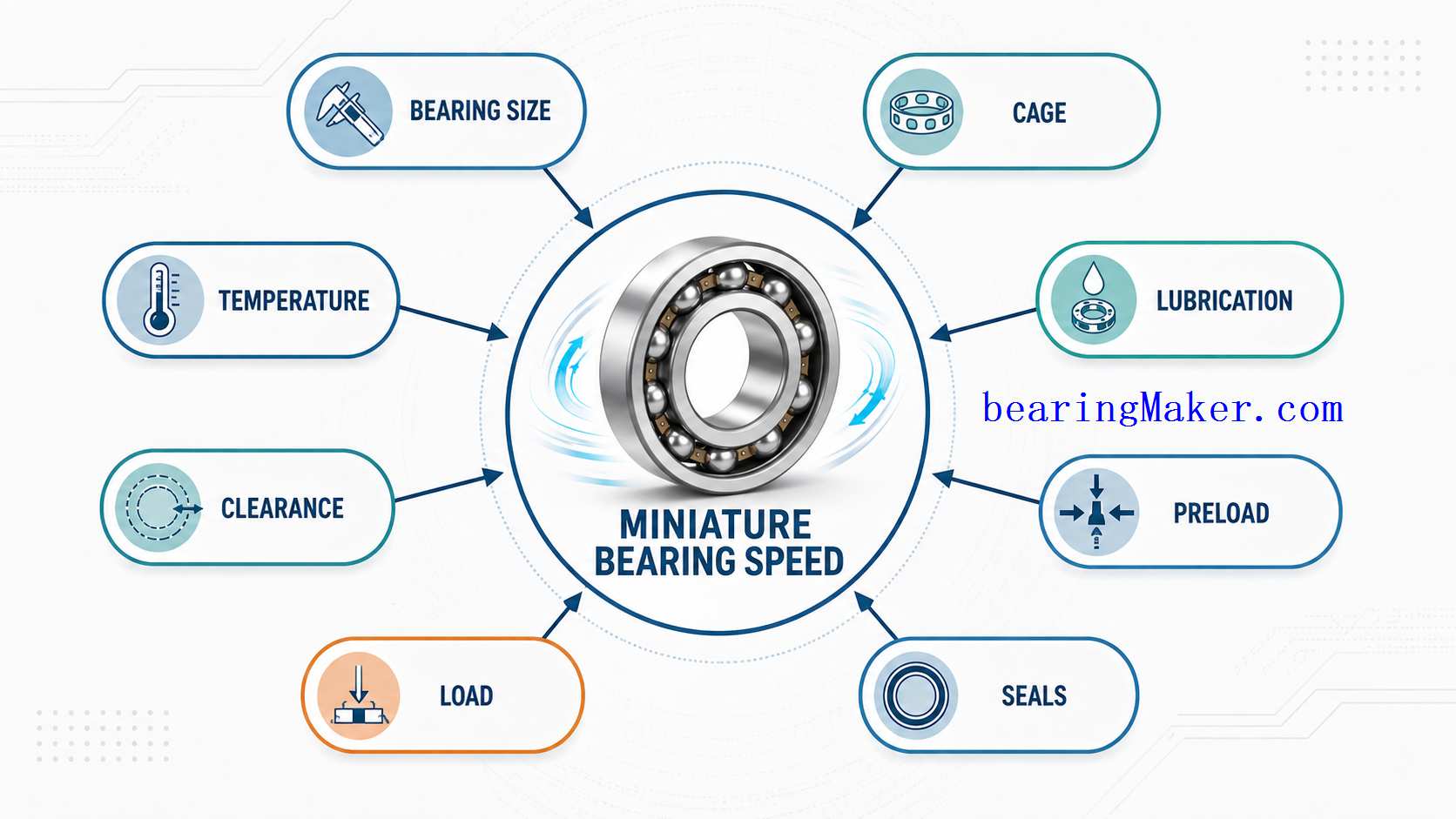
What Limits Miniature Bearing Speed?
Maximum usable speed depends on several interacting factors:
- bearing size
- ball diameter
- cage design
- lubricant
- lubricant quantity
- internal clearance
- preload
- seals
- external load
- temperature
The manufacturer’s limiting speed or reference speed is therefore only one part of the design evaluation.
Actual operating conditions may require a lower practical limit.
RPM Is Not the Whole Speed Story
Rotational speed is normally expressed in revolutions per minute:
RPM
This tells us how often the shaft rotates.
But it does not fully describe the internal speed of the bearing.
Bearing diameter also matters.
Why Bearing Diameter Matters
A point traveling around a larger circle must cover more distance per revolution than a point traveling around a smaller circle.
This means two bearings running at the same RPM can have very different:
- rolling-element velocity
- cage velocity
- lubricant shear conditions
Miniature bearings generally benefit from their small diameter because the internal rolling path is relatively short.
Mean Bearing Diameter
A useful approximation for bearing mean diameter is:
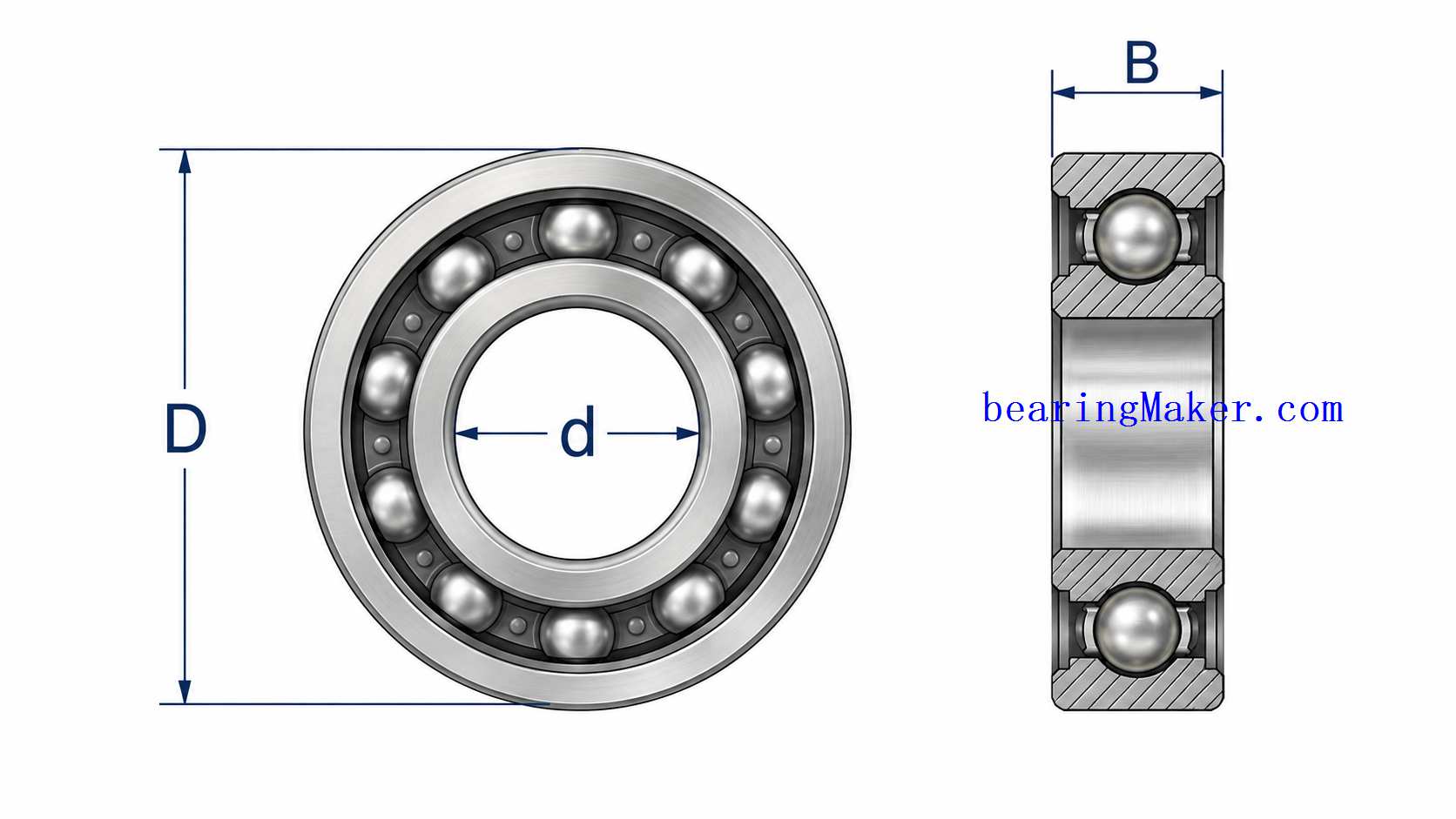
dm=d+D2d_m=\frac{d+D}{2}
where:
- dmd_m = mean bearing diameter
- dd = bore diameter
- DD = outside diameter
This can be combined with speed to form a useful speed factor.
DN and nDm Speed Factors
A common way of comparing bearing operating speed is to combine:
- rotational speed
- bearing diameter
A simplified relationship is:
n×dmn \times d_m
where:
- nn = RPM
- dmd_m = mean bearing diameter
This is often referred to conceptually as an nDm or related speed factor.
It helps explain why:
- a small bearing at 30,000 rpm
- a much larger bearing at 30,000 rpm
do not experience the same internal speed conditions.
No Universal nDm Limit
There is no single nDm limit that applies to every miniature bearing.
Allowable speed depends on:
- bearing construction
- cage
- lubricant
- seal
- preload
The actual bearing specification should therefore be checked.
High RPM and Number of Fatigue Cycles
Very high RPM also means the bearing accumulates revolutions quickly.
Consider a bearing running at:
30,000 rpm30,000\text{ rpm}
In one hour, it completes:
30,000×60=1.8 million revolutions30,000\times60 = 1.8\text{ million revolutions}
So even a bearing with a high calculated revolution life can accumulate its fatigue cycles quickly in continuous high-speed service.
Ball Speed
Inside the bearing, the balls do more than simply rotate around the shaft.
They:
- orbit around the bearing
- spin around their own axes
- interact with the raceways and cage
At high speed, these movements create:
- centrifugal force
- cage forces
- lubricant shear
Rolling-Element Centrifugal Effects
As rotational speed rises, centrifugal effects increase.
The approximate physical relationship follows the general principle that centrifugal loading increases strongly with rotational speed.
This can change:
- ball-to-raceway contact
- contact stress
- cage loading
Because miniature balls have low mass, miniature bearings generally benefit from reduced rolling-element centrifugal force compared with much larger bearings.
Why Ceramic Balls Can Be Useful at High Speed
Hybrid ceramic bearings use ceramic balls with metallic rings.
Because ceramic rolling elements can have lower density than steel balls, they may produce lower centrifugal force at high speed.
Potential benefits may include:
- reduced rolling-element inertial load
- reduced cage loading
But hybrid ceramic construction should not be treated as an automatic upgrade.
High-speed performance still depends on:
- preload
- lubrication
- cage
- fit
- temperature
Cage Behavior
The cage keeps the balls:
- separated
- evenly distributed
- guided
At high speed, cage dynamics become increasingly important.
The cage experiences:
- inertial force
- lubricant drag
- ball contact
- acceleration loads
Cage Material
Miniature bearing cages may be made from:
- metal
- engineered polymers
- other specialized materials
Cage selection can influence:
- speed
- friction
- noise
- temperature capability
Lightweight Cages
Reducing cage mass can reduce inertial forces.
This can be helpful in:
- high-speed motors
- rapid acceleration applications
Cage Stability
A cage must remain stable as the balls accelerate and decelerate.
Unstable cage motion can create:
- noise
- friction
- wear
- heat
Acceleration Matters, Not Just Maximum RPM
Many miniature bearing systems do not operate continuously at constant speed.
They may repeatedly:
- start
- accelerate
- stop
- reverse
Examples include:
- small servo motors
- actuators
- robotics
- instruments
In these systems, acceleration can influence bearing dynamics even if maximum RPM is moderate.
Rapid Acceleration
During rapid acceleration:
- balls change orbital speed
- cage speed changes
- lubricant redistributes
Repeated acceleration can create additional cage and lubricant demands.
Reversing Motion
Direction reversal can be especially demanding because the rolling elements and cage must repeatedly change dynamic state.
This should be considered in:
- servo systems
- miniature actuators
- positioning equipment
What Is Bearing Friction?
Bearing friction is the resistance that opposes rotation.
In a miniature bearing, total friction can come from several sources:
- rolling contact
- sliding contact
- lubricant drag
- cage interaction
- seal contact
- preload
The bearing’s torque is the rotational effect of these friction forces.
Rolling Friction
Ball bearings have relatively low rolling friction because the balls roll between the raceways.
However, contact is not perfectly frictionless.
Elastic deformation and microscopic sliding still occur.
Sliding Friction
Sliding may occur between:
- ball and raceway
- ball and cage
- cage and guiding surfaces
Its magnitude depends on:
- speed
- load
- lubrication
- internal geometry
Lubricant Drag
Grease and oil resist motion.
This viscous resistance becomes especially important when:
- lubricant viscosity is high
- grease quantity is excessive
- temperature is low
Seal Friction
Contact seals create direct sliding friction.
In a miniature bearing, seal drag can represent a significant percentage of total bearing torque.
Preload Friction
Preload increases the contact force between:
- balls
- raceways
This increases stiffness, but also increases friction.
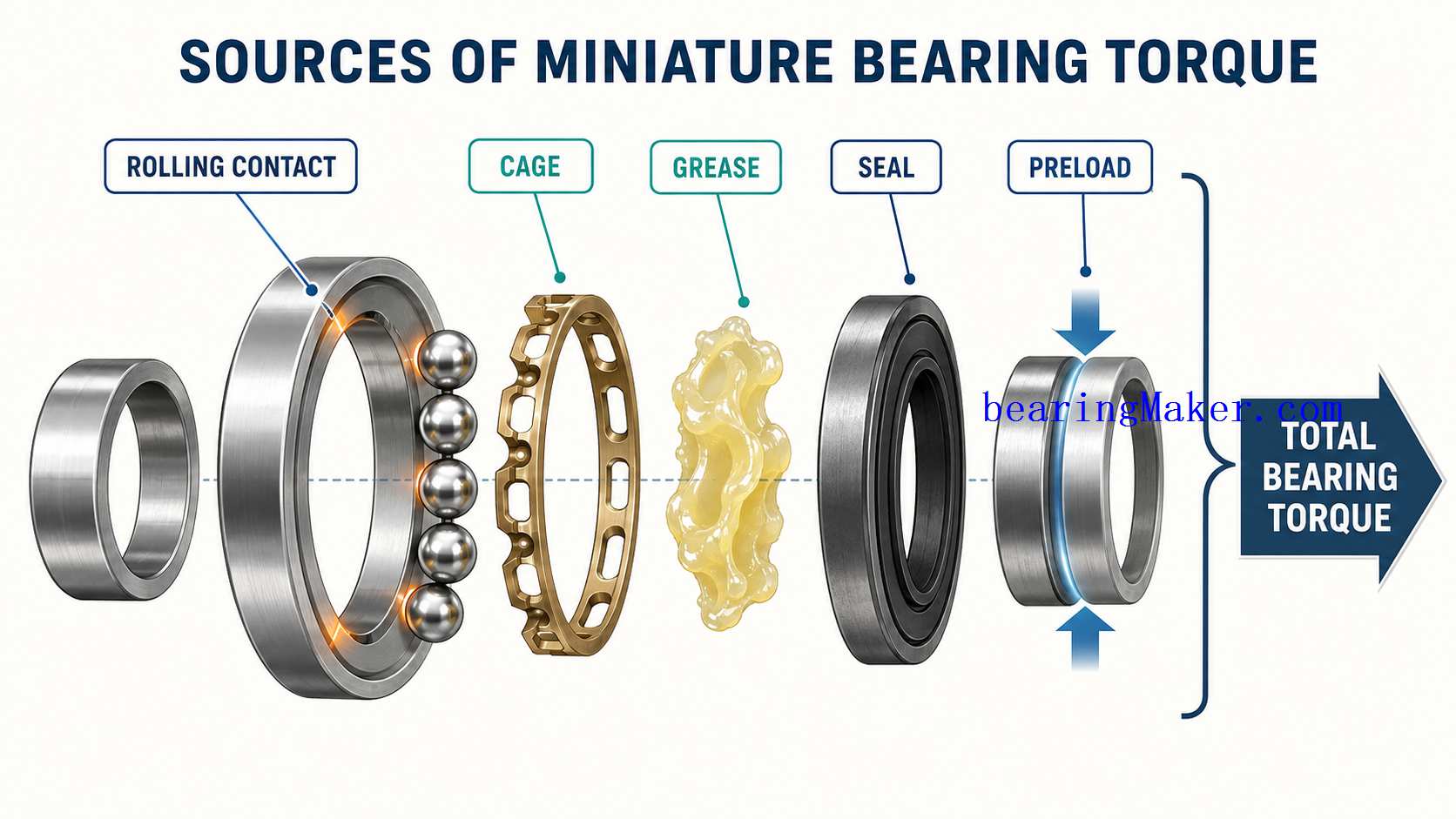
Total Bearing Torque
The practical bearing torque can therefore be viewed as the combined effect of:
rolling friction + sliding friction + lubricant drag + cage drag + seal drag + preload
This is why simply choosing a “low-friction bearing” is not enough.
The entire configuration must support the torque requirement.
Starting Torque vs. Running Torque
These two terms describe different operating conditions.
Starting Torque
Starting torque is the torque required to initiate rotation from rest.
It is also sometimes associated with breakaway torque.
Starting torque is particularly important in miniature systems because motors may have very limited available torque.
Running Torque
Running torque is the resistance after the bearing has begun rotating.
It affects:
- power consumption
- steady-state motor load
- heat generation
- operating speed
Why Starting Torque Can Be Higher
Starting torque can be higher because:
- seals are initially stationary
- grease resists initial displacement
- lubricant viscosity may be high
- static contact conditions differ from running conditions
Why Starting Torque Matters in Small Motors
Suppose a miniature motor produces only a small amount of startup torque.
If the bearing system consumes a significant fraction of it, the motor may:
- start slowly
- fail to start under cold conditions
- draw excessive current
This is why low starting torque can be a critical bearing requirement.
Low-Temperature Starting Torque
Low temperature can increase:
- grease viscosity
- seal stiffness
A bearing that starts easily at room temperature may become difficult to rotate when cold.
This should be evaluated in:
- outdoor equipment
- aerospace
- refrigerated systems
Seal Type and Starting Torque
In general:
- open bearings have no integral seal drag
- shielded bearings have very low closure friction
- contact seals produce higher drag
If contamination risk is low and torque is critical, open or shielded designs may be preferable.
Why the Strongest Seal Is Not Always Best
A designer may choose a heavy contact seal for maximum protection.
But if the mechanism is:
- very small
- high speed
- torque-sensitive
that seal may create more performance problems than the contamination risk it solves.
The correct seal balances:
protection vs. torque
Running Torque and Motor Efficiency
Bearing friction becomes a continuous parasitic load on the motor.
Higher running torque means the motor must consume more energy simply to overcome bearing resistance.
This can reduce:
- motor efficiency
- battery life
- available output torque
Bearing Torque and Heat Generation
Friction converts mechanical energy into heat.
A simplified relationship for frictional power is:
Q∝MfωQ \propto M_f\omega
where:
- MfM_f = friction torque
- ω\omega = angular speed
This means that even moderate friction torque can generate substantial heat at very high speed.
Why High Speed Amplifies Friction Problems
At low speed, a small increase in bearing torque may create little heat.
At high speed, the same additional torque acts through many more rotations per unit time.
Heat generation therefore rises.
Sources of Heat
Miniature bearing heat may come from:
- rolling friction
- sliding friction
- grease churning
- seal drag
- excessive preload
- misalignment
Heat Must Leave the Bearing
Heat generated inside the bearing must be transferred through:
- shaft
- housing
- surrounding air
- lubricant
If heat generation exceeds heat dissipation, temperature rises.
Small Bearings Have Both Advantages and Challenges
Miniature bearings have low mass and can respond quickly to temperature changes.
Their small size may also provide a favorable surface-area relationship.
However, the complete mechanism may be enclosed inside:
- plastic housing
- motor shell
- compact electronics
where cooling is limited.
Thermal Equilibrium
Bearing temperature typically rises until:
heat generation = heat dissipation
This steady state is the thermal equilibrium condition.
The important question is whether that temperature is acceptable for:
- lubricant
- seals
- cage
- clearance
- bearing life
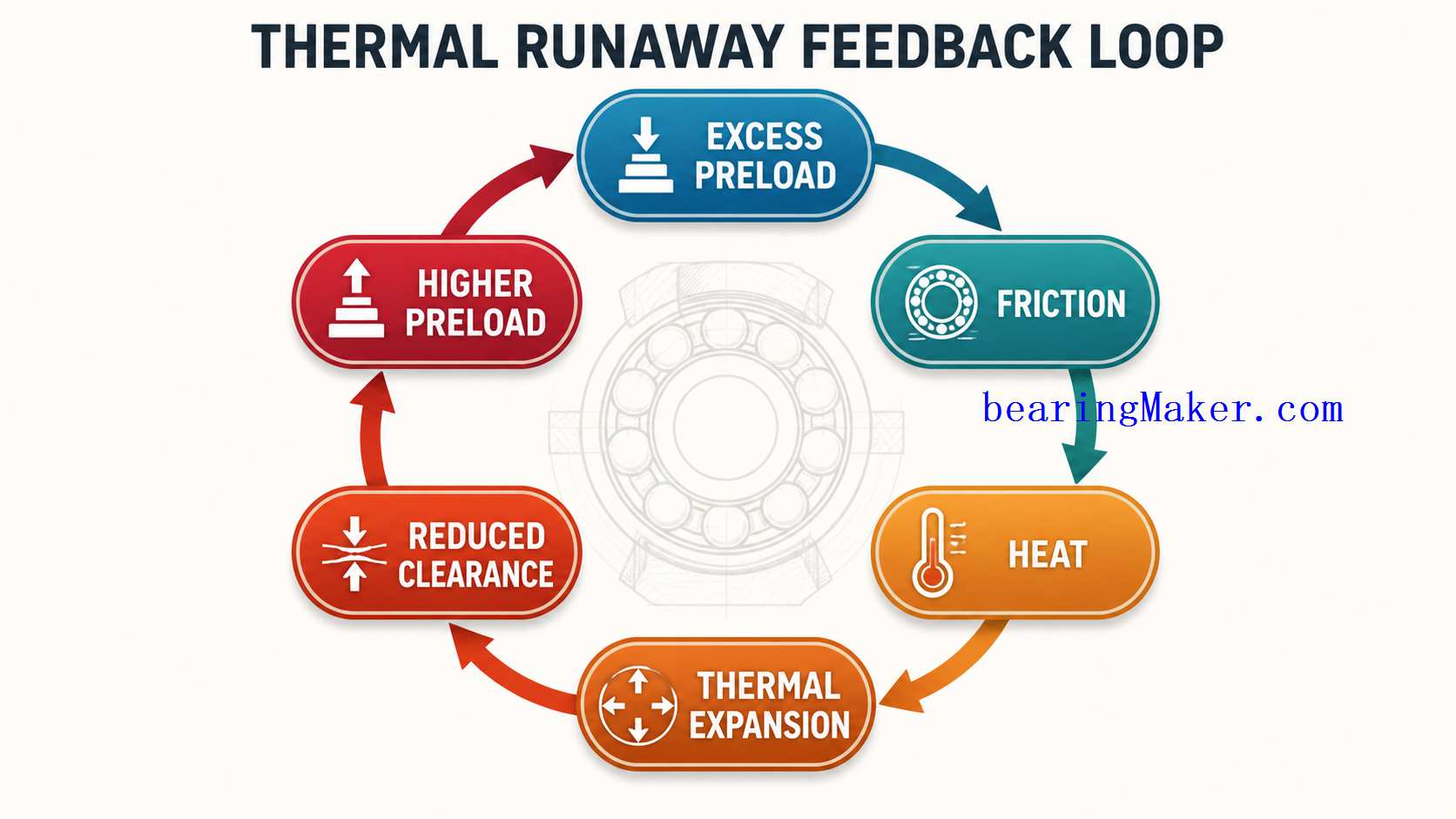
Thermal Runaway
A dangerous feedback process can occur:
friction rises → heat rises → clearance decreases → preload rises → friction rises further
This is especially possible when:
- fits are tight
- preload is high
- thermal expansion is poorly controlled
Internal Clearance and High Speed
Internal clearance changes as the bearing reaches operating temperature.
The inner ring may become warmer than the outer ring.
If the inner ring expands more:
- radial clearance decreases
A bearing with little initial clearance may become excessively tight.
Why Initial Clearance Cannot Be Selected in Isolation
The actual operating clearance depends on:
- initial bearing clearance
- inner-ring fit
- outer-ring fit
- temperature difference
This is why high-speed bearing selection should consider the installed and operating clearance, not only the free-bearing condition.
Preload and High-Speed Operation
Preload can improve:
- stiffness
- precision
- running stability
But it also increases:
- rolling contact force
- friction
- heat
Why Excessive Preload Is Dangerous at High Speed
A preload that seems acceptable when the shaft is rotated slowly by hand may become excessive once speed produces:
- thermal expansion
- lubricant heating
This can cause:
- rapid temperature rise
- reduced lubricant life
- premature bearing failure
Preload Should Be Purpose-Driven
Preload should be applied only to achieve a defined requirement such as:
- stiffness
- reduced play
- reduced vibration
It should not be added simply because tighter bearings “feel better.”
Grease and Friction
Grease lubrication is common in miniature bearings because it is:
- simple
- self-retaining
- low-maintenance
But grease can also become one of the largest contributors to torque.
Why Grease Quantity Is Especially Important
A miniature bearing has very little internal free volume.
A small absolute amount of excess grease can occupy a large percentage of that space.
The balls and cage then repeatedly push through the grease.
This creates:
- churning
- drag
- heat
Overgreasing
Symptoms may include:
- high initial torque
- rapid temperature rise
- temporarily high current draw in a motor
In some systems, excess grease may redistribute after operation and torque may decrease.
But excessive fill should not be used as the normal lubrication strategy.
Underlubrication
Too little grease creates a different risk.
It can result in:
- inadequate lubricant film
- wear
- noise
- shortened life
The objective is not minimum grease.
It is the correct grease quantity.
Grease Distribution During Run-In
After installation, grease may not initially be distributed evenly.
During early operation, excess grease can be pushed away from the immediate rolling path.
This may cause running torque to change during a run-in period.
Run-In Behavior
A new miniature bearing system may show:
- higher initial torque
- higher initial temperature
followed by stabilization.
However, excessive heat should not automatically be dismissed as normal run-in.
A stable baseline should be established for the actual machine.
Grease Viscosity
Higher-viscosity lubricant generally provides:
- greater film thickness
but can also increase:
- viscous drag
- starting torque
The correct viscosity must balance:
film formation vs. friction
Temperature and Grease Viscosity
As temperature decreases:
- grease and base oil become more resistant to motion
Starting torque may rise.
As temperature increases:
- lubricant becomes less viscous
but very high temperature may accelerate degradation.
Low-Torque Greases
Some precision systems use lubricants formulated to reduce:
- starting torque
- running torque
These may be useful in:
- instruments
- small motors
- encoders
Low-Noise Greases
Other lubricants may be optimized for:
- smooth acoustic performance
- stable consistency
This can matter in:
- cooling fans
- medical equipment
- consumer electronics
Oil Lubrication
Oil may provide advantages where:
- speed is extremely high
- very low viscous resistance is required
- heat removal matters
Possible oil systems include:
- oil mist
- oil-air
- circulation
depending on machine design.
Oil Limitations
Oil lubrication can increase system complexity through:
- leakage control
- reservoirs
- supply systems
For many miniature bearings, grease remains the more practical solution.
Open Bearings and High Speed
Open bearings provide:
- no integral seal drag
- good lubricant access
This makes them attractive for high-speed systems with controlled environments.
Shielded Bearings and High Speed
Shielded bearings are widely used because they provide:
- low drag
- basic contamination protection
They are common in:
- high-speed motors
- fans
Contact-Sealed Bearings and Speed
Contact seals offer stronger protection.
However, sliding seal contact creates:
- friction
- heat
At high speed, this can become an important limitation.
External Sealing
Instead of relying on a contact seal directly on the bearing, the machine may use:
- covers
- labyrinth features
- external seals
This can protect the bearing while preserving low internal bearing torque.
Friction vs. Protection
| Closure | Friction | Protection | High-Speed Suitability |
|---|---|---|---|
| Open | Lowest | Low | Excellent |
| Shielded | Very low | Moderate | Excellent |
| Low-contact sealed | Moderate | High | Good |
| Contact sealed | Higher | Very high | Application-dependent |
Load and Bearing Friction
Bearing load also influences friction.
As load increases:
- rolling contact deformation increases
- contact forces increase
This generally increases friction torque.
Why an Oversized Bearing Is Not Always Better
Choosing a larger bearing can increase:
- load capacity
but may also increase:
- diameter
- seal circumference
- lubricant volume
- rotational drag
If the application load is small, oversizing may not produce a useful performance benefit.
Misalignment and Friction
Misalignment can cause:
- uneven ball loading
- increased sliding
- higher torque
Possible causes include:
- shaft bending
- non-coaxial housing bores
- tilted shoulders
Tight Fits and Friction
Excessive interference can reduce internal clearance.
The bearing may become unintentionally preloaded.
Symptoms can include:
- high starting torque
- high temperature
Housing Fit
A tight outer-ring fit can also reduce clearance.
In small bearings, the absolute change in ring size may be tiny but still significant relative to internal clearance.
Shaft Fit
An oversized shaft can expand the inner ring.
Again, this reduces clearance.
Miniature Bearings in Plastic Housings
Plastic housings may change fit as temperature changes.
Possible effects include:
- loosening
- tightening
- alignment change
depending on:
- material
- geometry
- temperature
This can affect both:
- torque
- heat
Noise, Vibration, and Friction
Friction problems can also appear as:
- noise
- vibration
For example:
- damaged raceways may create periodic torque variation
- contamination can create rough rotation
- cage instability may create noise
High torque should therefore be diagnosed together with acoustic and vibration behavior.
Torque Variation Through a Revolution
A bearing can have an acceptable average torque but poor torque consistency.
Periodic torque variation may indicate:
- shaft runout
- housing misalignment
- raceway damage
- contamination
This matters in precision servo applications.
Breakaway Torque
Breakaway torque is often especially relevant in mechanisms that:
- remain stationary for long periods
- move only occasionally
Examples include:
- optical instruments
- positioning devices
A bearing with low running torque but high breakaway torque may still be unsuitable.
Torque Measurement
Bearing torque can be measured using:
- torque sensors
- motor current estimation
- specialized bearing test equipment
The exact method depends on the required accuracy.
Why Motor Current Can Be Useful
In a small motor, increased bearing torque often increases motor current.
Monitoring current can therefore provide an indirect indication of:
- bearing drag
- preload
- temperature change
However, motor current also includes other mechanical and electrical loads.
Measuring Starting Torque
Starting torque should be measured under realistic conditions, including:
- actual lubricant
- actual seals
- operating temperature
Room-temperature testing alone may not represent cold-start conditions.
Measuring Running Torque
Running torque should be evaluated at:
- low speed
- normal speed
- maximum operating speed
because lubricant and thermal effects change with speed.
Temperature Measurement
Possible measurement locations include:
- bearing housing
- outer ring area
- nearby shaft
Housing surface temperature is often easier to measure than the rolling contact itself.
Temperature Trend vs. Single Temperature
A single temperature number provides limited information.
More useful observations include:
- how quickly temperature rises
- when it stabilizes
- how it compares with baseline
High-Speed Thermal Test
A useful validation test may follow:
- begin from controlled starting temperature
- run at target speed
- measure torque or motor current
- record housing temperature
- continue until temperature stabilizes
- inspect for abnormal noise or vibration
Step Testing
Instead of jumping directly to maximum speed, a new system can be tested at increasing speed levels.
For example:
- low speed
- intermediate speed
- rated speed
- peak speed
At each stage, observe:
- torque
- temperature
- noise
This can reveal where performance begins to deteriorate.
High-Speed Motor Applications
Small electric motors are one of the most important applications for miniature bearings.
Typical requirements include:
- high RPM
- low torque
- low noise
- long life
Motor Bearing Friction
Bearing friction contributes directly to motor loss.
In very small motors, this contribution can be significant.
Motor Startup
High bearing starting torque can cause:
- slower startup
- higher startup current
Motor Temperature
Motor heat can also heat the bearing.
The bearing may therefore receive heat from:
- its own friction
- motor windings
This should be considered when selecting:
- lubricant
- clearance
Cooling Fan Applications
Cooling fans often run:
- continuously
- at relatively high speed
Typical priorities include:
- low noise
- low power consumption
- long lubricant life
Why Fan Bearings Often Fail From More Than Load
Fan bearing loads may be modest.
Service life may instead be controlled by:
- grease aging
- temperature
- contamination
Dental and Medical High-Speed Equipment
Some dental and medical mechanisms operate at extremely high speed.
Important considerations include:
- dynamic balance
- lubrication
- heat
- precision
At very high speed, small installation and lubrication errors become increasingly important.
Precision Instruments
Precision instruments may operate at much lower speeds than motors but require extremely low:
- starting torque
- torque variation
In this case, high-speed capacity may be less important than friction consistency.
Encoders
Encoder bearings can influence:
- rotational smoothness
- signal consistency
Important factors include:
- low torque
- low runout
- stable preload
Miniature Pumps
Miniature pump bearings may experience:
- higher loads
- axial thrust
Load-induced friction can therefore become more important.
The lubricant and seal must also match the operating environment.
Factors That Increase Miniature Bearing Torque
| Cause | Main Effect |
|---|---|
| High preload | Higher rolling contact force |
| Tight shaft fit | Reduced clearance |
| Tight housing fit | Reduced clearance |
| Excess grease | Churning |
| High-viscosity lubricant | Viscous drag |
| Contact seal | Sliding friction |
| Low temperature | Higher lubricant/seal resistance |
| Misalignment | Uneven loading/sliding |
| Contamination | Rough contact |
| Raceway damage | Periodic resistance |
Factors That Increase Bearing Temperature
| Cause | Why Temperature Rises |
|---|---|
| High speed | More frictional work per time |
| Excess preload | Higher contact forces |
| Excess grease | Churning |
| Contact seals | Sliding friction |
| Tight fit | Clearance reduction |
| Misalignment | Increased sliding/contact |
| Poor lubrication | Surface friction |
| Limited cooling | Heat cannot escape |
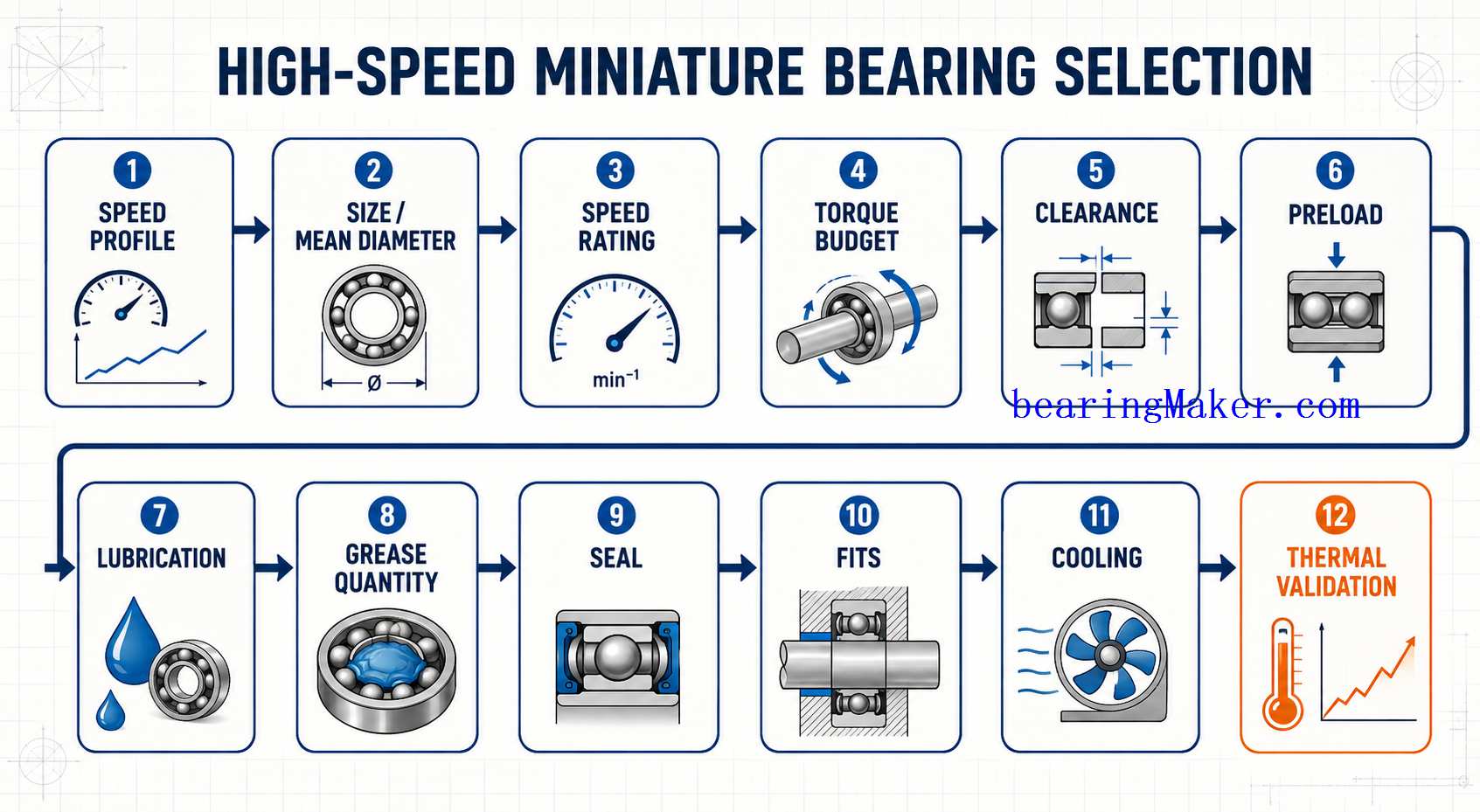
Practical High-Speed Bearing Selection Workflow
Step 1: Define the Speed Profile
Specify:
- continuous RPM
- peak RPM
- duration at peak
- acceleration
- reversal frequency
Step 2: Select Bearing Size
Determine:
- bore
- OD
- width
based on both:
- mechanical load
- speed
Step 3: Consider Mean Diameter
Evaluate the combination of:
- RPM
- bearing diameter
rather than RPM alone.
Step 4: Check Bearing Speed Rating
Compare actual speed with the appropriate bearing data for the selected:
- cage
- seal
- lubrication
Step 5: Define the Torque Budget
Determine the maximum acceptable:
- starting torque
- running torque
Step 6: Select Internal Clearance
Allow for:
- fits
- operating temperature
Step 7: Define Preload
Use only the preload needed for:
- stiffness
- precision
Step 8: Choose Lubrication
Select:
- grease
- oil
based on:
- speed
- temperature
- torque
- life
Step 9: Control Lubricant Quantity
Avoid both:
- overgreasing
- underlubrication
Step 10: Select Closure
Choose:
- open
- shielded
- low-contact sealed
- contact sealed
based on the contamination and torque requirements.
Step 11: Verify Shaft and Housing Fits
Check that fits do not reduce clearance excessively.
Step 12: Check Alignment
Verify:
- shaft straightness
- housing coaxiality
Step 13: Evaluate Cooling
Determine how bearing heat will leave the system.
Step 14: Validate at Low Temperature
If cold starts are relevant, check:
- starting torque
at the minimum operating temperature.
Step 15: Run Thermal Testing
Measure:
- torque/current
- temperature
- noise
- vibration
until steady-state behavior is reached.
Troubleshooting High Starting Torque
If starting torque is too high, check:
- lubricant viscosity
- grease quantity
- contact seals
- preload
- shaft fit
- housing fit
- temperature
Troubleshooting High Running Torque
Possible causes include:
- excessive preload
- excessive grease
- misalignment
- seal drag
- bearing damage
Troubleshooting Torque That Increases With Speed
Possible causes include:
- lubricant churning
- seal friction
- excessive preload
- thermal clearance reduction
Troubleshooting Torque That Increases as the Bearing Warms Up
This can indicate:
- thermal preload increase
- shaft expansion
- inadequate initial clearance
Troubleshooting High Temperature Immediately After Startup
Possible causes include:
- heavy preload
- tight fit
- excessive grease
- installation damage
Troubleshooting Gradual Temperature Rise
Possible causes include:
- poor heat dissipation
- lubricant degradation
- thermal preload
Troubleshooting High Torque at Low Temperature
The likely causes include:
- lubricant viscosity
- seal stiffness
A lubricant formulated for lower temperature may be required.
Troubleshooting Noise at High Speed
Possible causes include:
- cage instability
- insufficient lubrication
- imbalance
- bearing damage
- contamination
Common High-Speed Design Mistakes
Mistake 1: Selecting by RPM Alone
Bearing diameter and configuration also matter.
Mistake 2: Using Maximum Catalog Speed as the Normal Design Point
Real conditions involving:
- preload
- seals
- temperature
may reduce practical speed capability.
Mistake 3: Ignoring Starting Torque
A bearing may run efficiently after startup but still overload the motor during starting.
Mistake 4: Using Too Much Grease
Extra grease can increase:
- torque
- heat
without improving life.
Mistake 5: Choosing the Strongest Seal Automatically
Protection may come at the cost of excessive torque.
Mistake 6: Applying Excessive Preload for Precision
More preload increases:
- friction
- temperature
and may reduce high-speed capability.
Mistake 7: Ignoring Fit-Induced Preload
A bearing can become too tight after installation.
Mistake 8: Testing Only at Room Temperature
Cold-start and hot steady-state behavior may be very different.
Mistake 9: Ignoring Acceleration and Reversal
Cage behavior can be influenced strongly by dynamic motion.
Mistake 10: Assuming High Temperature Is Always a Bearing Defect
The real cause may be:
- lubrication
- seals
- fits
- preload
- system cooling
Speed and Torque Selection Matrix
| Requirement | Common Starting Direction |
|---|---|
| Very high RPM | Small low-friction bearing, suitable cage/lubricant |
| Lowest starting torque | Open/shielded + low-viscosity lubricant |
| Lowest running torque | Minimal preload + controlled lubrication |
| Dirty environment | Seal protection balanced against torque |
| Low-temperature startup | Low-temperature lubricant |
| Precision positioning | Controlled preload + low torque variation |
| Continuous fan duty | Lubricant life + low noise |
| Rapid acceleration | Low rolling/cage mass |
| Frequent reversal | Cage and lubricant behavior critical |
| High heat environment | Temperature-stable lubricant/materials |
Frequently Asked Questions
How Fast Can a Miniature Bearing Run?
There is no universal RPM limit.
Speed capability depends on:
- size
- cage
- lubrication
- seals
- preload
- load
- temperature
Why Can Miniature Bearings Run So Fast?
Their small rolling-element and bearing diameters generally reduce:
- rolling-element mass
- internal circumferential speed
for a given RPM compared with larger bearings.
Is RPM Enough to Select a High-Speed Bearing?
No.
Bearing mean diameter and actual configuration should also be considered.
What Is nDm?
nDm is a speed-related parameter combining:
- bearing mean diameter
- rotational speed
It helps compare operating speed severity across different bearing sizes.
What Is Starting Torque?
Starting torque is the rotational force required to begin bearing movement from rest.
What Is Running Torque?
Running torque is the resistance to rotation after the bearing is moving.
Why Is Starting Torque Important in Miniature Motors?
The motor may have limited available startup torque.
Bearing drag can therefore significantly influence whether the motor starts reliably.
Why Does a Miniature Bearing Have High Torque?
Possible causes include:
- grease
- seal friction
- preload
- tight fits
- misalignment
Why Does Bearing Torque Increase in Cold Conditions?
Low temperature increases:
- lubricant viscosity
- seal stiffness
Can Too Much Grease Cause High Torque?
Yes.
Excess grease creates churning and viscous drag.
Does More Grease Improve Bearing Life?
Not necessarily.
Correct lubrication quantity is more important than maximum quantity.
Do Sealed Bearings Have More Friction?
Contact seals generally create more friction than:
- shields
- open bearings
Are Shielded Bearings Better for High Speed?
They are often attractive because they provide moderate contamination protection with low closure drag.
Does Preload Affect Maximum Speed?
Yes.
Higher preload increases contact forces, friction, and heat and may reduce practical high-speed capability.
Can Tight Fits Cause Bearing Overheating?
Yes.
Excessive interference can reduce internal clearance and create unintended preload.
Why Does My Bearing Heat Up Only at High Speed?
Possible causes include:
- lubricant churning
- seal drag
- thermal preload
- insufficient cooling
Is Some Temperature Rise Normal?
Yes, some frictional heating is normal.
The important questions are:
- whether temperature stabilizes
- whether it remains compatible with bearing and lubricant requirements
Why Does Temperature Continue Rising?
Continuous temperature increase can indicate that heat generation exceeds dissipation or that thermal preload is increasing friction.
Are Ceramic Balls Better for High Speed?
Hybrid ceramic bearings can reduce rolling-element mass and may benefit selected high-speed applications.
They are not automatically the best choice for every system.
Does Bearing Size Affect Starting Torque?
Yes, but torque also depends strongly on:
- seals
- lubricant
- preload
- fits
What Is the Best Miniature Bearing for Low Torque?
A common starting point is a low-friction ball bearing with:
- controlled clearance/preload
- suitable low-drag lubricant
- open or shielded closure where the environment allows
The final choice depends on the complete application.
High-Speed Miniature Bearing Checklist
Before finalizing the bearing, define:
| Parameter | What to Determine |
|---|---|
| Continuous speed | rpm |
| Peak speed | rpm |
| Peak duration | Time |
| Mean diameter | dmd_m |
| Speed factor | nDm or equivalent |
| Acceleration | Normal and peak |
| Reversals | Frequency |
| Radial load | Continuous/peak |
| Axial load | Continuous/peak |
| Starting torque | Maximum acceptable |
| Running torque | Maximum acceptable |
| Torque variation | Acceptable level |
| Internal clearance | Cold and operating |
| Preload | Required amount |
| Shaft fit | Clearance impact |
| Housing fit | Clearance impact |
| Lubrication | Grease/oil |
| Lubricant viscosity | Operating temperature |
| Grease quantity | Controlled |
| Closure | Open/shielded/sealed |
| Cage | Speed compatible |
| Minimum temperature | Cold-start condition |
| Maximum temperature | Steady-state condition |
| Cooling | Heat dissipation path |
| Noise | Maximum acceptable |
| Vibration | Maximum acceptable |
| Run-in | Expected behavior |
| Thermal test | Required validation |
Conclusion
Miniature bearing high-speed performance is not determined by RPM alone.
The real operating condition is created by the interaction of:
- bearing size
- rolling-element dynamics
- cage behavior
- preload
- internal clearance
- lubrication
- seals
- fits
- temperature
Miniature bearings can operate at very high rotational speeds because their small size and low rolling-element mass are favorable for dynamic motion.
But the same miniature scale makes friction especially important.
A small amount of:
- grease drag
- seal friction
- fit-induced preload
can represent a significant percentage of the torque available from a small motor.
At high speed, that friction becomes heat.
Heat can then change:
- lubricant viscosity
- bearing clearance
- preload
creating a feedback process that may further increase torque and temperature.
The most reliable high-speed selection process is therefore:
Speed Profile → Bearing Size and Mean Diameter → Speed Capability → Starting Torque → Running Torque → Clearance → Preload → Lubrication → Grease Quantity → Sealing → Fits → Cooling → Thermal Validation
The goal is not simply to select a bearing with the highest RPM rating.
The goal is to create a miniature rotating system that can:
- start reliably
- accelerate smoothly
- maintain low running torque
- control temperature
- preserve lubrication
- remain quiet and stable
throughout the real speed and temperature range of the machine.