Miniature bearing material selection is often treated as a simple choice between:
- bearing steel
- stainless steel
- ceramic
In reality, the correct material depends on the complete operating environment.
A miniature bearing may need to operate in:
- a high-speed electric motor
- a humid medical device
- a cleanroom instrument
- a vacuum chamber
- a chemically aggressive environment
- a low-temperature aerospace mechanism
- an electrically sensitive motor
Each application places different demands on the bearing.
The material must provide an appropriate combination of:
- hardness
- rolling-contact fatigue resistance
- wear resistance
- corrosion resistance
- dimensional stability
- density
- electrical behavior
- temperature capability
- chemical compatibility
The best material is therefore not necessarily the hardest, lightest, or most corrosion-resistant option.
Every material involves trade-offs.
For miniature bearings, these trade-offs can become especially important because:
- rolling elements are very small
- internal clearances are small
- speed may be high
- available torque may be low
- contamination can have a large relative effect
This guide explains the main miniature bearing material options, how they behave in different environments, and how to select bearing rings, balls, cages, seals, and lubricants as one complete material system.
Why Bearing Material Matters
Bearing material directly affects:
- load capacity
- wear resistance
- corrosion resistance
- speed behavior
- noise
- electrical insulation
- operating temperature
It can also influence:
- manufacturing cost
- availability
- service life
A material that performs very well in one application may be poorly suited to another.
For example:
- standard bearing steel may provide excellent fatigue performance but limited corrosion resistance
- stainless steel may improve corrosion resistance but may not always match the mechanical performance of the highest-hardness bearing steels
- ceramic balls may reduce rolling-element mass but add cost and different impact behavior
Material selection must therefore begin with the application.
Main Materials Used in Miniature Bearings
Common material systems include:
- hardened bearing steel
- stainless bearing steel
- hybrid ceramic construction
- full ceramic construction
- specialized cage materials
- specialized seal materials
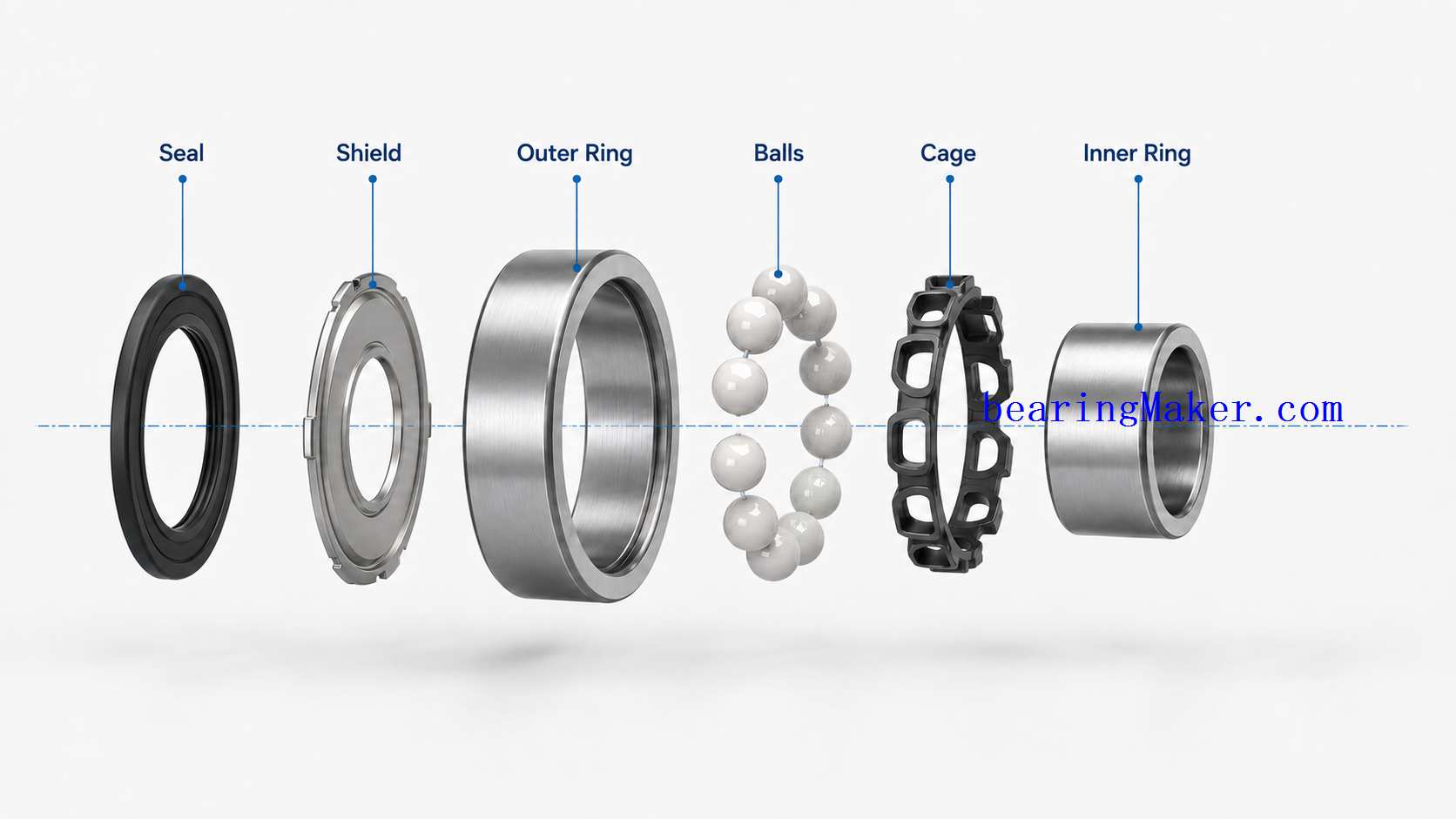
The term “bearing material” should not be limited to the rings.
A complete miniature bearing may contain different materials in:
- inner ring
- outer ring
- balls
- cage
- seals
Bearing Steel
Hardened bearing steel is the standard material for many miniature bearings.
It is widely used because it offers a strong combination of:
- high hardness
- rolling-contact fatigue resistance
- wear resistance
- dimensional accuracy
- cost efficiency
It is a suitable starting point for many general-purpose applications.
Why Bearing Steel Works Well
Rolling bearings operate with very high localized contact stress.
The material must resist:
- plastic deformation
- surface wear
- repeated subsurface stress
High hardness helps the raceways and balls maintain their geometry under repeated loading.
Typical Bearing Steel Applications
Bearing steel is commonly used in:
- electric motors
- fans
- instruments
- automation
- pumps
- consumer equipment
where:
- corrosion is controlled
- operating temperature is moderate
- conventional lubrication is available
Bearing Steel Advantages
Main advantages include:
- high load capability
- excellent fatigue behavior
- good surface finish potential
- wide availability
- relatively economical manufacturing
Bearing Steel Limitations
The main limitation is corrosion resistance.
Exposure to:
- water
- humidity
- cleaning chemicals
- corrosive process fluids
may cause oxidation if protection is inadequate.
Corrosion Protection for Bearing Steel
Corrosion risk can be reduced using:
- suitable lubricant
- shields or seals
- controlled humidity
- protective machine enclosure
However, these measures do not make standard bearing steel inherently corrosion-resistant.
Stainless Steel Miniature Bearings
Stainless steel is commonly selected when corrosion resistance is more important.
Potential applications include:
- medical equipment
- food-related machinery
- humid environments
- outdoor equipment
- laboratory instruments
- small pumps
Not All Stainless Steels Are Equivalent
“Stainless steel” describes a broad family of materials.
Different grades provide different balances of:
- corrosion resistance
- hardness
- toughness
- fatigue performance
Some stainless steels can be hardened for rolling-bearing use.
Others provide excellent corrosion resistance but may not achieve the same hardness required for heavily loaded rolling contacts.
Hardenable Stainless Bearing Materials
Bearing applications generally require sufficient hardness at:
- balls
- raceways
Hardenable stainless bearing materials are often used where both:
- rolling-contact performance
- corrosion resistance
are needed.
Austenitic Stainless Steels
Some highly corrosion-resistant stainless materials are not typically used as the primary rolling-contact raceway material in conventional high-load ball bearings because they cannot generally achieve the same bearing-raceway hardness as hardened bearing steels.
They may still be useful for:
- housings
- retainers
- surrounding structures
depending on the design.
Stainless Steel Advantages
Typical advantages include:
- improved corrosion resistance
- better moisture tolerance
- suitability for cleaner or chemically controlled environments
Stainless Steel Limitations
Depending on the specific material, possible trade-offs include:
- lower hardness
- lower fatigue capability
- higher cost
compared with conventional high-hardness bearing steel.
Actual bearing ratings should therefore be checked rather than assuming stainless construction provides identical load performance.
Corrosion Resistance Does Not Mean Corrosion-Proof
Even stainless steel can corrode under severe conditions.
Risk depends on:
- chemical concentration
- chloride exposure
- temperature
- surface condition
- moisture duration
The term “stainless” should not be interpreted as immunity to every corrosive environment.
Steel vs. Stainless Steel
| Property | Bearing Steel | Stainless Bearing Steel |
|---|---|---|
| Hardness | High | High, grade-dependent |
| Fatigue performance | Excellent | Good–Excellent, grade-dependent |
| Wear resistance | High | High, grade-dependent |
| Corrosion resistance | Limited | Better |
| Cost | Lower | Higher |
| Humid environments | Requires protection | Better suited |
| General motors/fans | Excellent | Often unnecessary |
| Medical/wet environments | Application-dependent | Often preferable |
Ceramic Rolling Elements
Ceramic materials can be used for rolling elements in miniature bearings.
A common arrangement is:
- steel or stainless rings
- ceramic balls
This is known as a hybrid ceramic bearing.
Why Ceramic Balls Are Different
Ceramic balls may offer:
- lower density
- high hardness
- electrical insulation
- corrosion resistance
- low thermal expansion
These properties can be useful in selected applications.
Lower Rolling-Element Mass
Lower density reduces the mass of the rolling elements.
At high speed, this can reduce:
- centrifugal force
- ball inertia
- cage loading
This may improve high-speed behavior.
Why Lower Mass Matters at High Speed
Centrifugal effects increase strongly as speed rises.
Reducing ball mass can therefore reduce the load associated with rapid orbital motion.
This is one reason hybrid ceramic miniature bearings may be considered in:
- high-speed motors
- miniature spindles
Electrical Insulation
Ceramic balls are electrically insulating.
This can interrupt the electrical path between:
- inner ring
- outer ring
and reduce the risk of electrical current passing directly through the rolling contacts.
Electrical Bearing Damage
Electrical current through a conventional steel bearing can cause:
- pitting
- fluting
- surface damage
Hybrid ceramic bearings may be useful where electrical insulation is required.
High Hardness
Ceramic balls can have very high hardness.
This can improve:
- wear resistance
- surface durability
under suitable conditions.
Ceramic Ball Surface Quality
High-quality ceramic balls can be manufactured with:
- high roundness
- smooth surfaces
This can support:
- low vibration
- high-speed operation
Hybrid Ceramic Bearings
Hybrid ceramic bearings combine ceramic balls with metallic rings.
This provides a compromise between:
- conventional bearing-ring properties
- ceramic rolling-element advantages
Hybrid Ceramic Advantages
Potential benefits include:
- lower rolling-element mass
- electrical insulation
- high ball hardness
- high-speed capability
- resistance to certain corrosion mechanisms at the balls
Hybrid Ceramic Limitations
Possible disadvantages include:
- higher cost
- different contact mechanics
- different response to shock
The complete bearing should be evaluated rather than assuming hybrid construction automatically improves every performance metric.
Ceramic Is Not Automatically Better
A hybrid ceramic bearing may offer no meaningful advantage in a:
- low-speed
- low-load
- non-electrical
- cost-sensitive
application.
Material should be selected for a defined engineering reason.
Full Ceramic Bearings
Full ceramic bearings use ceramic materials for:
- rings
- rolling elements
They are specialized components.
Potential Advantages of Full Ceramic Bearings
Depending on the ceramic material, potential advantages include:
- very high corrosion resistance
- electrical insulation
- non-magnetic behavior
- low density
- suitability for selected chemical environments
Full Ceramic Limitations
Full ceramic bearings may have different:
- fracture behavior
- impact resistance
- mounting requirements
- cost
compared with metallic bearings.
They should not be treated as direct drop-in replacements without considering the application.
Brittleness and Impact
Many ceramic materials are strong under compression but less tolerant of:
- impact
- edge loading
- local tensile stress
than ductile metallic materials.
Incorrect installation can therefore be particularly damaging.
Handling Full Ceramic Bearings
Installation should avoid:
- hammering
- sharp point loads
- excessive interference
Mounting methods should reflect the material’s mechanical behavior.
Hybrid vs. Full Ceramic Bearings
| Feature | Hybrid Ceramic | Full Ceramic |
|---|---|---|
| Rings | Metal | Ceramic |
| Balls | Ceramic | Ceramic |
| Electrical isolation | Often good | Very high |
| Corrosion resistance | Limited by ring material | Usually higher |
| High-speed benefit | Strong | Application-dependent |
| Impact tolerance | Better than full ceramic in many systems | More sensitive |
| Cost | High | Higher |
| General applicability | Broader | Specialized |
Cage Materials
The cage is another important material choice.
Common cage materials include:
- metal
- polymer
- engineered composites
Metal Cages
Metal cages may provide:
- good temperature resistance
- dimensional stability
- mechanical strength
They are often suitable for:
- demanding speed
- higher-temperature conditions
depending on cage design.
Polymer Cages
Polymer cages may provide:
- low mass
- low friction
- quiet operation
They are common in applications where:
- low noise
- low inertia
matter.
Polymer Cage Limitations
Polymer cages can be sensitive to:
- high temperature
- chemicals
- lubricant compatibility
Their usable environment may be limited before the steel rings themselves reach their limits.
Cage Material and Speed
Low-mass cage materials can help reduce:
- inertial loading
at high speed.
But cage geometry and guidance are also important.
Material alone does not determine cage speed capability.
Cage Material and Noise
Some polymer cages may reduce:
- impact noise
- contact noise
compared with harder metallic contact interfaces.
This can be useful in:
- motors
- fans
- medical equipment
Seal Materials
Seals may use elastomeric or polymeric materials.
They must remain compatible with:
- lubricant
- temperature
- chemicals
- environment
Seal Material Can Become the Limiting Component
A bearing ring may tolerate a certain temperature while the seal:
- hardens
- softens
- cracks
at a lower temperature.
The maximum operating condition should therefore be based on the weakest relevant component.
Shields
Metal shields generally provide:
- good dimensional stability
- low closure friction
They are useful where moderate contamination protection is required without strong seal drag.
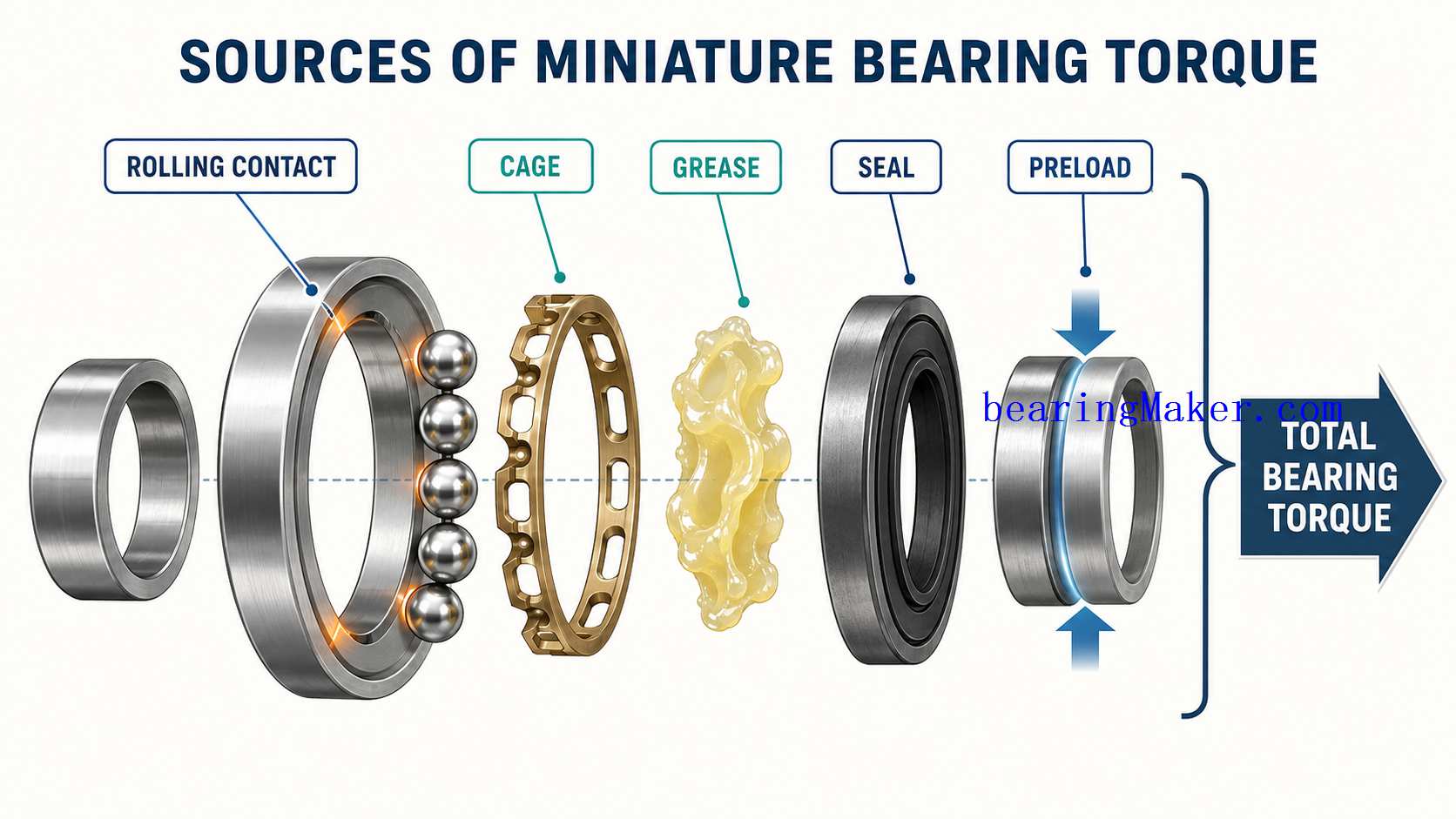
Bearing Material Is a System
A miniature bearing should be viewed as a material system:
rings + balls + cage + lubricant + seals
If one component is incompatible with the environment, the complete bearing may fail.
Corrosive Environments
Corrosion resistance becomes important in applications exposed to:
- water
- humidity
- salt
- cleaning chemicals
- process fluids
Water Exposure
Water can cause:
- raceway corrosion
- lubricant degradation
Even very small corrosion pits can create:
- noise
- stress concentration
- premature fatigue
Humidity
Long-term humidity can cause slow corrosion even without direct water immersion.
This matters in:
- outdoor electronics
- medical equipment
- storage environments
Salt Exposure
Saltwater or chloride-rich environments can be particularly aggressive.
A material described generally as stainless may still require careful evaluation.
Cleaning Chemicals
Medical and food-related equipment may be exposed to:
- detergents
- disinfectants
- cleaning solvents
The bearing material, lubricant, and seals must all tolerate the chemical environment.
Corrosion Resistance Strategy
A complete corrosion strategy may combine:
- stainless bearing materials
- seals
- corrosion-resistant lubricant
- protected housing
High-Speed Environments
At high speed, material selection affects:
- rolling-element inertia
- cage loading
- heat generation
Why Hybrid Ceramic May Help
Lower-mass ceramic balls can reduce centrifugal effects.
This can be beneficial when speed is a primary limitation.
Steel Still Works in Many High-Speed Applications
High-quality steel miniature bearings can also operate at very high speed.
Hybrid ceramic is not automatically required.
The final speed limit still depends on:
- cage
- lubrication
- preload
- temperature
Electrical Environments
Miniature bearings in electric motors may be exposed to electrical potential differences.
Possible problems include:
- current passing through rolling contacts
- raceway pitting
Hybrid Ceramic for Electrical Isolation
Ceramic rolling elements can interrupt the conductive path through the bearing.
This may be useful in:
- high-speed motors
- electrically sensitive equipment
Alternative Electrical Strategies
Electrical bearing damage can also be addressed through:
- grounding
- shaft grounding
- insulation elsewhere in the machine
Bearing material should be part of the complete electrical design.
Magnetic Requirements
Some instruments and scientific devices require low magnetic influence.
Possible applications include:
- sensors
- laboratory instruments
- imaging equipment
Non-Magnetic Bearing Requirements
Material selection may need to consider:
- rings
- balls
- cage
because making only one component non-magnetic may not satisfy the system requirement.
Stainless Does Not Automatically Mean Non-Magnetic
Different stainless steels have different magnetic behavior.
Material properties should be verified for applications with strict magnetic requirements.
High-Temperature Environments
High temperature affects more than the ring material.
It can influence:
- hardness
- dimensional stability
- lubricant life
- cage
- seals
Bearing Ring Stability
At elevated temperature, some bearing materials may gradually lose:
- hardness
- dimensional stability
depending on material and heat treatment.
Lubricant Usually Becomes Important First
In many miniature bearing systems, lubricant performance may limit usable temperature before the metallic rings themselves become mechanically unsuitable.
Seal Temperature Limits
Seal material may also determine the maximum practical operating temperature.
Cage Temperature Limits
Polymer cage properties may change at elevated temperatures.
High-Temperature Bearing Design
A complete high-temperature design should evaluate:
- rings
- balls
- cage
- lubricant
- seals
- fits
Low-Temperature Environments
Low temperature creates different problems.
Common effects include:
- increased lubricant viscosity
- higher seal stiffness
- higher starting torque
Material Contraction
Shaft, bearing rings, and housing contract as temperature falls.
If they use different materials, fits may change.
Cold-Start Requirements
Applications such as:
- aerospace systems
- outdoor devices
should evaluate starting torque at the minimum expected temperature.
Thermal Expansion
Different materials have different thermal expansion rates.
This can influence:
- shaft fit
- housing fit
- internal clearance
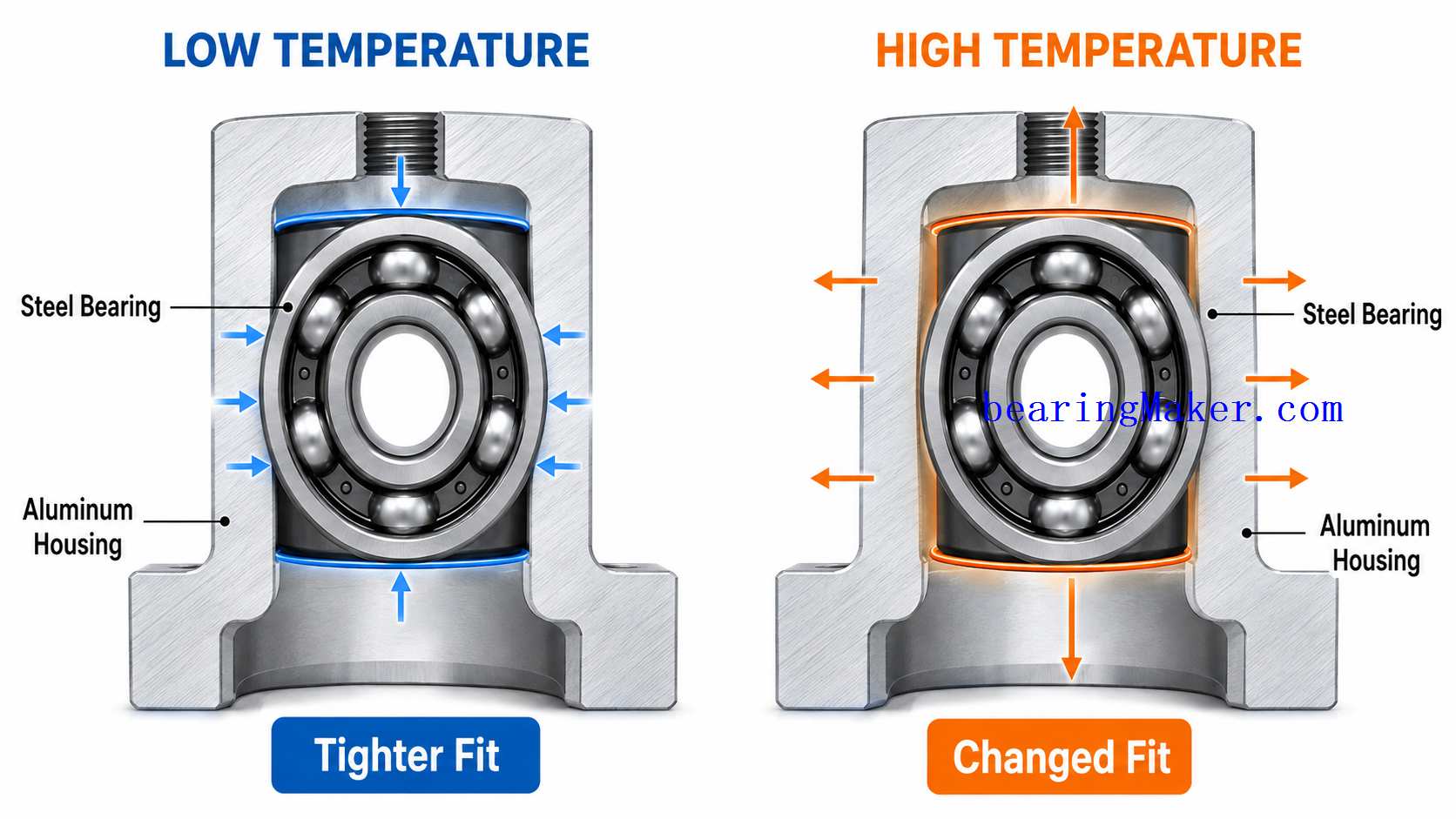
Steel Bearing in Aluminum Housing
An aluminum housing typically expands more than a steel bearing ring as temperature increases.
The outer-ring fit may therefore become looser.
Steel Bearing on a Different-Material Shaft
If shaft expansion differs from the inner ring, interference and internal clearance may change.
Why Temperature Matters for Precision
Changes in fit can change:
- preload
- runout
- torque
This is especially important in precision miniature mechanisms.
Thermal Cycling
Some equipment repeatedly moves between:
- cold
- hot
conditions.
This can create repeated changes in:
- fit
- preload
- lubricant viscosity
Material selection should therefore consider the full temperature cycle, not only the maximum temperature.
Vacuum Environments
Vacuum applications create special challenges because conventional lubricants may:
- outgas
- evaporate
- migrate
This can contaminate:
- optics
- sensors
- process surfaces
Vacuum-Compatible Materials
Vacuum systems may require:
- low-outgassing lubricant
- compatible polymers
- suitable cage materials
- carefully selected seals
Outgassing
Outgassing is the release of volatile substances from materials in vacuum.
Possible sources include:
- grease
- polymers
- adhesives
- seals
Why Outgassing Matters
Deposited volatile material can contaminate sensitive:
- optics
- semiconductor surfaces
- scientific instruments
Vacuum and Lubrication
The material system should be selected together with a suitable vacuum lubrication strategy.
Conventional factory grease should not automatically be assumed suitable.
Cleanroom Environments
Cleanroom applications emphasize:
- low particle generation
- controlled lubricant migration
- cleanliness
Typical Cleanroom Applications
Examples include:
- semiconductor handling equipment
- optical inspection
- laboratory automation
Particle Generation
Particles can originate from:
- wear
- seals
- cage
- contamination
The bearing should therefore be evaluated as a source of potential contamination.
Stainless in Cleanroom Systems
Stainless materials may be useful where:
- corrosion resistance
- cleanliness
are important.
However, material alone does not determine cleanroom suitability.
Lubrication and seals are equally important.
Medical Environments
Medical devices may require combinations of:
- corrosion resistance
- low noise
- cleanliness
- low torque
Cleaning and Sterilization
If the bearing is exposed to:
- repeated cleaning
- disinfectants
- sterilization processes
the complete material system must be evaluated.
Sterilization Is Application-Specific
Different sterilization processes create different:
- temperature
- moisture
- chemical
conditions.
Not every miniature bearing is suitable for repeated sterilization.
Food and Beverage Equipment
Applications near food may require consideration of:
- corrosion
- washdown
- lubricant control
The exact material and lubricant requirements depend on where the bearing is located relative to the process.
Chemical Exposure
Some miniature bearings operate near:
- solvents
- acids
- alkalis
- fuels
Material compatibility should be evaluated for:
- rings
- cage
- seals
- lubricant
Chemical Attack on Seals
A bearing may use corrosion-resistant steel but still fail because a chemical:
- swells
- softens
- cracks
the seal.
Chemical Attack on Lubricant
Chemicals may also contaminate or degrade grease.
Material Selection for Small Pumps
Miniature pumps may be exposed to:
- moisture
- chemicals
- axial thrust
Possible priorities include:
- corrosion resistance
- seal compatibility
- load capacity
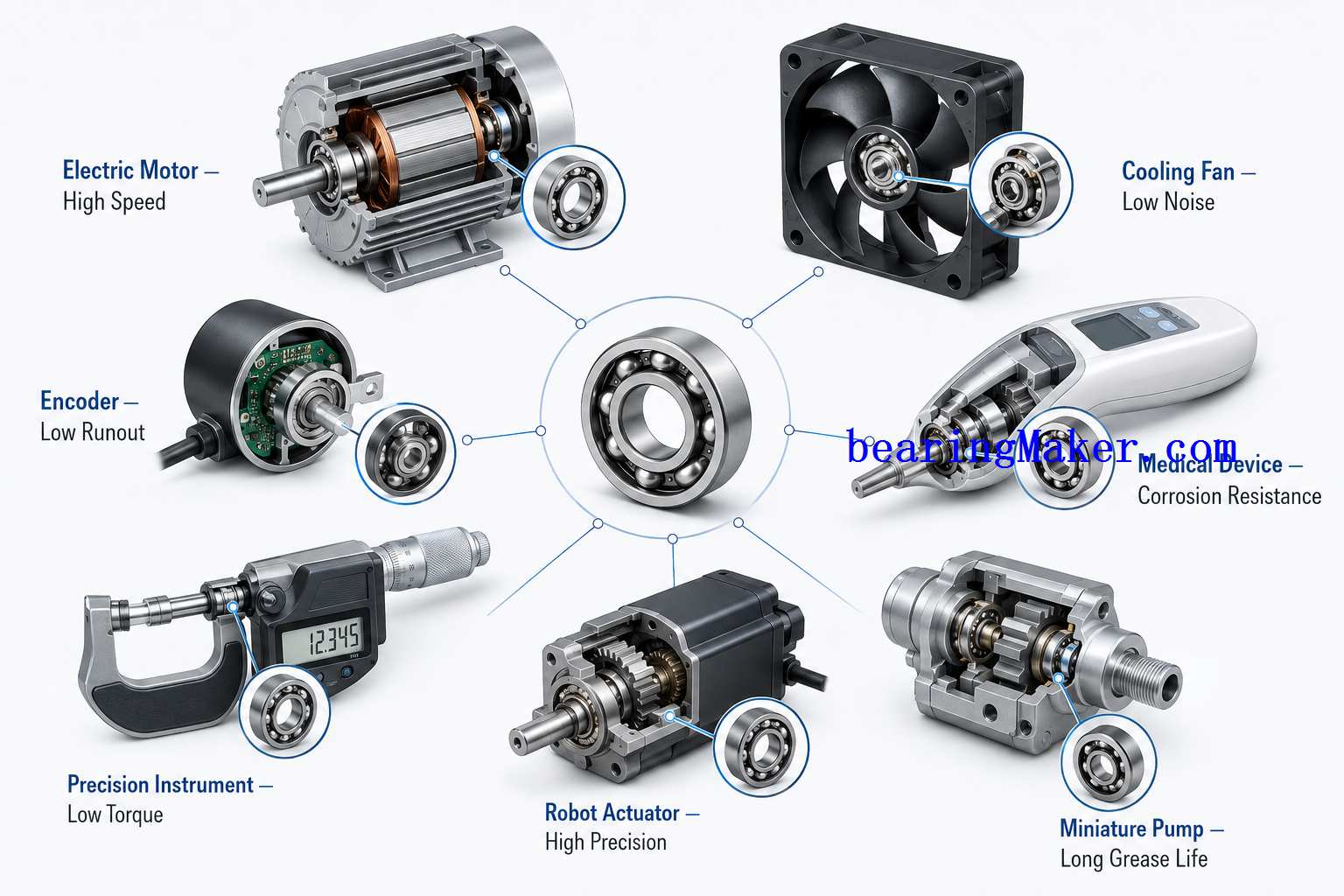
Material Selection for Electric Motors
Small motors usually prioritize:
- fatigue performance
- speed
- low noise
- cost
Bearing steel is often sufficient when corrosion is controlled.
Hybrid ceramic may be considered when:
- electrical insulation
- very high speed
provide real benefit.
Material Selection for Cooling Fans
Cooling fan bearings typically prioritize:
- long life
- low noise
- low cost
Material choice may be relatively conventional unless the environment introduces:
- moisture
- high temperature
Material Selection for Medical Equipment
Medical applications may prioritize:
- corrosion resistance
- cleanliness
- chemical compatibility
Stainless construction may be attractive.
Material Selection for Instruments
Precision instruments may prioritize:
- low torque
- stable dimensions
- low magnetic response
depending on the application.
Material Selection for Aerospace Mechanisms
Aerospace applications may prioritize:
- low mass
- temperature range
- vacuum behavior
- reliability
Material selection must therefore be coordinated with:
- lubrication
- thermal design
Material Selection for Semiconductor Equipment
Semiconductor equipment may require:
- low particle generation
- vacuum compatibility
- low outgassing
- corrosion control
Conventional bearing materials may still be suitable, but the complete material system must meet environmental requirements.
Bearing Material vs. Load Capacity
Material directly affects the maximum usable contact stress.
High hardness generally benefits:
- rolling-contact fatigue
- resistance to permanent deformation
However, actual load rating depends on the complete bearing geometry and material treatment.
Do Not Reuse Load Ratings Across Materials
Two bearings with identical dimensions but different materials may not have identical:
- dynamic rating
- static rating
Actual bearing data should be used.
Bearing Material vs. Speed
Material affects speed through:
- ball density
- cage mass
- friction
- temperature capability
But material is only one factor.
Bearing Material vs. Noise
Material can influence:
- contact behavior
- cage interaction
but noise is also strongly influenced by:
- raceway finish
- lubrication
- contamination
Bearing Material vs. Torque
Material itself usually does not determine total bearing torque.
Torque is strongly influenced by:
- seals
- lubricant
- preload
- fits
A ceramic bearing with heavy seals and excessive grease can still have high torque.
Bearing Material vs. Cost
Increasing material specialization generally increases cost.
Potential cost progression may involve:
- conventional bearing steel
- stainless bearing steel
- hybrid ceramic
- full ceramic or specialized materials
The more expensive option should provide a measurable system benefit.
Material Comparison Matrix
| Material System | Fatigue Capability | Corrosion Resistance | High-Speed Potential | Electrical Insulation | Relative Cost |
|---|---|---|---|---|---|
| Bearing steel | High | Low | High | Low | Low |
| Stainless bearing steel | Moderate–High to High | High | High | Low | Moderate |
| Hybrid ceramic | High | Depends on ring material | Very high potential | High across rolling contacts | High |
| Full ceramic | Application-dependent | Very high | Application-dependent | Very high | Very high |
These are qualitative comparisons. Actual performance depends on specific materials and bearing design.
Environment-to-Material Selection Matrix
| Environment | Common Material Direction |
|---|---|
| General electric motor | Bearing steel |
| Cooling fan | Bearing steel |
| High humidity | Stainless may be preferred |
| Water exposure | Stainless + sealing strategy |
| Corrosive chemical | Specialized corrosion-resistant system |
| Very high speed | Steel or hybrid ceramic |
| Electrical current risk | Hybrid ceramic may be considered |
| Vacuum | Vacuum-compatible complete material system |
| Cleanroom | Low-particle material/lubricant system |
| Low temperature | Material + low-temperature lubricant |
| High temperature | Temperature-stable rings/cage/lubricant/seals |
| Low magnetic requirement | Specialized low-magnetic materials |
Material Selection Workflow
Step 1: Define Mechanical Load
Determine:
- radial load
- axial load
- shock
Material must provide sufficient contact strength.
Step 2: Define Speed
Specify:
- continuous RPM
- peak RPM
Determine whether lower rolling-element mass is valuable.
Step 3: Define Corrosion Exposure
Identify:
- humidity
- water
- salt
- chemicals
Step 4: Define Temperature Range
Include:
- minimum temperature
- normal operating temperature
- maximum temperature
Step 5: Define Electrical Requirements
Determine whether current could pass through the bearing.
Step 6: Define Magnetic Requirements
Check whether conventional ferromagnetic bearing materials are acceptable.
Step 7: Define Cleanliness Requirements
Determine whether the application is:
- normal industrial
- cleanroom
- vacuum
Step 8: Select Ring Material
Choose based on:
- fatigue
- corrosion
- temperature
Step 9: Select Ball Material
Choose:
- steel
- ceramic
based on:
- speed
- electrical
- wear requirements
Step 10: Select Cage Material
Verify:
- speed
- temperature
- chemical compatibility
Step 11: Select Seal Material
Verify compatibility with:
- lubricant
- chemicals
- temperature
Step 12: Select Lubricant
The lubricant must match:
- material
- speed
- temperature
- environment
Step 13: Check Thermal Expansion
Evaluate how different materials affect:
- fit
- clearance
- preload
Step 14: Check Load Ratings
Use ratings specific to the selected bearing material and construction.
Step 15: Validate Real Operating Conditions
Test or verify:
- temperature
- torque
- corrosion
- noise
- life
under representative conditions.
Common Material Selection Mistakes
Mistake 1: Assuming Stainless Steel Cannot Rust
Stainless materials can still corrode under sufficiently aggressive conditions.
Mistake 2: Assuming All Stainless Bearings Have the Same Properties
Different stainless materials have different:
- hardness
- corrosion resistance
- fatigue behavior
Mistake 3: Assuming Ceramic Is Always Higher Performance
Ceramic rolling elements solve specific problems.
They are not automatically better for every application.
Mistake 4: Choosing Ceramic Without Considering Shock
Ceramic materials can behave differently under impact and edge loading.
Mistake 5: Considering Ring Material but Ignoring Cage and Seals
The non-metallic components may fail first.
Mistake 6: Choosing a High-Temperature Steel With Ordinary Grease
The lubricant may become the actual temperature limit.
Mistake 7: Choosing Stainless Steel but Ignoring the Lubricant
Corrosion protection requires the whole system to be compatible.
Mistake 8: Assuming Vacuum Compatibility From Bearing Material Alone
Lubricant, cage, adhesives, and seals may outgas.
Mistake 9: Assuming Stainless Steel Is Non-Magnetic
Magnetic behavior varies by stainless material.
Mistake 10: Using the Same Load Rating After Changing Material
Material changes may change bearing ratings.
Mistake 11: Ignoring Thermal Expansion
Different shaft, housing, and bearing materials may significantly alter fits.
Mistake 12: Selecting Material by Cost Alone
Low initial cost may be offset by:
- corrosion failure
- reduced service life
- maintenance
Troubleshooting Corrosion
If corrosion appears, check:
- bearing material
- moisture ingress
- seal condition
- lubricant protection
- chemical exposure
Troubleshooting Electrical Pitting
Check for:
- shaft voltage
- electrical current path
- grounding
Hybrid ceramic bearings or other isolation methods may be considered where appropriate.
Troubleshooting Ceramic Ball Damage
Possible causes include:
- impact
- installation damage
- contamination
- extreme edge loading
Troubleshooting Seal Failure
Check:
- temperature
- chemical exposure
- lubricant compatibility
- misalignment
Troubleshooting Cage Deformation
Possible causes include:
- excessive temperature
- chemical attack
- excessive speed
Troubleshooting Corrosion Despite Stainless Construction
Check:
- actual stainless material
- chloride exposure
- chemical concentration
- lubricant condition
Frequently Asked Questions
What Material Is Most Common for Miniature Bearings?
Hardened bearing steel is common because it provides a strong combination of:
- hardness
- fatigue resistance
- cost
When Should Stainless Steel Miniature Bearings Be Used?
They are useful where:
- humidity
- water
- chemical exposure
create corrosion risk.
Are Stainless Bearings Stronger Than Standard Bearing Steel Bearings?
Not automatically.
The answer depends on:
- stainless material
- heat treatment
- bearing design
Are Stainless Bearings Completely Rust-Proof?
No.
They provide improved corrosion resistance, but aggressive environments can still cause corrosion.
What Is a Hybrid Ceramic Bearing?
It typically combines:
- metallic rings
- ceramic balls
Why Use Ceramic Balls?
Potential reasons include:
- lower mass
- high hardness
- electrical insulation
- high-speed capability
Are Ceramic Bearings Always Faster?
No.
Speed also depends on:
- cage
- lubricant
- preload
- seals
Are Ceramic Bearings Always Lower Friction?
No.
Overall bearing friction depends strongly on:
- lubrication
- seals
- preload
- fit
Are Ceramic Balls Electrically Insulating?
Yes, many bearing ceramics used for rolling elements provide strong electrical insulation.
Can Hybrid Ceramic Bearings Prevent Electrical Bearing Damage?
They can interrupt current through the rolling contacts and may be useful as part of an electrical isolation strategy.
What Is a Full Ceramic Bearing?
A full ceramic bearing uses ceramic materials for both:
- rings
- rolling elements
Are Full Ceramic Bearings Suitable for Impact Loads?
They require careful evaluation because ceramic materials can be more sensitive to:
- shock
- localized impact
than ductile metallic materials.
Which Bearing Material Is Best for High Speed?
Both high-quality steel and hybrid ceramic bearings can be suitable.
Hybrid ceramic may offer advantages where rolling-element mass becomes important.
Which Material Is Best for Corrosion Resistance?
The answer depends on the specific environment.
Stainless and ceramic materials may offer improved corrosion resistance, but chemical compatibility must be evaluated in detail.
What Material Is Best for Vacuum?
Vacuum suitability depends on the complete bearing system:
- rings
- balls
- cage
- lubricant
- seals
not just the ring material.
Can Standard Grease Be Used in Vacuum?
Not automatically.
Vacuum systems may require specialized low-outgassing lubricants.
What Material Is Best for Cleanrooms?
There is no universal cleanroom bearing material.
The complete system should minimize:
- wear particles
- lubricant migration
- contamination
Do Polymer Cages Reduce Noise?
They can help in some applications because of:
- low mass
- different contact behavior
but noise also depends on many other factors.
Can Seal Material Limit Bearing Temperature?
Yes.
The seal may have a lower temperature capability than the rings.
Can Temperature Change Bearing Fits?
Yes.
Different thermal expansion rates among:
- shaft
- bearing
- housing
can change interference and clearance.
Are Stainless Bearings Suitable for Medical Equipment?
They are often attractive because of corrosion resistance, but actual suitability depends on:
- cleaning chemicals
- temperature
- lubrication
- sterilization requirements
Is Bearing Steel Suitable for Humid Environments?
It may be suitable if adequately protected by:
- seals
- lubricant
- enclosure
but stainless may provide better inherent corrosion resistance.
Miniature Bearing Material Selection Checklist
Before selecting bearing materials, define:
| Parameter | What to Determine |
|---|---|
| Radial load | Continuous and peak |
| Axial load | Continuous and peak |
| Shock | Expected level |
| Speed | Continuous and peak |
| Bearing life | Required |
| Ring hardness | Required performance |
| Corrosion | Expected severity |
| Humidity | Exposure level |
| Water | Direct exposure or not |
| Salt | Expected exposure |
| Chemicals | Type and concentration |
| Ring material | Steel/stainless/ceramic |
| Ball material | Steel/ceramic |
| Cage material | Metal/polymer/etc. |
| Seal material | Chemical/temperature compatible |
| Electrical current | Isolation required? |
| Magnetic requirement | Conventional materials acceptable? |
| Minimum temperature | Cold-start |
| Maximum temperature | Continuous/peak |
| Thermal expansion | Fit effect |
| Vacuum | Required or not |
| Outgassing | Acceptable level |
| Cleanroom | Particle control required |
| Lubricant | Material/environment compatible |
| Lubricant life | Required duration |
| Sterilization | Process and frequency |
| Maintenance | Accessibility |
| Cost | Acceptable premium |
| Load ratings | Verified for actual material |
| Final validation | Required environment testing |
Conclusion
Miniature bearing material selection should not be reduced to a simple question of:
steel, stainless, or ceramic?
Each material solves a different set of problems.
Hardened bearing steel offers an excellent balance of:
- hardness
- fatigue performance
- wear resistance
- cost
and remains a strong choice for many general miniature bearing applications.
Stainless bearing materials become more attractive when:
- humidity
- water
- cleaning
- corrosion
are important.
Hybrid ceramic bearings can provide valuable advantages where:
- high speed
- low rolling-element mass
- electrical insulation
matter.
Full ceramic bearings can address specialized requirements such as:
- severe corrosion
- electrical insulation
- non-magnetic behavior
but introduce different mechanical and cost considerations.
The rings are only part of the decision.
A reliable miniature bearing material system must also consider:
- balls
- cage
- seals
- lubricant
- shaft
- housing
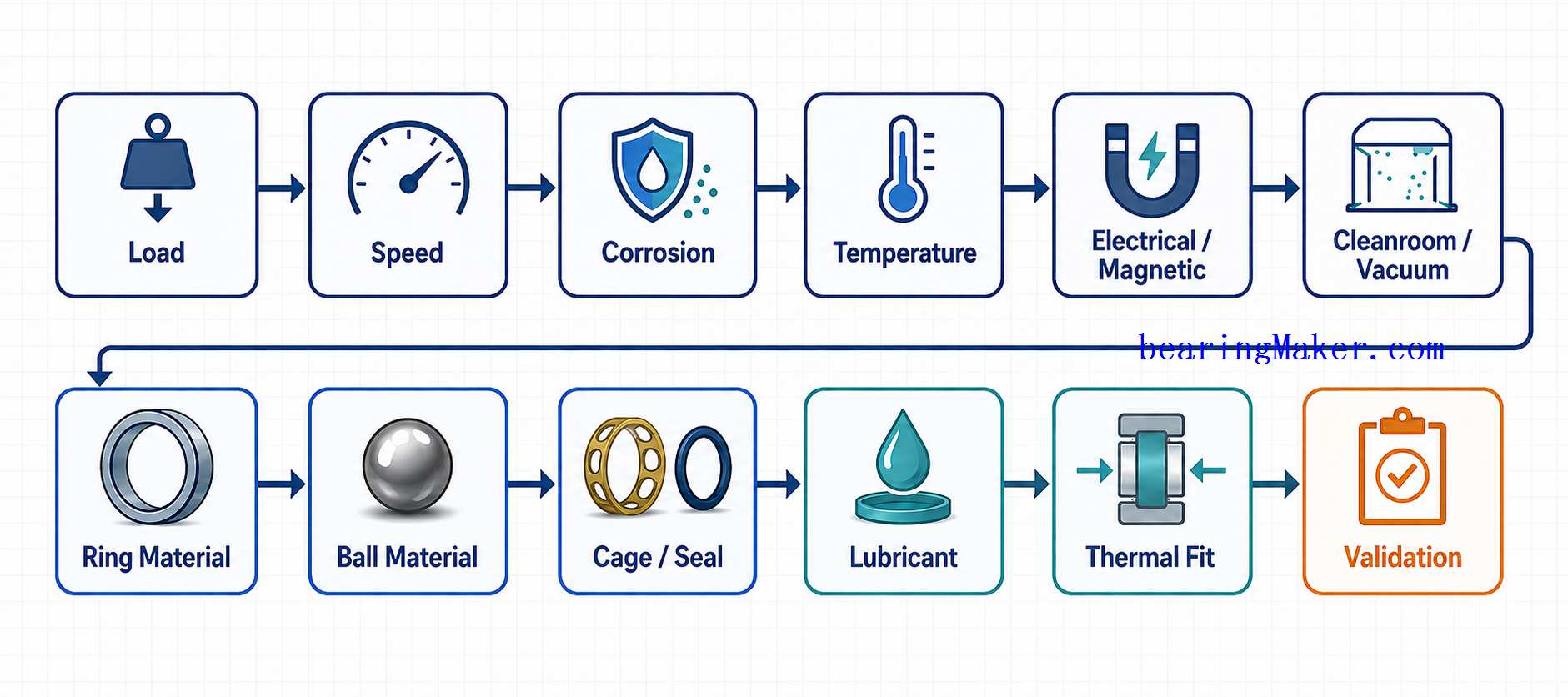
The correct selection process therefore follows:
Load → Speed → Corrosion → Temperature → Electrical and Magnetic Requirements → Cleanroom or Vacuum → Ring Material → Ball Material → Cage and Seal Material → Lubricant → Thermal Fit → Final Validation
The goal is not to select the most exotic material.
The goal is to select the material combination that maintains:
- rolling-contact strength
- corrosion resistance
- low torque
- dimensional stability
- environmental compatibility
- reliable service life
throughout the real operating conditions of the machine.