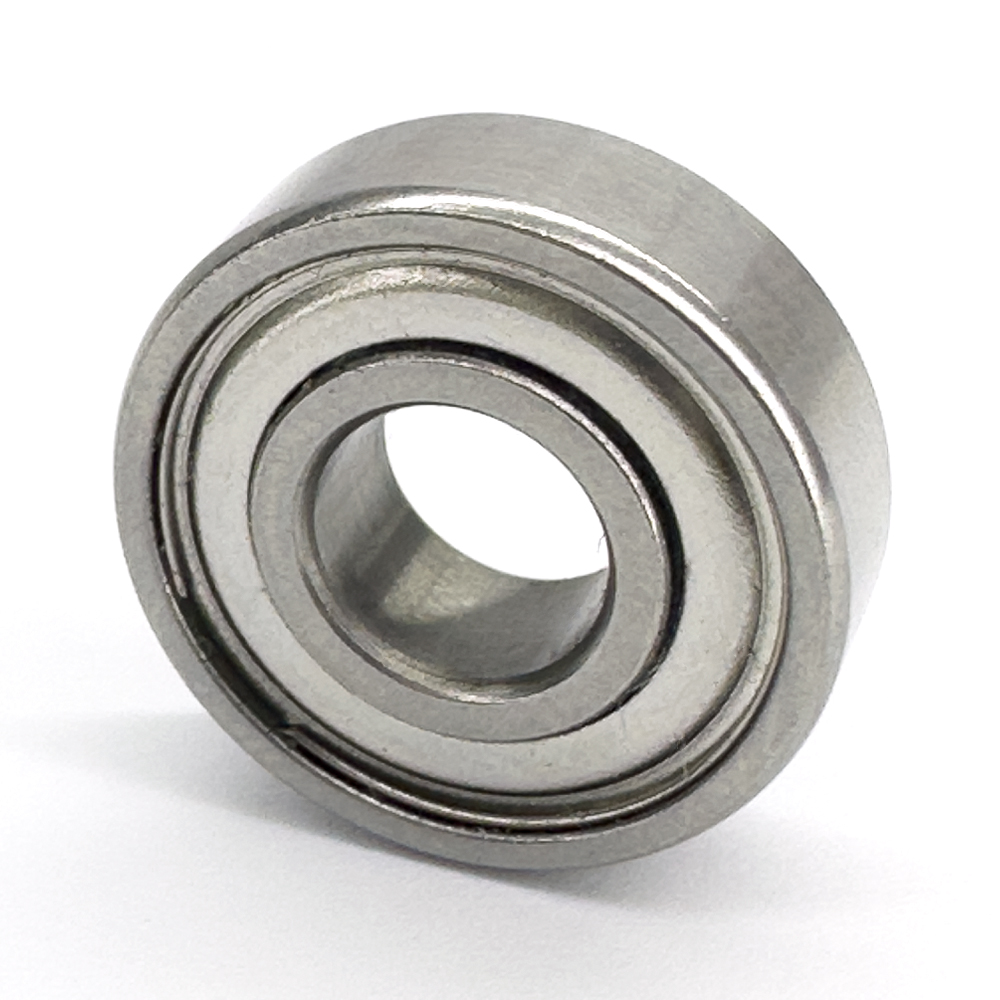
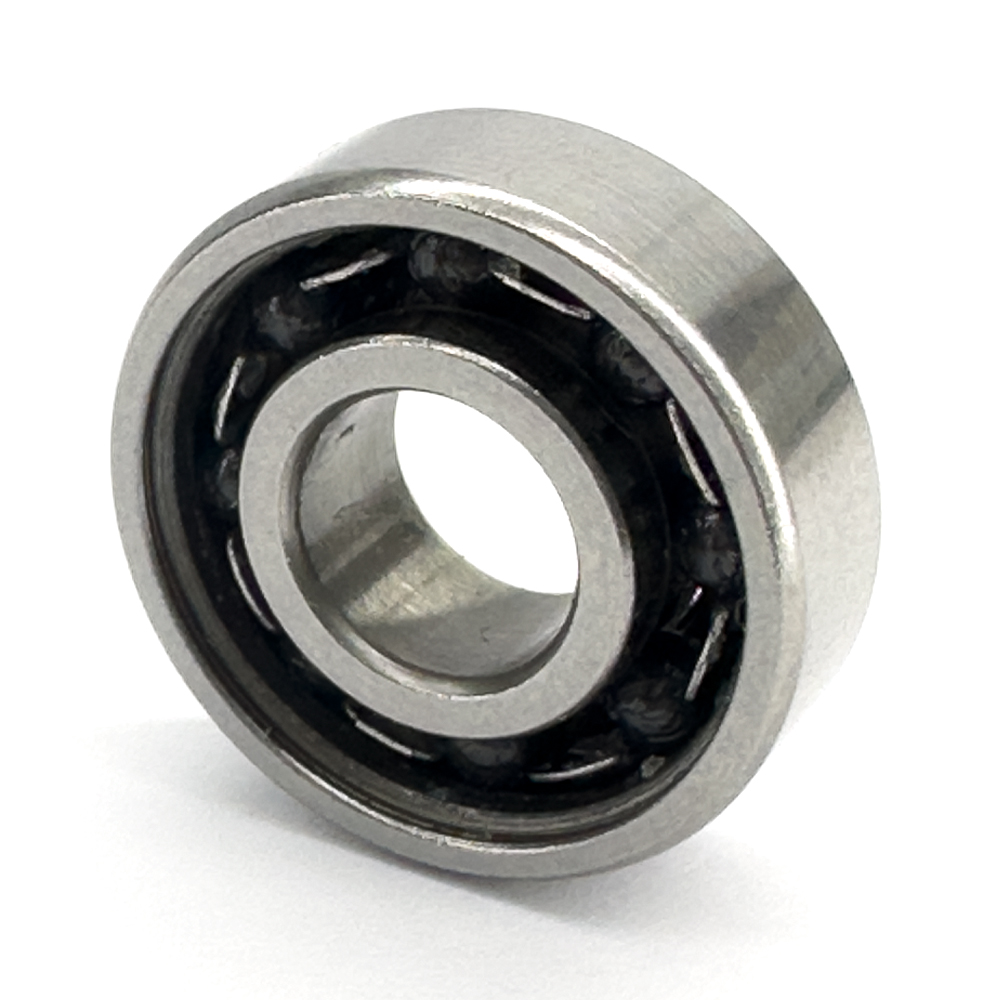
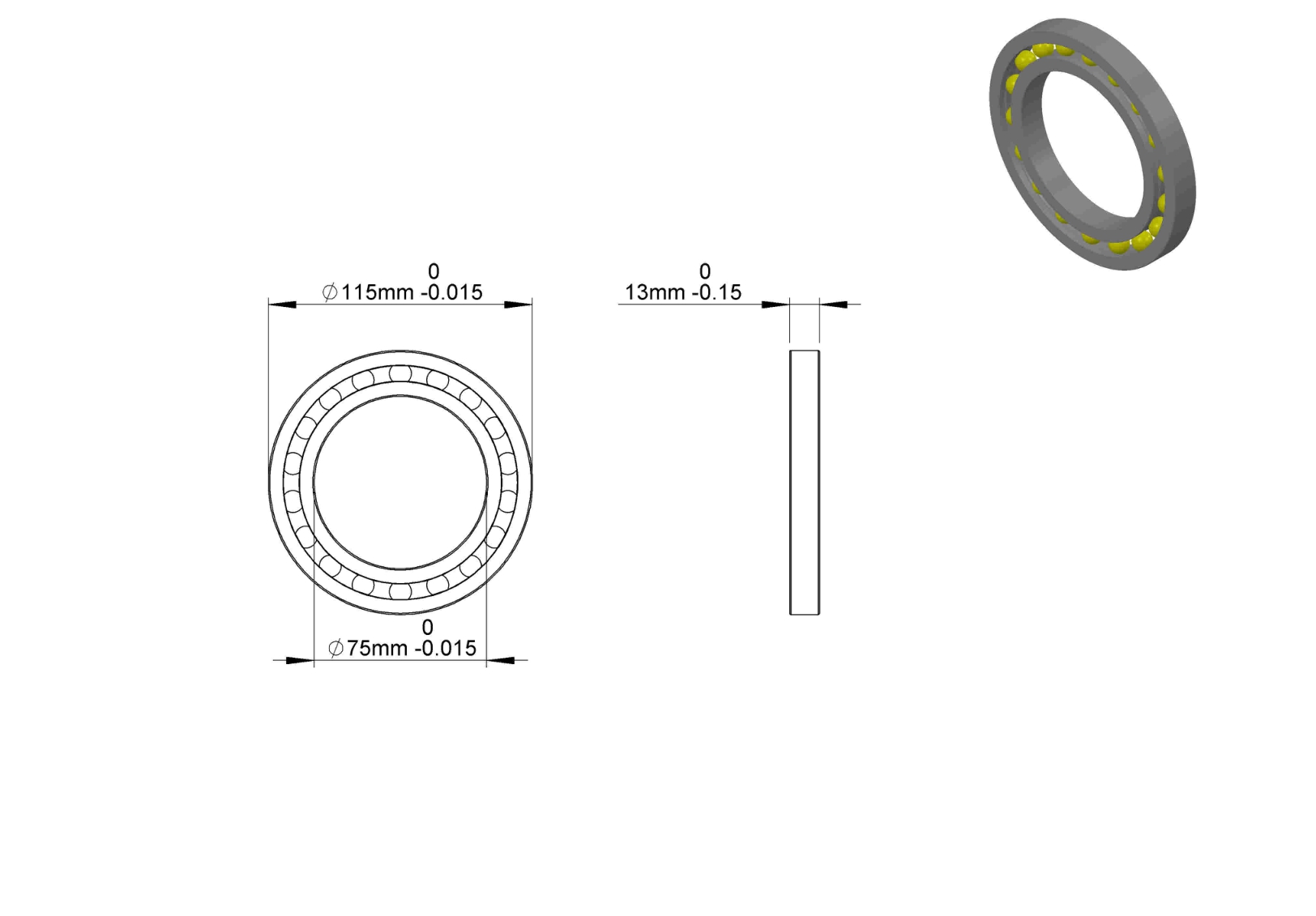
16015C is a hybrid ceramic deep-groove ball bearing. Its defined envelope includes 75 mm bore, 115 mm outside diameter, and 13 mm width. The listed configuration includes single row construction and open enclosure. Its deep raceway geometry provides the familiar radial ball-bearing load path, with limited axial reaction depending on the installed arrangement.
Design and Load Path
Deep-groove raceways wrap around the balls to support radial force and, within the selected arrangement, a limited axial reaction. Shaft and housing alignment, installed clearance and ring fits influence load distribution, heat generation and the freedom of the rolling elements to circulate. For 16015C, this behavior must be evaluated within the stated 75 mm bore, 115 mm outside diameter, and 13 mm width envelope rather than separated from the surrounding shaft and housing geometry.
Within the 75 mm bore and 115 mm outside-diameter interfaces, the stated load direction is Radial. The dimensions define the interfaces, but they do not alone establish interchangeability. Shoulder location, chamfers, seat geometry and available internal space should be checked with the mating design. For ceramic rolling contacts, avoiding local ring distortion and concentrated contact is especially important because the complete system must distribute load rather than rely on material labels as a substitute for correct support.
Material Configuration
The fixed component specifications identify rings: chrome steel, rolling elements: Silicon Nitride(Si3N4), and cage: 300 Series Stainless Steel. Each material remains tied to its component role; a ball material does not define the ring material, and neither defines the cage.
For 16015C, the hybrid arrangement places ceramic rolling elements against non-ceramic rings. The combination can change rolling-element mass, elastic contact and electrical behavior at the contact, but it does not by itself establish insulation for the complete machine or guarantee higher speed, lower friction or longer life. Those outcomes also depend on fits, lubricant, cage, load and temperature.
Load, Speed and Thermal Considerations
The published performance data include dynamic radial rating 6205 lbf and static radial rating 5688 lbf. Dynamic and static ratings answer different questions: the dynamic value supports life calculations under rolling load, while the static value addresses permanent-deformation risk under heavy or stationary contact. Neither should be interpreted as a direct permissible machine load without the applicable life, safety and load-distribution calculation.
A listed speed value of 4.6 × 1,000 rpm provides a configuration-specific reference. The stated operating-temperature information is -86 to 230 °F. Speed and temperature interact through lubricant behavior, cage guidance, seal friction, fit and thermal expansion. A material comparison cannot replace those system checks.
Enclosure and Lubrication
For 16015C, the enclosure is listed as Open. Open construction relies on the surrounding machine for lubricant retention and contamination control. Seals or shields change that boundary, but no unlisted protection level or maintenance interval should be assumed.
The lubrication entry for 16015C is Required. Lubricant type, quantity and replenishment should suit the actual speed, load, temperature and environment. Compatibility with cage, seal and ceramic/metal contact materials should be checked, particularly when changing from a previously qualified arrangement.
Mounting and Installed Condition
For 16015C, bearing fits must control the loaded rings without imposing harmful distortion or eliminating necessary internal operating freedom. Mounting force should be applied through the ring being fitted, not transmitted through the rolling elements. Clean seats, square shoulders and controlled runout help preserve the intended contact geometry after installation.
The precision notation for 16015C is ABEC-1. That designation should be retained as supplied and not converted to another standard without a validated equivalence. Seat form, shoulder runout, assembly cleanliness and clamping accuracy must be consistent with the required system precision.
Installed Behavior and System Checks
The chrome steel ring and Silicon Nitride(Si3N4) rolling-element configuration becomes an operating bearing only after fits, support, lubricant and temperature establish the installed condition. An interference fit can reduce internal clearance, while a temperature difference between shaft, rings and housing can change that condition further. These effects should be evaluated together with the stated material pair because ceramic and metallic components need not expand at the same rate.
Verification of 16015C should follow the actual duty cycle rather than a single published value. Starting, steady running, transient load, shutdown and storage can impose different lubrication, contamination and thermal demands. The selected bearing should be checked for the governing load case, required life, available support stiffness and maintenance method, while preserving every configuration detail that materially affects the contact system.
Selection Priorities
Selection of 16015C should verify the complete dimensional envelope, load direction, component materials, enclosure, lubricant, precision or clearance, and the applicable load and speed data. The surrounding shaft, housing and thermal environment are part of the operating system; they determine whether the supported construction can maintain its intended contact and alignment.
16015C may be considered in compact rotating equipment when its exact material, enclosure and operating configuration fit the duty. Application suitability follows from the complete specification and installation, not from the ceramic label alone.