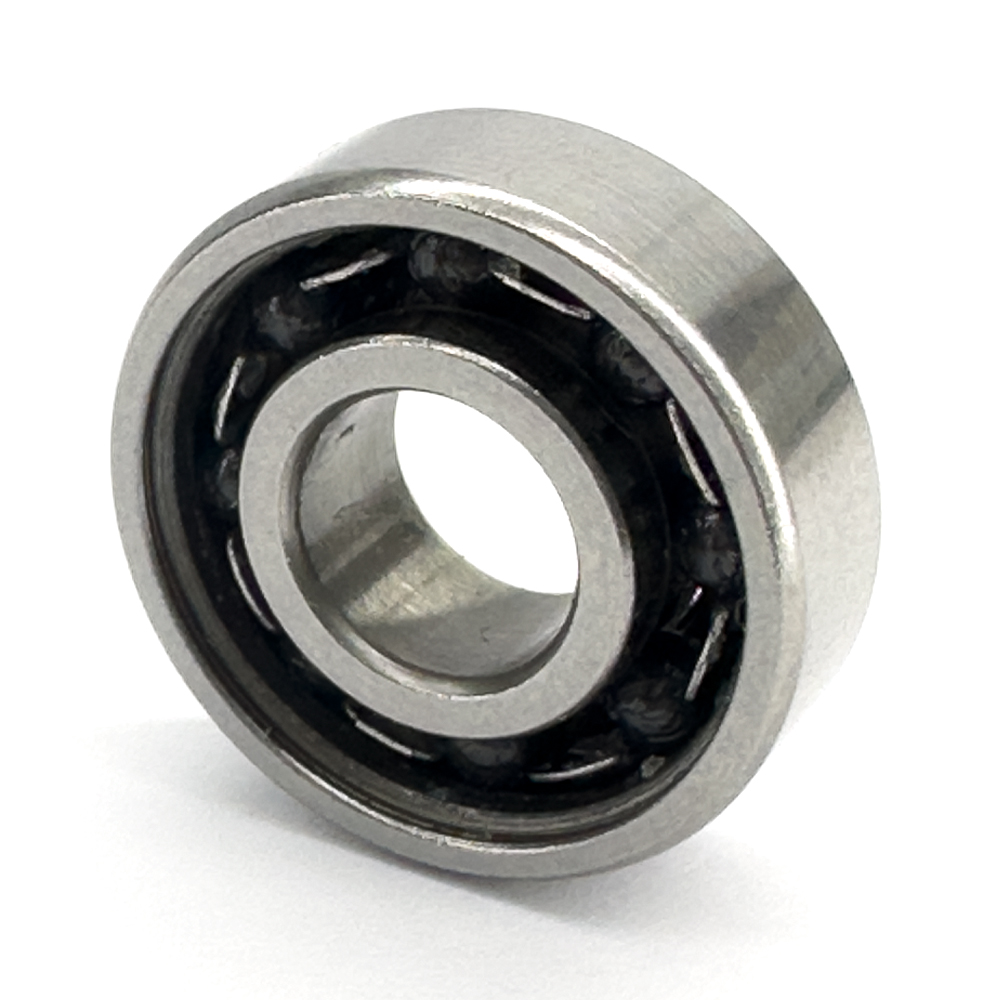
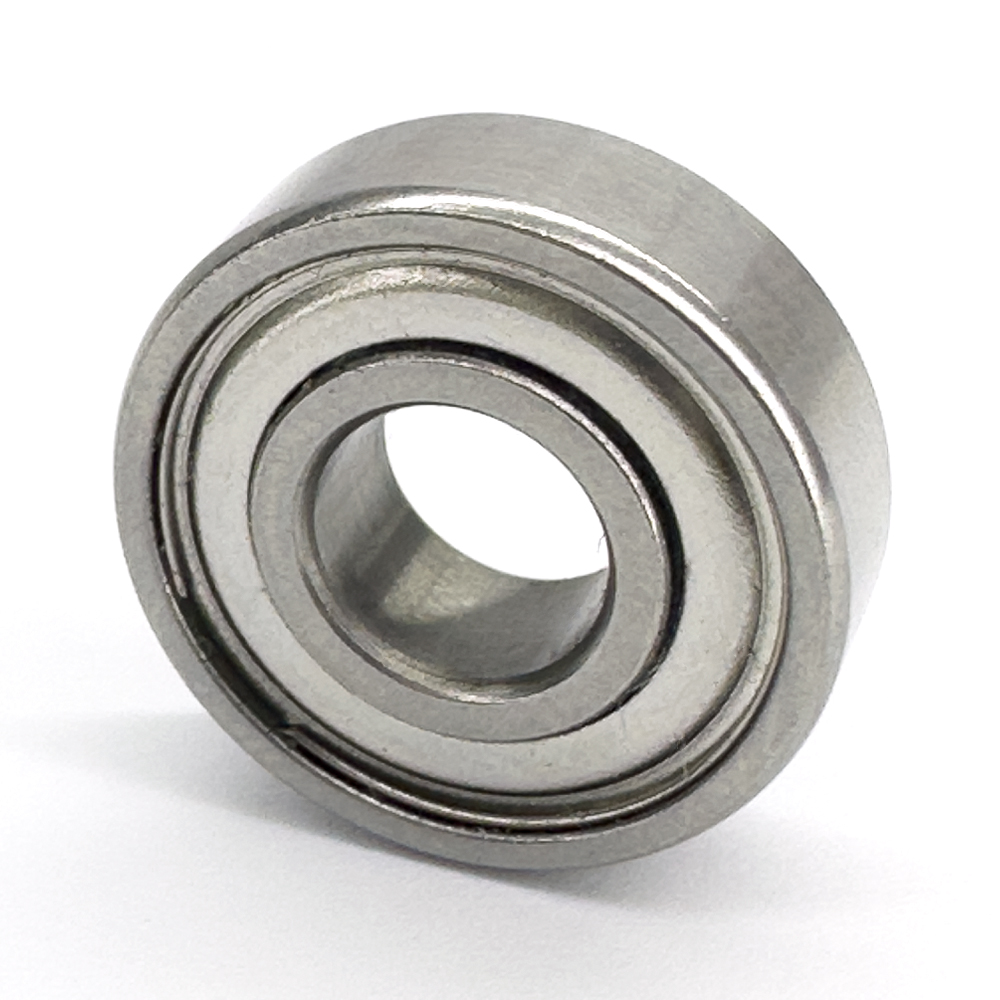
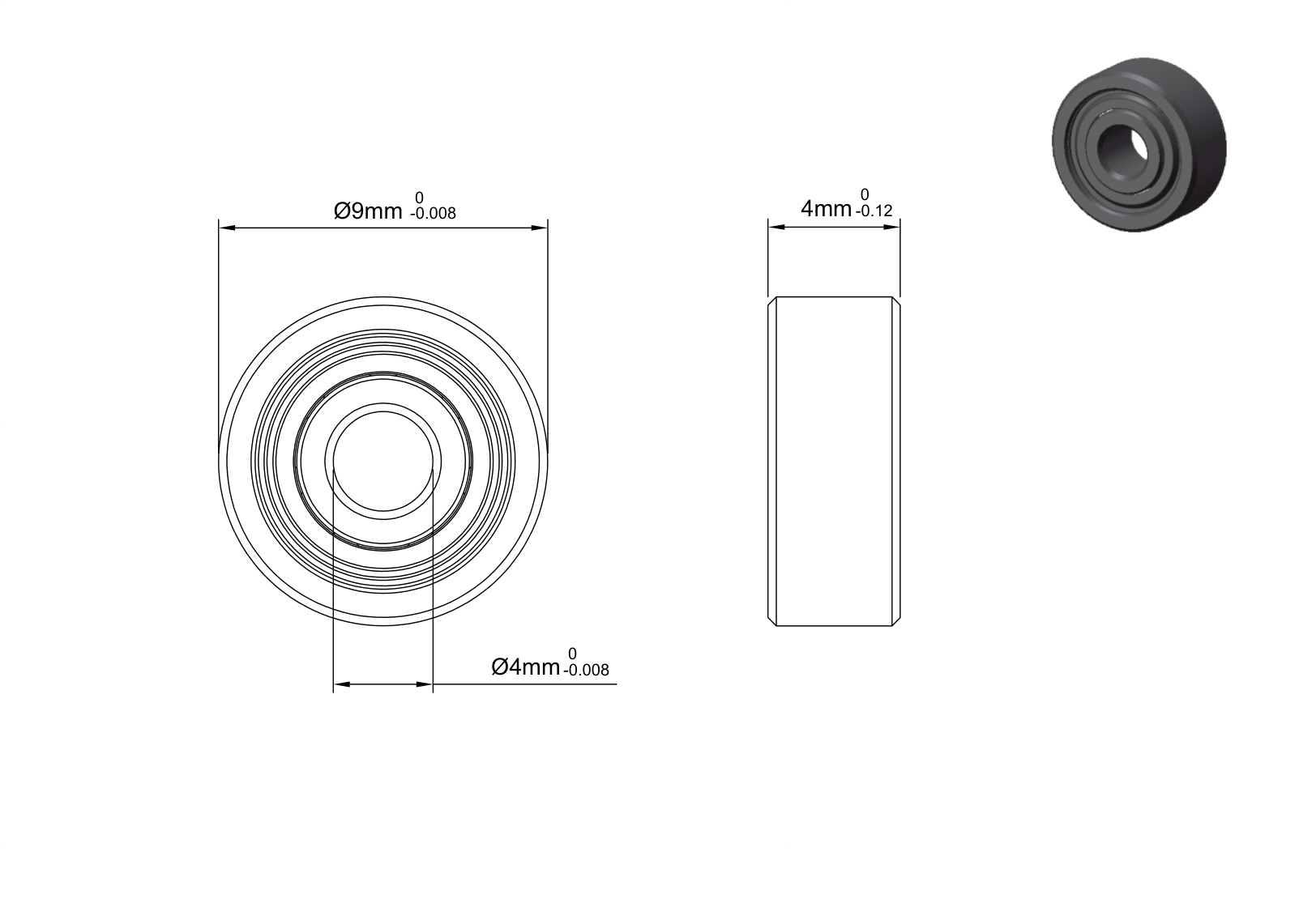
SMR684C-ZZ #3 L55 is a hybrid ceramic deep-groove ball bearing. Radial guidance and internal contact define the main selection questions for this construction. Its dimensional envelope is bore 4 mm, outside diameter 9 mm, and width 4 mm. The enclosure is shielded. Consider these features as parts of the installed contact system, together with component materials and the actual duty, rather than treating the ceramic designation as a performance rating.
Radial Guidance and the Raceway Contact
Force travels from the shaft seat through the inner ring, ball contacts and outer ring to the housing. Deep grooves provide radial guidance and allow axial reaction within the limitations of the bearing arrangement. The direction and magnitude of the actual forces matter more than the ceramic family label. The construction entry for SMR684C-ZZ #3 L55 is Single Row. Its stated load direction is Radial. The ball-grade entry is 10, distinct from the complete bearing’s precision notation.
A shaft may be well supported radially yet still need a deliberate means of axial location. Decide which bearing locates the shaft and which permits thermal movement. Excessive clamping or a distorted housing can concentrate the load on a small part of the circumference, changing heat generation and contact stress.
Choosing the Component Combination
The rings material is 440C Stainless Steel. The rolling elements material is Silicon Nitride(Si3N4). The cage material is Stainless Steel. Keep each material tied to its own part. A rolling-element compound does not identify the rings, and the cage remains a separate choice with its own guidance and lubricant-compatibility requirements.
Hybrid construction combines ceramic rolling elements with non-ceramic rings. This makes the contact pair central to thermal and elastic behavior. Different expansion rates can change the installed clearance, while rolling-element mass and stiffness affect contact response. These are engineering relationships to evaluate, not evidence of a particular machine’s insulation, maximum speed or service life.
Interpreting the Operating Data
The load data for SMR684C-ZZ #3 L55 include dynamic radial rating 143 lbf and static radial rating 51 lbf. Dynamic and static ratings are not alternative labels for the same operating limit. Dynamic data support a rolling-load life assessment; static data address the risk of lasting contact deformation. Resolve the forces at the bearing and apply the appropriate calculation before comparing the machine duty with either value.
The speed entry is 81 × 1,000 rpm. The temperature-range entry is -86 to 230 °F. Use these entries with the applicable enclosure, cage and lubrication conditions. A reference speed is not automatically a limiting speed, and a broad temperature entry does not establish continuous operation at every speed or load across that range. Heat generated at the contacts and removed through the surrounding structure must also be considered.
Enclosure and the Lubricated Contact
The shielded enclosure of SMR684C-ZZ #3 L55 sets the immediate boundary around the rolling contacts. Shields form a barrier without implying the same contact arrangement as a seal. Their presence alone does not establish a protection grade or a maintenance interval. The enclosure-count entry is Two Shields. Its barrier-material entry is Stainless Steel, separate from ring and rolling-element materials.
The lubrication entry is Kluber L55 Grease. This describes the supplied or required condition, not an unlimited dry-running approval. Select lubricant type and quantity for the contact pair, cage, enclosure and duty. Changing a grease or an oil supply can change drag, replenishment and heat removal even when the dimensional fit remains the same.
Assembly Accuracy and Internal Freedom
Plan the assembly force through the part being fitted. Passing a press force through the rolling contacts risks local damage rather than seating the ring cleanly. Square shoulders, clean seats and controlled support around the circumference help retain the intended geometry. Clamping should locate the bearing without forcing a distorted seat into the rings. The shaft-mount entry is Press Fit.
The precision notation is Abec#3/isop6. Retain that notation without assigning an unverified equivalence to another standard. The radial-clearance entry is MC3. Precision, initial clearance and installed preload describe different aspects of the assembly. Interference and temperature differences can alter the running internal condition. Check shaft and housing fits, seat form and shoulder runout together; a close dimensional match cannot establish the accuracy of the complete rotating system.
Mating Surfaces and the Duty Cycle
Check shoulder diameters, fillets and chamfer clearance against the complete dimensional drawing. A fillet that interferes with a ring corner prevents full seating, while an inadequate abutment can leave the load-carrying face poorly supported. These dimensions concern distinct surfaces and must not be substituted for the main bore, outside diameter or width.
For SMR684C-ZZ #3 L55, assess starts, steady rotation, load changes and stops as parts of the same duty. The governing load case may not occur at the highest speed. Thermal growth can also shift the load between supports, so verify the locating arrangement, remaining clearance and lubricant supply over the operating cycle rather than at one nominal condition.
Matching the Bearing to the Support Arrangement
Choose SMR684C-ZZ #3 L55 by matching its contact geometry and actual component configuration to the support arrangement. Verify the primary dimensions first, then orientation or axial location, load direction, enclosure and lubrication. Use the explicit ratings and precision or clearance entries where provided. Missing values need confirmation, not substitution from another ceramic product.
The important application question is how radial guidance, axial location and contamination control are shared by the complete assembly. The bearing family describes a useful construction choice. Acceptance for a particular machine still depends on the complete duty calculation and installation, not a general promise attached to its material name.