Miniature bearings are selected first by size, but dimensional selection is more complicated than simply matching a shaft diameter.
A bearing that fits the shaft may still be unsuitable because its:
- outside diameter is too large
- width exceeds the available space
- load capacity is insufficient
- flange geometry does not match the housing
- seal or shield adds unwanted friction
- internal construction does not suit the application
Miniature bearing selection therefore begins with three basic dimensions:
- bore diameter
- outside diameter
- width
but quickly expands into a broader question:
Which bearing series and structural configuration provides the best balance of size, load, speed, torque, mounting, and protection?
This guide explains the main miniature bearing types, how bore, OD, and width relate to each other, how metric and inch series differ, when flanged and extended-inner-ring designs are useful, and how to choose the correct miniature bearing size for a real machine.
What Counts as a Miniature Bearing?
The term miniature bearing generally refers to rolling bearings designed for very small shafts and compact mechanisms.
Most miniature bearings are ball bearings because ball geometry provides an effective combination of:
- low friction
- high speed
- compact size
- precision
There is no single dimensional boundary used universally by every supplier or industry.
For engineering purposes, it is more useful to define a miniature bearing by its actual dimensions and application than by a rigid naming rule.
Miniature Bearings vs. Small Ball Bearings
The terms miniature bearing and small ball bearing often overlap.
A practical interpretation is:
- miniature bearings occupy the smallest end of the small-bearing size range
- small ball bearings extend into somewhat larger dimensions
The exact boundary may vary.
When selecting a bearing, actual dimensions are more important than the category label.
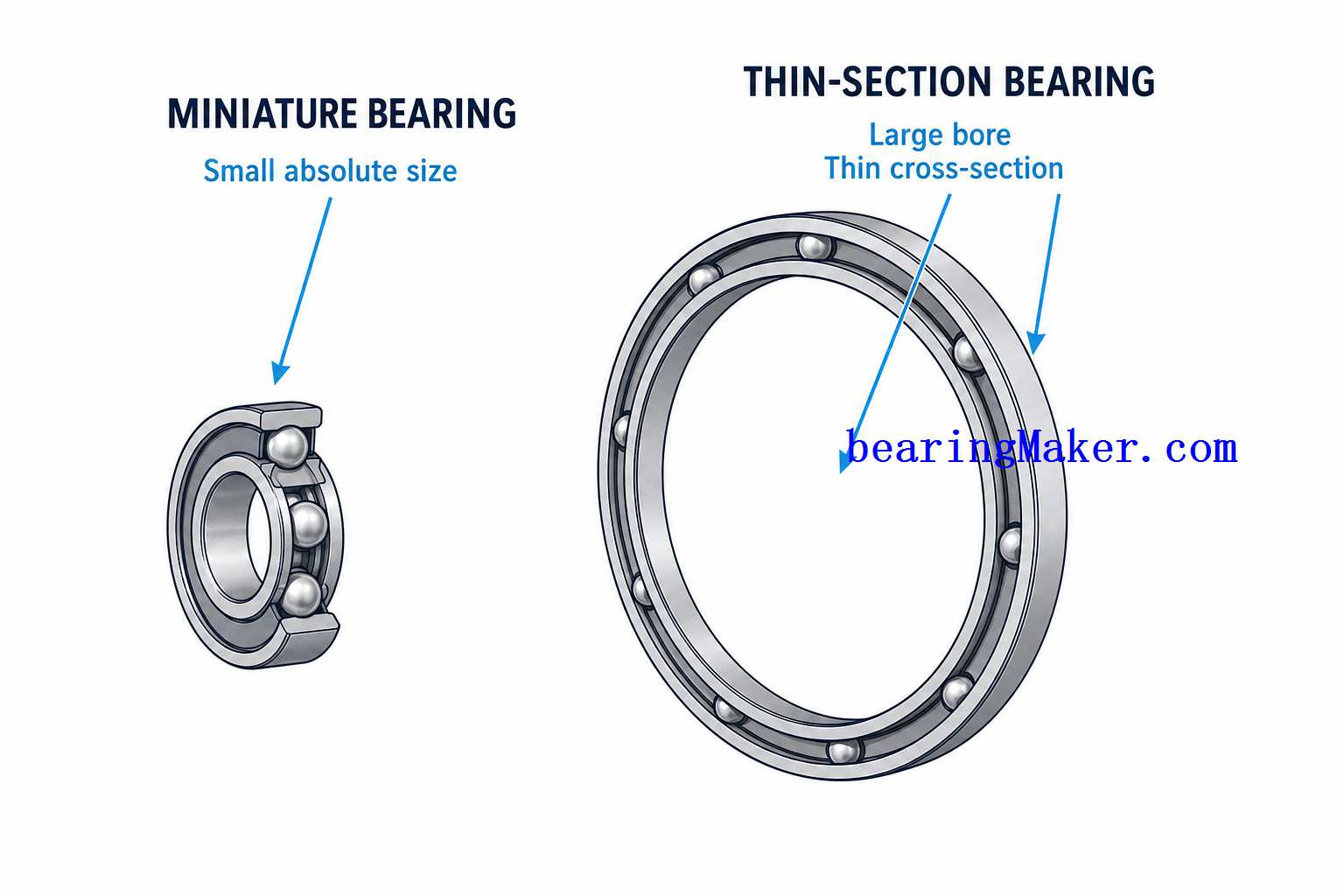
Miniature Bearings vs. Thin Section Bearings
These two bearing families are frequently confused.
Miniature bearings are defined primarily by:
small absolute size
Thin section bearings are defined by:
small cross-section relative to bore diameter
This means a thin section bearing may have a very large bore while a miniature bearing may have a bore of only a few millimeters.
| Feature | Miniature Bearing | Thin Section Bearing |
|---|---|---|
| Overall size | Very small | Can be large |
| Bore | Usually small | Often large |
| Cross-section | Small | Small relative to bore |
| Main objective | Compact small mechanism | Large bore, low radial envelope |
| Typical shaft | Small shaft | Large or hollow shaft |
| Common applications | Motors, fans, instruments | Robotics, optics, rotary systems |
The Three Main Bearing Dimensions
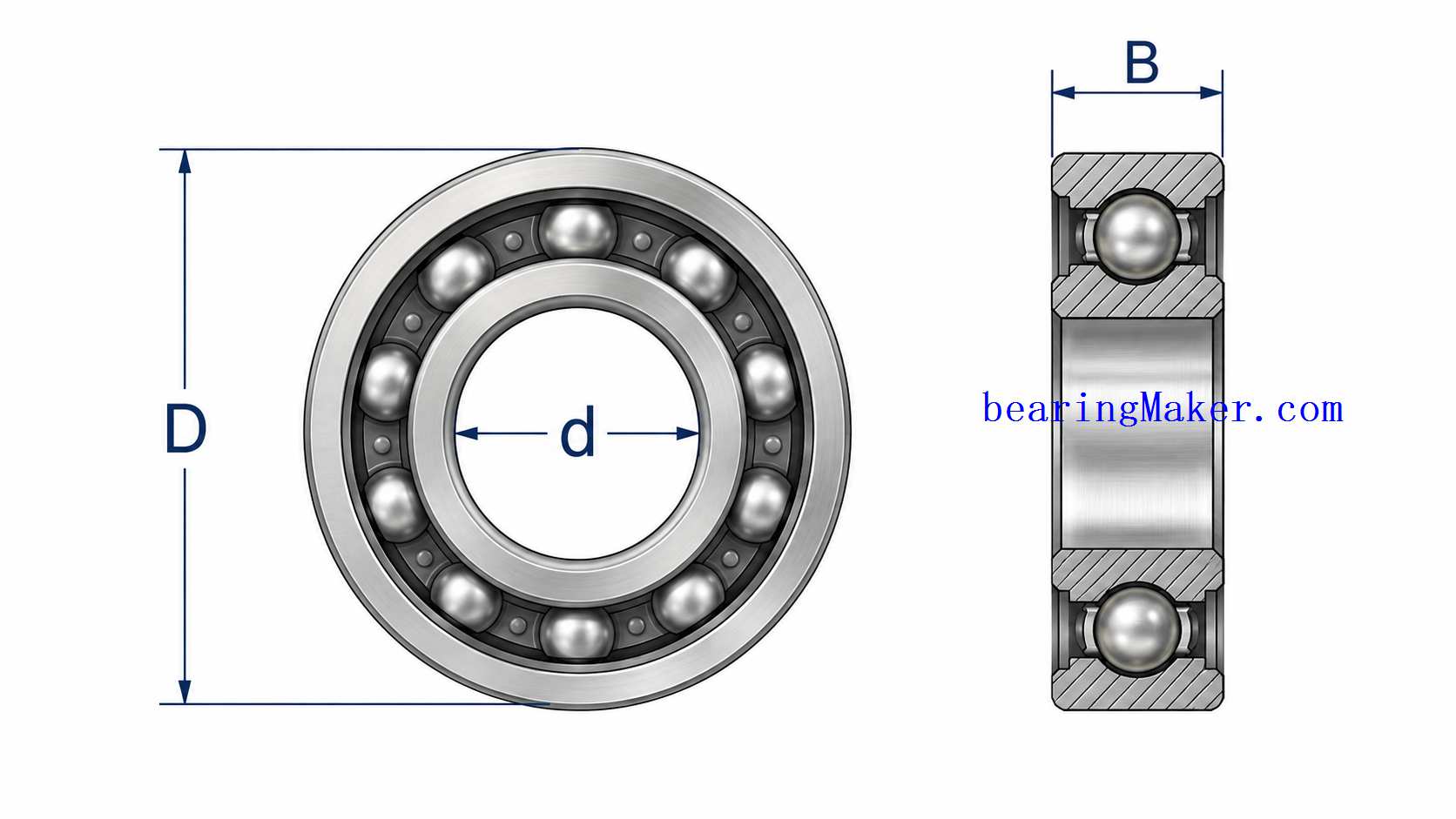
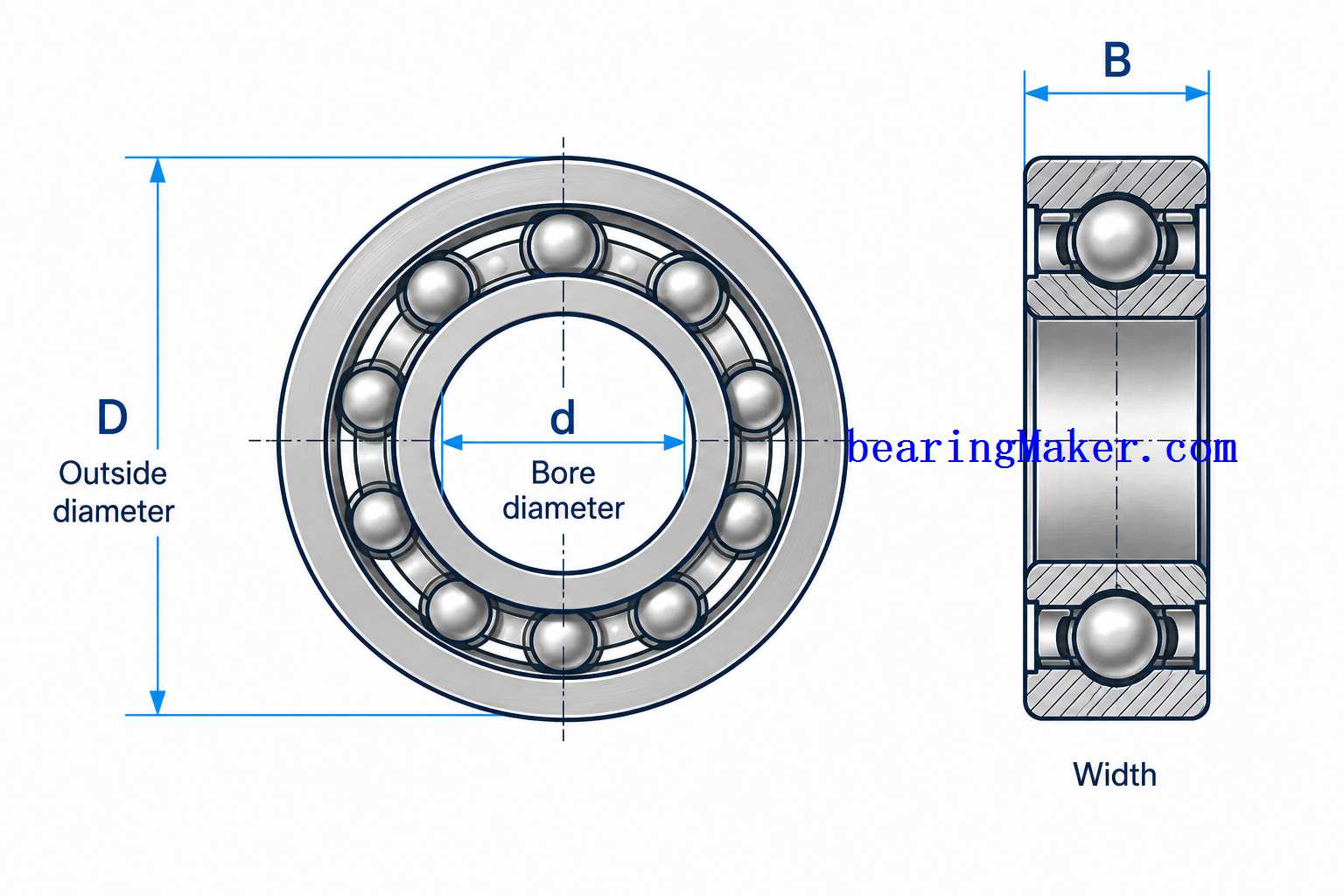
The basic dimensions of a miniature bearing are:
- bore diameter dd
- outside diameter DD
- width BB
These three dimensions determine the physical envelope of the bearing.
Bore Diameter
The bore diameter determines the shaft size.
This is usually the first dimension selected.
The bore must match:
- shaft diameter
- fit requirement
- shaft tolerance
A larger bore generally allows:
- stronger shaft
- greater shaft stiffness
but it also tends to increase the overall bearing size.
Outside Diameter
The outside diameter determines how much radial space the bearing occupies.
It must fit within the housing.
For highly compact mechanisms, OD may be almost as important as bore.
Applications such as:
- small motors
- encoders
- sensors
- fans
often have very limited radial envelope.
Width
Bearing width controls the axial space required.
A wider bearing may provide:
- more internal space
- larger balls
- greater structural robustness
but occupies more axial length.
In very compact designs, even a small increase in width may be unacceptable.
Why Bore Alone Is Not Enough
Two miniature bearings can have the same bore but different:
- OD
- width
- ball size
- load rating
- speed capability
For example, one series may be designed to minimize radial space while another uses a larger OD to obtain:
- higher load capacity
- greater stiffness
Selecting by bore alone therefore ignores the purpose of the bearing series.
Understanding Bearing Series
A bearing series groups bearings that follow a related dimensional pattern.
Different series may provide different relationships among:
- bore
- outside diameter
- width
For the same bore, one series may be:
- thinner
- narrower
while another may be:
- larger
- stronger
Why Multiple Series Exist
Machine designers have different priorities.
Some need:
- smallest possible OD
Others need:
- higher load capacity
Others need:
- narrow width
A single dimensional series cannot optimize all three at the same time.
Size Series as an Engineering Trade-Off
A useful way to think about miniature bearing series is:
smaller envelope → generally less internal space
and:
larger envelope → generally more room for rolling elements and raceways
This often translates into trade-offs among:
- load capacity
- speed
- stiffness
- packaging
Main Types of Miniature Bearings
Miniature bearings can be classified by both:
- internal bearing construction
- external mounting geometry
The most common types include:
- deep groove
- flanged
- extended inner ring
- open
- shielded
- sealed
Deep Groove Miniature Ball Bearings
Deep groove ball bearings are the most common miniature bearing type.
Their raceways are designed to provide:
- strong radial support
- some axial load capability
- low friction
- high speed
They are widely used in:
- small electric motors
- cooling fans
- instruments
- pumps
- office equipment
Why Deep Groove Bearings Are So Common
Their main advantage is versatility.
One compact bearing can provide:
- radial support
- limited bidirectional axial support
- smooth high-speed rotation
This makes them suitable for many small machines.
Flanged Miniature Bearings
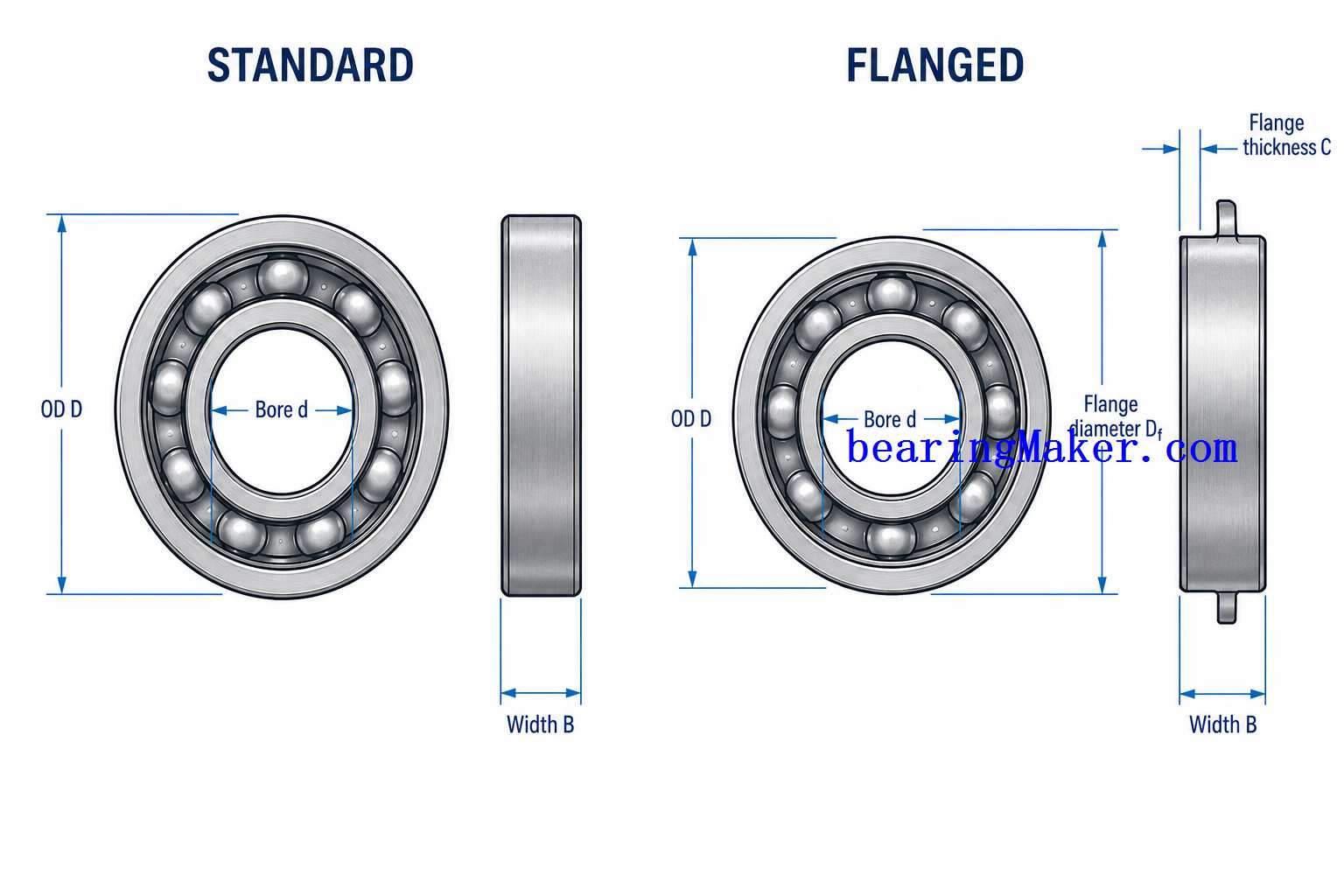
A flanged bearing has an integral flange on the outer ring.
The flange provides an axial locating feature.
This can simplify the housing.
Why Use a Flanged Bearing?
Without a flange, the housing may require:
- a machined shoulder
- a retaining feature
A flange can help locate the bearing against the housing face.
This is especially useful where:
- housing dimensions are very small
- machining a precise internal shoulder is difficult
Common Flanged Bearing Applications
Flanged miniature bearings are often used in:
- instruments
- small gear mechanisms
- rollers
- miniature motors
- compact actuators
Flange Diameter
A flanged bearing adds another important dimension:
- flange outside diameter
This must be considered separately from the bearing OD.
The housing design should account for:
- bearing OD
- flange OD
- flange thickness
Extended Inner-Ring Bearings
Some miniature bearings use an inner ring that extends beyond the outer ring.
This can simplify the assembly by providing additional shaft support or locating surface.
Benefits of an Extended Inner Ring
Possible benefits include:
- simplified spacer design
- easier axial positioning
- more convenient shaft mounting
- reduced component count
Where Extended Inner Rings Are Useful
They may be used in:
- small rollers
- compact drives
- miniature mechanisms
where separate spacers would otherwise be required.
Open Miniature Bearings
Open bearings have no shield or seal.
They provide:
- lowest closure friction
- easy lubricant access
- high speed potential
They are suitable where the surrounding machine provides a clean environment.
Shielded Miniature Bearings
Shielded bearings use thin non-contact or very low-contact closures.
They help protect the bearing from:
- dust
- larger particles
while keeping friction relatively low.
Shielded bearings are common in:
- electric motors
- cooling fans
- office electronics
Sealed Miniature Bearings
Sealed bearings use contact or low-contact sealing elements.
They provide stronger protection against:
- dust
- moisture
- debris
The trade-off can be:
- increased friction
- higher starting torque
- lower practical speed
Open vs. Shielded vs. Sealed Dimensions
Closure type usually does not change the primary:
- bore
- OD
- width
dramatically within the same series, but the internal design and torque behavior may differ.
For replacement applications, the exact suffix or configuration should still be verified.
Metric Miniature Bearings
Metric miniature bearings use:
- bore
- OD
- width
specified in millimeters.
They are widely used in modern:
- electronics
- motors
- automation
- robotics
Advantages of Metric Series
Metric series are convenient when the machine uses:
- metric shafts
- metric housings
- metric hardware
They also integrate naturally with international machine designs.
Inch Miniature Bearings
Inch miniature bearings use imperial dimensional standards.
They remain important in:
- legacy equipment
- aerospace
- instruments
- equipment originally designed around inch shafts
Why Inch Bearings Still Matter
A bearing is often selected as part of an existing machine architecture.
If the shaft is already an inch dimension, converting to metric may require:
- new shaft
- new housing
- new tooling
In such cases, inch bearings may remain the more practical choice.
Metric vs. Inch Bearings
| Factor | Metric | Inch |
|---|---|---|
| Dimension system | mm | inch |
| Typical new equipment | Very common | Application-dependent |
| Legacy equipment | Common | Very common in some sectors |
| Shaft matching | Metric shaft | Inch shaft |
| Availability | Broad | Broad in specialized sizes |
How to Read Miniature Bearing Dimensions
A miniature bearing is often specified by a dimensional sequence such as:
bore × OD × width
For example:
3 × 8 × 3 mm
would describe:
- 3 mm bore
- 8 mm outside diameter
- 3 mm width
This dimensional format is useful even when part-number systems differ.
Why Part Numbers Alone Can Be Misleading
Different bearing numbering systems may encode:
- size
- seal
- shield
- flange
- clearance
- material
in different ways.
When comparing miniature bearings, always verify the actual dimension table.
Bore Size Selection
The bore is usually determined by the shaft.
But shaft diameter should itself be selected based on:
- torque
- load
- stiffness
- manufacturing
Shaft Strength vs. Bearing Size
Choosing the smallest possible bearing may require a very small shaft.
The shaft may then become the weak component.
A shaft that is too thin may:
- bend
- vibrate
- misalign the bearing
The smallest bearing is therefore not always the best system choice.
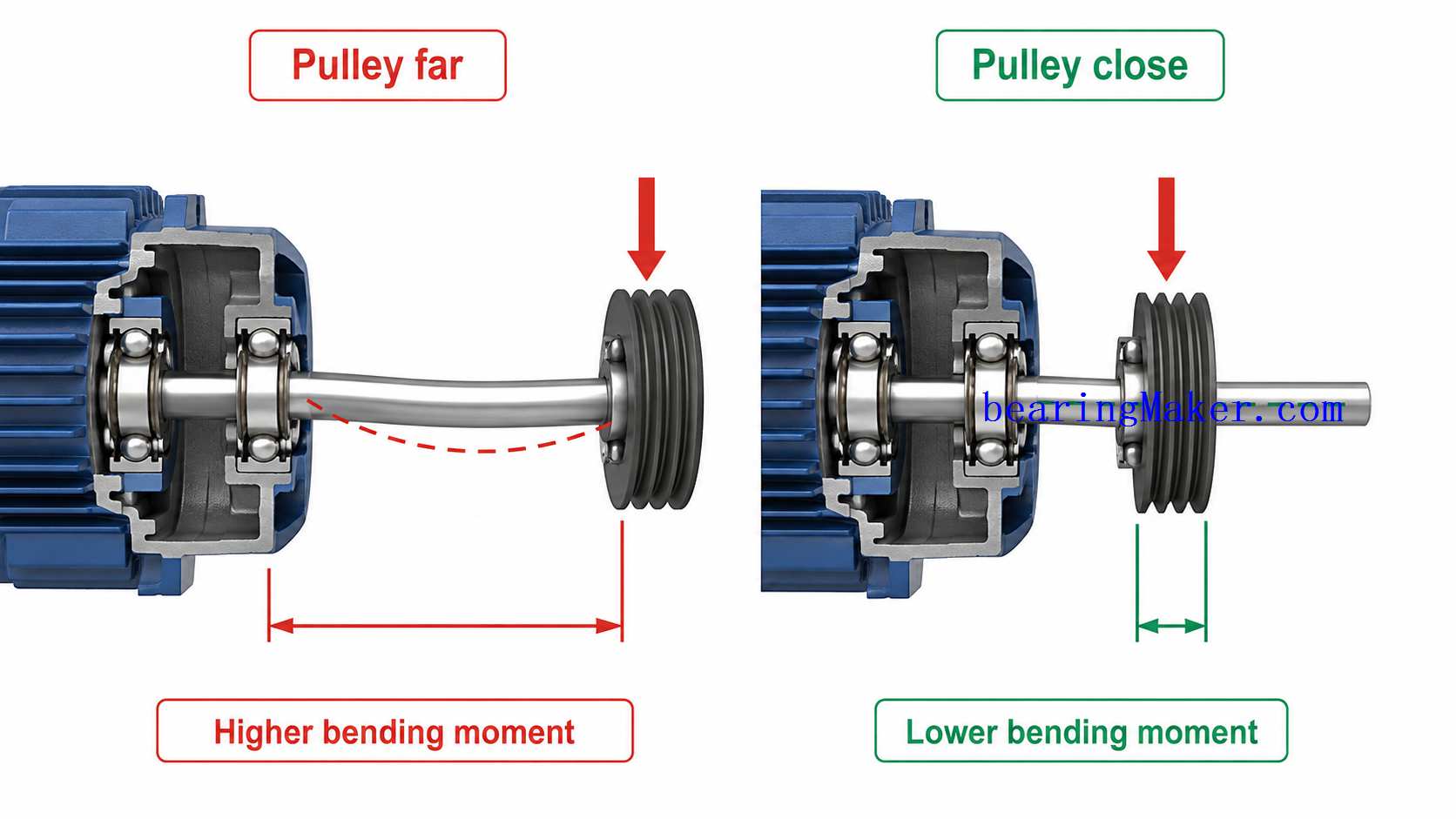
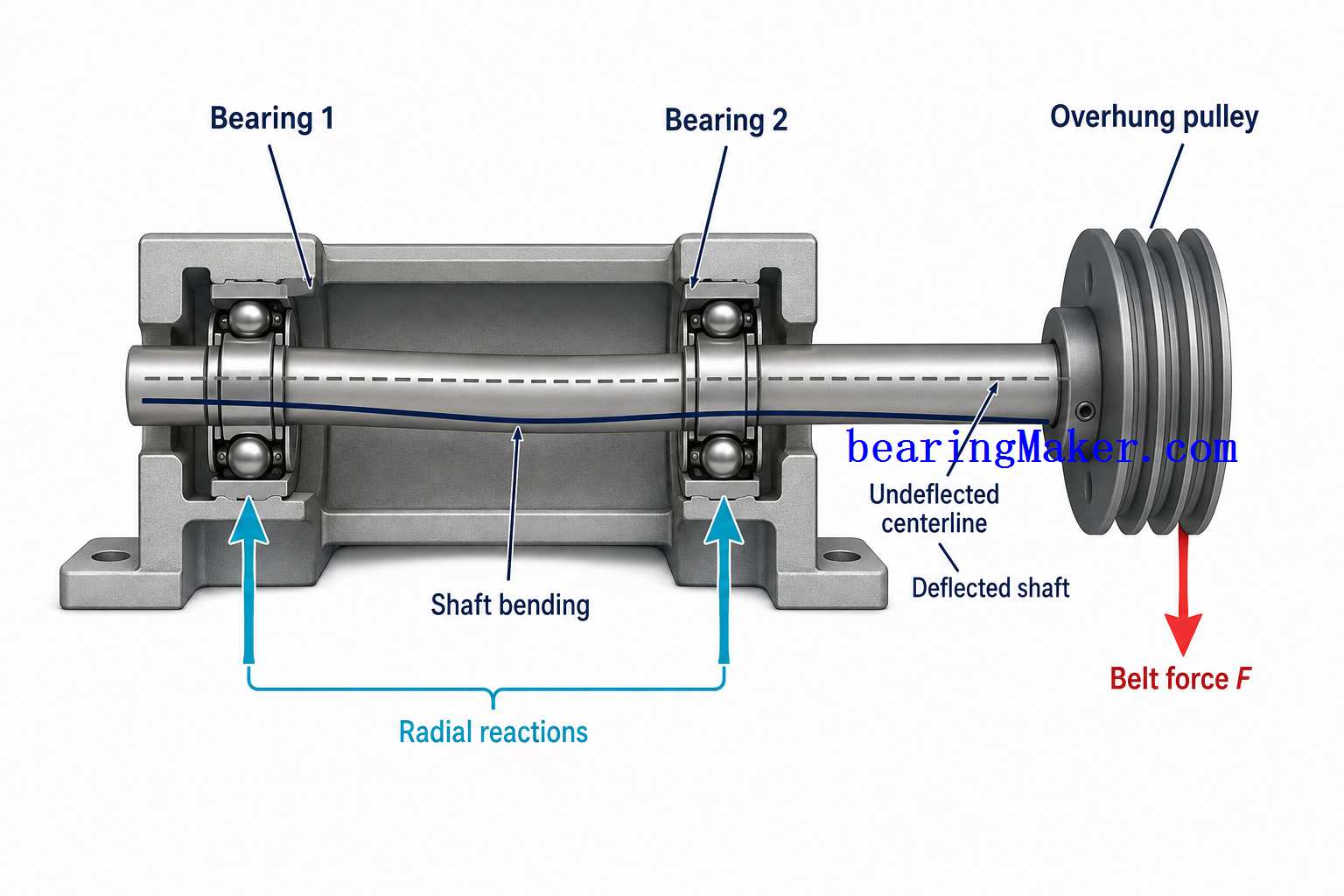
Shaft Stiffness
Shaft stiffness can be especially important in miniature systems.
A small-diameter shaft may deflect under:
- belt load
- gear load
- impeller load
- overhung load
This can change bearing alignment.
Example: Overhung Load
Suppose a small pulley is mounted some distance away from the bearing.
The side force on the pulley creates:
- radial bearing load
- shaft bending
Even if the bearing load rating is sufficient, excessive shaft deflection can create:
- misalignment
- uneven bearing load
Outside Diameter Selection
Once bore is known, the next question is:
How much radial space is available?
The OD is limited by:
- motor housing
- gearbox body
- instrument casing
- surrounding components
Smaller OD vs. Higher Capacity
For the same bore, choosing a smaller OD usually means:
- thinner ring section
- smaller internal geometry
This can reduce:
- load capacity
- stiffness
A larger OD may provide better mechanical performance if space allows.
Width Selection
Width is constrained by the available axial package.
A narrow bearing helps reduce:
- total shaft length
- mechanism width
But wider designs may offer advantages depending on internal geometry.
Width and Bearing Support
Bearing width itself does not determine the effective support spacing of a multi-bearing system.
If two bearings are used, their axial distance from each other often matters more for:
- moment stiffness
- shaft support
Single Bearing vs. Two Bearings
A small rotating shaft may use:
- one bearing
- two bearings
depending on load and alignment requirements.
Two bearings can provide:
- better shaft stability
- better moment resistance
but require more axial space.
Bearing Spacing
Increasing the spacing between two miniature bearings can improve the shaft’s ability to resist:
- tilting
- moment load
This can be more effective than simply choosing a larger individual bearing.
Flanged vs. Non-Flanged Bearing Selection
A flanged bearing is especially useful when axial location is difficult.
A standard non-flanged bearing may be preferable when:
- housing already has a shoulder
- minimal OD is required
- flange provides no functional benefit
Flange as an Assembly Feature
The flange is mainly a mounting and locating feature.
It does not automatically increase:
- radial load capacity
- speed
The bearing should still be selected based on the underlying bearing geometry.
Extended Inner Ring vs. Standard Inner Ring
An extended inner ring may simplify:
- mounting
- shaft spacing
but is not always necessary.
A standard bearing may be preferable if:
- shaft spacers already exist
- minimum axial width is critical
Bearing Type vs. Bearing Size
These are separate decisions.
For example:
- deep groove describes internal type
- flanged describes outer-ring mounting geometry
- 3 × 8 × 3 describes size
- shielded describes closure
A complete miniature bearing specification may therefore include all four characteristics.
Example Bearing Definition
A design might require:
- deep groove ball bearing
- 3 mm bore
- 8 mm OD
- 3 mm width
- flanged outer ring
- shielded closure
Each characteristic answers a different engineering requirement.
Size and Radial Load Capacity
As bearing dimensions increase, the bearing usually gains more room for:
- larger balls
- larger raceways
This generally increases radial load capability.
However, exact load rating should always be taken from the bearing data.
Size and Axial Load
Deep groove miniature bearings can carry some axial load.
Axial capability depends on:
- raceway geometry
- internal clearance
- radial load
A larger bearing does not automatically solve a demanding axial-load problem.
Size and Static Capacity
Small bearings can be damaged by relatively modest shock loads because the rolling contacts are small.
Static capacity should be checked when the bearing may experience:
- assembly impact
- transport shock
- stationary load
Size and Bearing Life
Basic bearing life depends on:
- dynamic rating
- equivalent load
For ball bearings:
L10=(CP)3L_{10}=\left(\frac{C}{P}\right)^3
Increasing bearing size often increases CC, which can increase theoretical life.
But larger size may also increase:
- friction
- mass
- package size
Size and Speed
Small bearings often achieve very high rotational speeds.
This is one reason miniature bearings are widely used in motors and fans.
However, maximum speed is influenced by more than size.
Important factors include:
- cage
- lubricant
- seal type
- preload
- temperature
Mean Diameter and Speed
A useful geometric parameter is the mean bearing diameter:
dm=d+D2d_m=\frac{d+D}{2}
The combination of speed and mean diameter gives a better indication of internal rolling speed than RPM alone.
Small OD and High Speed
Reducing OD can reduce mean bearing diameter, which may benefit high-speed operation.
But a smaller bearing may also provide:
- lower load capacity
- less shaft stiffness
Selection should balance these effects.
Size and Starting Torque
Miniature bearing torque is important because the drive system may be very small.
Bearing size can influence:
- rolling friction
- lubricant drag
- seal contact circumference
However, torque is also strongly affected by:
- preload
- grease
- seals
Seal Size and Torque
A contact seal adds sliding friction.
Even if the absolute seal force is small, it can be significant relative to a miniature motor’s available torque.
This is why closure selection matters as much as dimensional size.
Size and Internal Clearance
Internal clearance becomes especially important at miniature scale.
Small changes caused by:
- shaft fit
- housing fit
can represent a meaningful percentage of the original clearance.
Interference Fits
If the inner ring is fitted tightly to the shaft:
- inner-ring diameter expands
- internal clearance decreases
If the outer ring is pressed tightly into the housing:
- outer ring contracts
- clearance decreases
This can increase:
- torque
- heat
Size and Manufacturing Tolerance
As components become smaller, manufacturing errors do not necessarily become proportionally smaller.
A small absolute dimensional error may represent a larger percentage of:
- bearing clearance
- shaft diameter
- ring thickness
Precision manufacturing therefore becomes especially important.
Miniature Shaft Diameter Tolerance
Shaft fit should be controlled according to:
- bearing bore
- load direction
- desired clearance
An excessively oversized shaft can produce unintended preload.
Housing Bore Tolerance
The housing should provide:
- correct diameter
- roundness
- concentricity
A small housing may be easy to machine inaccurately if:
- wall thickness is low
- plastic molding distortion is present
Miniature Bearings in Plastic Housings
Small bearings are often installed in:
- molded plastic
- polymer housings
because these materials are common in:
- fans
- electronics
- consumer products
Plastic housings can introduce special considerations.
Plastic Housing Challenges
Possible issues include:
- lower stiffness
- molding shrinkage
- temperature-dependent dimensions
- creep over time
This can change:
- fit
- alignment
Press-Fit Into Plastic
A press fit may appear secure initially but may change as the plastic:
- relaxes
- warms
- ages
The complete operating condition should therefore be considered.
Adhesive Retention
Some miniature bearings are retained with adhesive.
This may be useful where:
- tight mechanical interference would distort the bearing
- housing material cannot maintain a reliable press fit
However, adhesive selection and application must avoid:
- contamination
- misalignment
- unintended bonding of moving parts
Flanged Bearings in Plastic Housings
Flanged miniature bearings can be especially useful in plastic housings because the flange provides a simple axial locating surface.
This may reduce dependence on a precisely machined internal shoulder.
Open, Shielded, or Sealed by Application
Open
Consider when:
- machine is clean
- lowest torque matters
- maximum speed matters
Shielded
Consider when:
- light contamination exists
- low friction remains important
Sealed
Consider when:
- dust or moisture is significant
- protection matters more than minimum torque
Typical Bearing Configurations by Application
| Application | Common Starting Configuration |
|---|---|
| Small electric motor | Deep groove, shielded |
| Cooling fan | Deep groove, shielded or sealed |
| Encoder | Precision deep groove, low-drag closure |
| Instrument | Open or shielded |
| Miniature pump | Sealed/corrosion-resistant depending on environment |
| Small roller | Flanged bearing |
| Compact mechanism | Flanged or extended inner ring |
| High-speed spindle | Open or low-friction shielded |
Selecting Bearings for Small Electric Motors
Small motors typically prioritize:
- high speed
- low noise
- low torque
The bearing must fit both:
- rotor shaft
- motor housing
Motor Shaft Diameter
The shaft diameter must balance:
- bearing bore
- rotor strength
- stiffness
If the shaft is too small, bending or vibration may become a problem.
Motor Bearing OD
The bearing OD affects:
- end-cap size
- motor housing diameter
A smaller bearing can reduce motor size, but may reduce load capacity.
Selecting Bearings for Cooling Fans
Cooling fans typically prioritize:
- long life
- low noise
- low friction
- low cost
Bearing size is constrained by the motor hub.
Lubrication and sealing often become more important than maximum static load.
Selecting Bearings for Precision Instruments
Precision instruments may prioritize:
- low runout
- low torque
- repeatability
The smallest bearing is not always the best choice if a slightly larger bearing provides:
- stiffer shaft support
- better running stability
Selecting Bearings for Encoders
Encoders require accurate rotational relationship between:
- shaft
- sensor element
Bearing selection should emphasize:
- runout
- shaft alignment
- low drag
Selecting Bearings for Miniature Pumps
Pumps may produce both:
- radial load
- axial thrust
Bearing size should therefore be selected based on:
- shaft geometry
- impeller load
- axial load
not packaging alone.
Selecting Flanged Bearings
Flanged bearings are a strong option when:
- axial housing space is limited
- a shoulder is difficult to machine
- assembly must be simple
When Not to Use a Flanged Bearing
A flange may be unnecessary when:
- housing already provides precise axial location
- minimum outer envelope matters
- flange interferes with surrounding parts
Selecting an Extended Inner Ring
Consider an extended inner ring when the extension can replace:
- spacer
- sleeve
- locating collar
This may simplify assembly.
When a Standard Inner Ring Is Better
Use a standard inner ring if:
- axial packaging is very tight
- separate spacing is already well controlled
Dimension Selection Workflow
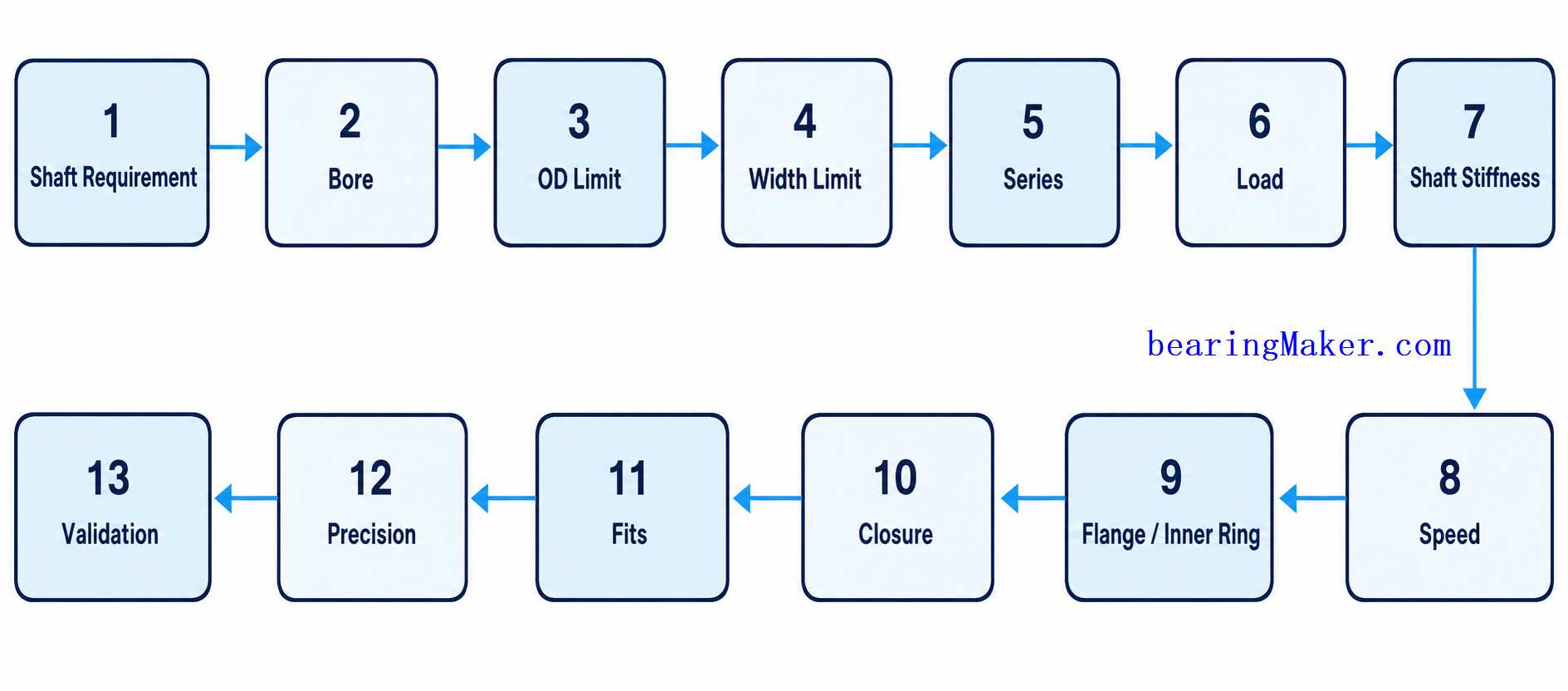
A practical miniature bearing selection process can follow these steps.
Step 1: Define Shaft Diameter
Determine the minimum shaft size required for:
- strength
- stiffness
- torque
Do not simply choose the smallest available bore.
Step 2: Define Maximum Housing OD
Determine the maximum acceptable bearing outside diameter.
Step 3: Define Axial Space
Determine the maximum bearing width.
Step 4: Select the Size Series
Choose between:
- compact series
- larger-capacity series
based on the available envelope.
Step 5: Check Load Capacity
Verify:
- dynamic load
- static load
Step 6: Check Shaft Stiffness
Confirm that the chosen bore does not force the shaft to become too flexible.
Step 7: Check Speed
Evaluate:
- RPM
- mean diameter
- closure type
Step 8: Select Mounting Geometry
Choose:
- standard
- flanged
- extended inner ring
Step 9: Select Closure
Choose:
- open
- shielded
- sealed
Step 10: Check Fits
Define:
- shaft tolerance
- housing tolerance
Step 11: Check Precision
Specify:
- radial runout
- axial runout
Step 12: Validate Final Assembly
Check:
- torque
- noise
- vibration
- temperature
under real operating conditions.
Size Selection Matrix
| Design Priority | Preferred Direction |
|---|---|
| Minimum OD | Compact series |
| Higher load capacity | Larger OD/cross-section |
| Minimum width | Narrow series |
| Simplified axial location | Flanged bearing |
| Simplified shaft spacing | Extended inner ring |
| Highest speed | Open/shielded, suitable series |
| Low torque | Minimal closure drag |
| Dirty environment | Sealed |
| Tiny plastic housing | Flanged design may help |
| High shaft stiffness | Avoid unnecessarily small bore |
Common Miniature Bearing Size-Selection Mistakes
Mistake 1: Choosing the Smallest Bearing Available
Smaller is not automatically better.
The result may be insufficient:
- load capacity
- shaft stiffness
- service life
Mistake 2: Selecting by Bore Only
OD and width are equally important.
Mistake 3: Ignoring Bearing Series
Two bearings with the same bore may have very different:
- load capacity
- speed
- envelope
Mistake 4: Ignoring Shaft Deflection
The bearing may be strong enough while the shaft is too flexible.
Mistake 5: Using a Flanged Bearing Without Checking Flange OD
The flange may interfere with the housing or neighboring components.
Mistake 6: Treating Shielded and Sealed Bearings as Identical
They may have similar external dimensions but different:
- friction
- protection
Mistake 7: Assuming Inch and Metric Sizes Are Interchangeable
Small dimensional differences can create unacceptable fit errors.
Mistake 8: Ignoring Fit-Induced Clearance Change
A very small dimensional change can significantly alter miniature bearing clearance.
Mistake 9: Using Excessive Press Fit to Secure a Small Bearing
This can increase:
- torque
- heat
Mistake 10: Designing the Bearing Before the Shaft
Shaft stiffness and strength should help determine the minimum practical bore.
Troubleshooting Dimensional Problems
Bearing Fits the Shaft but Not the Housing
Check:
- outside diameter
- flange diameter
- housing wall thickness
Bearing Fits but Runs With High Torque
Possible causes include:
- excessive interference
- seal drag
- preload
- grease
Shaft Has Excessive Runout
Check:
- shaft diameter
- straightness
- bearing spacing
- fit
Bearing Moves in the Housing
Possible causes include:
- loose housing fit
- plastic housing creep
- inadequate axial retention
Flanged Bearing Does Not Seat Properly
Check:
- flange diameter
- flange thickness
- housing face flatness
- chamfer interference
Frequently Asked Questions
What Dimensions Define a Miniature Bearing?
The three primary dimensions are:
- bore diameter
- outside diameter
- width
Flanged bearings also require checking flange dimensions.
What Is the Most Important Miniature Bearing Dimension?
There is no single most important dimension.
Bore determines shaft size, while OD and width determine the housing envelope.
How Do I Choose a Miniature Bearing Bore?
Choose bore based on:
- shaft strength
- stiffness
- available space
not simply the smallest bearing available.
How Do I Choose the Outside Diameter?
Use the largest practical OD that:
- fits the housing
- meets weight and packaging requirements
while providing adequate load capacity.
Does a Larger Bearing Carry More Load?
Generally, a larger bearing has more internal space for rolling elements and may provide higher load capacity.
Actual catalog ratings should always be checked.
Does a Smaller Bearing Run Faster?
Smaller diameter can favor high speed, but actual speed capability also depends on:
- cage
- lubricant
- seal
- load
- preload
What Is a Flanged Miniature Bearing?
It is a miniature bearing with an outer-ring flange that helps locate the bearing axially in the housing.
When Should I Use a Flanged Bearing?
A flange is useful when:
- housing axial location is difficult
- assembly needs simplification
Does the Flange Increase Bearing Load Capacity?
Not necessarily.
The flange is mainly a mounting feature.
What Is an Extended Inner-Ring Bearing?
It has an inner ring that extends beyond the normal bearing width.
The extension can simplify:
- spacing
- shaft mounting
What Is the Difference Between Open, Shielded, and Sealed Miniature Bearings?
Open bearings provide the lowest closure friction.
Shielded bearings offer moderate protection with low drag.
Sealed bearings provide stronger contamination protection but generally higher friction.
Are Metric and Inch Miniature Bearings Interchangeable?
Usually not directly.
Even small dimensional differences can create incorrect fits.
Can I Replace a Bearing With One That Has the Same Bore but Different OD?
Only if the housing and performance requirements also allow it.
Load, speed, and fit must be rechecked.
Can I Use a Wider Bearing for More Strength?
Possibly, but width alone does not determine capacity.
The actual bearing design and load ratings should be compared.
Why Does My Miniature Bearing Become Tight After Installation?
Possible causes include:
- excessive inner-ring interference
- excessive outer-ring interference
- misalignment
These conditions can reduce internal clearance.
Why Is Shaft Stiffness Important?
Miniature bearing shafts can be very small.
If the shaft bends, bearing alignment and precision may deteriorate even when bearing load capacity is adequate.
Miniature Bearing Dimension Selection Checklist
Before finalizing a bearing size, define:
| Parameter | What to Determine |
|---|---|
| Bore | Shaft diameter |
| Shaft stiffness | Adequate for load |
| Outside diameter | Maximum housing space |
| Width | Maximum axial space |
| Bearing series | Compact or higher-capacity |
| Bearing type | Deep groove/etc. |
| Flange | Required or not |
| Flange OD | Housing clearance |
| Extended inner ring | Required or not |
| Closure | Open/shielded/sealed |
| Radial load | Continuous and peak |
| Axial load | Magnitude |
| Static load | Assembly/shock |
| Speed | Continuous and peak |
| Starting torque | Maximum acceptable |
| Running torque | Maximum acceptable |
| Shaft fit | Required tolerance |
| Housing fit | Required tolerance |
| Internal clearance | Required after fit |
| Radial runout | Required accuracy |
| Axial runout | Required accuracy |
| Housing material | Metal/plastic/etc. |
| Temperature | Dimensional effect |
| Contamination | Protection required |
| Maintenance | Access and replacement |
Conclusion
Miniature bearing size selection begins with three dimensions:
- bore
- outside diameter
- width
but a good design cannot stop there.
The bore determines the shaft.
The OD determines the housing.
The width determines axial packaging.
The bearing series determines how those dimensions are balanced against:
- load capacity
- speed
- stiffness
External configurations such as:
- flanges
- extended inner rings
- shields
- seals
then adapt the bearing to the assembly and operating environment.
The most important distinction is that the smallest bearing that physically fits is not automatically the best bearing.
An excessively small bearing may force the shaft to become too flexible.
A very compact series may sacrifice useful load capacity.
A sealed design may solve contamination problems but create too much torque.
A tight fit may secure the ring but reduce internal clearance.
A reliable dimensional selection process should therefore follow:
Shaft Strength and Stiffness → Bore → Housing OD → Axial Width → Bearing Series → Load Capacity → Speed → Mounting Geometry → Closure → Fits → Precision → Final Operating Validation
Miniature bearing dimensions should be treated as part of the complete mechanical design rather than as a simple catalog lookup.
The best bearing size is the one that fits the available space while still providing the required:
- shaft support
- load capacity
- speed
- precision
- torque
- reliability
throughout the real operating life of the machine.