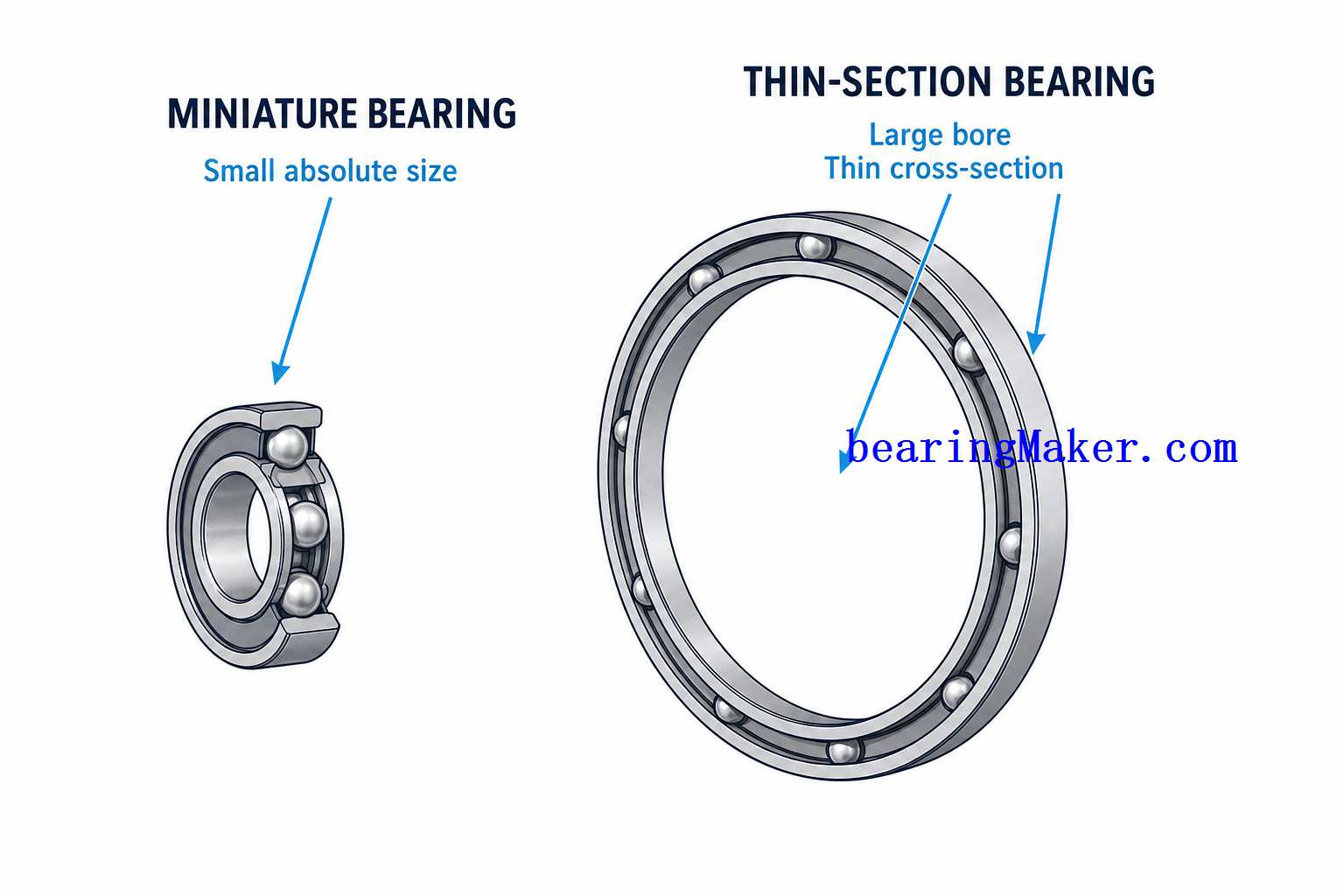
Miniature bearings can fail for many of the same reasons as larger rolling bearings, but the small scale changes which problems become most important.
A miniature bearing may carry only a modest load and still fail early because of:
- contamination
- excessive grease
- incorrect fits
- installation damage
- shaft misalignment
- excessive preload
- corrosion
- high speed
- lubricant degradation
- electrical damage
In many miniature bearing applications, the first warning is not catastrophic failure.
Instead, the machine may show:
- increased noise
- rough rotation
- higher starting torque
- higher running torque
- rising temperature
- vibration
- runout
- loss of precision
- reduced motor speed
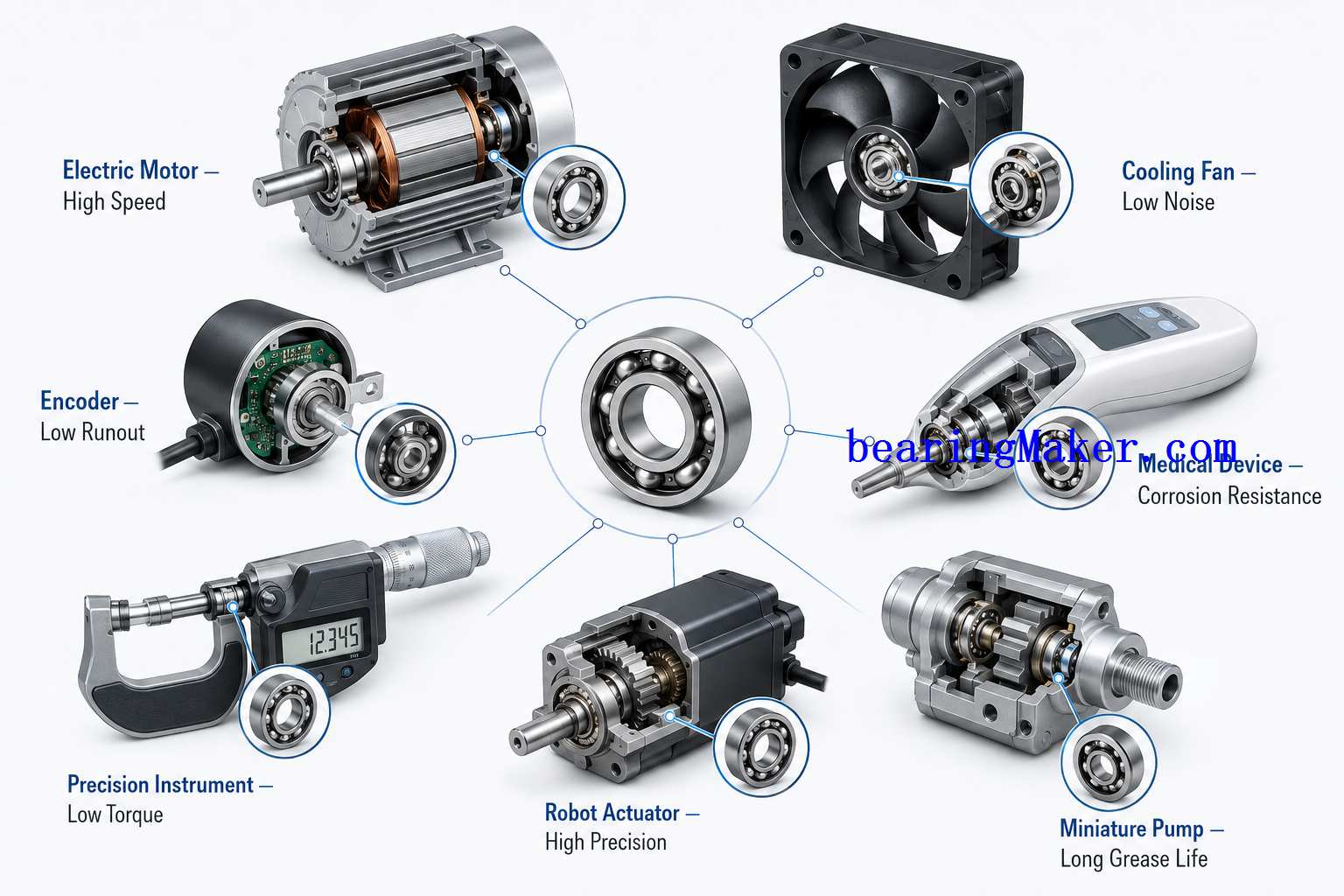
These symptoms are especially important in:
- small electric motors
- cooling fans
- encoders
- medical devices
- precision instruments
- miniature pumps
- small actuators
A bearing that still rotates may already be functionally unacceptable.
For this reason, miniature bearing troubleshooting should not begin with:
“Is the bearing broken?”
A better question is:
“What changed in the bearing, shaft, housing, lubrication, or environment to produce the symptom?”
This guide explains the most common miniature bearing failure modes, how to distinguish them, how to identify root causes, and how to prevent repeated failures.
Why Miniature Bearing Failures Need Special Attention
Miniature bearings operate with:
- small balls
- small raceways
- small internal clearances
- small lubricant volumes
- small shafts
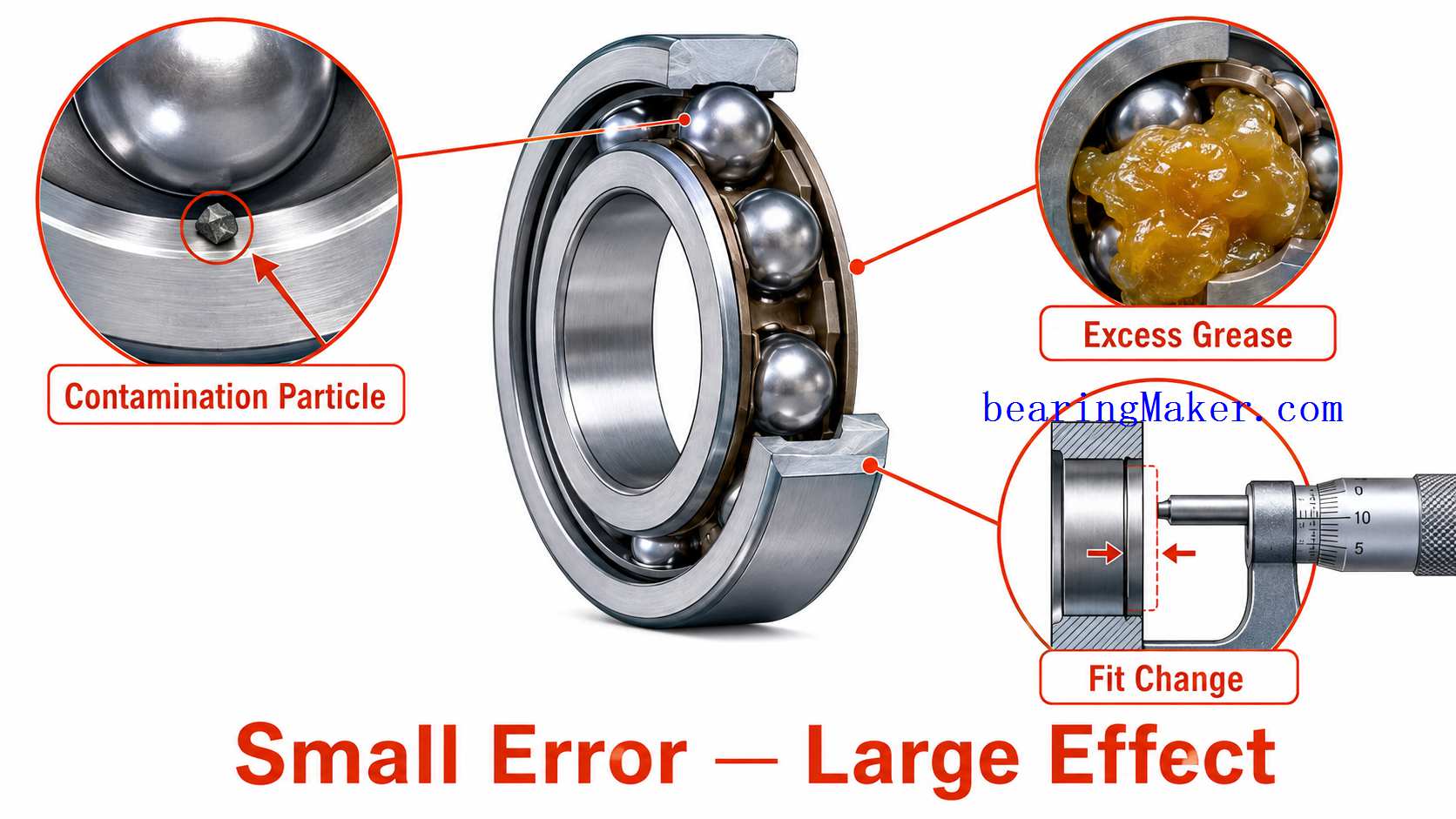
This means a small absolute error can have a large relative effect.
For example:
- a tiny particle can be large relative to the rolling contact
- a small amount of extra grease can occupy a large percentage of the free internal volume
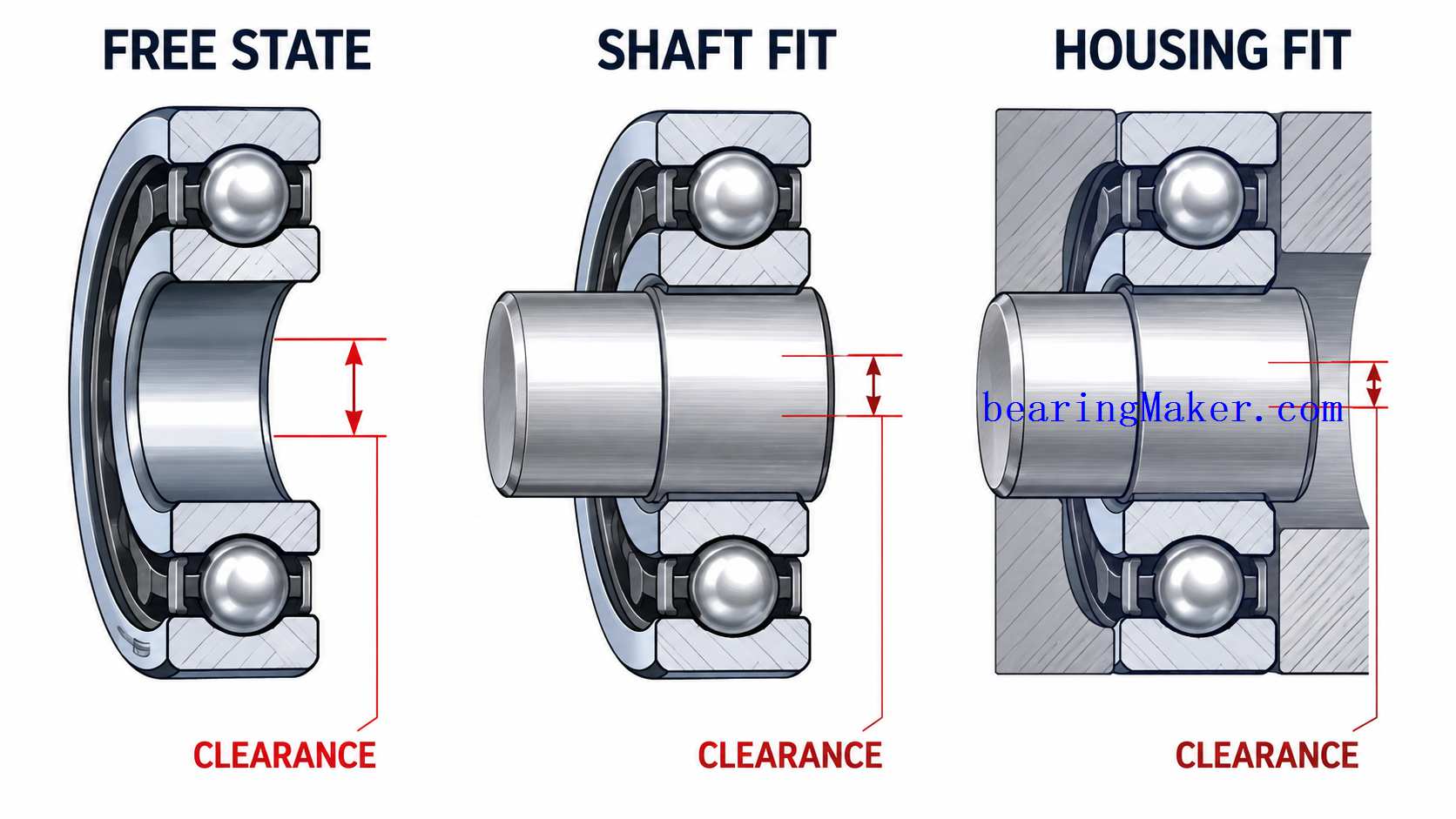
- a few micrometers of fit change can significantly alter internal clearance
- a small installation force can still create high local contact stress
This is why miniature bearing failures are often strongly influenced by assembly and environment.
Main Miniature Bearing Failure Categories
Common failure categories include:
- fatigue
- static overload
- lubrication failure
- contamination
- corrosion
- excessive preload
- excessive clearance
- fit problems
- shaft or housing misalignment
- cage damage
- seal or shield damage
- electrical damage
- thermal effects
Several mechanisms may occur together.
For example:
tight shaft fit → reduced clearance → excessive preload → high torque → heat → grease degradation → raceway damage
The final visible failure may therefore be far removed from the original cause.
Noise as an Early Failure Symptom
Noise is one of the most common warning signs in miniature bearings.
Possible changes include:
- high-pitched noise
- clicking
- rough sound
- rattling
- periodic noise
Noise should not automatically be interpreted as normal bearing wear.
It can indicate:
- contamination
- raceway damage
- grease deterioration
- cage problems
- shield rubbing
- misalignment
High-Pitched Bearing Noise
High-frequency noise may be associated with:
- raceway surface damage
- insufficient lubrication
- contamination
- high-speed contact behavior
The system should also be checked for non-bearing noise sources such as:
- motor electromagnetic forces
- fan airflow
- structural resonance
Clicking or Repeating Noise
Periodic clicking may indicate:
- raceway indentation
- contamination
- localized damage
If the sound repeats at regular intervals, the damage may be tied to a particular rotating component.
Rattling Noise
Rattling may be associated with:
- excessive clearance
- cage movement
- loose fit
The exact cause depends strongly on operating speed and load.
Noise Is Not Always a Bearing Defect
Noise can also come from:
- rotor imbalance
- gears
- fan blades
- housing vibration
- motor electromagnetic excitation
A proper diagnosis separates the bearing from the machine.
Rough Rotation
A miniature bearing that feels rough when rotated by hand may have:
- contamination
- brinelling
- spalling
- corrosion
- insufficient lubrication
However, hand rotation is only a rough diagnostic.
A bearing can feel acceptable by hand and still perform poorly at operating speed.
What Causes Roughness?
Common causes include:
- hard particles in the raceway
- permanent indentations
- surface fatigue
- corrosion pits
- damaged balls
Why Roughness Matters in Precision Equipment
Rough rotation can produce:
- torque variation
- vibration
- positioning error
In an encoder or instrument, this may be unacceptable long before complete bearing failure.
High Starting Torque
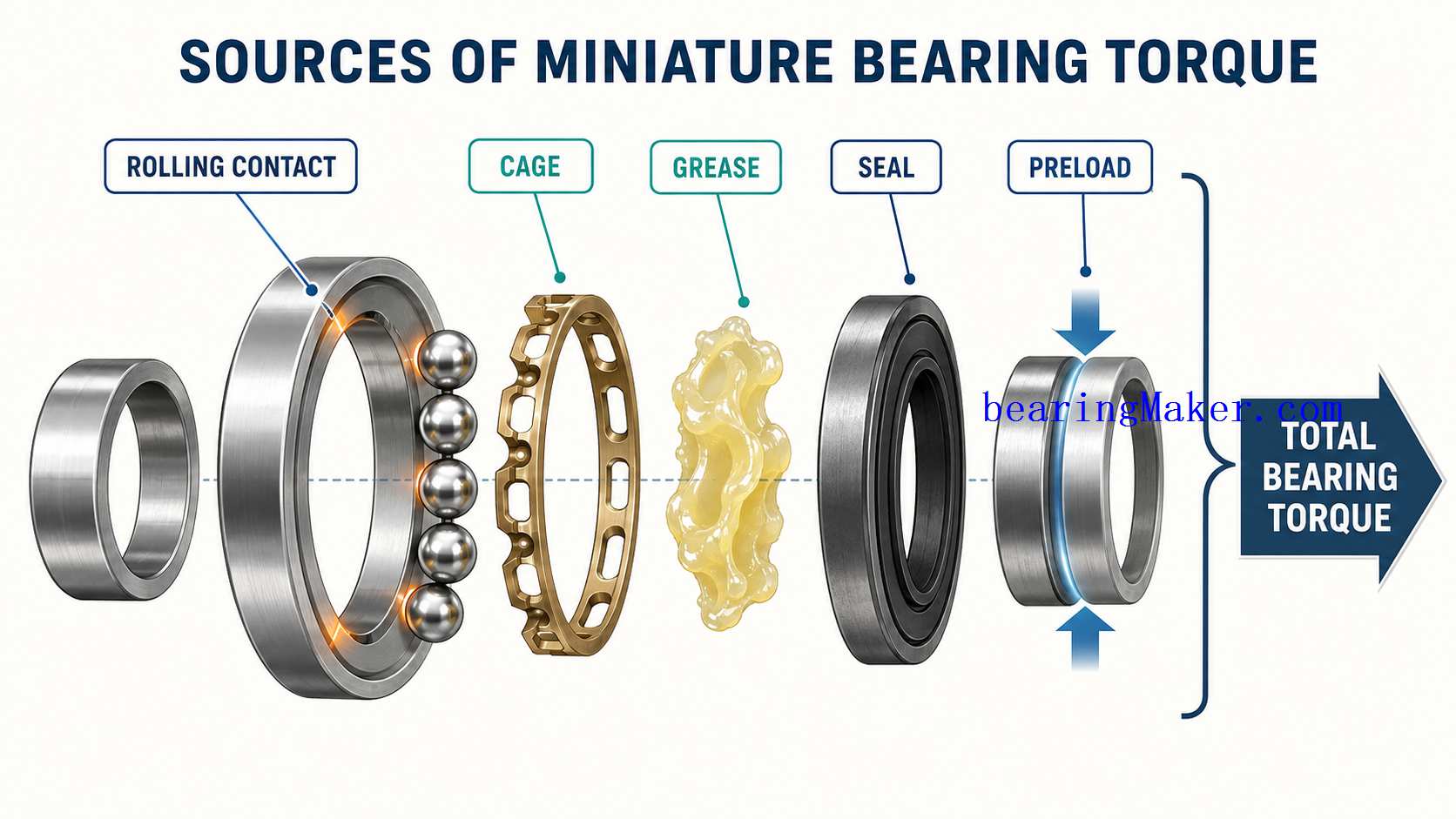
High starting torque means the bearing requires too much torque to begin rotation.
Possible causes include:
- excessive grease
- high-viscosity lubricant
- contact seal drag
- excessive preload
- tight fits
- low temperature
- contamination
Cold-Start Torque
If torque is acceptable when warm but too high when cold, likely causes include:
- lubricant viscosity
- seal stiffness
This is especially relevant in:
- outdoor equipment
- aerospace mechanisms
- refrigerated systems
Fit-Induced Starting Torque
A tight shaft or housing fit can reduce internal clearance enough to create:
- unintended preload
The bearing may then require significantly more startup torque.
High Running Torque
Running torque may become excessive because of:
- grease churning
- excessive preload
- seal friction
- misalignment
- bearing damage
- contamination
High Constant Torque vs. Periodic Torque
These symptoms can point to different causes.
High Constant Torque
Possible causes:
- excess preload
- excessive grease
- seal drag
Periodic Torque Variation
Possible causes:
- shaft runout
- raceway damage
- housing eccentricity
- brinelling
This distinction is useful during troubleshooting.
Overheating
Overheating is usually a symptom rather than the root cause.
Common causes include:
- excessive preload
- high-speed friction
- excess grease
- seal drag
- tight fits
- misalignment
- poor lubrication
Thermal Feedback
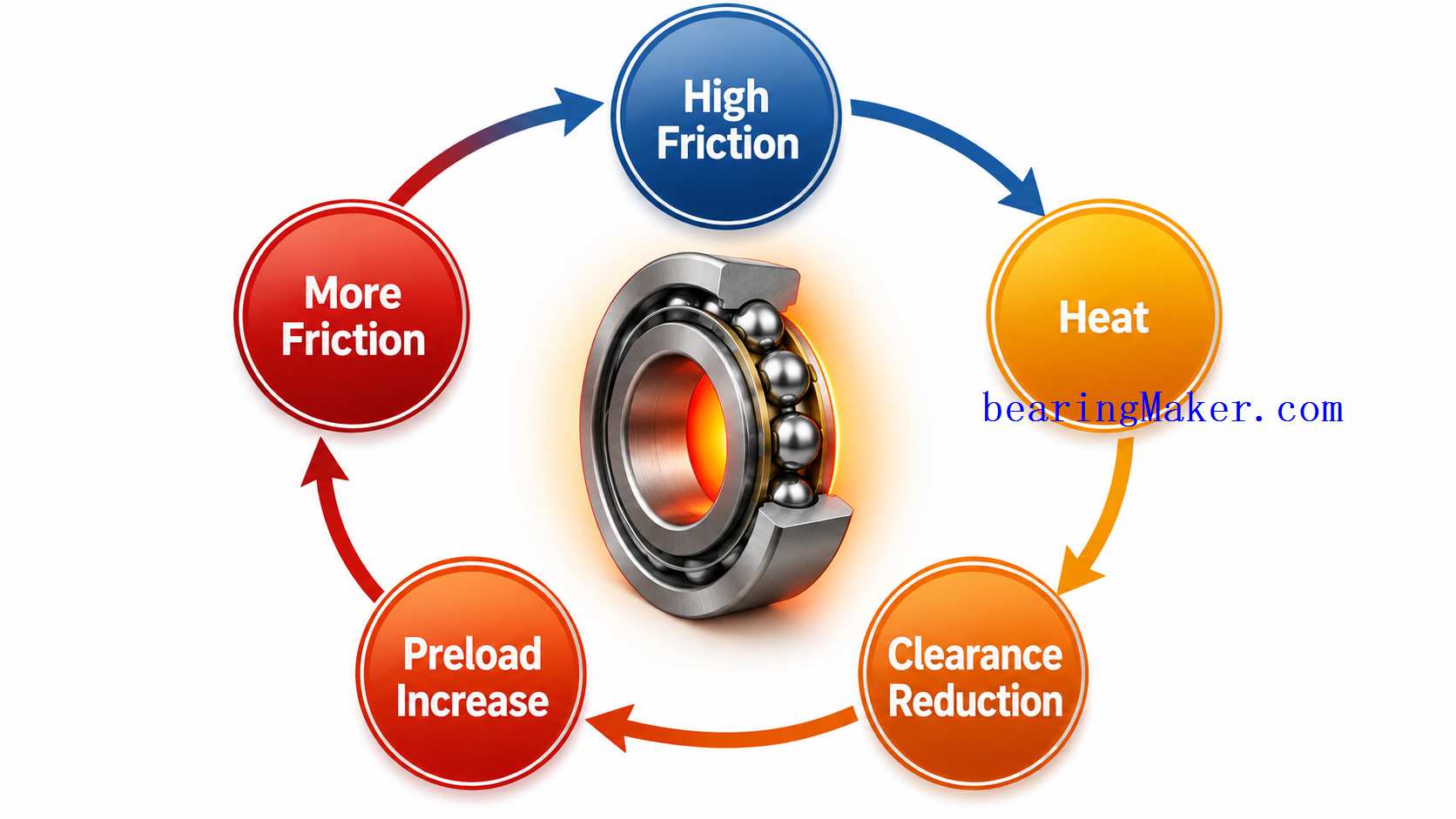
A dangerous feedback loop can occur:
high friction → heat → thermal expansion → reduced clearance → higher preload → more friction
This can lead to rapid deterioration.
Spalling
Spalling is the flaking or breaking away of material from:
- raceways
- balls
It is commonly associated with rolling-contact fatigue or severe local stress.
Causes of Spalling
Possible causes include:
- fatigue
- overload
- contamination
- poor lubrication
- excessive preload
- misalignment
Early Spalling Symptoms
Possible signs include:
- increasing vibration
- rough noise
- metallic debris
- torque variation
Why Miniature Bearings May Spall Early
A bearing may have adequate calculated L10 life but still develop local overload because of:
- shaft bending
- incorrect fit
- contamination
- installation damage
Brinelling
Brinelling is permanent indentation of the raceway caused by excessive static or impact load.
Common causes include:
- hammering
- incorrect pressing
- dropping components
- shock
Installation Brinelling
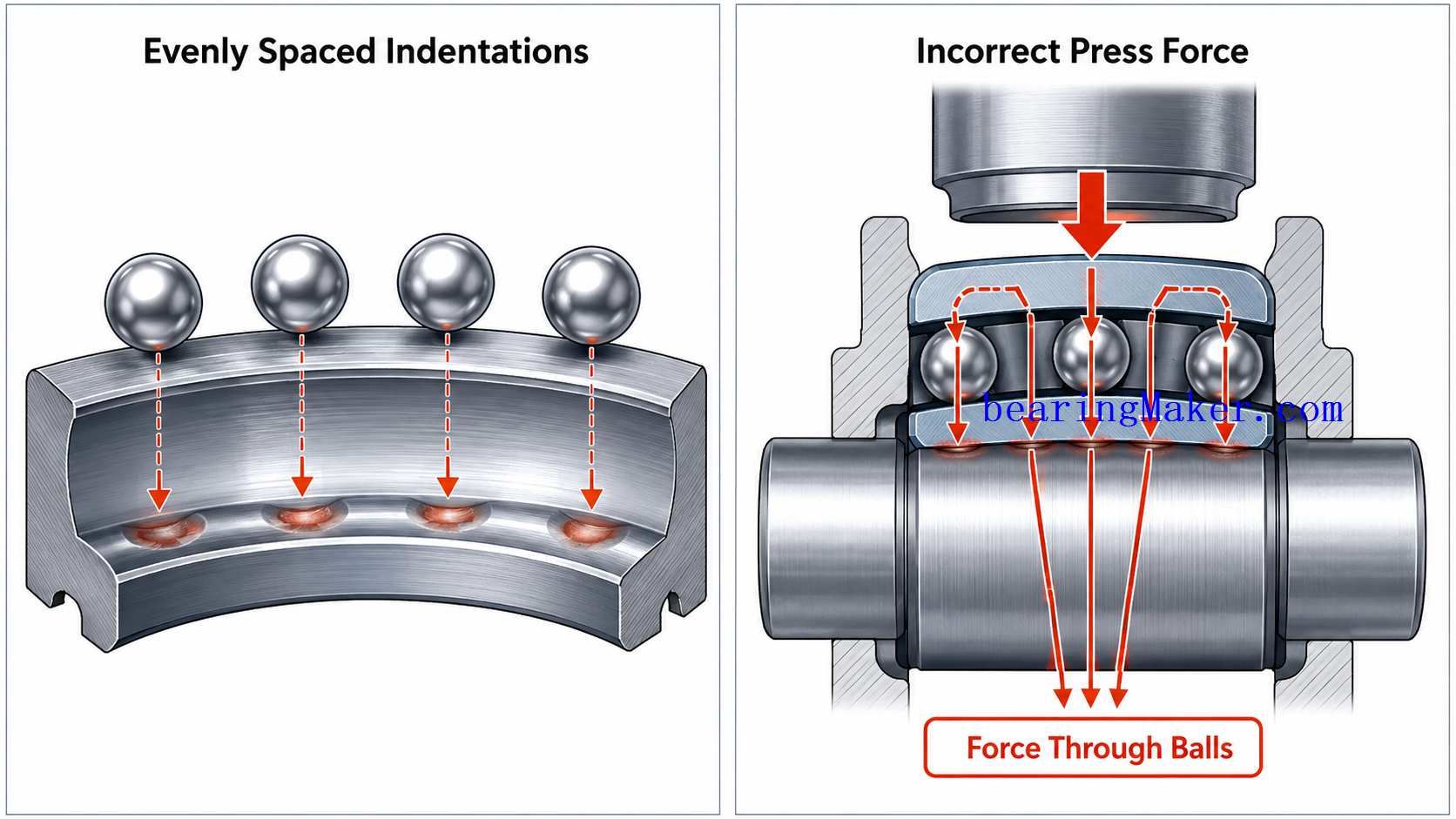
One of the most common causes is installation force passing through the balls.
If the inner ring has the interference fit, pressing on the outer ring can transmit load through the rolling elements.
This can permanently indent the raceways.
Symptoms of Brinelling
Typical symptoms include:
- periodic vibration
- periodic noise
- rough rotation
False Brinelling
False brinelling resembles brinelling but results from repeated small-amplitude movement rather than a single static overload.
It can occur in:
- transported equipment
- parked machines exposed to vibration
- small oscillating mechanisms
Why Small Oscillation Is Difficult
If the bearing moves only through a very small angle:
- lubricant may not redistribute
- the same raceway region is repeatedly loaded
This can create localized wear.
Prevention of False Brinelling
Possible methods include:
- vibration isolation
- transport locking
- suitable lubrication
- periodic larger movement where practical
Fretting
Fretting occurs at interfaces where small repeated movement takes place.
It commonly occurs between:
- inner ring and shaft
- outer ring and housing
Signs of Fretting
Possible signs include:
- reddish-brown debris
- dark marks
- polished wear zones
Causes of Fretting
Common causes include:
- loose fit
- vibration
- thermal movement
- cyclic loading
Ring Creep
Ring creep is relative movement between:
- bearing ring
- shaft or housing
It may occur when the fit does not provide sufficient retention.
Effects of Ring Creep
Possible consequences include:
- wear
- fretting
- loss of accuracy
- heat
Do Not Solve Creep With Excessive Interference Automatically
Increasing interference can reduce creep, but too much interference may:
- reduce clearance
- increase preload
- increase torque
The correct solution should balance:
retention vs. bearing distortion
Excessive Preload
Preload can be intentional or accidental.
Intentional preload may improve:
- stiffness
- shaft stability
Accidental preload may result from:
- tight shaft fit
- tight housing fit
- thermal expansion
- axial clamping
Symptoms of Excessive Preload
Common symptoms include:
- high starting torque
- high running torque
- overheating
- reduced speed
Preload and Bearing Life
Preload increases internal rolling-element load.
Too much preload can increase:
- contact stress
- heat
and reduce fatigue life.
Insufficient Preload or Excessive Clearance
The opposite problem can also occur.
Too much clearance can create:
- shaft play
- vibration
- noise
- poor positioning accuracy
Causes of Excessive Clearance
Possible causes include:
- incorrect bearing selection
- loose fits
- wear
- preload loss
- plastic housing creep
Preload Loss
Preload may decrease over time because of:
- wear
- component settling
- spring relaxation
- housing creep
Symptoms of Preload Loss
Possible effects include:
- increased play
- reduced stiffness
- poorer repeatability
- rattling
Lubrication Failure
Lubrication failure can occur even when grease is still physically present.
Possible causes include:
- inadequate quantity
- excessive quantity
- wrong viscosity
- grease aging
- contamination
- chemical degradation
Underlubrication
Too little lubricant can lead to:
- inadequate film
- wear
- heat
- noise
Overlubrication
Too much grease can create:
- churning
- high torque
- heat
This is particularly important in miniature bearings because internal free volume is small.
Grease Aging
Over time, grease may:
- oxidize
- harden
- separate
- lose base oil
Symptoms of Aged Grease
Possible signs include:
- increased torque
- increased noise
- temperature rise
Grease Life vs. Bearing Life
A miniature bearing may have sufficient fatigue life but still fail because the lubricant degrades first.
This is common in:
- cooling fans
- sealed motors
- maintenance-free devices
Contamination
Contamination is one of the most important causes of miniature bearing failure.
Possible contaminants include:
- dust
- metal chips
- fibers
- adhesive
- moisture
Why Tiny Contaminants Matter So Much
A particle that seems very small at machine scale may be large relative to:
- ball diameter
- raceway contact
- lubricant film
It can create:
- dents
- scratches
- noise
- fatigue initiation sites
Assembly Contamination
Contamination may enter during:
- installation
- lubrication
- handling
This is why cleanliness is critical.
Adhesive Contamination
Adhesive used for bearing retention can cause severe problems if it enters:
- shield gaps
- seals
- raceways
Possible results include:
- high torque
- rough rotation
- complete seizure
Corrosion
Corrosion can damage:
- raceways
- balls
- bearing seats
Possible causes include:
- humidity
- water
- cleaning chemicals
- condensation
Corrosion Symptoms
Possible signs include:
- staining
- rust
- roughness
- increased noise
Corrosion Pits
Small corrosion pits can become local stress concentrations.
These may later develop into:
- spalling
- fatigue damage
Corrosion Prevention
Possible methods include:
- stainless bearing materials
- suitable seals
- corrosion-resistant lubricant
- environmental control
Cage Damage
The cage guides and separates the balls.
Damage can result from:
- high speed
- rapid acceleration
- repeated reversal
- poor lubrication
- contamination
- misalignment
Cage Damage Symptoms
Possible symptoms include:
- rattling
- irregular torque
- noise
- debris
Reversing Motion and Cage Stress
Small actuators and servo mechanisms may repeatedly:
- accelerate
- stop
- reverse
This can create dynamic cage loads that do not occur in continuous rotation.
Seal Damage
Contact seals can fail due to:
- wear
- high temperature
- chemical attack
- misalignment
- installation damage
Seal Failure Symptoms
Possible signs include:
- lubricant leakage
- increased torque
- contamination entry
Shield Damage
Thin metal shields can be bent during installation.
A bent shield may rub against:
- cage
- inner ring
This can produce:
- noise
- torque
- heat
Installation Damage to Shields and Seals
Press tooling should not contact:
- shields
- seals
Force should be applied only to the appropriate bearing ring.
Shaft Misalignment
Miniature bearings are often installed on very small shafts.
Misalignment can result from:
- bent shaft
- non-coaxial housing bores
- tilted shoulders
- assembly error
Misalignment Effects
Possible consequences include:
- uneven ball loading
- higher friction
- heat
- reduced life
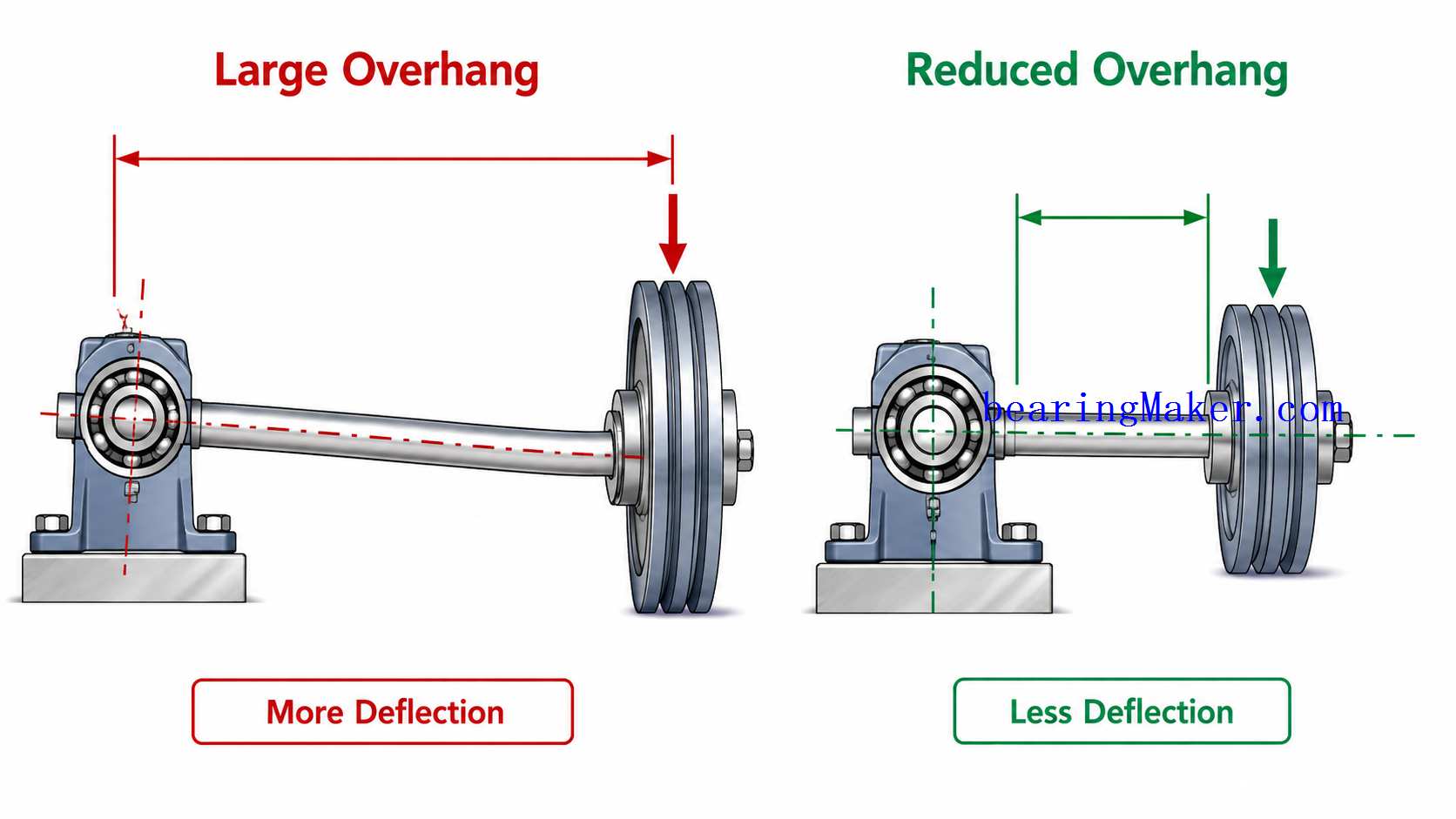
Shaft Deflection
A shaft may be small enough that it bends before the bearing itself reaches its load limit.
Common causes include:
- overhung pulley
- gear
- fan
- impeller
Why Shaft Deflection Is a Bearing Failure Cause
Shaft bending changes the relative alignment of the bearing rings.
This can create:
- localized contact stress
- uneven load distribution
- noise
Reduce Shaft Bending
Possible solutions include:
- larger shaft diameter
- shorter overhang
- greater bearing spacing
Housing Misalignment
If two bearing seats are not coaxial, the bearings may be forced into different axes.
This can create:
- shaft bending
- high torque
- heat
Plastic Housing Creep
Miniature bearings are frequently installed in plastic housings.
Over time, plastic may creep under stress.
This can cause:
- loose fit
- ring movement
- alignment loss
Thermal Expansion of Plastic Housings
Plastic often expands more than metallic bearing rings.
As temperature changes, the fit may:
- loosen
- tighten
depending on geometry.
Bearing Failure in Plastic Housings
If failures appear after long service rather than immediately, check:
- housing creep
- thermal cycling
- fit stability
Electrical Damage
Electrical current passing through a conventional steel bearing can damage the rolling contacts.
Possible forms include:
- pitting
- fluting
Electrical Damage in Small Motors
Miniature bearings in electric motors may be exposed to:
- shaft voltage
- electrical discharge
depending on the motor and drive system.
Prevention of Electrical Damage
Possible methods include:
- grounding
- electrical isolation
- hybrid ceramic rolling elements
where appropriate.
Shock and Impact
Miniature bearings may be damaged by:
- product drops
- transportation
- assembly impacts
- sudden stops
Why Small Bearings Are Sensitive to Shock
Their rolling contact area is small.
A brief impact can create permanent local deformation.
Shock Damage May Be Invisible Externally
The bearing may look normal but develop:
- periodic vibration
- noise
because of internal raceway indentation.
High-Speed Failure
At high speed, several failure mechanisms can interact:
- cage instability
- grease churning
- seal heating
- centrifugal effects
- thermal preload
Speed Alone May Not Be the Root Cause
A bearing that fails at high RPM may actually be limited by:
- grease
- preload
- closure type
- cooling
The design should therefore be analyzed as a complete system.
Thermal Failure
Temperature can cause or accelerate failure by changing:
- lubricant viscosity
- clearance
- fits
- cage behavior
- seal properties
Cold-Temperature Failure
At low temperature:
- grease becomes more viscous
- seal drag increases
Possible symptoms include:
- failure to start
- excessive current
- high torque
High-Temperature Failure
At high temperature:
- lubricant degrades faster
- seals may soften
- plastic cages may lose stability
- preload may change
Loss of Precision Without Catastrophic Failure
Some miniature bearings fail functionally before they fail mechanically.
Possible symptoms include:
- higher runout
- increased axial play
- torque variation
- reduced repeatability
This is common in:
- encoders
- sensors
- precision instruments
Noise Increase Without Visible Damage
A bearing may become too noisy for the application even though it still rotates normally.
In low-noise systems, this is a genuine functional failure.
Motor Efficiency Loss
Higher bearing torque may reduce:
- motor efficiency
- speed
- battery life
A bearing can therefore be functionally failed without obvious raceway destruction.
Failure Pattern vs. Likely Cause
| Symptom | Possible Cause | What to Check |
|---|---|---|
| High-pitched noise | Lubrication/raceway issue | Grease, contamination, surfaces |
| Clicking | Local dent/debris | Raceway, particles |
| Rattling | Excess clearance/cage | Clearance, cage |
| Rough rotation | Contamination/damage | Raceways, balls |
| High starting torque | Grease/seal/preload | Lubricant, fit, seal |
| High running torque | Churning/misalignment | Grease, alignment |
| Bearing runs hot | Preload/friction | Fits, grease, seals |
| Periodic vibration | Brinelling/runout | Raceway, shaft |
| Increasing vibration | Spalling/wear | Bearing surfaces |
| Excessive axial play | Clearance/preload loss | Fit, wear |
| Fretting | Loose fit | Shaft/housing fit |
| Ring creep | Inadequate retention | Fit, load direction |
| Corrosion | Moisture/chemicals | Seal, material |
| Cage noise | Cage wear/dynamics | Speed, lubrication |
| Grease leakage | Excess fill/heat | Quantity, temperature |
| Shield rubbing | Installation damage | Shield geometry |
| Motor current rises | Bearing torque | Grease, preload, fit |
| Precision degrades | Wear/runout/misalignment | Shaft, housing, bearing |
| Repeated early failure | System problem | Load, fit, installation |
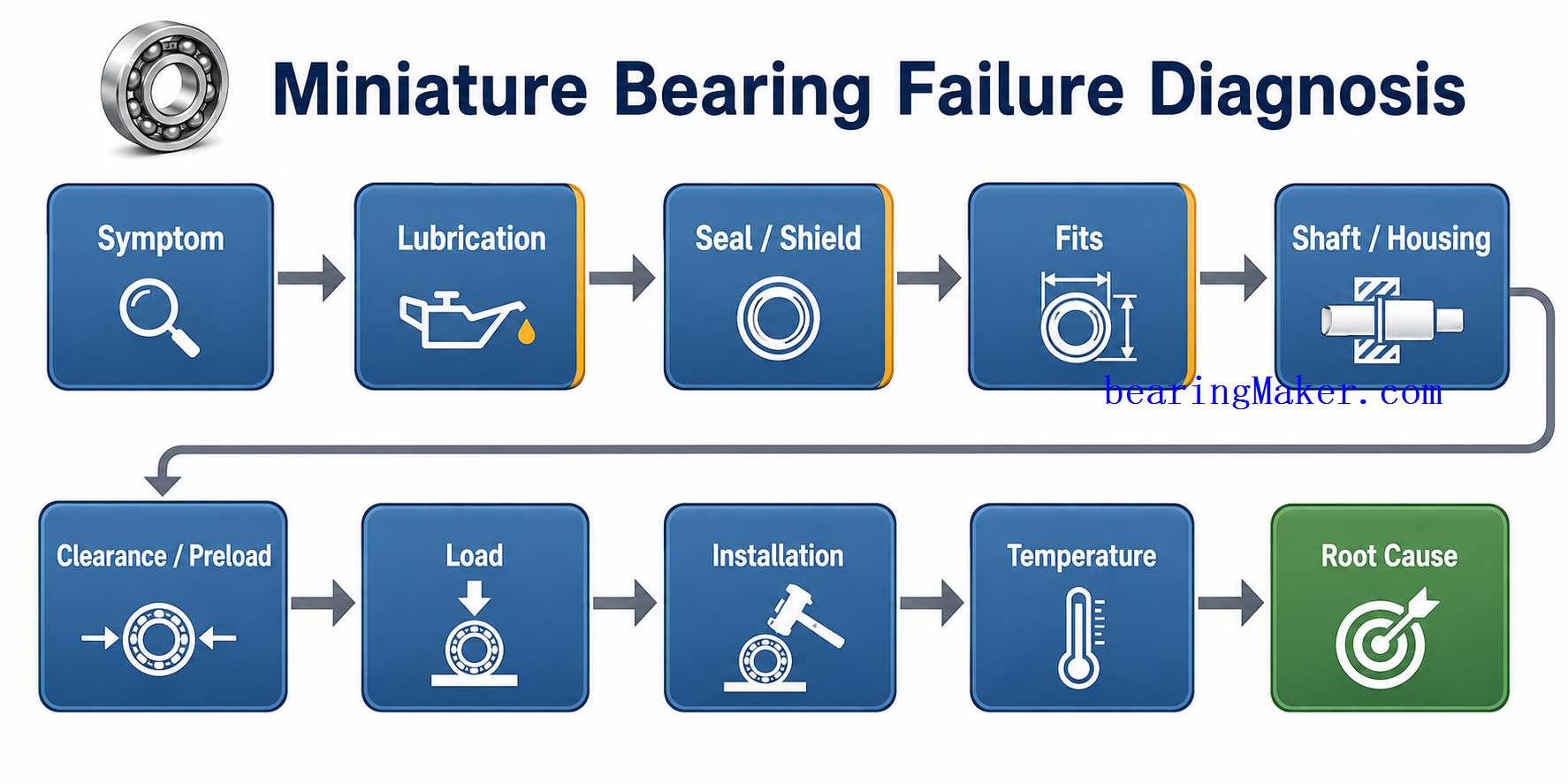
Root-Cause Diagnosis Workflow
A systematic diagnosis is more reliable than replacing the bearing immediately.
Step 1: Record the Symptom
Document:
- noise
- torque
- temperature
- vibration
- speed loss
- runout
Step 2: Record Operating Conditions
Include:
- hours
- RPM
- load
- temperature
- duty cycle
- environment
Step 3: Compare With a Known-Good Baseline
Check whether:
- noise increased
- torque increased
- temperature changed
- vibration increased
Step 4: Inspect Before Cleaning
Look for:
- grease condition
- debris
- corrosion
- leakage
Cleaning too early may remove useful evidence.
Step 5: Check Lubrication
Inspect:
- grease amount
- grease condition
- contamination
Step 6: Check Seals and Shields
Look for:
- rubbing
- deformation
- wear
Step 7: Check Shaft and Housing Fits
Measure:
- shaft diameter
- housing bore
Check for:
- creep
- fretting
Step 8: Check Shaft Geometry
Inspect:
- runout
- straightness
- roundness
Step 9: Check Housing Alignment
Verify:
- concentricity
- coaxiality
Step 10: Check Preload and Clearance
Determine whether the bearing is:
- too loose
- excessively preloaded
Step 11: Review Loads
Include:
- radial load
- axial load
- shock
- overhung load
Step 12: Review Installation Method
Determine whether installation force may have passed through the balls.
Step 13: Review Temperature
Check whether temperature changes:
- fits
- preload
- lubricant behavior
Step 14: Identify the Failure Chain
Do not stop at the visible symptom.
For example:
high noise → raceway damage
may actually have begun as:
installation brinelling → periodic vibration → raceway wear → high noise
Condition Monitoring
Miniature bearing health can often be monitored using simple system-level measurements.
Useful parameters include:
- noise
- vibration
- torque
- motor current
- temperature
- runout
Noise Monitoring
Increasing noise may indicate:
- contamination
- grease aging
- wear
Vibration Monitoring
Increasing vibration may indicate:
- imbalance
- brinelling
- spalling
- looseness
Torque Monitoring
An increase in torque can indicate:
- grease deterioration
- preload change
- seal damage
- contamination
Motor Current Monitoring
In small motors, motor current can provide an indirect indication of increasing mechanical resistance.
A rising current at the same operating condition may suggest:
- bearing torque increase
though electrical causes must also be considered.
Temperature Monitoring
Useful observations include:
- warm-up rate
- steady-state temperature
- change from baseline
A continuously rising temperature is more concerning than a stable, repeatable warm-up pattern.
Runout Monitoring
Precision systems may benefit from periodic checks of:
- radial runout
- axial runout
Increasing runout can indicate:
- bearing wear
- shaft movement
- fit loss
Bearing Failure in Small Electric Motors
Common issues include:
- noise
- high torque
- overheating
- electrical damage
Motor Failure Diagnosis
Check:
- shaft runout
- grease
- preload
- bearing fits
- motor current
Bearing Failure in Cooling Fans
Common failure mechanisms include:
- lubricant aging
- contamination
- blade imbalance
- bearing wear
Why Fans Can Fail Despite Low Bearing Load
Their operating life may be controlled more by:
- grease
- temperature
than by rolling-fatigue load capacity.
Bearing Failure in Encoders
Typical symptoms include:
- unstable position
- increased drag
- runout
Possible causes include:
- excessive clearance
- preload change
- shaft movement
Bearing Failure in Medical Devices
Important risks include:
- corrosion
- contamination
- seal degradation
- noise
Bearing Failure in Miniature Pumps
Common causes may include:
- axial thrust
- corrosion
- fluid contamination
- shaft misalignment
Bearing Failure in Small Robotics
Potential issues include:
- reversing-motion cage stress
- preload loss
- shaft bending
- shock
When Should a Miniature Bearing Be Replaced?
Replacement may be justified when there is:
- significant spalling
- brinelling
- corrosion
- cage damage
- excessive play
- unacceptable noise
- unacceptable torque
- unacceptable runout
In precision systems, replacement may be required before catastrophic damage occurs.
Do Not Replace the Bearing Without Finding the Root Cause
If the cause was:
- incorrect fit
- poor installation
- contamination
- excessive grease
a new bearing may fail in the same way.
Repeated failures usually indicate a system problem.
Failure Prevention
A good prevention strategy includes the following.
Use Correct Bearing Size
Do not select the smallest bearing only because it fits.
Check:
- load
- speed
- shaft stiffness
Control Shaft Geometry
Verify:
- diameter
- roundness
- straightness
- stiffness
Control Housing Geometry
Verify:
- bore diameter
- concentricity
- alignment
Use Appropriate Fits
Avoid both:
- creep from loose fits
- preload from excessive interference
Control Preload
Use only the preload required for:
- stiffness
- precision
Use Correct Lubricant
Select lubricant based on:
- speed
- load
- temperature
- torque
- noise
Control Grease Quantity
Avoid:
- overgreasing
- underlubrication
Protect Against Contamination
Use suitable:
- shields
- seals
- external covers
- clean assembly procedures
Use Correct Installation Force
Apply force to the ring being fitted.
Do not transmit unnecessary installation load through the rolling elements.
Protect Shields and Seals During Installation
Do not press directly on closures.
Control Temperature
Evaluate:
- cold-start torque
- steady-state temperature
- thermal fit changes
Establish a Baseline
Record normal:
- noise
- vibration
- torque
- temperature
- runout
This makes future changes much easier to detect.
Common Troubleshooting Mistakes
Mistake 1: Replacing a Noisy Bearing Without Checking Contamination
The replacement may become noisy again.
Mistake 2: Assuming High Torque Means Bearing Defect
The cause may be:
- grease
- seals
- fits
- preload
Mistake 3: Adding More Grease to Every Noisy Bearing
Overgreasing can increase torque and temperature.
Mistake 4: Increasing Interference to Fix Creep
This may create unintended preload.
Mistake 5: Ignoring Installation Damage
A new bearing can already be brinelled.
Mistake 6: Ignoring Shaft Runout
The bearing may be healthy while the shaft causes vibration.
Mistake 7: Treating All Noise as Bearing Noise
Check:
- motor
- gears
- fan blades
- housing
Mistake 8: Cleaning the Bearing Before Inspection
Important evidence may be lost.
Mistake 9: Ignoring Plastic Housing Creep
Fit may change over time.
Mistake 10: Using L10 Life as the Only Reliability Measure
Lubrication and contamination may dominate actual life.
Miniature Bearing Failure Prevention Checklist
| Category | What to Verify |
|---|---|
| Bearing size | Adequate, not merely smallest |
| Radial load | Continuous and peak |
| Axial load | Continuous and peak |
| Shock | Expected impacts |
| Shaft diameter | Correct fit |
| Shaft roundness | Within requirement |
| Shaft straightness | Within requirement |
| Shaft stiffness | Deflection acceptable |
| Housing bore | Correct fit |
| Housing alignment | Acceptable |
| Inner-ring fit | No excessive interference |
| Outer-ring fit | No excessive compression |
| Internal clearance | Correct after installation |
| Preload | Correct amount |
| Lubricant type | Appropriate |
| Grease quantity | Controlled |
| Lubricant life | Sufficient |
| Closure | Suitable for environment |
| Shield/seal condition | Undamaged |
| Contamination | Controlled |
| Moisture | Controlled |
| Corrosion | Material appropriate |
| Installation force | Correct ring |
| Adhesive | Kept away from raceway |
| Operating speed | Within capability |
| Temperature | Stable |
| Noise | Baseline established |
| Vibration | Baseline established |
| Torque | Baseline established |
| Runout | Baseline established |
| Maintenance | Defined |
Frequently Asked Questions
What Is the Most Common Cause of Miniature Bearing Failure?
There is no single universal cause.
Common causes include:
- contamination
- lubrication problems
- incorrect fits
- installation damage
- excessive preload
Why Is My Miniature Bearing Noisy?
Possible causes include:
- contamination
- raceway damage
- lubricant
- cage
- seal rubbing
Why Does the Bearing Feel Rough?
Possible causes include:
- debris
- brinelling
- corrosion
- raceway damage
Why Is Starting Torque Too High?
Check:
- grease viscosity
- grease quantity
- seals
- preload
- fit
Why Does Running Torque Increase Over Time?
Possible causes include:
- grease aging
- contamination
- seal wear
- preload change
Why Does the Bearing Run Hot?
Common causes include:
- excessive preload
- excessive grease
- tight fits
- misalignment
- seal friction
What Causes Spalling?
Possible causes include:
- fatigue
- overload
- poor lubrication
- contamination
- local stress concentration
What Is Brinelling?
Brinelling is permanent raceway indentation caused by excessive static or impact load.
What Is False Brinelling?
False brinelling is localized wear caused by very small repeated motion or vibration.
What Causes Fretting?
Fretting is usually caused by small repeated movement between the bearing ring and mating surface.
What Causes Bearing Creep?
Creep can occur when ring retention is insufficient for the load condition.
Can Too Much Grease Cause Bearing Failure?
Yes.
Excess grease can increase:
- torque
- heat
and accelerate lubricant degradation.
Can Too Little Grease Cause Bearing Failure?
Yes.
Insufficient lubrication can lead to:
- wear
- noise
- surface damage
Can Installation Damage a New Bearing?
Yes.
Incorrect press force can create permanent raceway indentation before the machine starts.
Why Does My New Bearing Make Noise Immediately?
Possible causes include:
- contamination
- brinelling during installation
- shield damage
- excessive preload
Can Tight Fits Cause Failure?
Yes.
Excessive interference can reduce internal clearance and create unwanted preload.
Can a Loose Fit Cause Failure?
Yes.
A loose fit may lead to:
- creep
- fretting
- loss of precision
Can Shaft Bending Damage the Bearing?
Yes.
Shaft deflection can create misalignment and uneven ball loading.
Can Plastic Housings Cause Bearing Problems?
Yes.
Plastic can change due to:
- creep
- thermal expansion
- molding variation
Why Does a Cooling Fan Bearing Fail Even With Very Low Load?
The limiting factors may be:
- lubricant life
- contamination
- temperature
rather than fatigue load.
Can Electrical Current Damage a Miniature Bearing?
Yes.
Electrical discharge can create pitting or fluting in metallic rolling contacts.
Does a High L10 Life Guarantee Long Service Life?
No.
Actual life can be shortened by:
- lubrication
- contamination
- corrosion
- installation damage
- misalignment
When Should a Miniature Bearing Be Replaced?
Consider replacement when there is:
- significant raceway damage
- excessive play
- high torque
- unacceptable noise
- unacceptable runout
- cage damage
Should I Replace a Failed Bearing Before Finding the Cause?
The bearing may need replacement, but the root cause should be identified so the replacement does not fail in the same way.
Miniature Bearing Failure Diagnosis Checklist
Before concluding that the bearing itself is defective, ask:
- What was the actual speed?
- What was the actual radial load?
- Was there axial load?
- Was there shock?
- Was the shaft bent?
- Was the housing aligned?
- Were fits correct?
- Was preload correct?
- Was internal clearance checked after installation?
- Was the bearing pressed correctly?
- Did installation force pass through the balls?
- Was the shield or seal damaged?
- Was grease quantity controlled?
- Was the lubricant appropriate?
- Was contamination present?
- Was moisture present?
- Was corrosion present?
- Did operating temperature rise?
- Did motor current increase?
- Did noise increase gradually or suddenly?
- Did vibration become periodic?
- Did torque become constant-high or position-dependent?
- Did runout increase?
- Did the housing material creep or change with temperature?
- Did the same failure occur in previous replacement bearings?
Conclusion
Miniature bearing failure is often a system problem rather than a simple bearing problem.
The visible symptom may be:
- noise
- rough rotation
- high torque
- overheating
- spalling
- corrosion
- excessive play
while the actual cause may have started with:
- contamination
- excessive grease
- incorrect fit
- shaft deflection
- misalignment
- installation damage
- preload
- temperature
Miniature bearings are particularly sensitive because their:
- rolling contacts
- internal clearances
- lubricant volumes
- shafts
are all very small.
A tiny contaminant can be significant.
A small fit error can eliminate clearance.
A modest amount of extra grease can increase torque.
A small installation mistake can permanently dent the raceway.
For this reason, effective diagnosis should follow:
Symptom → Operating History → Lubrication → Seals/Shields → Fits → Shaft and Housing → Clearance/Preload → Loads → Installation → Temperature → Root Cause
And prevention should follow:
Correct Selection → Accurate Shaft and Housing → Controlled Fits → Correct Preload → Clean Installation → Controlled Lubrication → Suitable Protection → Temperature Control → Condition Monitoring
The goal is not simply to replace a failed miniature bearing.
The goal is to understand the failure chain, correct the underlying system condition, and make the next bearing operate:
- quietly
- smoothly
- with low torque
- with stable temperature
- with reliable precision
- for the intended service life.