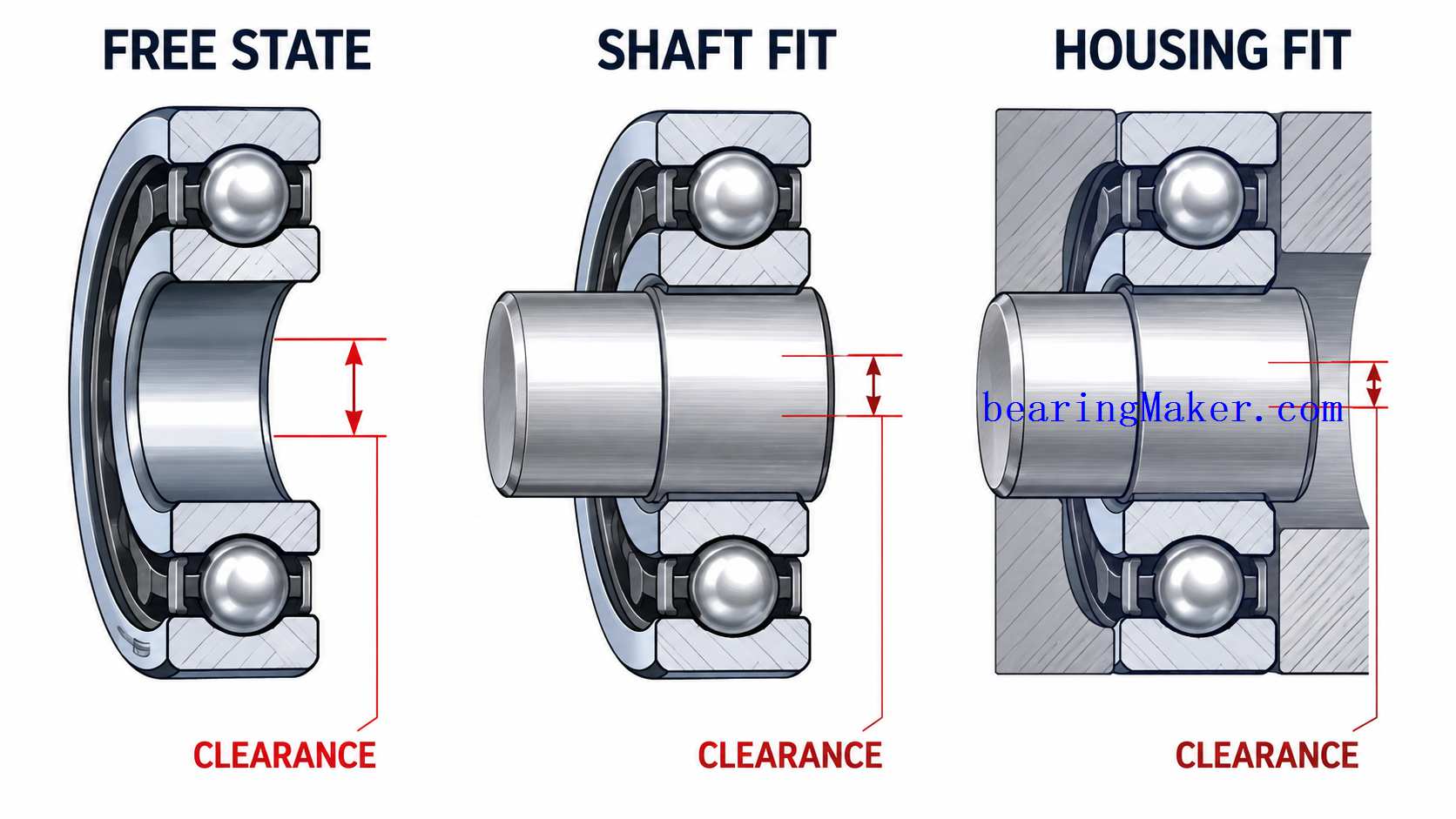
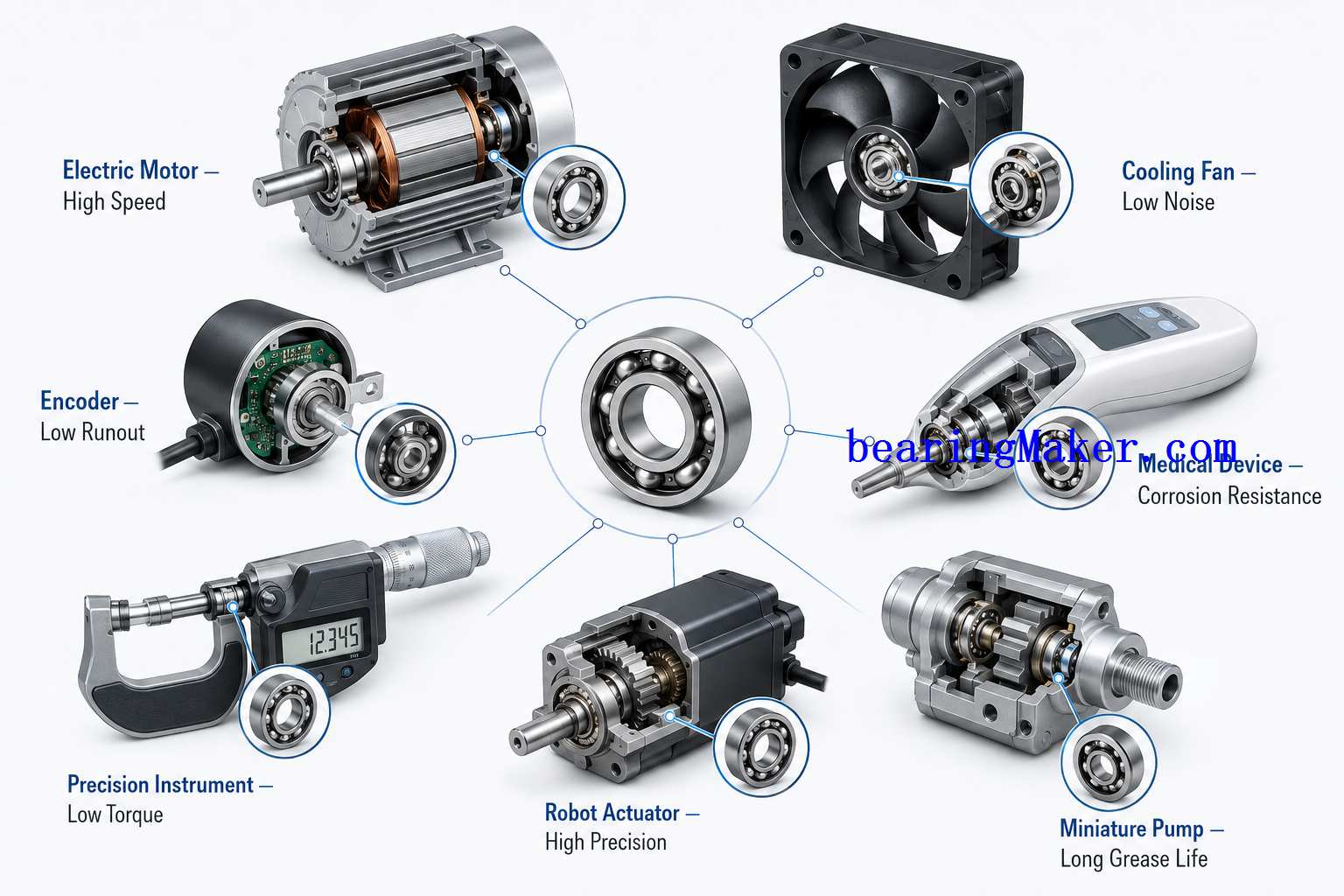
Miniature bearings are used wherever a rotating mechanism must fit inside a very small package while still providing reliable, smooth, and precise motion.
They are especially common in:
- small electric motors
- brushless motors
- cooling fans
- precision instruments
- encoders
- medical devices
- dental equipment
- miniature pumps
- robotics
- drones
- compact actuators
- office equipment
- consumer electronics
- laboratory equipment
The reason for using a miniature bearing is not always the same.
In one application, the main priority may be:
- high rotational speed
In another, the dominant requirement may be:
- low starting torque
- low noise
- low runout
- corrosion resistance
- long grease life
- extremely compact dimensions
This is why miniature bearing selection should begin with the application rather than with a bearing part number.
A bearing that works well in a cooling fan may be unsuitable for a precision encoder.
A bearing optimized for a high-speed motor may not provide the corrosion resistance required in a medical pump.
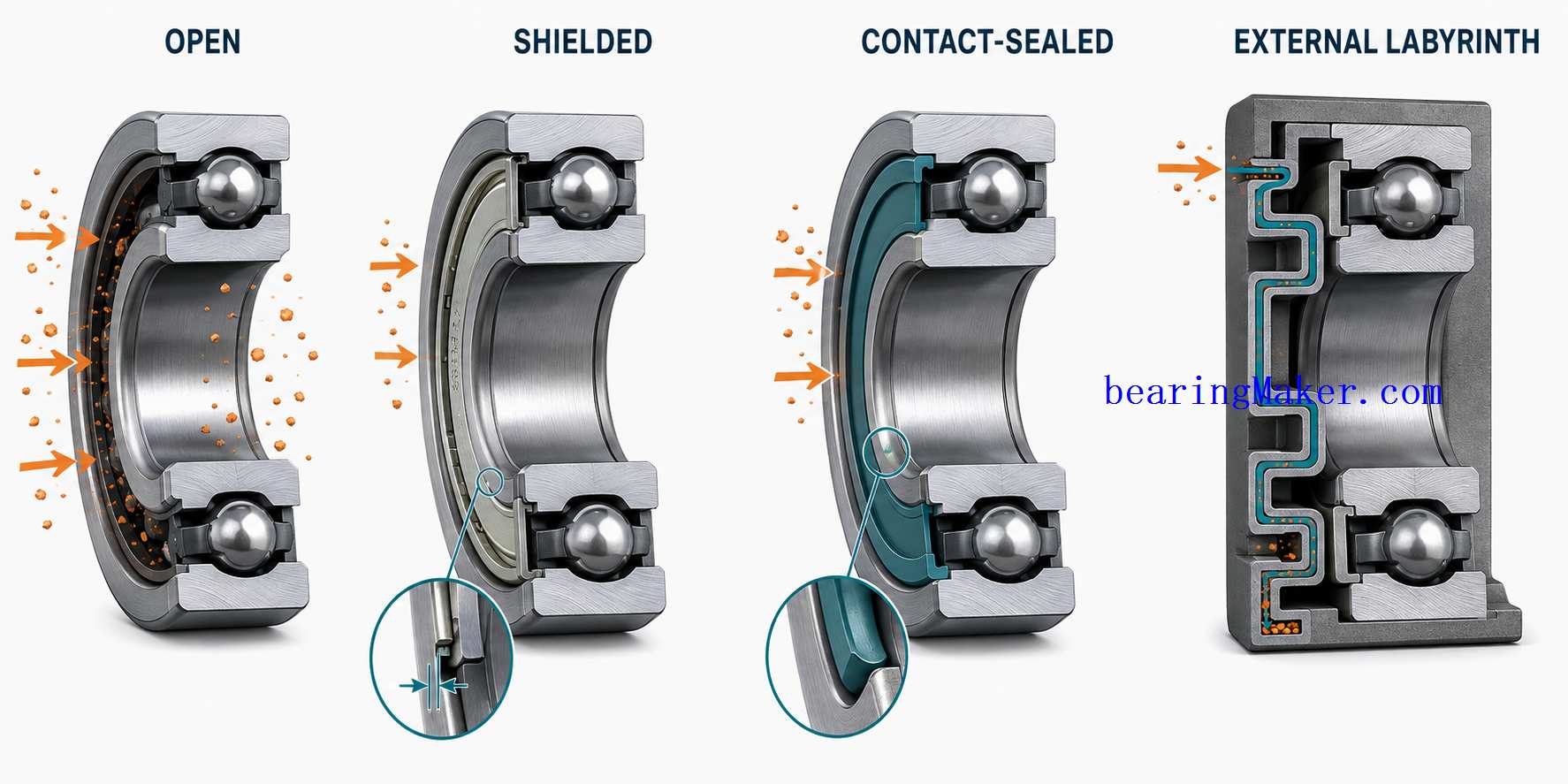
A sealed bearing may survive contamination better, but the additional seal drag may be unacceptable in a low-torque instrument.
This guide explains the major applications of miniature bearings and shows how the bearing requirements change from one machine to another.
Why Miniature Bearings Are Used
Miniature bearings solve a basic mechanical problem:
How can a very small shaft rotate accurately and reliably without using a large support system?
They provide:
- low friction
- compact size
- low mass
- high-speed capability
- accurate shaft support
This combination is especially useful in machines where total dimensions are tightly limited.
Application Requirements Are More Important Than Bearing Size Alone
A small bearing may physically fit the machine but still fail because of:
- excessive torque
- insufficient speed capability
- poor lubrication
- incorrect sealing
- inadequate precision
- poor environmental resistance
The correct bearing therefore depends on both:
- mechanical envelope
- operating conditions
Typical Miniature Bearing Design Priorities
Common application-level priorities include:
- smallest possible size
- high RPM
- low starting torque
- low running torque
- low noise
- low vibration
- low runout
- long life
- corrosion resistance
- contamination protection
- temperature stability
The importance of each parameter changes significantly by application.
Small Electric Motors
Small electric motors are one of the most important applications for miniature bearings.
Typical examples include:
- DC motors
- brushless motors
- servo motors
- miniature drive motors
The bearing supports the rotor shaft and helps maintain:
- alignment
- low friction
- stable air gap
- low vibration
Why Bearings Matter in Small Motors
The rotor must remain centered while rotating at high speed.
Bearing performance directly affects:
- motor efficiency
- acoustic noise
- vibration
- temperature
- service life
Because the motor itself is small, even modest bearing friction can represent a meaningful percentage of total mechanical loss.
High Speed
Many miniature motors operate at high RPM.
Bearing selection should therefore consider:
- continuous speed
- peak speed
- cage design
- lubricant
- closure type
Starting Torque
A small motor may produce only limited starting torque.
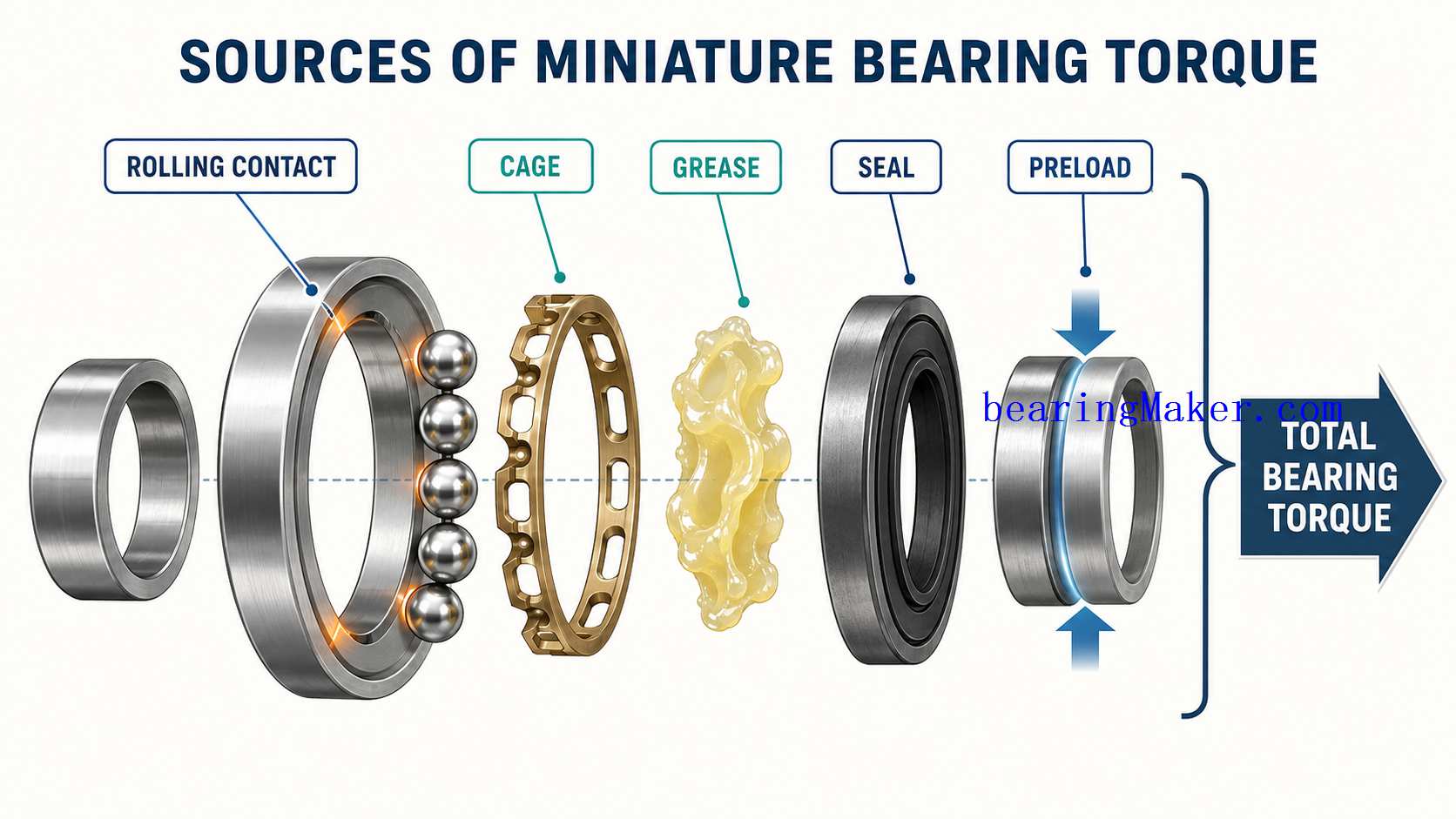
Excess bearing drag from:
- contact seals
- high-viscosity grease
- excessive preload
may create:
- slow startup
- high current
- failure to start in cold conditions
Running Torque
Running torque affects:
- efficiency
- heat
- available output power
Low-friction miniature bearings are particularly valuable in small motors because motor power is limited.
Noise
Motor bearings can be a major contributor to acoustic performance.
Possible noise sources include:
- raceway finish
- contamination
- lubricant
- cage
- shaft runout
Rotor Alignment
Bearing runout and shaft accuracy affect the rotor position.
Excessive runout may cause:
- vibration
- magnetic air-gap variation
- reduced motor efficiency
Typical Motor Bearing Priorities
| Requirement | Importance |
|---|---|
| High speed | Very high |
| Low torque | Very high |
| Low noise | Very high |
| Low vibration | High |
| Long life | Very high |
| Precision | High |
| Contamination protection | Moderate–High |
Brushless Motors
Brushless motors often place even greater demands on miniature bearings.
They may operate at:
- high speed
- rapid acceleration
- frequent speed changes
Acceleration and Cage Behavior
Rapid acceleration can influence:
- ball dynamics
- cage motion
- lubricant distribution
Maximum RPM alone may therefore not describe the real operating severity.
Electrical Environment
Electrical potential may sometimes exist across motor components.
Where current through the bearing becomes a risk, design options may include:
- electrical grounding
- isolation
- hybrid ceramic bearings
depending on the system.
Cooling Fans
Cooling fans are another major miniature bearing application.
They appear in:
- computers
- servers
- electronics
- power supplies
- appliances
- industrial equipment
Why Fan Bearings Are Different
Fan bearings often carry relatively small mechanical loads.
Their life may instead be dominated by:
- lubricant aging
- temperature
- contamination
- noise
Continuous Operation
Many cooling fans operate for long periods.
This makes:
- grease life
- temperature stability
- seal performance
particularly important.
Low Noise
Fan noise can come from:
- blades
- air turbulence
- motor
- bearings
A low-noise bearing helps reduce the mechanical component of total fan noise.
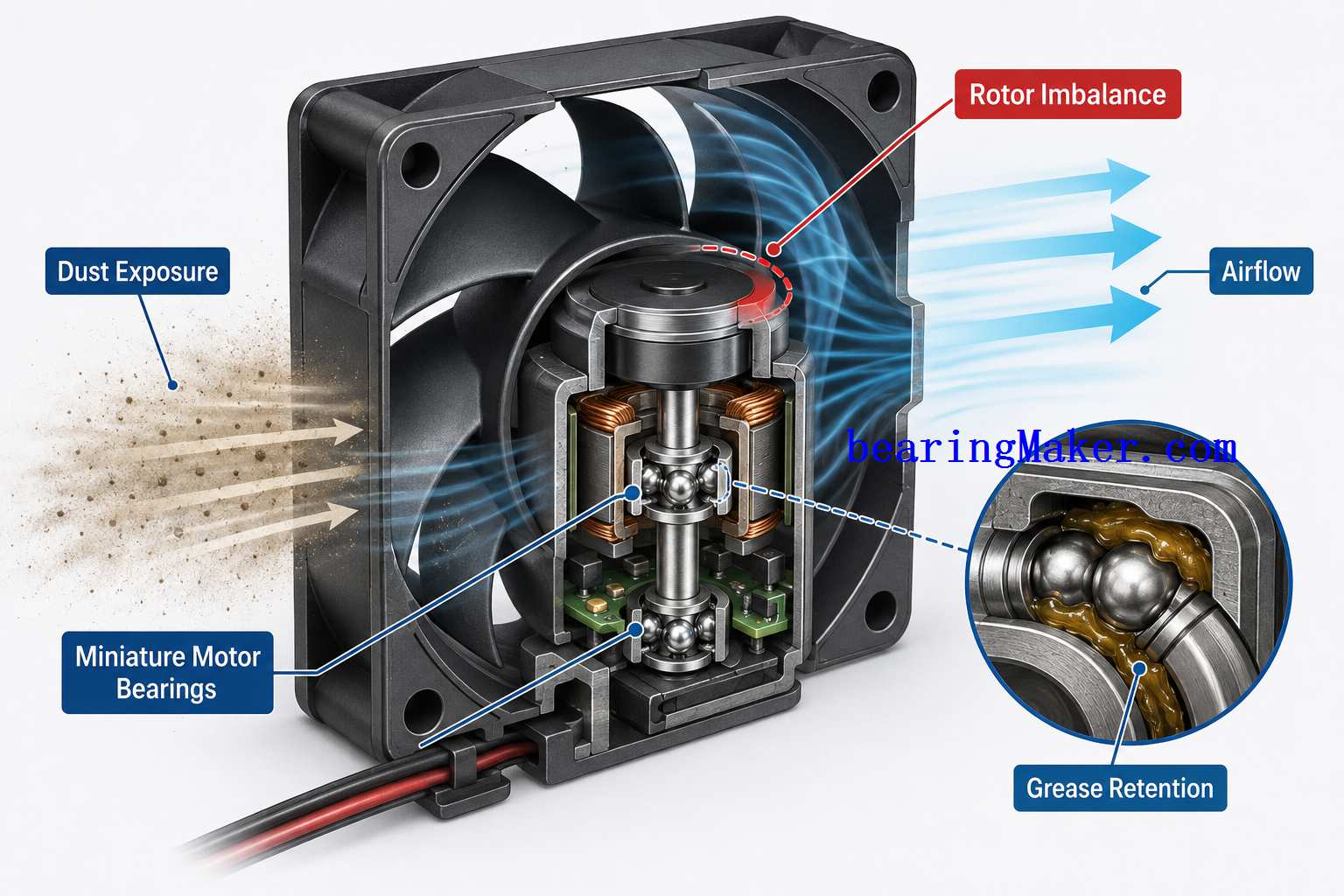
Fan Bearing Lubrication
Grease must provide:
- long life
- stable torque
- low acoustic noise
Too much grease can cause:
- drag
- heat
Too little can shorten life.
Fan Bearing Closures
Common starting options include:
- shields
- low-contact seals
because they balance:
- grease retention
- contamination protection
- low torque
Dust Exposure
Fans naturally move air, which may carry:
- dust
- fine particles
This makes contamination protection particularly important.
Fan Imbalance
Dust accumulation on fan blades can create imbalance.
This may increase:
- vibration
- bearing load
A bearing failure should therefore not automatically be blamed on bearing quality alone.
Precision Instruments
Precision instruments often use miniature bearings because they require very small, smooth rotary mechanisms.
Examples include:
- measuring devices
- optical instruments
- laboratory equipment
- sensor mechanisms
Low Torque
Instruments may use very small actuators.
Bearing torque can therefore strongly affect:
- sensitivity
- response
- repeatability
Low Torque Variation
Average torque may not be the only concern.
Variation during one revolution can cause:
- uneven motion
- servo error
- measurement instability
Runout
Precision instruments may require very low:
- radial runout
- axial runout
because shaft position directly affects measurement accuracy.
Vibration
Small vibration may interfere with:
- optical measurement
- sensor output
- mechanical calibration
Precision Instrument Priorities
| Requirement | Importance |
|---|---|
| Low torque | Extremely high |
| Low torque variation | Extremely high |
| Runout | Very high |
| Low vibration | Very high |
| Precision | Very high |
| High load capacity | Often secondary |
Encoders
Encoders measure rotational position or speed.
A miniature bearing may support the encoder shaft or rotating disk.
Why Bearing Accuracy Matters in Encoders
Encoder performance depends on a stable relationship between:
- shaft
- code disk
- sensor
Bearing movement can affect that relationship.
Radial Runout
Radial runout may cause the disk or shaft to move relative to the sensing element.
Axial Runout
Axial movement can change:
- sensor spacing
- optical gap
in some encoder designs.
Axial Play
Excess bearing clearance can introduce:
- shaft end play
- reduced repeatability
Controlled preload may be useful where very stable shaft position is required.
Encoder Torque
Low torque is important when the encoder is driven by:
- a small actuator
- a low-power mechanism
Encoder Design Priorities
Typical priorities include:
- low runout
- low axial play
- low torque
- repeatability
- clean operation
Medical Devices
Miniature bearings are widely used in medical equipment because many medical mechanisms must be:
- compact
- smooth
- quiet
- clean
Possible applications include:
- diagnostic devices
- hand-held tools
- miniature motors
- pumps
- robotic mechanisms
Low Noise in Medical Equipment
Equipment used close to patients may require:
- quiet operation
- low vibration
Bearing noise may therefore be more important than in ordinary industrial machinery.
Smooth Motion
Medical mechanisms often require controlled movement without:
- roughness
- stick-slip
- excessive torque variation
Corrosion Resistance
Medical equipment may be exposed to:
- humidity
- cleaning chemicals
- disinfectants
This can influence:
- ring material
- seal material
- lubricant selection
Cleanliness
The bearing system may need to minimize:
- particle generation
- lubricant leakage
- contamination
Medical Device Priorities
| Requirement | Importance |
|---|---|
| Smooth motion | Very high |
| Low noise | Very high |
| Cleanliness | Very high |
| Corrosion resistance | Application-dependent |
| Compact size | Very high |
| Precision | High |
| Low torque | High |
Dental Equipment
Dental devices are one of the most demanding miniature bearing applications.
Some systems operate at extremely high rotational speeds.
High-Speed Requirements
Bearing performance may be limited by:
- ball dynamics
- cage behavior
- lubricant
- heat
Precision
High-speed rotating tools require accurate shaft support.
Excessive runout can cause:
- vibration
- poor tool performance
Heat
High RPM can generate heat rapidly.
Bearing design must control:
- lubrication
- preload
- friction
Cleanliness and Environment
Dental equipment may also require:
- contamination control
- corrosion resistance
depending on the design and cleaning process.
Dental Bearing Design Priorities
The most important factors may include:
speed → runout → heat → lubrication → noise → corrosion/environment
Miniature Pumps
Miniature pumps use bearings to support:
- impellers
- rotors
- drive shafts
They may appear in:
- medical devices
- laboratory equipment
- cooling systems
- dosing equipment
Radial Load
Impellers may create radial hydraulic forces.
Axial Load
Pump geometry may also generate:
- axial thrust
This can become a major bearing selection factor.
Corrosive Environment
Pump applications may expose the bearing system to:
- water
- chemicals
- humidity
Material and sealing may therefore be critical.
Pump Sealing
The bearing may need protection from:
- fluid ingress
- chemical contamination
However, contact seals can increase torque.
Miniature Pump Priorities
Typical priorities include:
- combined load
- corrosion resistance
- sealing
- speed
- service life
Robotics
Miniature bearings are widely used in small robotic mechanisms.
Applications include:
- robotic grippers
- small joints
- miniature actuators
- servo mechanisms
Compact Packaging
Robotic mechanisms often have very limited space.
Miniature bearings can reduce:
- joint diameter
- actuator size
Low Weight
Reducing bearing mass can improve:
- actuator response
- total mechanism mass
Repeated Reversals
Robotic joints may repeatedly:
- accelerate
- stop
- reverse
This affects:
- cage behavior
- lubricant distribution
Precision and Repeatability
Robotic mechanisms may require:
- low clearance
- controlled preload
- low runout
Robotics Design Priorities
| Requirement | Importance |
|---|---|
| Compact size | Very high |
| Low weight | High |
| Repeatability | Very high |
| Low torque | High |
| Reversal capability | High |
| Bearing stiffness | High |
Small Actuators
Compact actuators often use miniature bearings to support:
- lead screws
- gear shafts
- motor rotors
Axial Load
Lead-screw or thrust-producing actuators may generate significant axial load.
A standard deep groove bearing may not always be sufficient.
Gear Forces
Small gear trains can generate:
- radial load
- axial load with helical gears
Bearing load should be calculated from actual gear forces.
Actuator Precision
Backlash and shaft movement can reduce positioning accuracy.
Bearing clearance and preload may therefore be important.
Drones and Small Aerospace Mechanisms
Miniature bearings are attractive in drone and aerospace systems because they provide:
- low mass
- compact size
- high-speed capability
Drone Motors
Small electric motors in drones may operate at high speed.
Bearing priorities include:
- low friction
- low mass
- vibration resistance
- long life
Propeller Imbalance
Propeller imbalance can create:
- radial vibration
- cyclic bearing load
The bearing must tolerate both normal and abnormal operating conditions.
Shock
Drone mechanisms may experience:
- landing impact
- transport shock
- crash loads
Static bearing capacity and installation robustness become important.
Aerospace Temperature
Aerospace mechanisms may operate across wide temperature ranges.
This affects:
- lubricant viscosity
- internal clearance
- fits
Aerospace Environment
Some systems may also require:
- vacuum-compatible lubrication
- low outgassing
- low magnetic response
Office Equipment
Miniature bearings are common in:
- printers
- scanners
- document handling systems
- small drive rollers
Low Noise
Office environments place emphasis on:
- quiet operation
Long Duty Cycles
Bearings may experience:
- frequent start-stop cycles
- long service periods
Rollers and Flanged Bearings
Flanged miniature bearings can simplify small roller assemblies by providing:
- axial positioning
- compact mounting
Consumer Electronics
Miniature bearings can be used in consumer products where compact mechanical motion is required.
Typical priorities include:
- small size
- low noise
- cost
- long life
Cost Sensitivity
Consumer products often have strict cost constraints.
The highest precision or most exotic material may not be justified.
The bearing should provide only the performance level the product actually needs.
Laboratory Equipment
Laboratory instruments may require:
- low vibration
- chemical compatibility
- precise motion
Chemical Exposure
Equipment may operate near:
- reagents
- cleaning agents
Stainless or specialized bearing materials may be appropriate.
Precision Motion
Laboratory instruments often prioritize:
- repeatability
- runout
- low torque
over maximum load capacity.
Optical Equipment
Miniature bearings may support:
- lens mechanisms
- scanning assemblies
- optical stages
Low Runout
Optical systems may be highly sensitive to:
- shaft displacement
- angular error
Low Torque
Small motors may need to reposition optics accurately.
High bearing friction can reduce:
- servo accuracy
- repeatability
Vibration
Bearing vibration can degrade:
- image stability
- measurement quality
Camera and Imaging Mechanisms
Compact imaging equipment may use miniature bearings in:
- stabilization mechanisms
- lens drives
- scanning systems
Important requirements include:
- low noise
- precision
- small size
Miniature Gearboxes
Small gearboxes use bearings to support:
- pinion shafts
- output shafts
- intermediate gears
Gear Loads
Gear tooth forces can produce:
- radial load
- axial load
depending on gear type.
Bearing Spacing
Two bearings are often used to improve:
- shaft stability
- gear alignment
Noise
Bearing and gear noise can interact.
A noisy gearbox should not automatically be diagnosed as a bearing problem.
Small Rollers and Guide Wheels
Miniature bearings can be integrated into small rollers.
Examples include:
- guide rollers
- transport rollers
- small pulleys
Flanged Bearings
Flanged bearings are particularly useful because the flange helps:
- locate the bearing
- simplify housing design
Belt and Pulley Systems
A small pulley can create significant radial load from belt tension.
The bearing load may be greater than expected even when transmitted power is low.
Overhung Load
If the pulley is mounted far from the bearing, shaft bending can become important.
Sensors
Rotational sensors may use miniature bearings where a small shaft must move:
- smoothly
- repeatedly
- accurately
Low Starting Torque
A sensor may respond to very small mechanical forces.
Bearing friction can therefore directly limit sensitivity.
Sensor Precision
Important factors include:
- runout
- clearance
- torque consistency
Application Selection: Start With the Failure Constraint
A useful way to choose a miniature bearing is to ask:
What is most likely to prevent this mechanism from working correctly?
For different applications, the answer may be very different.
When Speed Is the Main Constraint
Typical examples:
- high-speed motors
- dental equipment
- miniature spindles
Focus on:
- cage
- lubrication
- seal drag
- preload
- heat
When Noise Is the Main Constraint
Typical examples:
- cooling fans
- medical devices
- office equipment
Focus on:
- raceway quality
- lubricant
- contamination
- rotor balance
When Precision Is the Main Constraint
Typical examples:
- encoders
- optical instruments
- metrology
Focus on:
- runout
- shaft accuracy
- clearance
- preload
When Environment Is the Main Constraint
Typical examples:
- medical equipment
- pumps
- outdoor mechanisms
Focus on:
- material
- sealing
- lubricant compatibility
When Size Is the Main Constraint
Typical examples:
- consumer devices
- sensors
- compact robots
Focus on:
- bore
- OD
- width
- flanged geometry
Application-to-Requirement Matrix
| Application | Main Design Priority | Secondary Priorities |
|---|---|---|
| Small electric motor | Speed + low torque | Noise, life |
| Brushless motor | Speed + acceleration | Vibration, electrical environment |
| Cooling fan | Low noise + lubricant life | Contamination |
| Encoder | Runout + low torque | Preload |
| Precision instrument | Low torque + repeatability | Vibration |
| Medical device | Smoothness + cleanliness | Corrosion, noise |
| Dental equipment | Very high speed | Heat, runout |
| Miniature pump | Load + environment | Sealing |
| Small robot | Compactness + repeatability | Reversals |
| Drone motor | Low mass + speed | Vibration |
| Office equipment | Noise + cost | Life |
| Optical equipment | Runout + low vibration | Torque |
| Miniature gearbox | Load + alignment | Noise |
| Sensor mechanism | Low starting torque | Precision |
Application-to-Bearing-Type Matrix
| Requirement | Common Starting Direction |
|---|---|
| General high-speed shaft support | Deep groove miniature ball bearing |
| Simple axial housing location | Flanged miniature bearing |
| Very low closure friction | Open bearing |
| Light contamination protection | Shielded bearing |
| Strong dust/moisture protection | Sealed bearing |
| Corrosive environment | Stainless construction may be considered |
| Electrical isolation | Hybrid ceramic may be considered |
| High precision | Tighter rotational accuracy + precise shaft/housing |
| Low noise | High-quality bearing + suitable lubricant |
| Low torque | Controlled grease + low-drag closure |
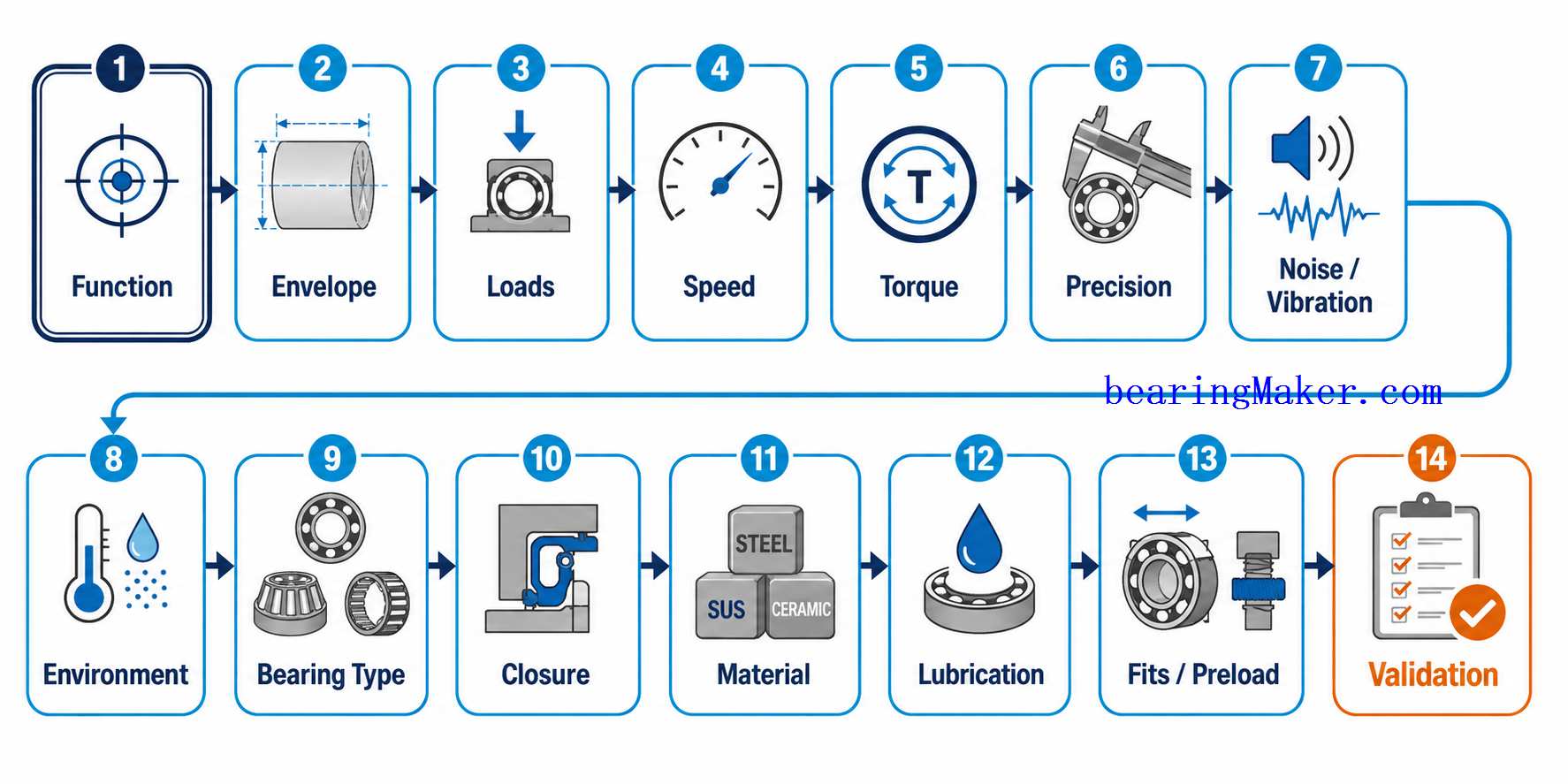
How to Select a Miniature Bearing by Application
A practical application-driven process can follow these steps.
Step 1: Define the Function
Determine what the bearing supports:
- motor rotor
- fan
- encoder
- pump
- actuator
- instrument
Step 2: Define the Mechanical Envelope
Specify:
- shaft diameter
- maximum OD
- maximum width
Step 3: Define Load
Calculate:
- radial load
- axial load
- shock
Step 4: Define Speed Profile
Specify:
- continuous RPM
- peak RPM
- acceleration
- reversing frequency
Step 5: Define Torque Requirement
Determine allowable:
- starting torque
- running torque
Step 6: Define Precision
Specify:
- radial runout
- axial runout
- axial play
- repeatability
Step 7: Define Noise and Vibration Requirements
Determine acceptable:
- acoustic noise
- vibration
Step 8: Define Environment
Identify:
- dust
- moisture
- chemicals
- cleanroom
- vacuum
Step 9: Select Bearing Structure
Choose:
- standard
- flanged
- extended inner ring
Step 10: Select Closure
Choose:
- open
- shielded
- sealed
Step 11: Select Material
Choose based on:
- corrosion
- speed
- electrical requirements
Step 12: Select Lubrication
Consider:
- speed
- temperature
- noise
- torque
Step 13: Define Fits and Preload
Ensure the installed bearing retains suitable:
- clearance
- torque
- stiffness
Step 14: Validate Final Assembly
Test:
- temperature
- noise
- vibration
- torque
- runout
under actual operating conditions.
Example: Selecting a Bearing for a Small Electric Motor
Suppose a small motor requires:
- 3 mm shaft
- high RPM
- low acoustic noise
- long continuous life
The selection should not stop at finding a 3 mm bore bearing.
The next checks should include:
- speed capability
- closure drag
- grease type
- grease quantity
- runout
- shaft fit
- preload
A shielded deep groove miniature bearing may be a common starting point, but the final choice depends on the actual performance requirements.
Example: Selecting a Bearing for a Cooling Fan
The fan may have:
- light radial load
- high operating hours
- moderate-high speed
- strict noise requirement
The dominant design concern may be:
lubricant life and low noise
rather than dynamic load capacity.
Example: Selecting a Bearing for an Encoder
An encoder may require:
- low radial runout
- low axial movement
- low torque
The main design priorities may therefore be:
precision → clearance/preload → shaft accuracy → torque
rather than maximum load capacity.
Example: Selecting a Bearing for a Medical Pump
The bearing may experience:
- radial impeller load
- axial thrust
- humidity
- possible chemical exposure
The selection process may prioritize:
combined load → corrosion → sealing → lubricant compatibility
Example: Selecting a Bearing for a Precision Instrument
A precision instrument may carry almost no meaningful external load.
Its success may instead depend on:
- low breakaway torque
- smooth running torque
- low vibration
- low runout
A higher load rating alone offers little benefit if it increases size or torque.
Common Application Selection Mistakes
Mistake 1: Selecting Only by Bore Size
A bearing that fits the shaft may fail speed, torque, or precision requirements.
Mistake 2: Selecting Only by Load Rating
Many miniature bearing applications are limited by:
- noise
- torque
- lubrication
- runout
before load capacity becomes critical.
Mistake 3: Ignoring Starting Torque in Small Motors
The motor may not have enough torque margin.
Mistake 4: Ignoring Lubricant Life in Fans
The bearing may have excellent fatigue life but fail because the grease degrades.
Mistake 5: Choosing Contact Seals for Every Application
Seal drag may be unacceptable in a low-torque system.
Mistake 6: Using a High-Precision Bearing on an Inaccurate Shaft
System precision will still be poor.
Mistake 7: Ignoring Axial Load in Pumps and Gear Drives
Small components can still generate meaningful thrust.
Mistake 8: Ignoring Shaft Deflection
A small shaft may bend even when bearing capacity is sufficient.
Mistake 9: Assuming Stainless Is Required for Every Medical Application
Material should be selected based on actual:
- moisture
- chemical
- cleaning
exposure.
Mistake 10: Assuming Ceramic Is Always Better for High Speed
Hybrid ceramic can help in some cases, but:
- lubrication
- preload
- cage
remain critical.
Mistake 11: Treating Noise as a Bearing-Only Problem
Noise may come from:
- motor
- fan blades
- housing
- gears
Mistake 12: Ignoring the Real Duty Cycle
Continuous rotation, repeated reversal, and long stationary periods create different bearing requirements.
Application Troubleshooting: Small Motors
Motor Fails to Start Reliably
Check:
- bearing starting torque
- grease viscosity
- seal drag
- preload
Motor Runs Hot
Check:
- running torque
- interference fits
- grease quantity
- speed
Motor Is Noisy
Check:
- bearing contamination
- lubricant
- rotor balance
- shaft runout
Application Troubleshooting: Cooling Fans
Fan Becomes Noisy Over Time
Possible causes:
- grease aging
- contamination
- bearing wear
- blade imbalance
Fan Speed Drops
Check:
- bearing torque
- motor condition
- contamination
Application Troubleshooting: Encoders
Position Signal Becomes Unstable
Check:
- radial runout
- axial play
- shaft movement
- bearing preload
Encoder Requires Too Much Drive Torque
Check:
- seals
- grease
- preload
Application Troubleshooting: Medical Devices
Motion Becomes Rough
Check:
- contamination
- corrosion
- lubrication
Noise Increases
Check:
- bearing condition
- seals
- lubricant
Application Troubleshooting: Pumps
Bearing Life Is Short
Check:
- axial thrust
- corrosion
- contamination
- shaft alignment
Frequently Asked Questions
Where Are Miniature Bearings Most Commonly Used?
They are widely used in:
- electric motors
- fans
- instruments
- encoders
- medical devices
- pumps
- robotics
- consumer electronics
Why Are Miniature Bearings Used in Small Motors?
They provide:
- compact shaft support
- high speed
- low friction
- low noise
What Is Most Important in a Cooling Fan Bearing?
Common priorities include:
- low noise
- long lubricant life
- low torque
- contamination protection
What Is Most Important in an Encoder Bearing?
Typical priorities include:
- low runout
- low axial play
- low torque
Why Are Miniature Bearings Used in Medical Devices?
They can provide:
- compact size
- smooth motion
- low noise
- precision
What Is Important in Dental Bearings?
Key factors often include:
- very high speed
- precision
- lubrication
- heat control
Are Miniature Bearings Suitable for Robotics?
Yes.
They are widely used in:
- small actuators
- grippers
- miniature joints
where compact size and precision matter.
Can Miniature Bearings Be Used in Pumps?
Yes.
The design should check:
- radial load
- axial thrust
- corrosion
- sealing
Are Miniature Bearings Good for Drones?
Yes.
Their low mass and high-speed capability can be useful in small aerospace and drone mechanisms.
What Bearing Type Is Best for Small Motors?
Deep groove miniature ball bearings are a common starting point.
The actual choice depends on:
- speed
- torque
- load
- noise
- environment
Are Shielded Bearings Better for Fans?
They are common because they provide:
- low drag
- moderate contamination protection
but the best choice depends on the environment.
Are Sealed Bearings Better for Medical Equipment?
Not necessarily.
Seals improve protection but can increase torque.
The correct balance depends on:
- contamination risk
- cleaning exposure
- torque requirement
Are Stainless Bearings Better for Pumps?
They may be advantageous where:
- moisture
- chemicals
- corrosion
are present.
The actual material should match the fluid environment.
Do Precision Instruments Need the Highest Bearing Precision Class?
Not always.
The shaft, housing, and mounting must also support that level of accuracy.
Why Do Fan Bearings Fail Even With Low Load?
Fan life may be controlled more by:
- grease aging
- contamination
- temperature
than by fatigue load.
Why Can a Small Bearing Cause Large Motor Efficiency Losses?
Because the available motor power is also small.
A modest absolute bearing torque can therefore represent a meaningful percentage of total motor torque.
Are Ceramic Bearings Best for High-Speed Motors?
Not automatically.
Hybrid ceramic bearings can offer advantages where rolling-element mass or electrical insulation matters, but conventional steel bearings may also perform very well.
What Is the Most Important Rule When Selecting a Miniature Bearing by Application?
Start with the machine requirement rather than the bearing catalog.
Define:
- load
- speed
- torque
- precision
- environment
before selecting the bearing configuration.
Miniature Bearing Application Selection Checklist
Before finalizing a bearing, define:
| Parameter | What to Determine |
|---|---|
| Application | Motor/fan/encoder/etc. |
| Shaft diameter | Required bore |
| Maximum OD | Housing limit |
| Maximum width | Axial limit |
| Radial load | Continuous/peak |
| Axial load | Continuous/peak |
| Shock | Expected level |
| Continuous speed | rpm |
| Peak speed | rpm |
| Acceleration | Normal/peak |
| Reversals | Frequency |
| Starting torque | Maximum acceptable |
| Running torque | Maximum acceptable |
| Radial runout | Maximum allowable |
| Axial runout | Maximum allowable |
| Axial play | Maximum allowable |
| Noise | Required level |
| Vibration | Required level |
| Bearing precision | Appropriate class |
| Internal clearance | Installed requirement |
| Preload | Required or not |
| Shaft stiffness | Adequate |
| Housing alignment | Adequate |
| Lubricant | Speed/noise/temperature compatible |
| Grease quantity | Controlled |
| Closure | Open/shielded/sealed |
| Bearing material | Steel/stainless/hybrid/etc. |
| Corrosion | Expected exposure |
| Dust | Expected exposure |
| Moisture | Expected exposure |
| Chemicals | Expected exposure |
| Operating temperature | Minimum/normal/maximum |
| Lubricant life | Required duration |
| Maintenance | Serviceable or lifetime |
| Final validation | Torque/noise/runout/temp |
Conclusion
Miniature bearings are used across a wide range of machines because they provide a valuable combination of:
- compact size
- low friction
- high speed
- low mass
- precision
But different applications use these advantages for different reasons.
In small electric motors, the dominant requirements may be:
- high speed
- low torque
- low noise
In cooling fans:
- long lubricant life
- low noise
- contamination control
In encoders and instruments:
- low runout
- low torque
- repeatability
In medical equipment:
- smooth motion
- cleanliness
- corrosion resistance
In pumps:
- combined load
- sealing
- environmental resistance
In robotics and small actuators:
- compact packaging
- repeatability
- reversing motion
This means miniature bearing selection should not begin with:
“What is the smallest bearing available?”
It should begin with:
“What does the machine need the bearing to do?”
A reliable application-driven selection process is:
Application Function → Bearing Envelope → Loads → Speed → Starting Torque → Running Torque → Precision → Noise/Vibration → Environment → Bearing Type → Closure → Material → Lubrication → Fits/Preload → Final Validation
The goal is not simply to fit a miniature bearing into a small mechanism.
The goal is to create a complete rotating system that remains:
- reliable
- quiet
- low-friction
- accurate
- thermally stable
- appropriate for its environment
throughout the actual operating life of the machine.